 Matthew Bailey
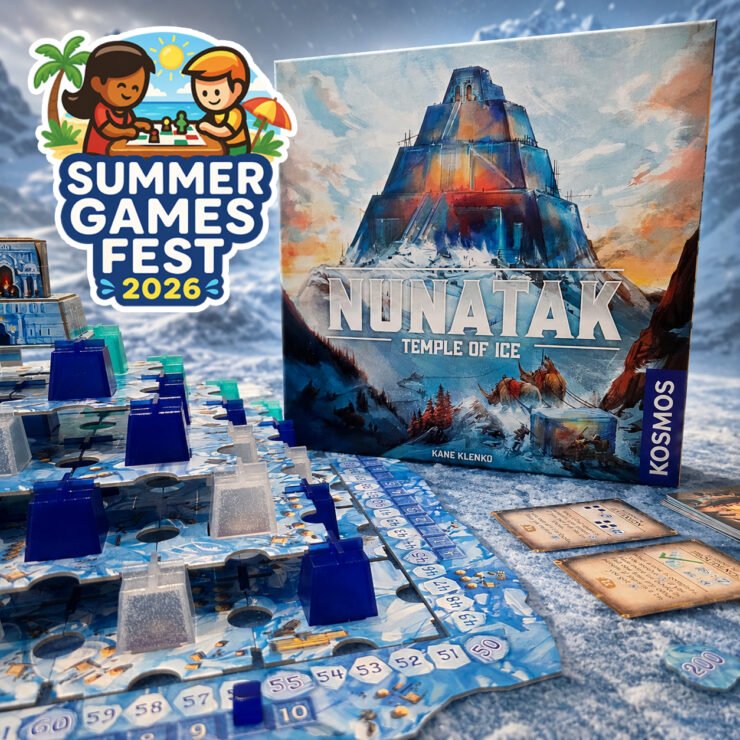
Today we are going to be looking at Nunatak: Temple of Ice (which I’m going to call Nunatak from here on), a spatial point-salad strategy game with great table presence and some fairly cool mechanics.
In Nunatak, you are working together to physically build a giant ice temple, although, of course, you are competing to be the player who scores the most points while doing it.
I’m going to go off on a slight tangent here and give an early, slightly weird criticism. I don’t know why this bothered me, but there’s no lore reason as to why we’re competing against each other. Obviously, mechanically, we’re doing it for points, but within the lore of the game we’re all working together to build a giant ice temple, so I’m not quite sure why we’re gaining points against each other. But whatever!
The other thing is that the blurb for the game itself claims that this is a complex game, and it really isn’t. This is relatively simple to understand and play. There are a few different ways you can score, but they’re all very manageable. The boys got it immediately, and I imagine any board-game-savvy six or seven-year-old should be fine.
Anyway, back to talking about how the game actually plays.
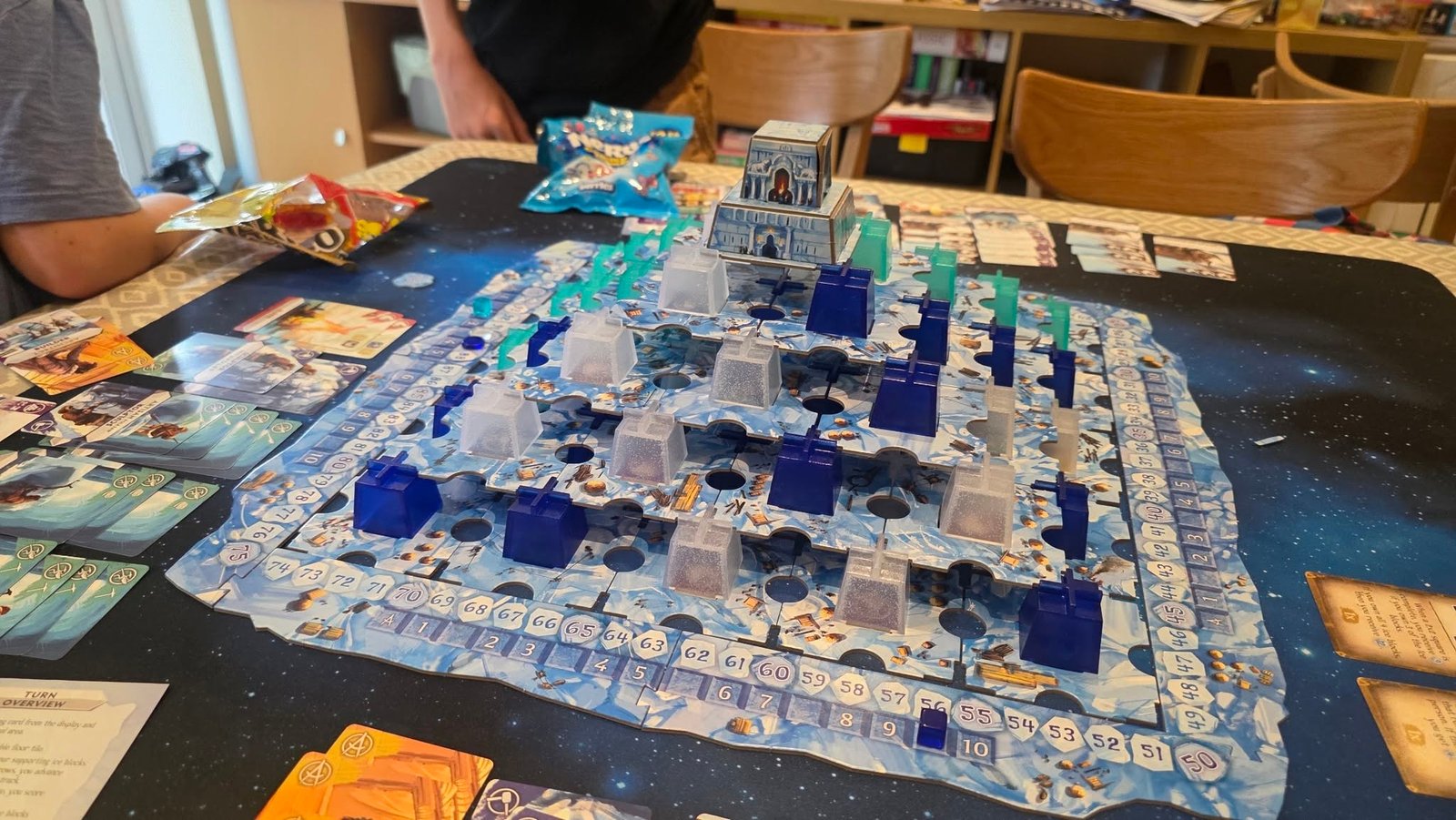
The game starts with a 5×5 grid of floor tiles, each showing one of several different symbols. On your turn, you choose one of the four face-up Building cards and add it to your own collection. The card you take then determines where you can place one of your ice blocks, as you need to choose a currently available floor tile showing the matching symbol.
As more blocks are added, the temple starts to grow upwards. Whenever a 2×2 square of ice blocks is completed, it is scored, with the player who has the most blocks in that square getting the most points. A new floor tile is then placed on top of those four blocks, creating part of the next level.
You don’t have to finish an entire level before building higher either, so different areas of the temple can start climbing upwards at different speeds. I really like this because not only does it give you more options, but it also looks really cool on the table as the temple gradually starts to build.
There are a few different things you are looking out for whenever you place a block. Firstly, if you are building on a higher level, you score one point for each of your own ice blocks directly supporting the floor tile underneath your newly placed block. This can add up surprisingly quickly, so placing lots of blocks lower down in the temple can potentially pay off again later as the building grows.
Quite often there are also additional ways to score points later depending on block placement, but we will talk about those shortly.
You also check whether you have completed a horizontal or vertical row. Completing a row moves your marker along your Architect track, and if you manage to complete both a horizontal and vertical row with the same placement, you move twice. This doesn’t score points immediately, but becomes important later depending on how many Architect cards you have collected.
When completing a 2×2 square, the player with the most blocks making up that square scores 5 points, while the player with the second most scores 2. The player who actually completed the square wins ties involving themselves, which means there is a nice little bit of timing involved in deciding when you want to finish one off rather than leaving it there for somebody else.
This adds a nice extra layer of strategy for older players, but isn’t going to break the game for a younger player who isn’t keeping track of every possible future turn.
The Building cards are important because the majority of your points come from the cards you collect rather than simply putting blocks into the temple. There are Builders, Sculptors, Artisans, Beasts of Burden, Architects and Elders, with each category scoring differently at the end of the game.
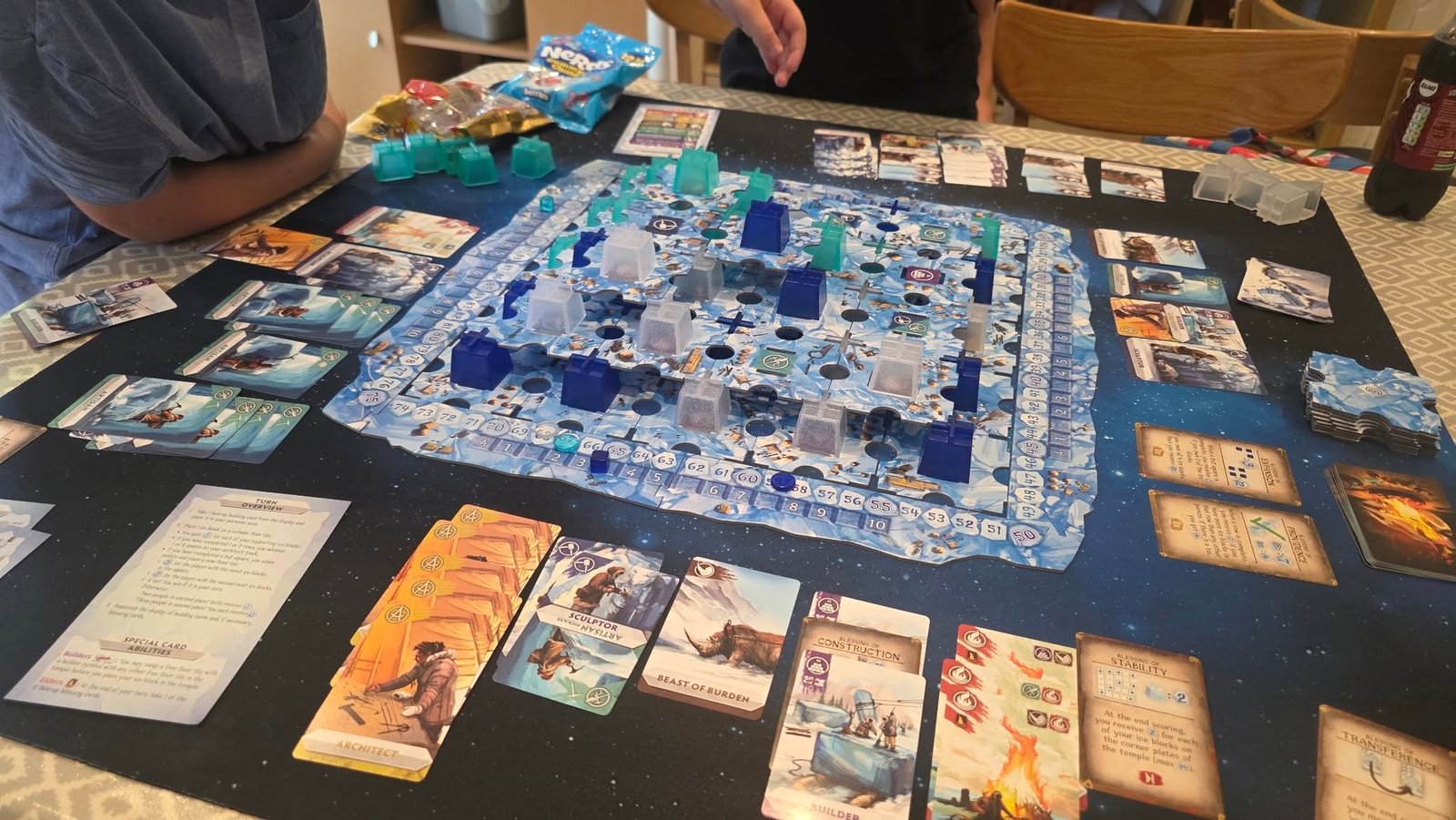
The game seemed fairly balanced over the games we played, and it appears to be just as viable to concentrate on one or two types of Building card as it is to collect a broader mix of several.
Builders are mainly about collecting more than the other players, Sculptors become increasingly valuable the more you collect, while Artisans come in three different tool types and reward both matching tools and complete sets. Beasts of Burden score using the symbols shown on the cards multiplied by the number of cards, Architects combine the number of cards you own with your position on the Architect track, while Elders score based on the other card types shown on them and usually give you additional ways to gain points.
There are also some split cards and floor tiles showing two symbols that appear later in the game.
What I really like about the way the deck works is that it is split into four preset sections, with each section shuffled and then placed back into a predetermined order. This means certain types of cards don’t show up until later and greatly reduces the chance that you will end up with all the same cards available and therefore be unable to build.
In all the games we played, while someone couldn’t always build exactly where they wanted, I think we only had one occasion where somebody couldn’t build at all.
Play continues with the temple levels getting progressively smaller as it rises until eventually you reach the final 2×2 level at the very top.
Before scoring all of your collected cards, there is also a bonus for the outside of the temple, with the player who has placed the most ice blocks around its outer tiles gaining 7 points and getting to place the temple cap on top. This is a cool little crescendo to the game and gives it some fantastic table presence.
You then work through each of the different Building card types, scoring them in their own way, as well as gaining points for complete sets containing all six types and any unused Blessing cards. Once everything has been counted, whoever has the most points wins.
What is quite unusual with Nunatak is that three players is essentially the default way to play, and this is actually how we played all of our games.
With two players, there is also a neutral third builder called Siku. Both players control some of Siku’s blocks during the game, so while Siku can’t actually score points, those blocks still get in the way, contribute towards completed squares and can affect some of the end-game majorities. With four players, meanwhile, each player simply has fewer blocks available.
We really liked Nunatak. It’s a really fun point-salad game that, while it doesn’t do anything outrageously different, is incredibly solid. It also feels really well balanced, which quite often these games aren’t, and it’s rare to find something where going for a broad mix of things can feel just as viable as going all-in on one or two scoring methods. I really like it for that.
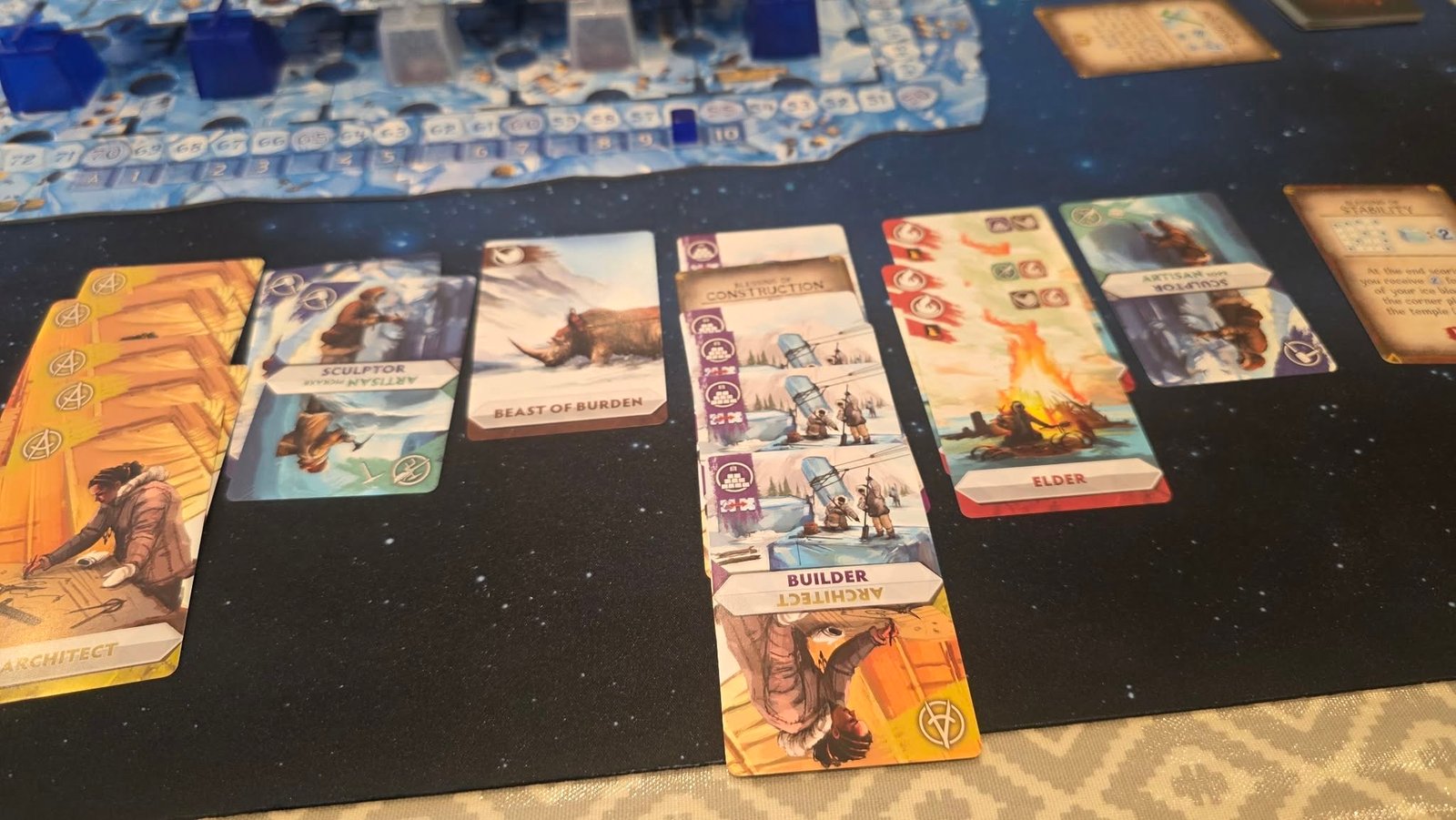
The components are really good quality and everything looks fantastic on the table, giving the game excellent table presence.
While this isn’t really a criticism, it is something I’m going to mention as a point of note, especially for those of you playing this with children. For a low-to-medium-weight game, the setup and teardown time is surprisingly long. Obviously, that just comes with the way the game is presented, and it definitely isn’t a major criticism, but it is something to be aware of. This isn’t a game you can get onto the table and packed away again particularly quickly.
The artwork is nice, although I think it is perhaps a little uninspiring. They’ve gone heavily into the ice itself, and I think leaning slightly more into the people actually building the temple might have been a good idea. Again, though, this is a really minor criticism and, especially if you’re playing it with kids, you’re probably not going to care once you’re in the middle of the game.
I really like Nunatak: Temple of Ice. I think it’s a really well-done point-salad game with fantastic table presence. The mechanic of physically building the temple adds a really nice spatial element to what’s going on and gives you another thing to think about beyond simply collecting cards and scoring points. I just wish setup and takedown were a little quicker for a low-mediumweight game.
It’s also really approachable and definitely playable with younger kids. I’d say children of around six or seven who are already keen on board games should be able to get involved without too much difficulty.
Disclaimer: A copy of Nunatak: Temple of Ice was kindly gifted to us by Kosmos. We have not been paid or compensated for this review in any way, we were not required to post a review, and all thoughts and opinions are our own.