 Matthew Bailey
Today I am going to talk to you about Scream Park, an interestingly fairground haunted house-themed drafting and set collection card game that, as much as I want to love it, doesn’t really do much to stand out.
In Scream Park, you are competing to build the best haunted house attraction over three days, trying to impress your boss and a series of VIP visitors (who act as extra point-scoring opportunities). You do this by collecting and arranging cards to create different scenes and then adding spooky effects, costumes and themes to make your attraction as impressive as possible. The player with the most points at the end of the three days wins.
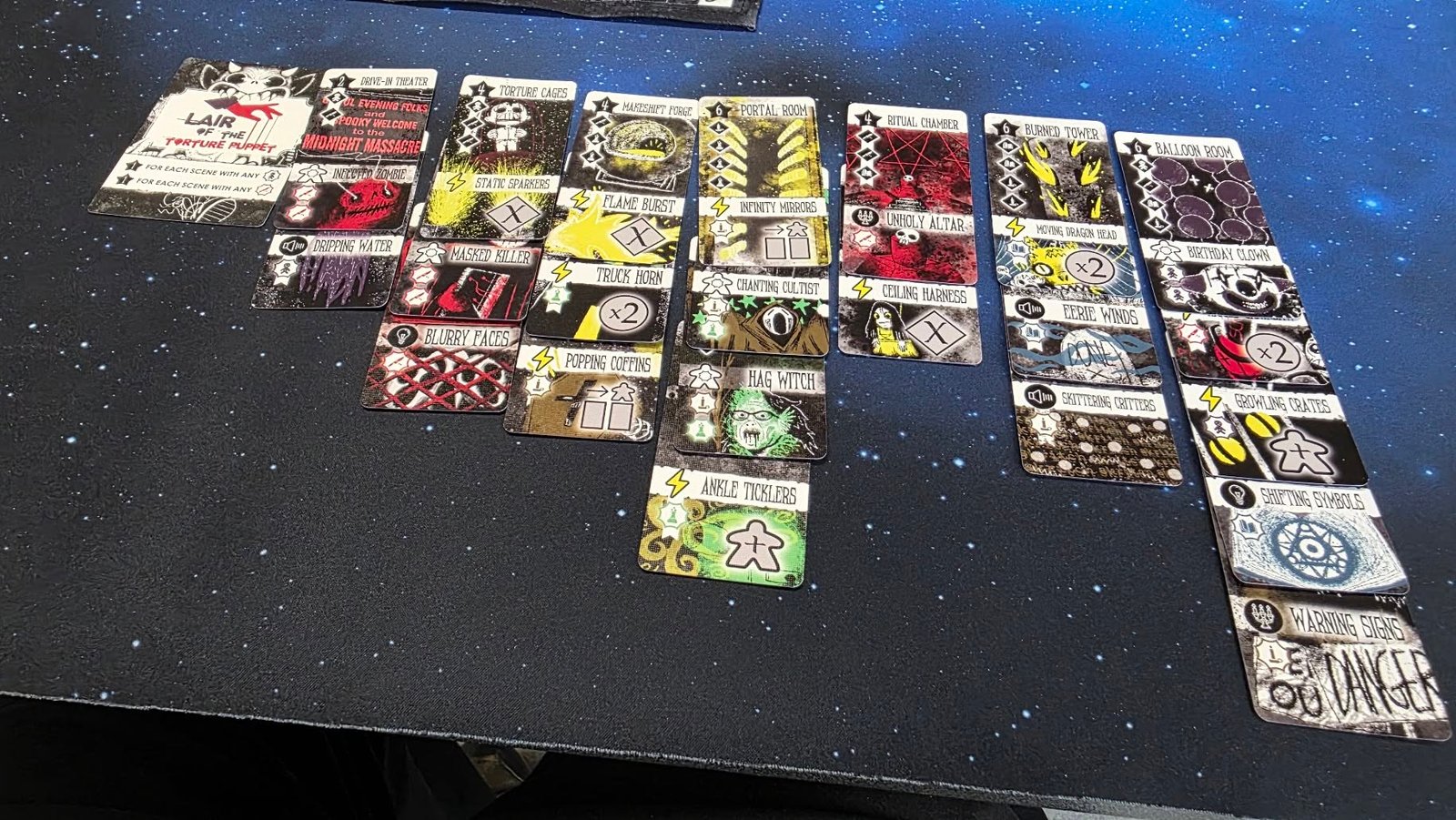
Before I start explaining the general rules, it’s worth noting that the very small rule sheet is not particularly well written, and certain mechanics are mentioned briefly without being elaborated on. We managed to work it out largely because we play a great deal of board games and therefore have a pretty decent idea of how things work, but if you were new to the genre of drafting card games, it’s going to be surprisingly heavy going considering the rules fit on less than one side of A4. One rule is only properly mentioned on the side of the box and not in the rulebook, while several icons are only explained on the quick reference card and not in the rulebook.
You begin by choosing a theme and name for your attraction.
These give you two colours of icons that you are going to gain points for at the end, so in most cases, you will want to focus on these where possible. Each day (a round, of which there are three), you start with a hand of eight cards and simultaneously choose two to play before passing the remaining cards to the next player. You can use these cards to build new scenes, add effects to existing ones or discard them to gain additional staff. New scenes are normally placed at the end of your attraction in ascending point order, although you can spend staff to reset your number. I am still not 100% sure whether the ones you add go at the end or in the middle, as it is not abundantly clear in the rules, but provided everyone does the same, it doesn’t matter too much.
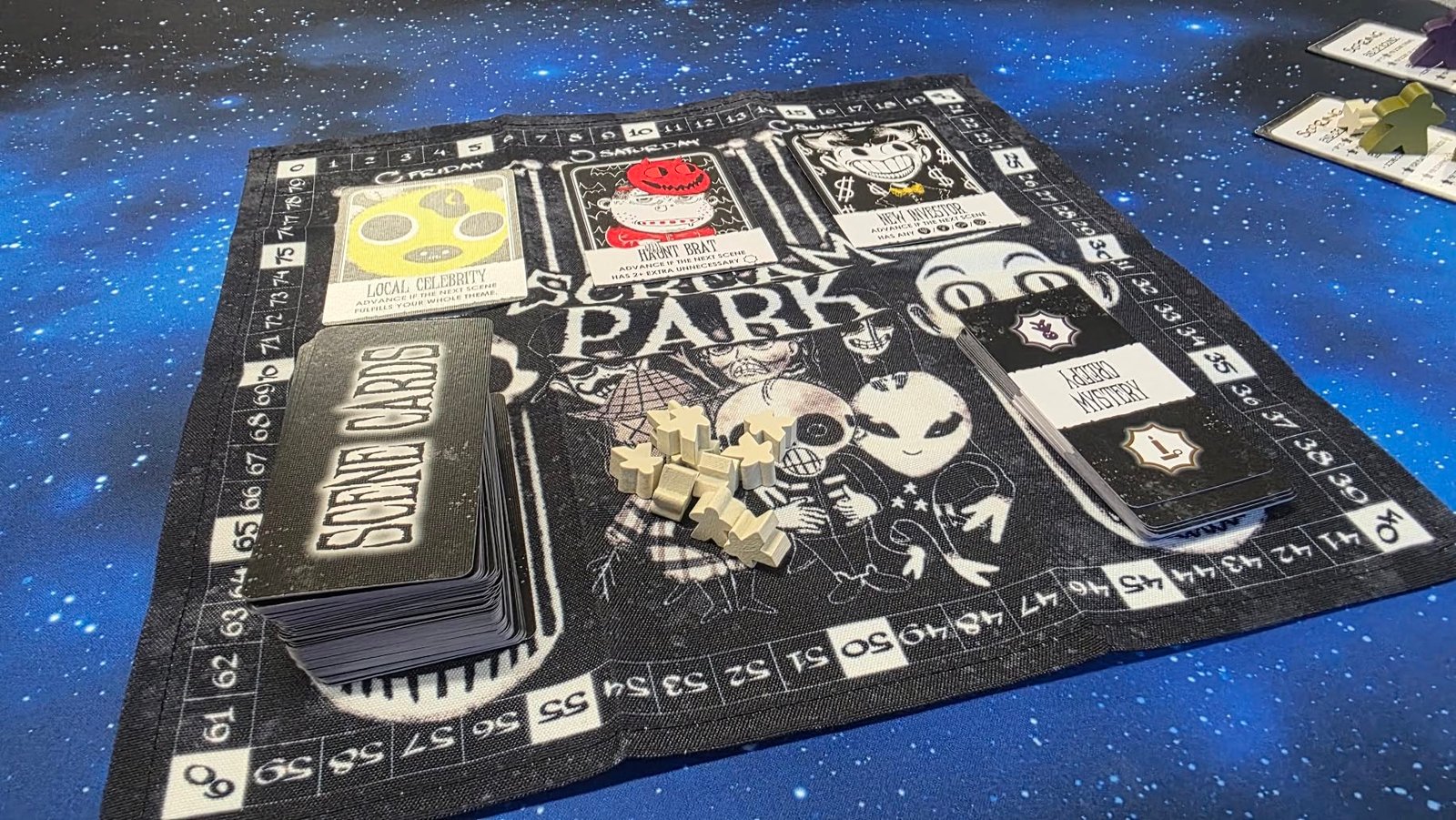
Alternatively, you can tuck cards underneath existing scenes, using the symbols on their bottom halves to help complete them. You can also discard both cards to add a genre card of your choice, giving you a little more control over your attraction.
Each scene has a point value and a number of genre symbols required to complete it. You need to collect the right combination of symbols by adding cards underneath, although you can include additional symbols that aren’t needed. Some cards also have special abilities, such as providing extra staff, ignoring requirements or allowing VIPs to enter particular scenes regardless of whether their requirements have been met. Completing scenes is important because incomplete scenes score nothing at the end of the game, regardless of how many points they might otherwise be worth.
At the end of each day, you score points based on your chosen theme and how far the visiting VIP manages to make it through your haunted house. Each VIP has different requirements for entering scenes, and they must work their way through your attraction in order, meaning a poorly positioned scene can prevent them from reaching everything beyond it. After the third day, you also score your completed scenes, staffing symbols, special effects, sets of different scenic symbols and lighting icons (none of the last two being mentioned anywhere else). Add everything together, and whoever has created the highest-scoring haunted house wins.
The scoring is bitty and messy, and because everything seems to be worth pretty much the same, the tactics aren’t that varied.
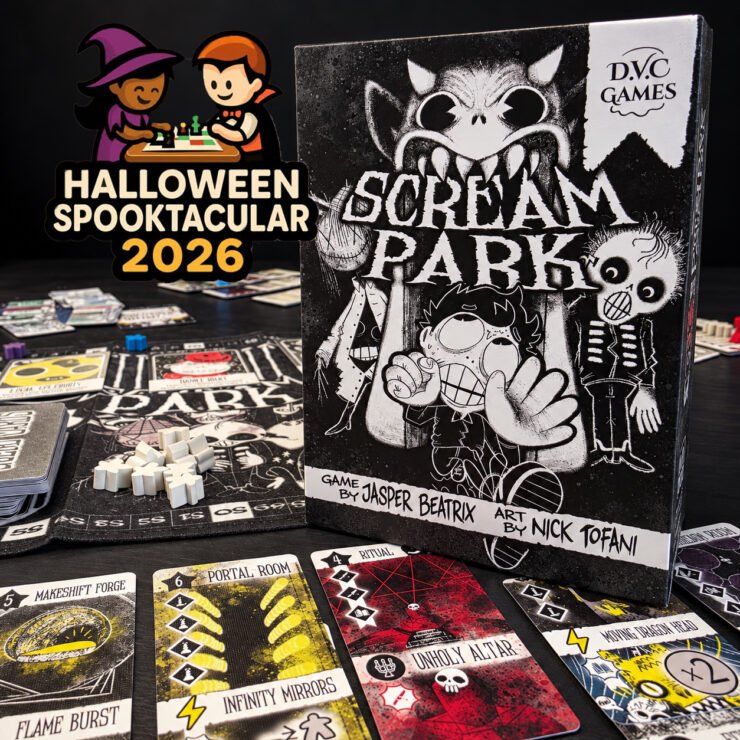
Visually, the game is a real treat. It comes in a relatively small box and everything looks lovely. The board is a nice cloth mat which looks great, and all the cards are excellent quality with beautiful artwork. The meeples are big and chunky, and everything screams quality. Massive A+ for effort here.
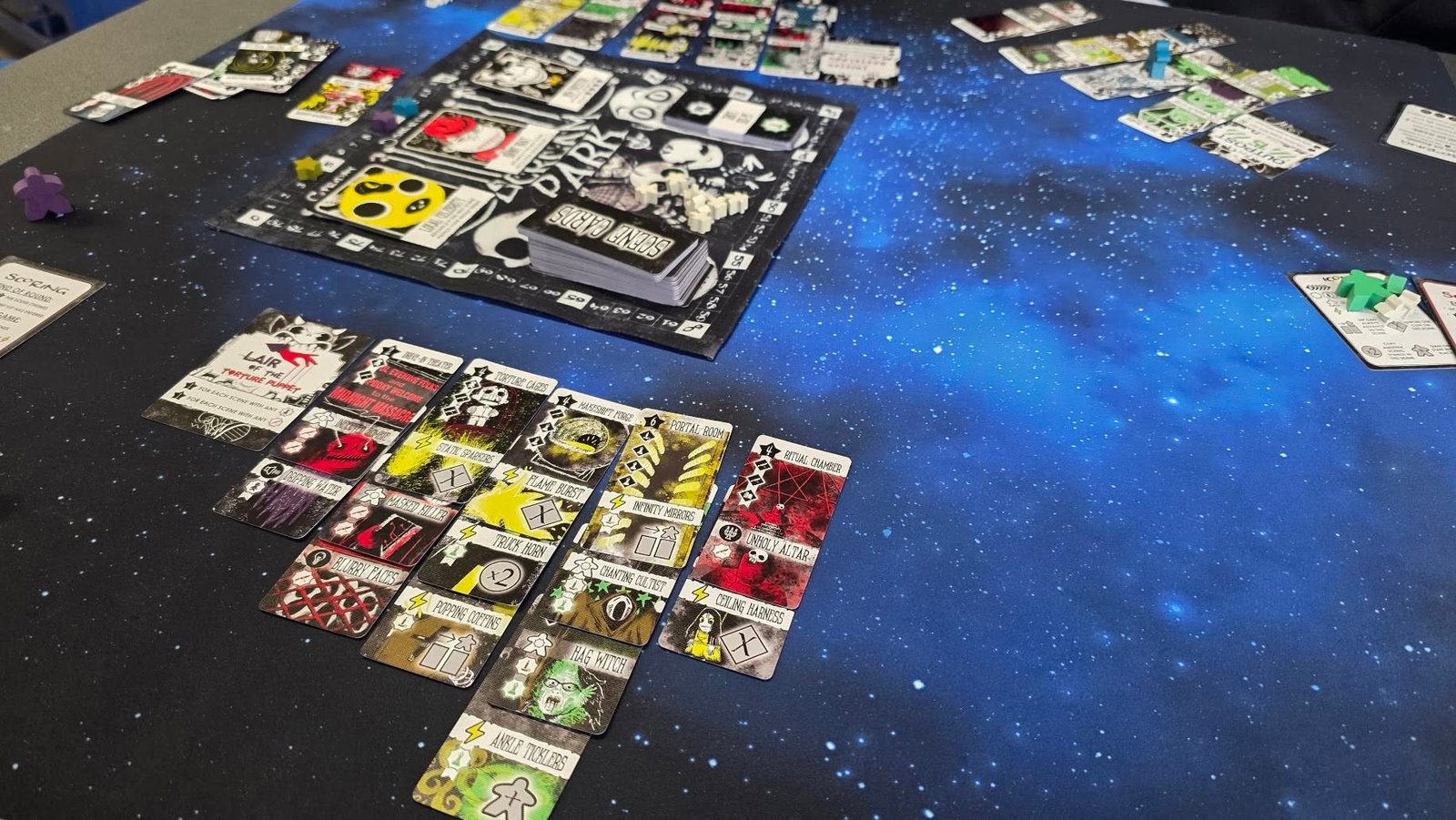
The overall issue is that it’s nothing special. The poorly explained rules don’t help, but even once you are sure what’s going on, the set collection is very flat. Because none of the colours (except yellow, which gets you three extra points for having the most, which is basically nothing in the grand scheme of scoring) have extra abilities or rules, everything feels very one-dimensional. The way the VIPs work, while a great idea, again doesn’t give you masses of points compared to just completing the cards as efficiently as possible.
It’s not terrible, and if you really like card drafting and set collection, there is certainly some spooky fun to be had. However, without the Halloween theme, I’d recommend Zuuli or Fetching Feathers instead (reviews of both are on the website).