
 Matthew Bailey
Today we are going to be looking at Removal, a tetromino-style tiling game from Albi which, at first glance, looks fairly typical, but when you actually start playing you realise it’s got some really unusual mechanics that make this something quite unique for tetromino tile-laying fans.
Most tetromino games work in roughly the same way. You draft or take tetrominoes and then have to lay them on some sort of grid in such a way that gains you points, either by their relation to other tetrominoes or alternatively their position on the board.
Removal works quite differently in that you’ve essentially got a relatively small grid and you are filling it in waves, with a risk/reward element where you are trying to gain as many points as possible but equally not leave yourself in a sticky situation where you have to drive off too early and lose points.
In Removal, you are running a team of movers tasked with clearing out a mansion. Over three rounds, you will be taking furniture and other belongings from the house, trying to fit them efficiently into your lorry and then sending the lorry off to score points.
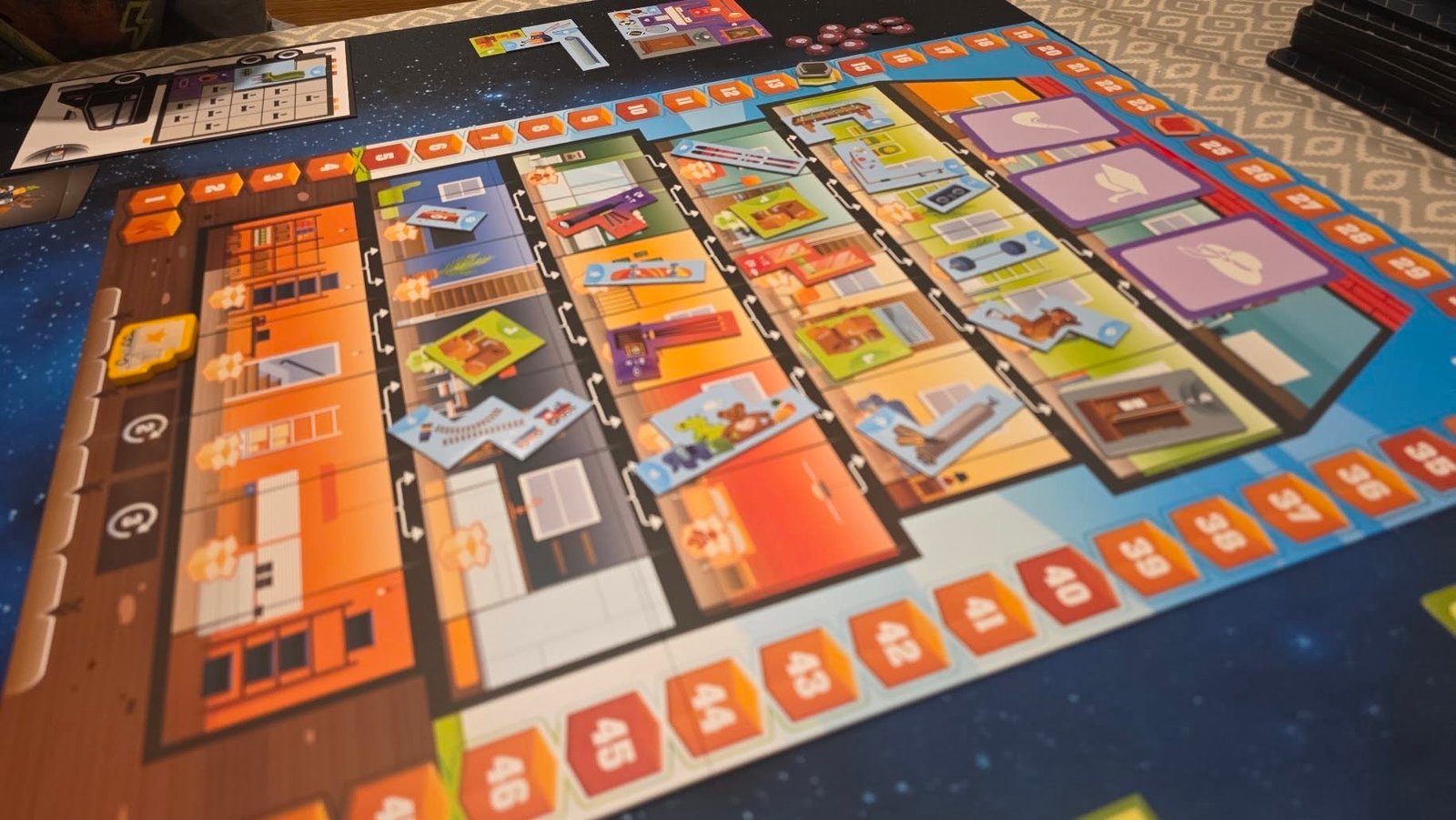
On your turn, you choose one of four actions. You can Pick and Load, taking an available item directly from the house and putting it into your lorry; Pick and Store, taking an available item and putting it into your lorry’s storage space for later; Load from Storage, moving your stored item into the lorry; or Drive and Score, sending your lorry off and scoring everything you have managed to pack inside.
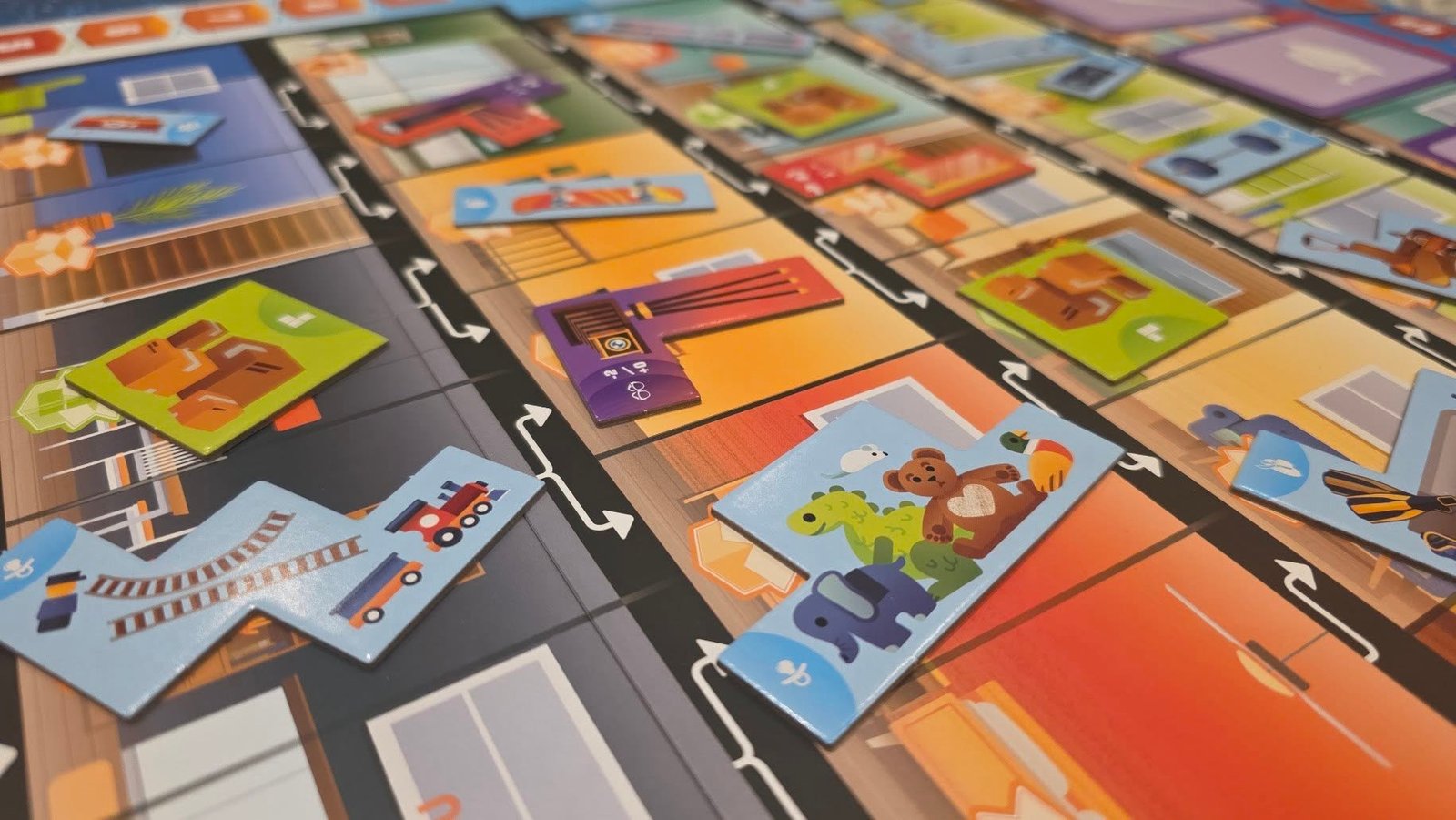
When taking something from the house, you have to take items from the bottom of the board towards the top, and an item is only available if there isn’t another item directly underneath it. As furniture is removed, more items gradually become accessible. This means your choices change throughout the round as everyone works their way through the house. This works really well and adds a fun tactical element to your choices. Sometimes it’s a toss-up: do you take the thing that’s good for you, or do you take the thing that means your opponent is going to get a much worse pick next time?
Actually loading the lorry is a typical spatial puzzle. Every item has to be positioned directly on the floor of the lorry or supported by other items, the whole tile must remain within the lorry, and tiles cannot normally overlap. You can rotate and flip items however you like before placing them, so a large part of the game is working out how to squeeze everything together while leaving useful spaces for whatever you might collect next.
There are also types of items with certain restrictions, such as Heavy Items, which have to be placed directly on the floor or on another Heavy Item, or Delicate Items, which can break if other items are put on top of them and more of that item is touching the Delicate Item than anything supporting it underneath. Without a diagram, exactly how that works is quite difficult to explain, so I’m not really going to try, but it works well and makes sense when you’re actually playing the game and have it visually in front of you. Most of these extra items have additional points attached to them, so they are worth using.
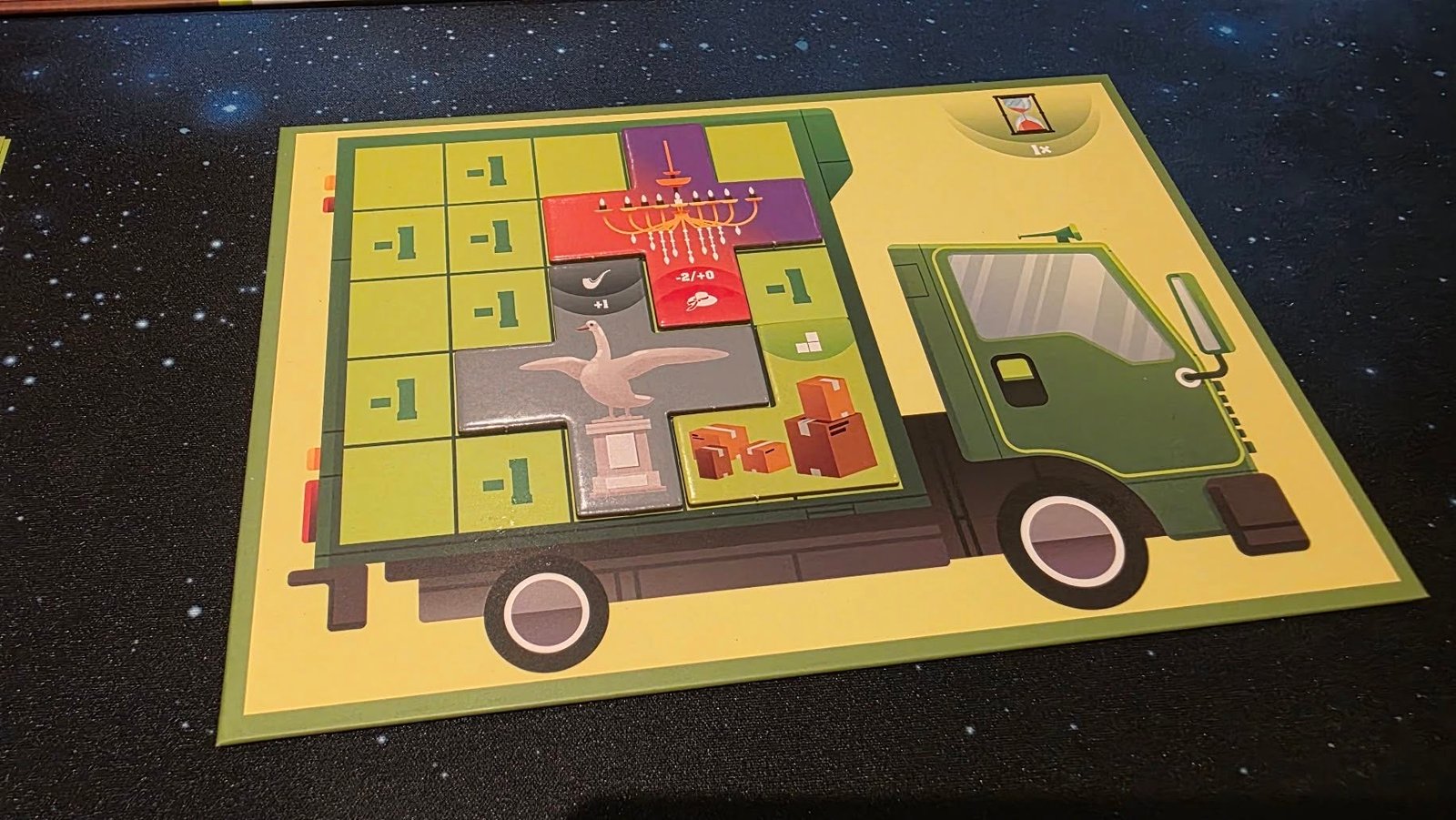
If you don’t want to load something immediately, your lorry also has a single storage space. Taking the Pick and Store action lets you put one available item there instead of trying to fit it into the main lorry. You can only store one item at a time, and a later Load from Storage action is needed to actually move it into the lorry. This is really useful if you’ve got an idea of how you want to fill up your lorry, but it does obviously take two turns to use an item rather than one. Theoretically, though, ‘wasting’ a turn like this can actually be a sensible thing to do, and I’ll talk about that in a minute.
At any point during your turn, you can choose to Drive and Score rather than collecting another item. You immediately receive 10 points simply for driving off, then adjust your score based on the contents of the lorry. Every visible -1 space on the lorry costs you a point, while Heavy Items give you an extra point each and Delicate Items score according to whether they survived the journey undamaged. Once everything has been scored, all of the items in the lorry are moved to your personal pile of transported items and your lorry is empty again, ready to start filling it up once more.
This whole filling-up-the-lorry, driving-off and trying-to-time-everything mechanic is really unusual, and I haven’t really come across anything quite like it before, especially not in a tile-laying tetromino game. It makes Removal stand out as something quite different, particularly if you’re a fan of these types of games and already have a lot of them in your collection. You’ll notice that I haven’t actually reviewed many tetromino games recently, and that’s largely because I got a little overwhelmed by just how many there were and how many seemed to be variations on the same idea. Removal, with this mechanic, definitely stands above the crowd and has a place in your collection even if you’ve already got quite a few tetromino games.
Each player also begins with three Helper cards, which give you one-off ways of bending the normal rules. One lets you ignore item restrictions while loading, another allows you to take an otherwise unavailable item from directly above an available one, and the third lets items overlap and can also ignore their normal characteristics. Each Helper can only be used once, but there is a reason not to burn through them unnecessarily, as unused Helpers are worth the Victory Points printed on them at the end of the game. This was a bit of a weird one that I don’t think works quite as well. I kind of get why the Helper cards are worth points, but it meant that in most cases, if you used a Helper card, with the exception of maybe using one to complete a lorry, you were using it so that you didn’t lose some points on the lorry but then losing the value of the Helper card instead. In almost all of the situations where we thought about using one, it basically ended up having a neutral effect on our score, so it was rare that we actually ended up using them.
A round continues until the final item has been taken from the house. The round marker then advances, new items are added to refill the house and the waiting areas are replenished ready for another round. After the third round, everyone gets one final opportunity to drive their lorry and score whatever is still inside it.
There is then some final scoring. Anything you left sitting in your lorry’s storage space is lost and costs you 2 points. You then score all of the Boxes you successfully transported, which have secret values on their reverse sides that aren’t revealed until final scoring. Your collection of Antiques is also scored, with increasingly large bonuses for collecting different symbols, starting at 3 points for one symbol and rising all the way to 20 points for eight, with another 2 points for every additional symbol beyond that. Finally, you add the value of any unused Helper cards.
There is also an optional Keepsake card variant which doesn’t add too much, and I would recommend just playing with the base game from the start. Three Keepsakes are revealed at the beginning of the game, each showing a particular Antique symbol. At the end, you look through the items you successfully transported and gain 2 additional points for each matching symbol, making particular belongings considerably more desirable when deciding what to remove from the house.
Whoever has the most points wins.
We really liked Removal. I haven’t played many tetromino games recently, largely because they all started to come across as a bit samey, but the filling-up-and-driving-off mechanic, working out when the best time to do it is, and essentially having lots of little spatial puzzles rather than one big one really appealed to us, and all of us really enjoyed playing it.
Visually, the game is really nice to look at. It does take up quite a lot of space for a tetromino game, as the board you’re playing on is really large and probably could have been a bit smaller for what it is, but that’s a small whinge about what is otherwise a really good game.
If you like tetromino-style games, this is definitely one that I would recommend, and it sits up there with games like Patchwork, Subway Squeeze and The Isle of Cats as one of the best in the genre.
Disclaimer – A copy of Removal was gifted to us by Albi. Our thoughts and opinions are our own.