 Matthew Bailey
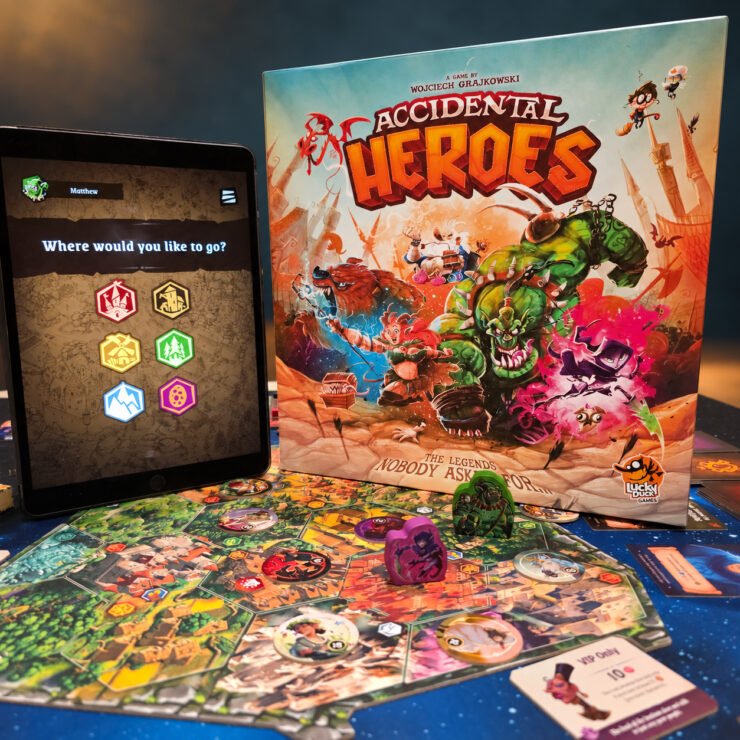
Today I am really excited to talk to you about Accidental Heroes, an upcoming app-integrated game from Lucky Duck Games. There’s still a while to go before it comes to Kickstarter, and it’s not actually due out until 2028, but I’ve spent a couple of weeks with an extremely early, two-player, competitive-only prototype. I definitely feel that I’ve played enough to give you my thoughts and tell you whether this is one to keep an eye on over the next year or so. In short, it definitely is.
Now, just to make you aware before I start, the version I’m playing here is limited to two players and only has the competitive mode, as opposed to the main game, which will also have solo and cooperative modes. It also only has 15 different adventure tokens, meaning the number of available adventures is quite small compared with the final release, which will have over 200 tokens. They have already announced that there will be expansions, which is a really exciting prospect. Let me explain.
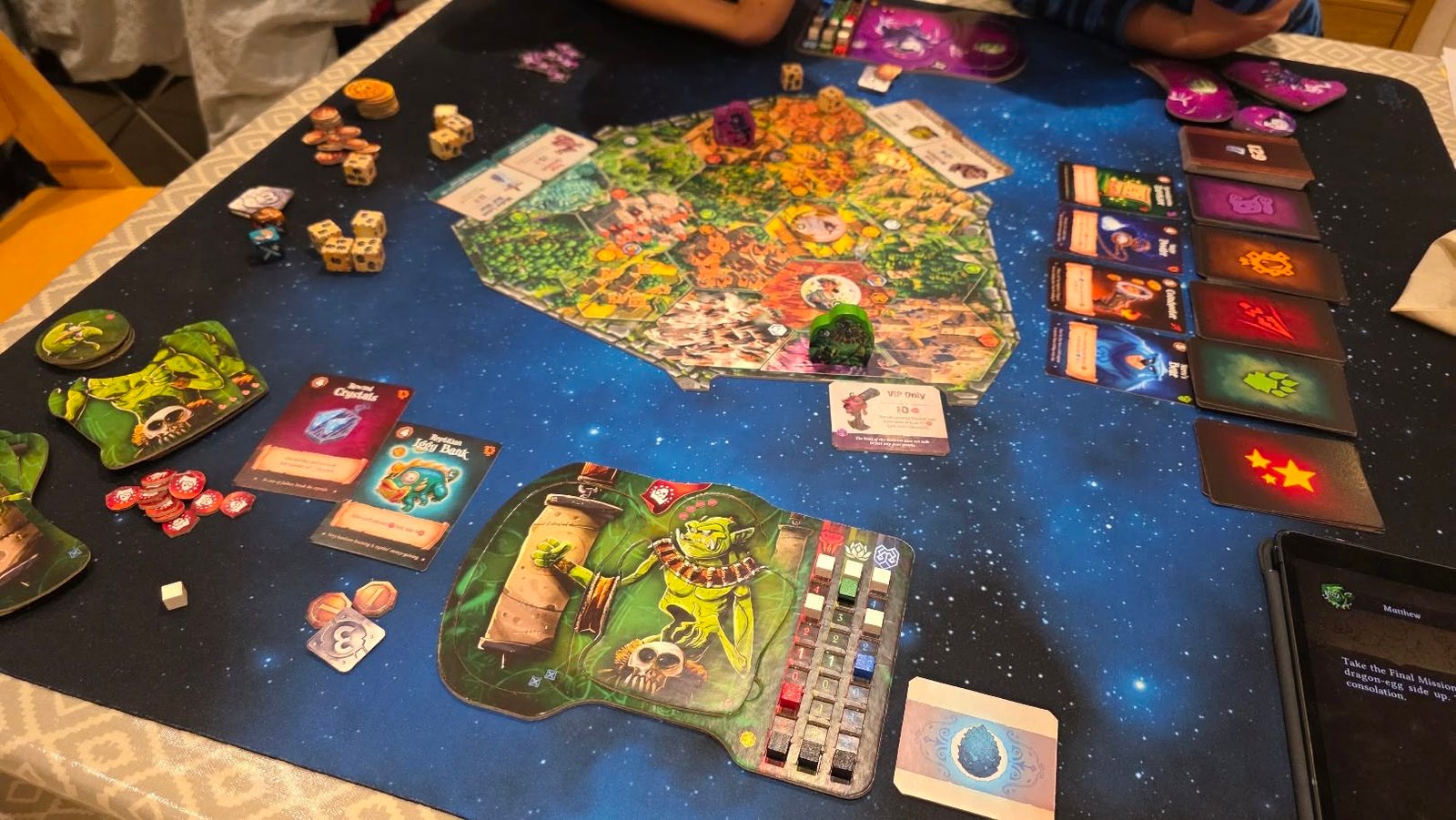
In Accidental Heroes, you move around a fantasy kingdom, completing adventures, improving your character and collecting items as you try to become the first player to collect two dragon eggs and win the game. As I said, our preview copy includes the two-player competitive mode, so that’s what I’ll explain here, but it doesn’t take too much imagination to see how the cooperative and solo versions might work.
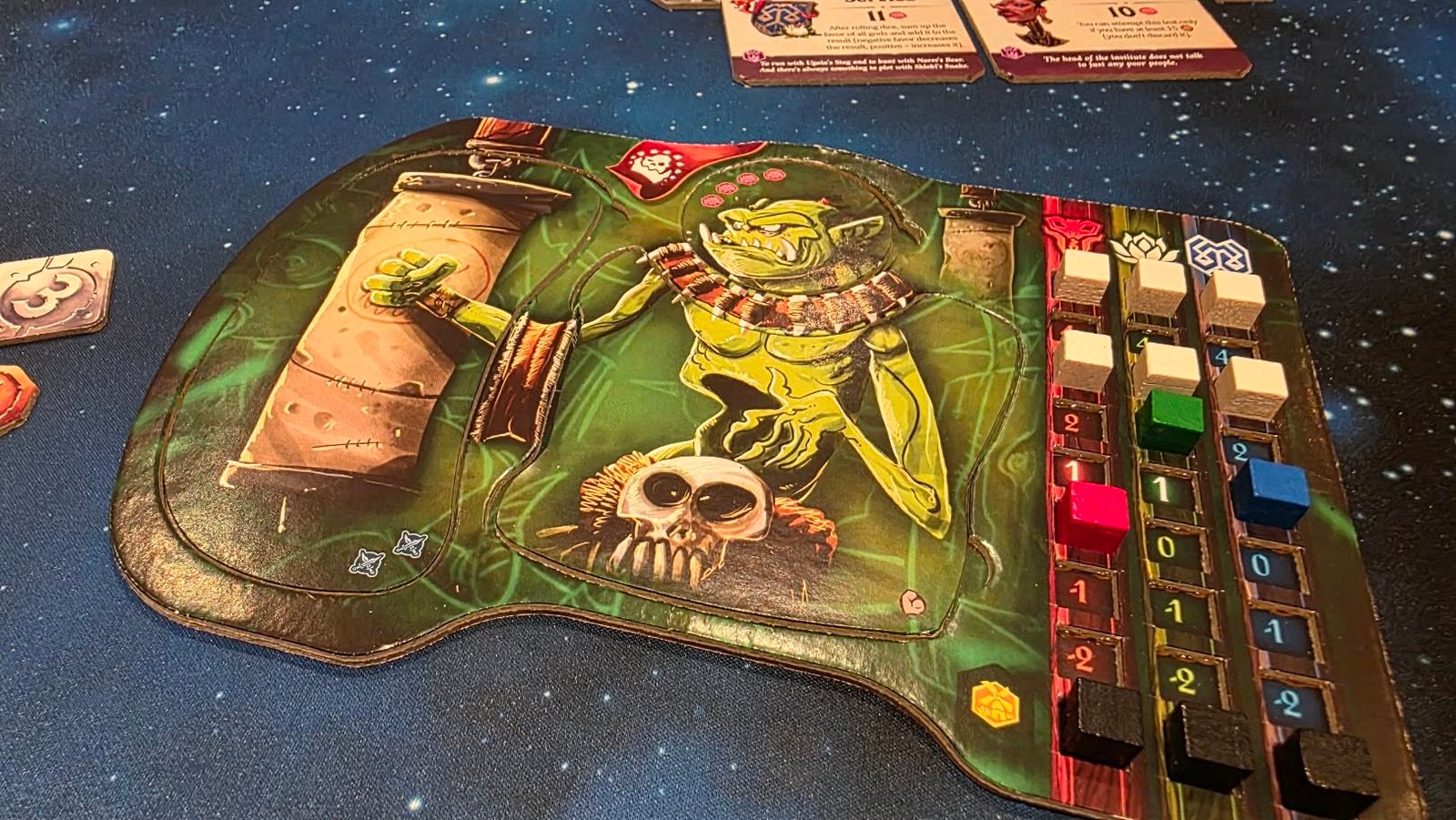
You each take a character board with three portrait tiles representing your brain, body and combat stats. These are super cool, and the boys absolutely love them because, rather than just increasing your stats by moving a counter on a board, you physically take your head, body or arm off the board and put a new one into the slot. This makes your character physically look stronger and cooler as your stats level up. This is a system that could easily be expanded in future expansions to include other stat upgrades. I absolutely love this and have no idea why it’s never been done before. Toby especially really hooked into this, and it got him into the game right from the start.
Your stats all start at two, and whenever a stat changes, you swap the relevant tile to show its new value. You also have three tracks showing your favour with the game’s three gods. At least in the version we played, these didn’t directly affect gameplay on their own, but as your favour with those gods went up and down, you could trigger rolls to increase your stats or, in some cases, lower them. You could also pray to a god before a test to get extra dice, sacrificing divine favour to do it.
On your turn, you can move up to two spaces or stay where you are. You select your location type in the companion app, then enter the number on the adventure token at that location. If there isn’t a token there yet, you draw one from the bag and add it to the board. The adventure depends on both the token number and the location type, so finding a sword token in a forest gives you a different encounter from finding that same sword token number in a town.
This is why the app integration is so important and necessary, as the number of quests and interactions just couldn’t be handled easily on cards. Even if they could, this avoids the issue with Vantage of working through thousands of cards. With five different location types and 15 adventure tokens, the preview copy has 75 possible adventures. There seem to be an average of about three choices per adventure, giving you around 225 different branches to explore, although passing or failing tests can change what happens, potentially doubling that number. The full game is set to include over 200 adventure tokens, which, across those five location types, would mean over 1,000 possible adventures and roughly 3,000 outcomes. That would make the likelihood of seeing the same adventure multiple times, and therefore being able to predict the outcome, pretty slim.
This is extremely cool, and I absolutely loved playing with it, but it also leads to my one very small criticism of the game so far. It may be something that gets sorted out before release, but you don’t always know, or at least it’s very difficult to guess, what you’re going to get from the outcome of a quest. Outside of the few that give epic items, which I’ll talk about in a minute, being able to train a specific stat is tricky. In one of our games, through a series of events, I ended up with my brain stat at six and an item or two to increase it further. However, as you generally need to get two of the three stats up to claim the final dragon eggs, I found it extremely difficult to train up another stat. When going into various battles, I rarely knew what the outcome of that battle was going to be.
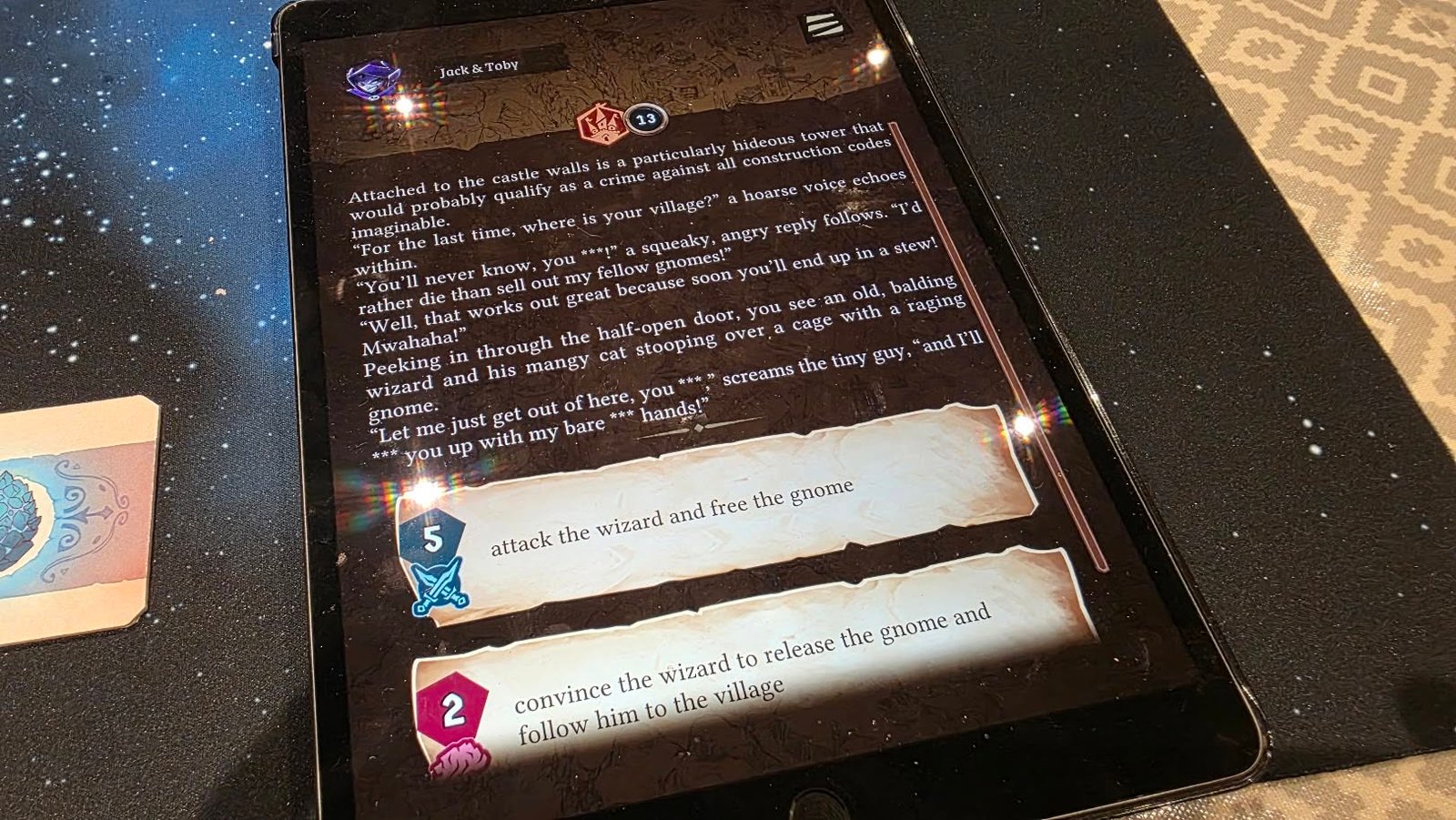
Back to how the game plays…
The app then describes what you’ve encountered and gives you a choice of how to respond. Some options involve taking a test, others require you to spend coins or items, and some can be chosen without either. You pick one option and follow the instructions to find out what happens.
For a test, you roll one die for each point in the relevant stat, with any bonuses from your items added on. You add up the successes shown on your dice and compare the total with the number you need. Match or beat it and you pass. You then enter the result into the app, which tells you what you gain or what happens next. If you fail, you receive two coins as consolation.
All of the story content we encountered was very well written and whimsical, which definitely helps the game sit really nicely in a family environment. You’re instructed to have the next player read you the story, but if, like me, you’re quite confident talking, you might end up doing most of the reading for the kids so you can put on voices and put on a show. As I always say when we’re talking about games on Little Board Gamers, when you’re playing games that you can turn into a story, making an experience of it makes them all the more exciting. Hence why I can’t wait to finally get my hands on a cooperative version of this, as I think it’s going to be an absolute star.
Your choices can also gain or lose you favour with the gods. You move the corresponding markers as instructed, and reaching certain spaces for the first time makes you roll a blessing or punishment die, increasing or decreasing one of your stats. Before rolling for a test, you can also spend positive favour to pray for extra dice, gaining one die for each point you spend.
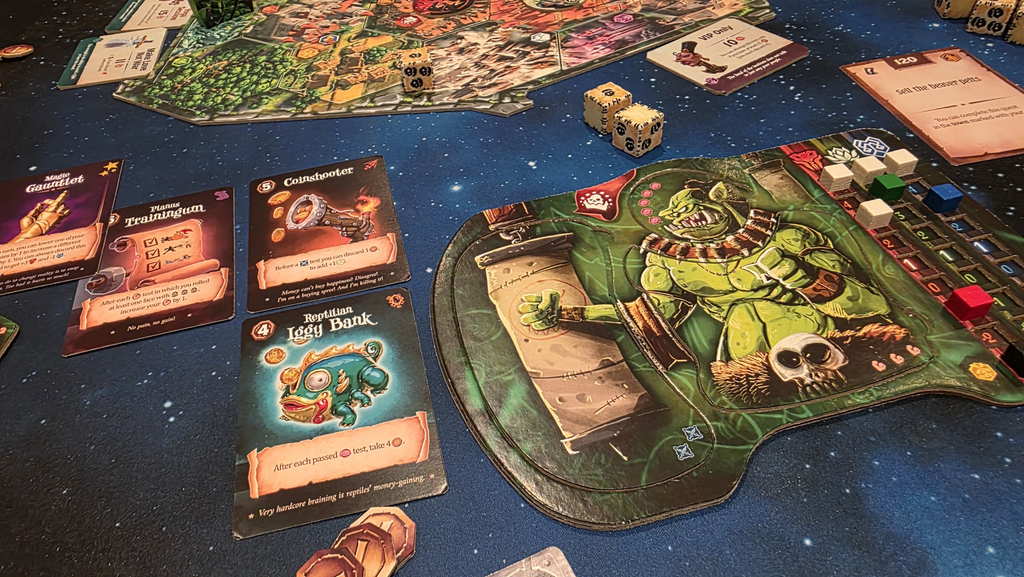
Unlike the stats, I actually found this a bit easier to predict. For instance, you tend to gain favour with SHLOKI, the red god, when you kill things or generally act less than nicely. UGAIA, the green god, acts as the polar opposite, with NARES, the blue god, tending to sit somewhere in the middle, rewarding you when you “follow the rules”, even if it isn’t necessarily the moral thing to do. This created quite a fun balancing act, as it meant that, as well as obviously trying to raise my stats, I was constantly thinking about how my actions would likely impact my favour with the gods so that I didn’t go too low on one of them and receive a penalty. Currently, there are two possible stat bonuses per god and one possible stat loss per god. I actually think you could probably add another loss to keep the game balanced.
Some adventures give you a quest card and ask you to mark a destination on the map. When you reach it, you enter the quest number into the app and follow the instructions. Completing a quest doesn’t replace your normal adventure, so you then resolve the adventure at that location too. This is definitely the part of the game that I think is in its earliest stages and could use the most work. Most of the quests we got involved delivering an object to someone, and we normally received some gold and maybe an item, but that was about it. I definitely feel these could be more unusual and a bit more involved.
You can also collect weapons, scrolls, amulets and animal companions, each with its own ability, alongside epic items available through particular adventures. You can hold up to five items at a time. If you pass through a market symbol during your movement, you can buy and sell items, or pay two coins to replace some or all of the available market cards. These cards, especially towards the end of the game, are integral to raising your stats and potentially winning. We quite often found it easier to manipulate our stats and dice totals with items than to increase the base stats themselves. I guess that’s what they’re going for, plus the artwork on the cards is really well done.
To collect dragon eggs, you need to visit the final mission locations around the edge of the board. Here, you can attempt one of the available missions instead of having a normal adventure. Each mission requires a test using a particular stat, along with any additional conditions shown on its tile. Pass and you take the tile as your dragon egg; fail and you receive two coins. Either way, your turn ends.
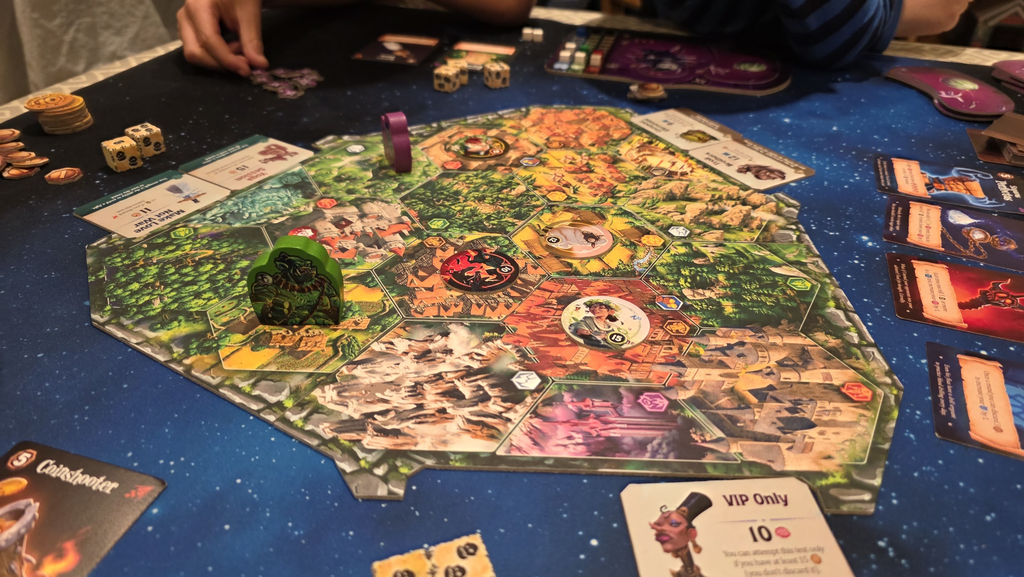
Each of the three dragon locations favours a different stat, meaning that, as you go through the game, you basically need to focus on two stats in order to win and get the two eggs. After the first couple of goes, I realised the best approach was usually to focus on raising one stat naturally and then raising another with items. That seemed to be a fairly good tactic that served me well across the games we played.
The first player to collect two dragon eggs from two different final mission locations wins.
Both my kids and I absolutely adored our games of Accidental Heroes, and our main disappointment was that we have such an early version that there aren’t more adventures to go on and more of the game to explore. I want more characters, more adventure tokens and maybe even some weird, unusual stuff along the way in expansions. Walking over a bridge? Let me see if I can balance a coin on its edge and roll it along a line. Why not? It’s app-based, after all, so let me do a reaction-time game on the iPad to see if I pass the test.
The artwork is great, and even at this early stage, the components are fantastic. While I know anything being app-based is a put-off for some, trust me: this is a better way of doing it than going down the Vantage route of thousands of cards. Hey, I guess if it really takes off, they could do a downgraded version that does come with thousands of cards at a premium cost.
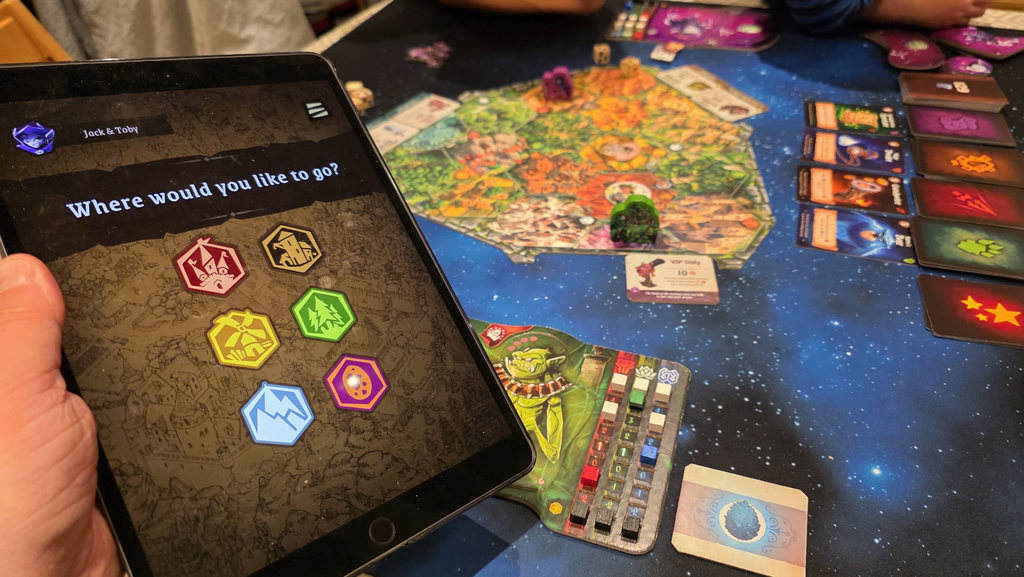
Accidental Heroes is a long way away and isn’t expected to hit retail until well into 2028, but this is one to look forward to. Between this and the excellent Boss Fighters QR, which hit shelves earlier this year, we really are hitting our stride with excellent games that use app integration to make the experience better, rather than just for the sake of it.
Watch this space!
Disclaimer – An extremely early preview copy was loaned by Lucky Duck via the UK Board Game Review Circle. All thoughts and opinions are our own and we have received no incentive financial or otherwise for this coverage



 Nicola Asker