 Matthew Bailey
Pathogen is a bubonic plague-themed abstract strategy game that has been sitting on my shelf for quite a while now. I had left it well alone until the start of spooky season, and I greatly regret that because, as it turns out, Pathogen is one of the best abstract strategy games I have ever played, despite it being a genre I’m not usually a big fan of and once you get the hang of the rules its very family-friendly and most kids will be able to play this. Jack especially loved it and we have been playing it nightly for the last week or so.
Before we start its worth mentioning that Pathogen is a Chinese import and is not super easy to get hold of in the UK. It does however come with full English rules and is language independent so is definitely worth tracking down a copy.
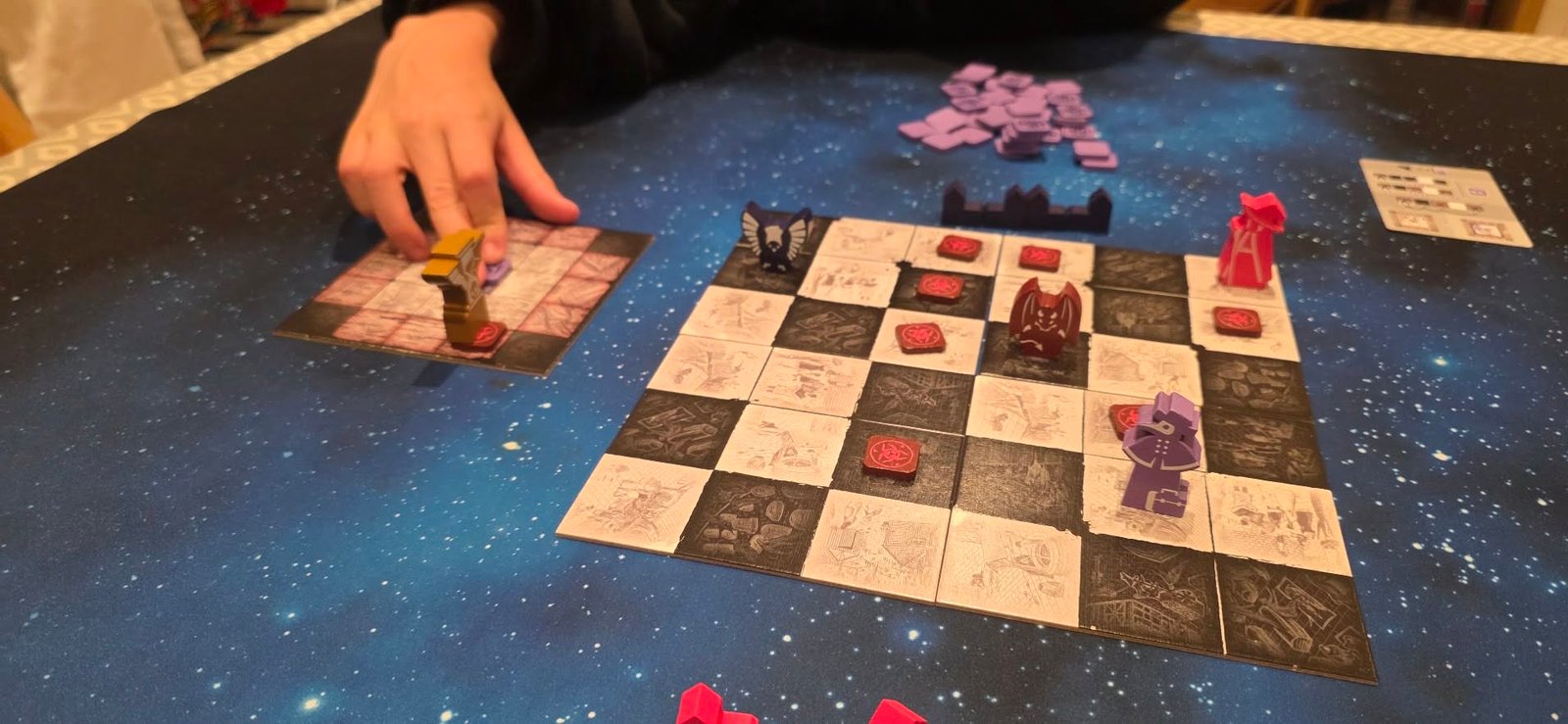
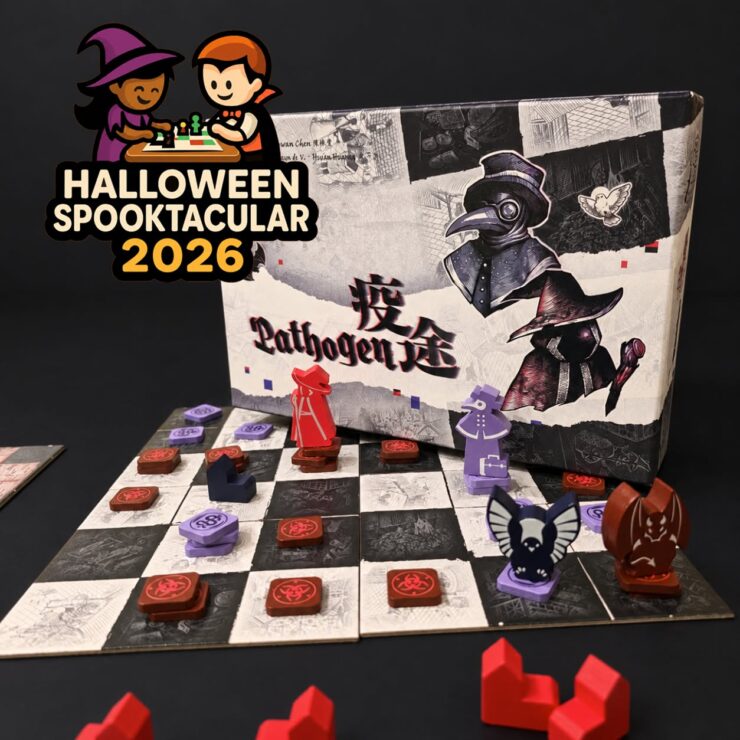
In Pathogen, you play as either the Doctors or the Plagues, competing to spread your tokens across a shared map. You build the board from four randomly chosen sections (that look like a messed-up chessboard), and you each control two characters: one that moves on the white squares representing the human world, and another that moves on the black squares representing the underworld. Your aim is to either connect two opposite sides of the board with your tokens and settlements or build a settlement in each of the four sections.
And this is what makes the game so cool. You are essentially playing on two overlapping boards, trying to position and move your characters to create a connected path across the map.
On your turn, you first move your token on a separate movement panel, then trace a shortest route from your opponent’s token to your own. You must then move one of your characters using that exact sequence of directions on the main board. Each character skips over squares belonging to the other world, and you cannot move off the board or through an opponent’s character or settlement. Where you place your token on the panel therefore determines your movement while also setting the starting point for your opponent’s next turn. This is another really key part of the game, as making sure your opponent doesn’t have a powerful move available on their next turn becomes just as important as planning your own.
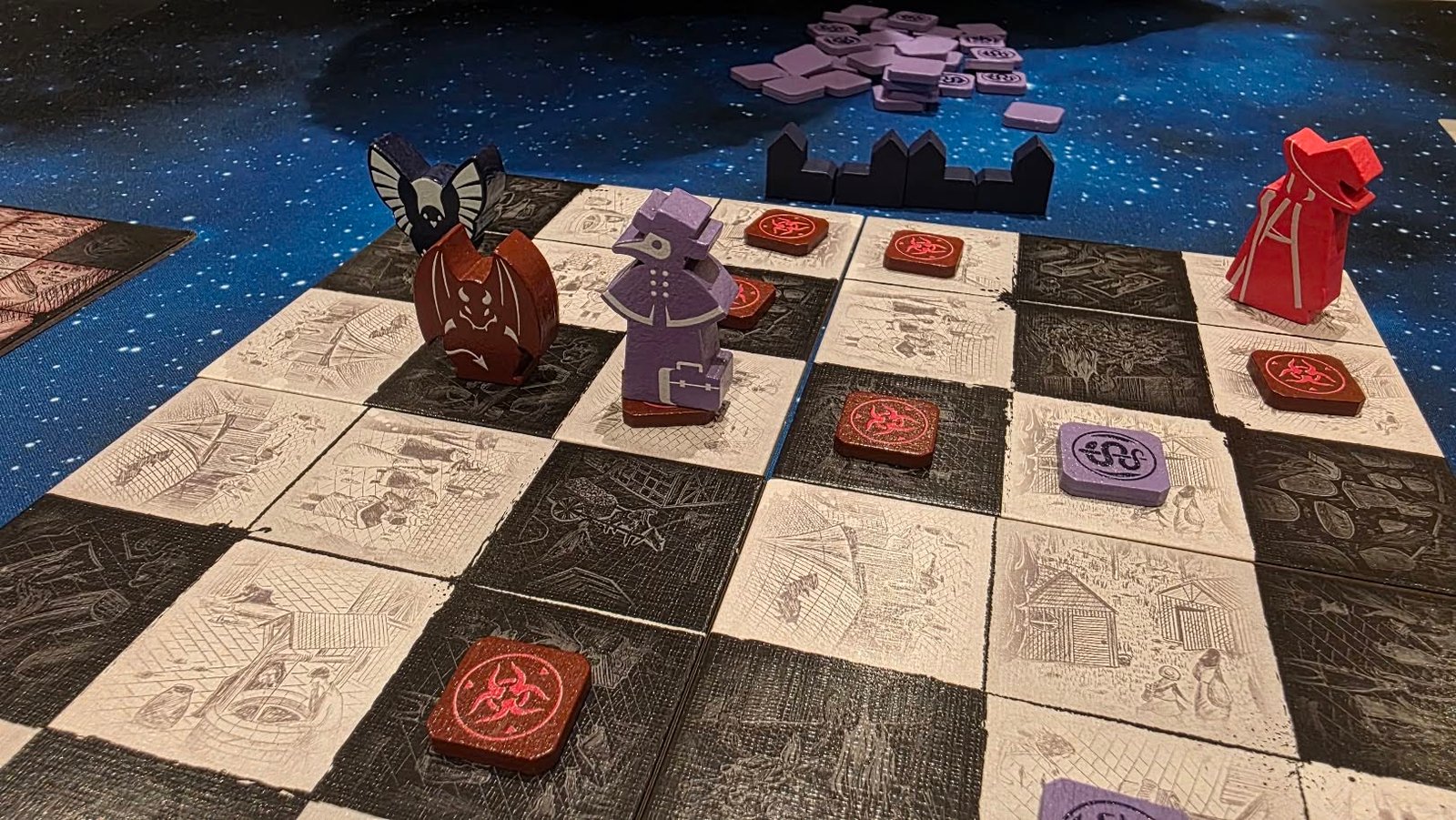
The feeling of pulling off an excellent move, adding several pieces to your own puzzle and leaving your opponent with limited movement options is fantastic. The asymmetrical movement rules also make it feel much harder to end up in a stalemate than in chess, which has always been one of my biggest frustrations with that game and something I consider a weakness in its design.
While the game doesn’t play like chess, it involves a similar thought process and, if I’m being honest, I think it’s a much better game.
After moving, you spend action points to place your own tokens or remove your opponent’s. You can use these on the square you started from and any squares you passed through in your character’s world, but not the square you finished on. Each token you place or remove costs one action point, and you must clear all opposing tokens from a square before adding your own. You can also stack your tokens, with a stack of six becoming a settlement at the end of your turn. These block opposing characters in the same world, and you can only build one per section.
While each side has a limited number of action points, we rarely found this a limitation, with most turns involving three things at most.
The two sides have slightly different abilities. The Doctors get five action points each turn, compared with the Plagues’ four, but the Plagues can use more spaces on the movement panel, giving them more movement options. The Doctors can also move their panel token into the centre to rotate the panel and trigger a lockdown, temporarily restricting the Plagues to its inner spaces. You keep alternating turns until one of you connects opposite edges or builds your fourth settlement. Having played quite a few games, these asymmetrical differences seem incredibly balanced, even if that isn’t immediately obvious, and it is fun to play as both factions.
The components are lovely, and everything has a really high-quality feel. The wooden tokens are decent, and everything works extremely well. The visual style of the game is strong, and I’d love to own a high-quality deluxe wooden version of the whole thing.
I’m generally not a fan of abstract strategy games, and I’ve gone on record several times saying that games like chess, for instance, would not have the same recognition or respect if they were released today.
Pathogen is probably my favourite abstract strategy games I have ever played. It works extremely well, requires a lot of thinking and feels really well balanced. Thanks to the randomly created board, it changes every time. The plague-inspired Halloween aesthetic is obviously why it’s being reviewed here, but this game could 100% be played all year round. It comes in a relatively small box, and I cannot recommend it enough. This is an outstanding two-player abstract strategy game.
Having said that it is not the easiest game to get hold of in the UK being a chinese import but if you can track down a copy its worth it.