 Matthew Bailey
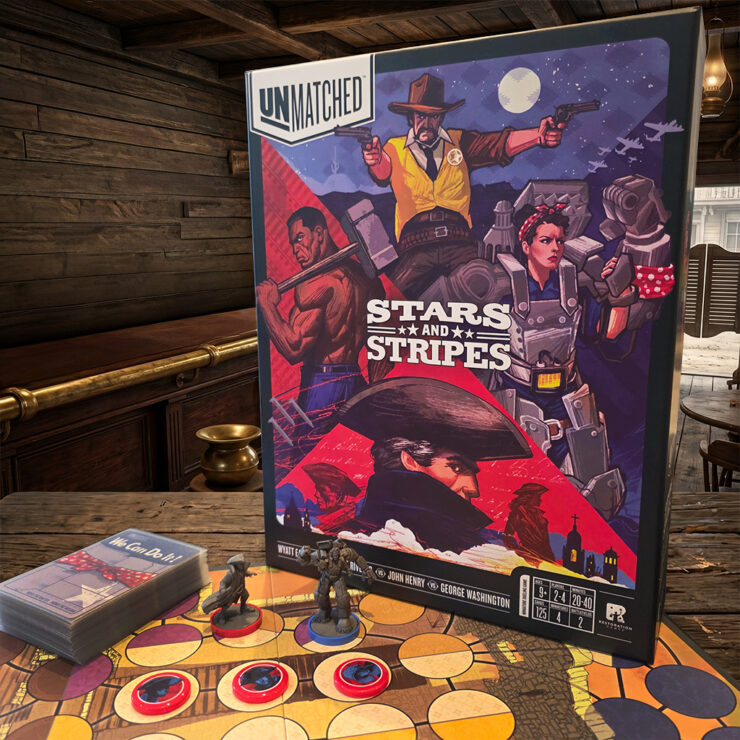
Today I’m going to be looking at the newest Unmatched set “Stars and Stripes.” The top half of the review is specifically about the new set and characters with the bottom half being about Unmatched as a whole.
Now, before I get into it, I do just want to briefly acknowledge that, given the current political climate, a set so heavily themed around patriotic American historical figures might not feel like the most tactful release for everyone. That said, this is very much a character-driven board game rather than a political statement, so I’m going to park that there and focus on how it actually plays on the table.
For the sake of keeping the group unpolitical please do not mention politics in the comments.
Now, the Unmatched 4 character sets have traditionally been a really good entry point for the series, usually featuring slightly less complex characters than you get in some of the other releases. This is maybe sorta the case for Stars and Stripes, as the mechanics of the characters are not that complex, but some of them are quite difficult to play well, and there is quite a lot of admin compared to some of the other releases.
I’ll go through all of the characters below in detail for those of you who are already fans of the Unmatched series, of which I know there are plenty in our group. Needless to say, there isn’t really a true “beginner” character here, and all four fighters lean towards the more complex, puzzle-like end of the Unmatched spectrum.
Unlike some other sets. The only new mechanic here is that all characters have a “gain an extra attack action” wording that works as it does in all other sets, but the difference is that you can only attack with that extra action. With that in mind its worth noting that this change makes this a more aggressive set overall in terms of playstyle.
John Henry is probably the closest thing here to a more straightforward fighter, although even that comes with some caveats.
John Henry can lay track on the board that allows him to move around spaces without the usual movement restrictions.
His whole game revolves around building momentum through movement, laying track and powering up his attacks based on how much he’s been able to move around the board. When it works, it feels brilliant, hitting hard and really rewarding aggressive play.
He is also vulnerable to that inevitbal moment when someone accidently nudges the board and moves all of the cardboard track pieces left everywhere….
However, if you get bogged down or mismanage your movement, he can stall out quite quickly.
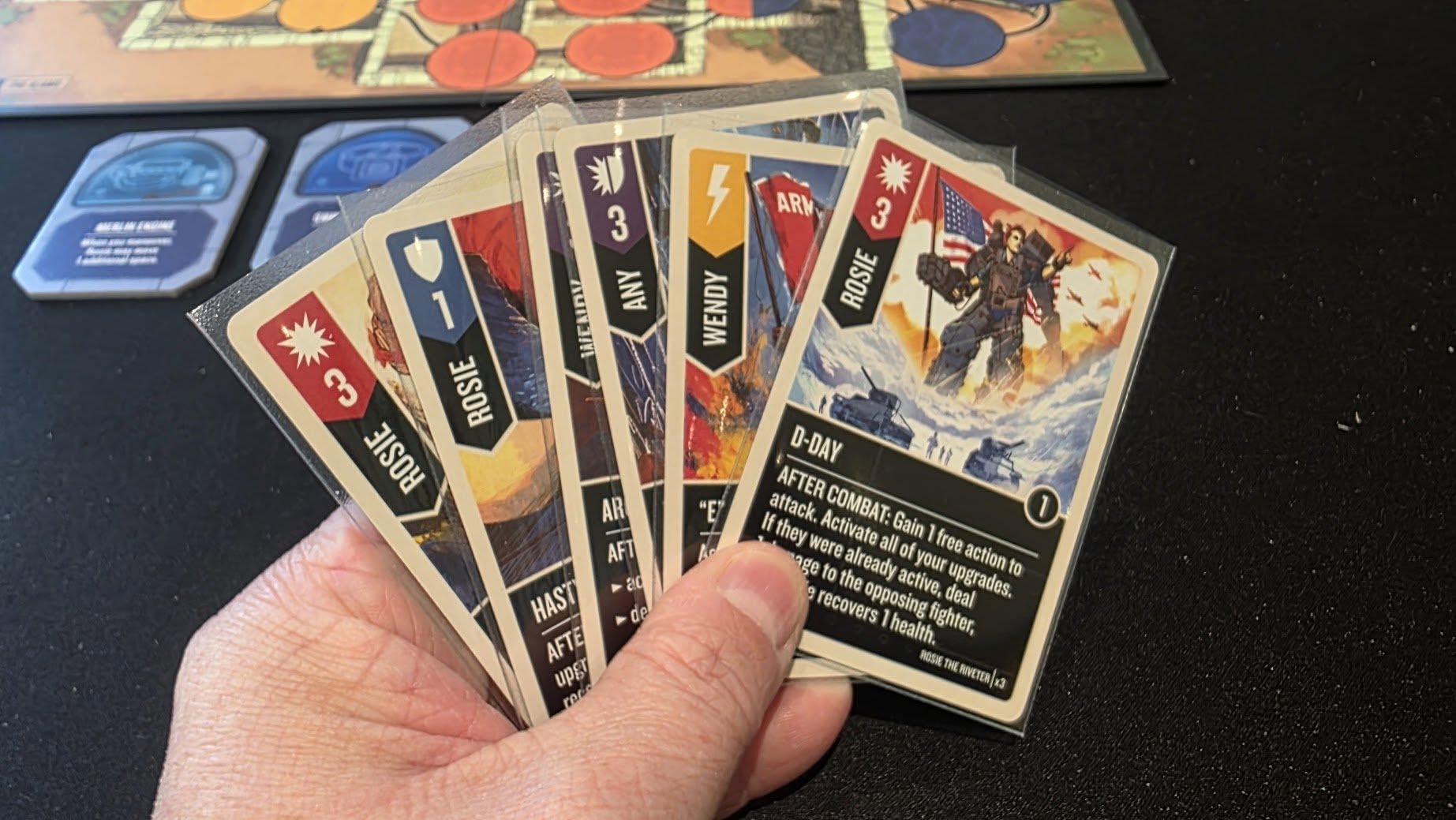
Rosie the Riveter is a really unusual character and probably my favourite of the set.
She has four bonuses in a specific order that you reveal one of in order at the start of your turn. If you get to the end, she resets back to zero, meaning she gets stronger and stronger, then goes back to being weak. She’s essentially building a mech suit throughout the game, adding different components that each give her bonuses.
Her sidekick Wendy is also strong but if she goes down Rosie is affected a lot more than I sometimes find with other characters.
The clever twist is that once you complete the full suit, it actually starts to become less efficient, so you’re constantly balancing how far to push it. It almost feels like a mini engine-building game inside Unmatched. Many of her attacks rely on these suit parts, and some allow you to add and take away mech parts, meaning if you plan carefully, you can keep her constantly powered up, but doing this is really difficult and while she is powerful, she is definitely one for a very confident Unmatched player. I loved her but Toby(7) struggled to get his head around how to play her well.
Wyatt Earp is probably the most traditionally “Unmatched” feeling character in the box. He’s an agressive character who gains bonuses when he wins combats meaning he pays to be agressive.
With Doc Holliday alongside him, there’s a nice bit of synergy and positioning play, and he feels like a proper duelist. He’s not as flashy as some of the others, but he’s solid and probably the one newer players will gel with the easiest. He is also the only ranged (ignoring the odd turn with Rosie fully powered) in the box.
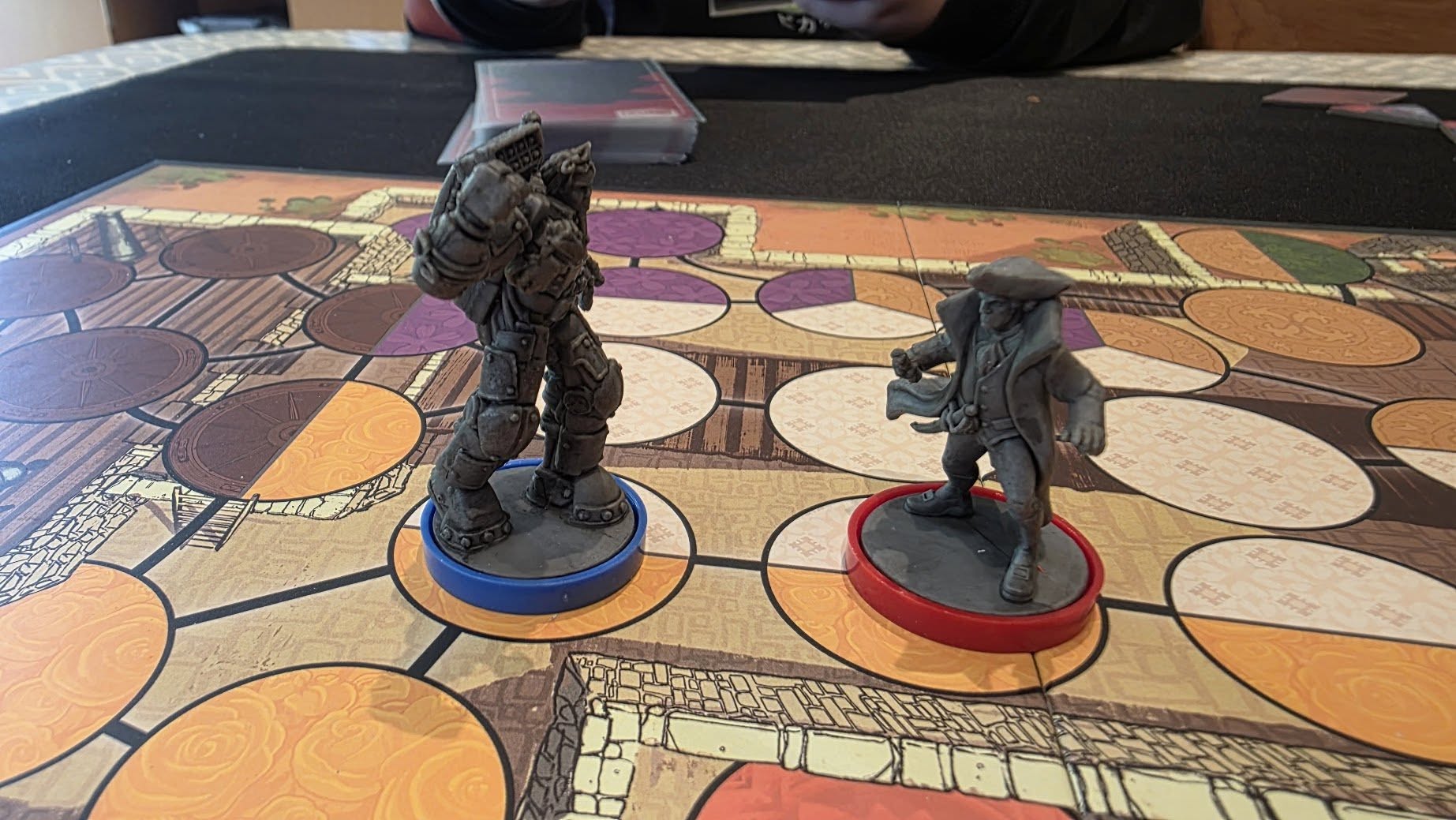
Finally, George Washington. Washington is a simple fighter but add an element of social deduction and while we still dont have a proper mill character definitely sits in that discard area.
Built around managing his Ruse tokens that can be played alongside his cards. The opponent can then choose whether they want to allow the extra ability to go off (without having seen what that ability is) or discard a card randomly from their hand. It’s worth noting you can actually bluff and use a ruse token without actually having a ruse ability in order to try and force someone to discard a card. There’s a strong element of bluffing and hand management here, as a lot of his power comes from setting up plays that your opponent might try to disrupt. When it all comes together, he feels incredibly clever to play and he has some massive attacks if the ruse tokens go off at a good time but he’s definitely not one I’d hand to someone learning the game for the first time.
There are two new maps in the box and I really like both of them. One has a tighter, more tactical layout that makes positioning really important and can lead to some interesting choke points. The other offers a bit more space to move and rewards characters who rely on building momentum or setting up longer plays. Both maps feel well thought out and add nicely to the overall package but sadly add no interesting map-based mechanics.
The Unmatched System as a Whole
At its core, Unmatched is a card game with tactical miniature movement layered on top. It can be played 2v2 or in a free-for-all format, but for me, the best way to play is one-on-one.
You pick your character, grab their deck and health dial, and place them on a starting space. On your turn, you take two of three actions: move (which includes drawing a card) or attack. Moving always gives you a card, whether you want one or not, which can be a blessing or a curse if you’re running low on cards. Attacking is done by playing a card face down, which your opponent may counter with one of their own defence cards. You can also use schemes, which are card effects that don’t involve combat.
This goes back and forth until someone hits zero health. What’s great is that while the rules are relatively simple, the real depth comes from the card abilities and the way each character plays completely differently.
You can play each set as a standalone game, but the real magic of Unmatched comes from mixing and matching characters from different sets. That opens up some properly mad combinations. I’ve got every single set, and the number of potential matchups is just huge.
One of the big draws is the use of interesting IPs. Ever wanted to see Buffy the Vampire Slayer fight a T-Rex? Or Spider-Man take on Medusa? Or Dracula square off against Hamlet in a battle of the literary icons? With Hellboy characters due later this year, I expect even more fun and obscure matchups to come.
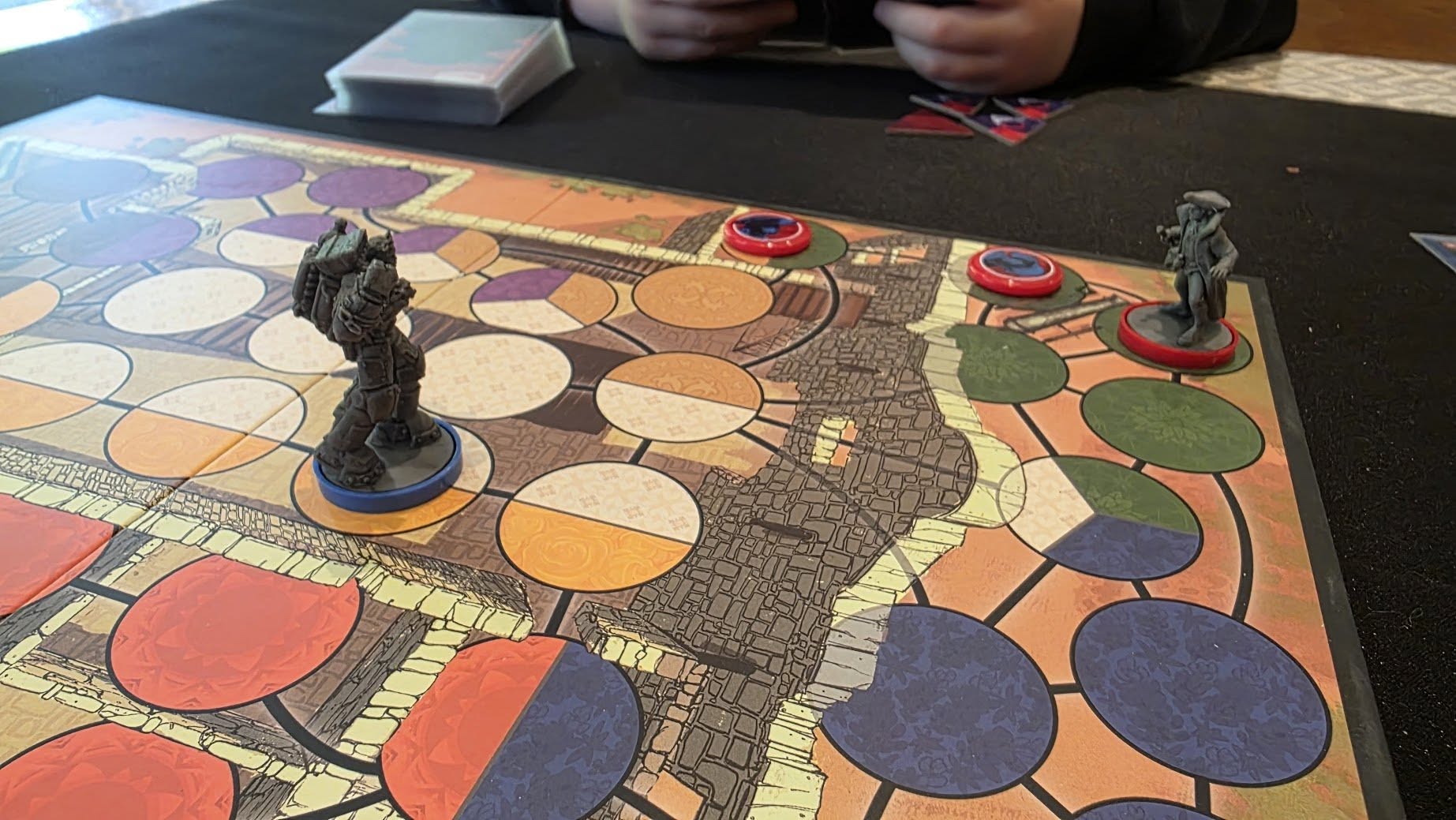
Games usually last about 30 minutes and it really does have that “just one more go” feel. At school, I’ve got around 15 boys playing this every day and we’ve just wrapped up a tournament.
Getting into Unmatched can feel a bit daunting, as there’s so much to buy. Most of the sets are good though. If you’re starting out, I’d really recommend Cobble & Fog or any of the Legends volumes. The Marvel sets are fun too, but the characters are not always the easiest, and some of them, like Squirrel Girl and Cloak & Dagger, are delightfully niche picks.
You can definitely play this with younger kids. I played this with Jack when he was seven, though you do need decent reading skills.
Unmatched has become not just one of the biggest games in my life, but a regular part of my day-to-day work. Luckily, the system is excellent and really rewarding to play. Production values are top-notch, the minis are great, and the artwork and presentation across the sets is consistently brilliant. I also love that the box design has stayed consistent across all the volumes.
I’m not saying you should go out and buy everything like I did, but I would absolutely recommend picking up a set that interests you. Who knows — this time next year, you might be reorganising your shelves to fit them all in.
Final Thoughts on Stars and Stripes
I really like Stars and Stripes. It’s a strong addition to the Unmatched lineup, but all of the characters here lean towards the easier-to-play but very difficult to master side of the system. This is definitely a set for players who are already confident with the rules and want something a bit meatier.
For newcomers, I’d recommend starting with Cobble & Fog or one of the Legends sets. But if you’re already deep in the world of Unmatched, this one is well worth adding to your collection.