 Matthew Bailey
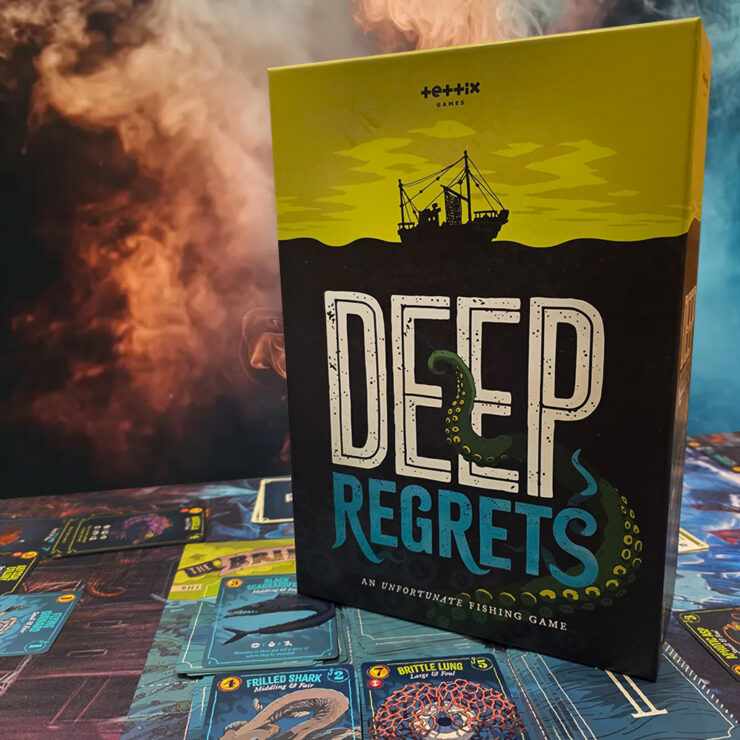
Today we’re going to be looking at Deep Regrets, a resource management and push-your-luck game based around the idea of fishing in murky depths for increasingly monstrous fish, all wrapped in a strong Lovecraftian madness theme.
Now I’m going to start this review by simply saying that the game says 16+ on the box, and I really respect the publisher for going with this. When I spoke to them about it, they were very honest that the reason for the 16+ rating is not because of the mechanics, but because there are some moderately scary creatures, there is a monster mermaid creature with breasts on one of the cards, and a few of the cards use alcohol as a resource, for example drinking grog lets you remove some of your Madness. If you felt strongly about one particular card, you could happily remove it without really affecting anything in a meaningful way. It’s no more scary, though, than something like Escape the Dark Castle, which we have reviewed positively in the past.
They definitely could have marked it lower than this, and I’ve seen games with a 14+ or even 12+ age rating with similar content, so I genuinely respect them for being upfront about it.
In reality though, I played this game with Jack, who is 10, and he was absolutely fine with the content. To be honest, as long as your child is reasonably comfortable with monsters and gruesome themes, I think this is probably fine, but it may be worth having a quick look at some of the cards online beforehand if you’re thinking of playing it with a slightly younger child and, of course, this is my opinion, not that of the publisher, and you would need to make your own judgement for your child.
Let’s crack on and talk about how the game plays, because what started off as, “Jack, shall we play a slightly more complicated game this evening because Toby’s going to bed early?” ended with me ordering the mini expansion, emailing the publisher to work out where I can get access to the expansion, and working out when mummy could play again with us the next day. And we had already played it three times before I even thought about writing this review.
Each player takes the role of an angler spending a troubled week at sea, trying to haul in the most valuable catch while managing growing regret and slipping madness. Across six days (rounds), you’ll decide whether to stay out fishing or return to port to sell your haul, buy better gear, and regroup. Deciding what you are going to do on a day really matters, and while you have to come into port to get better gear and “present” your catch, you can only actually get the fish you need to win the game out at sea.
At the start of each day, everyone rolls their available dice to determine their energy and resources for that round. Dice are split between fresh dice, which can be used immediately, and spent dice, which must wait until later to be refreshed. How many of these dice you can actually use for that round, with more added later, is decided by how much madness you have. The more madness, the more dice you can use, but more madness also equals more regret, which can have devastating repercussions at the end of the game on your final score.
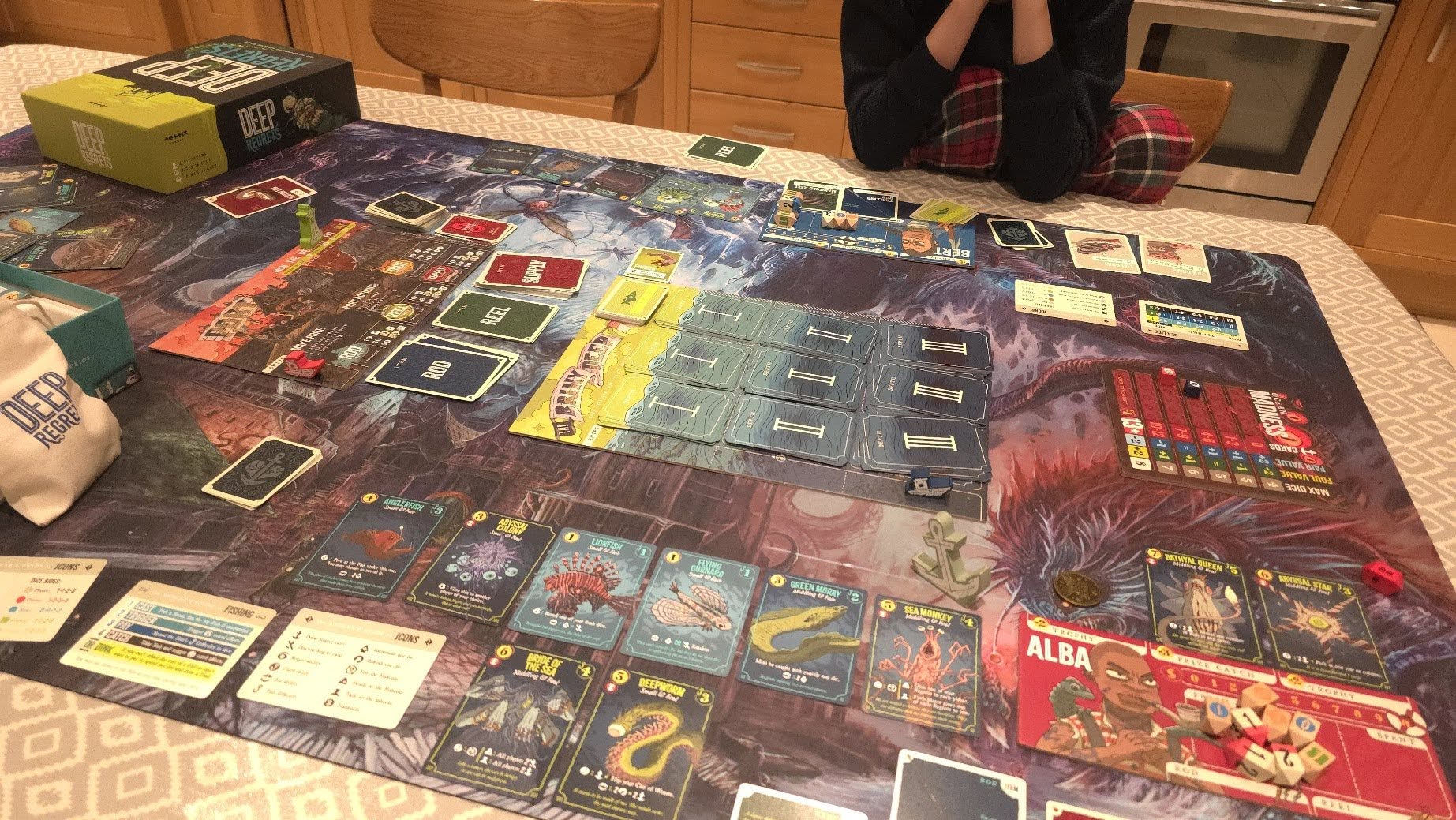
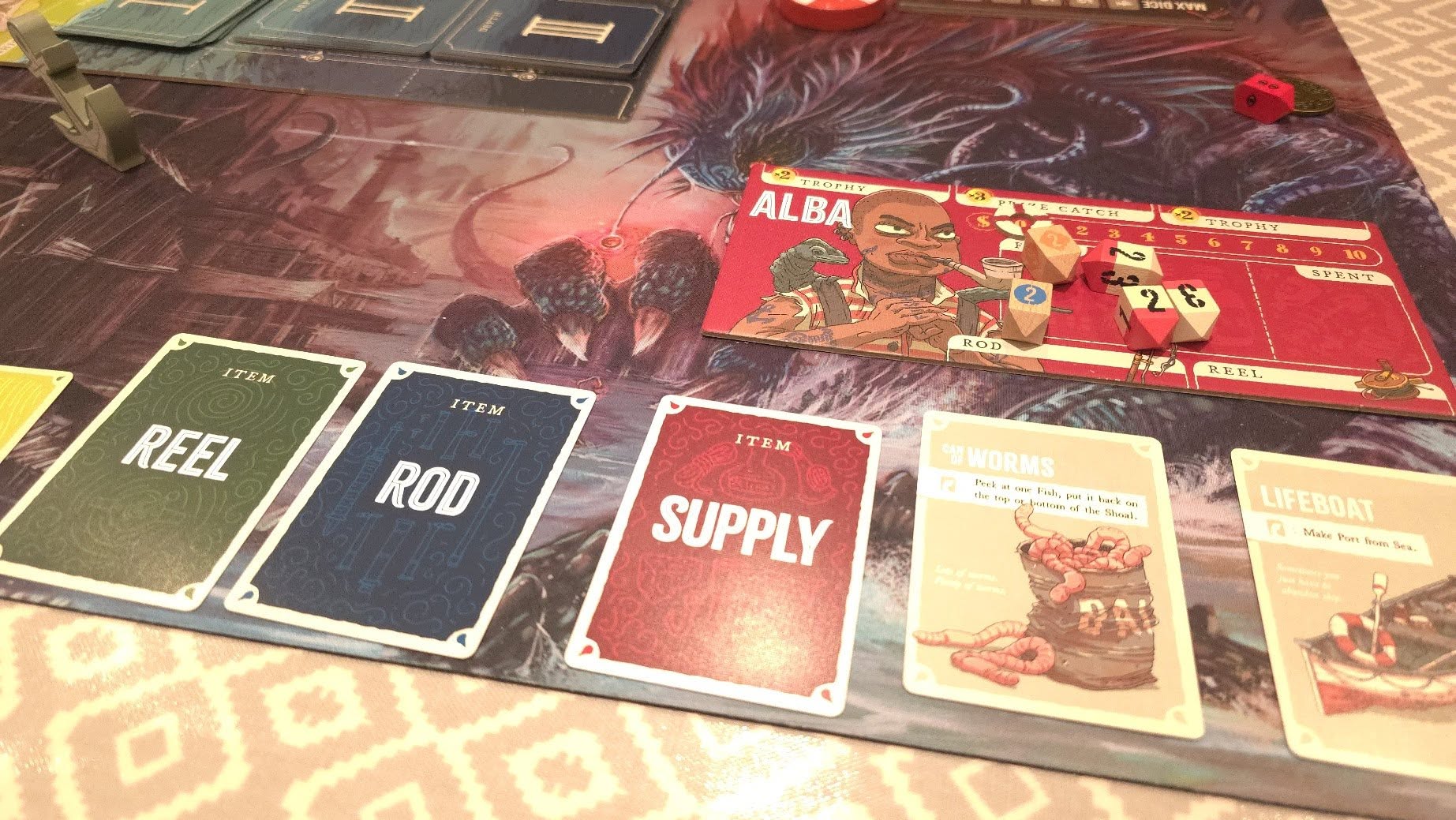
Players then choose whether they are spending the day at sea or in port. If you have rods or reels, which you buy at the port, you may equip one of each before the action begins. The rods generally make it easier to catch the fish you want, and reels usually help with movement or some other buff.
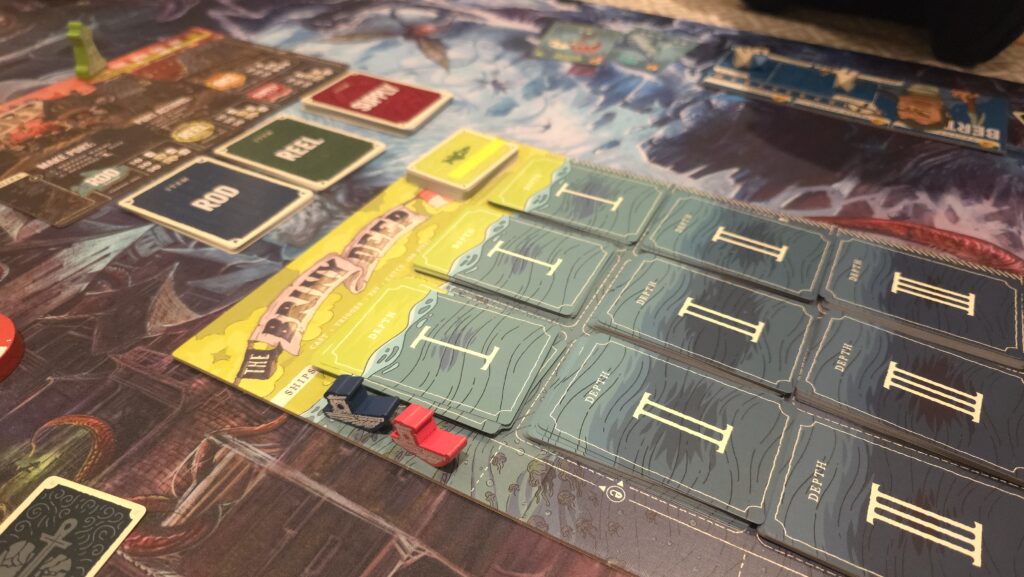
Turns are then taken clockwise. If you are at sea, your main option is to fish. To do this, choose one of the shoals (columns) at your current depth or higher, reveal the top fish card if it is hidden, and check its difficulty. You must spend dice equal to or higher than that number to catch it. If successful, the fish goes secretly into your hand, although the first game we played with everything visible on the table and it didn’t make much difference, and any special catch effects are resolved.
If you cannot or do not want to pay the cost, you still spend a die and instead take a small consolation card called a Dink (we ended up calling them tiddlers as I always think about the Only Foolds and Horses fishing episode whenever I think about fishing) which usually gives you a small bonus you can use on a future catch. You can also spend dice to dive deeper before fishing, use items, eat certain fish for effects, or even abandon ship once per game to head straight back to port. This comes with a massive regret penalty, but is the only way you can be in both locations during one round.
If you are in port, you can sell fish from your hand for Fishbucks, with values affected by your current madness level, fair fish are worth more if you are sane, and foul fish are worth more if you are mad. You may also buy new rods, reels, supplies, or tackle dice from the three shops. These upgrades can make later fishing trips far more efficient. Another option is mounting up to three fish onto your board, locking them in as trophy catches worth bonus points at the end of the game. Once mounted, they cannot be replaced, although there is one card I think that lets you do this, but it never came up in our three games.
As the game goes on, you’ll collect Regret cards from certain effects, overfishing shoals, selling foul fish, and other unpleasant events. The number of Regret cards you hold determines your position on the Madness track. More madness can reduce the value of fair fish, increase the value of foul fish, raise your maximum dice pool, and even make port shopping cheaper as your morals erode.
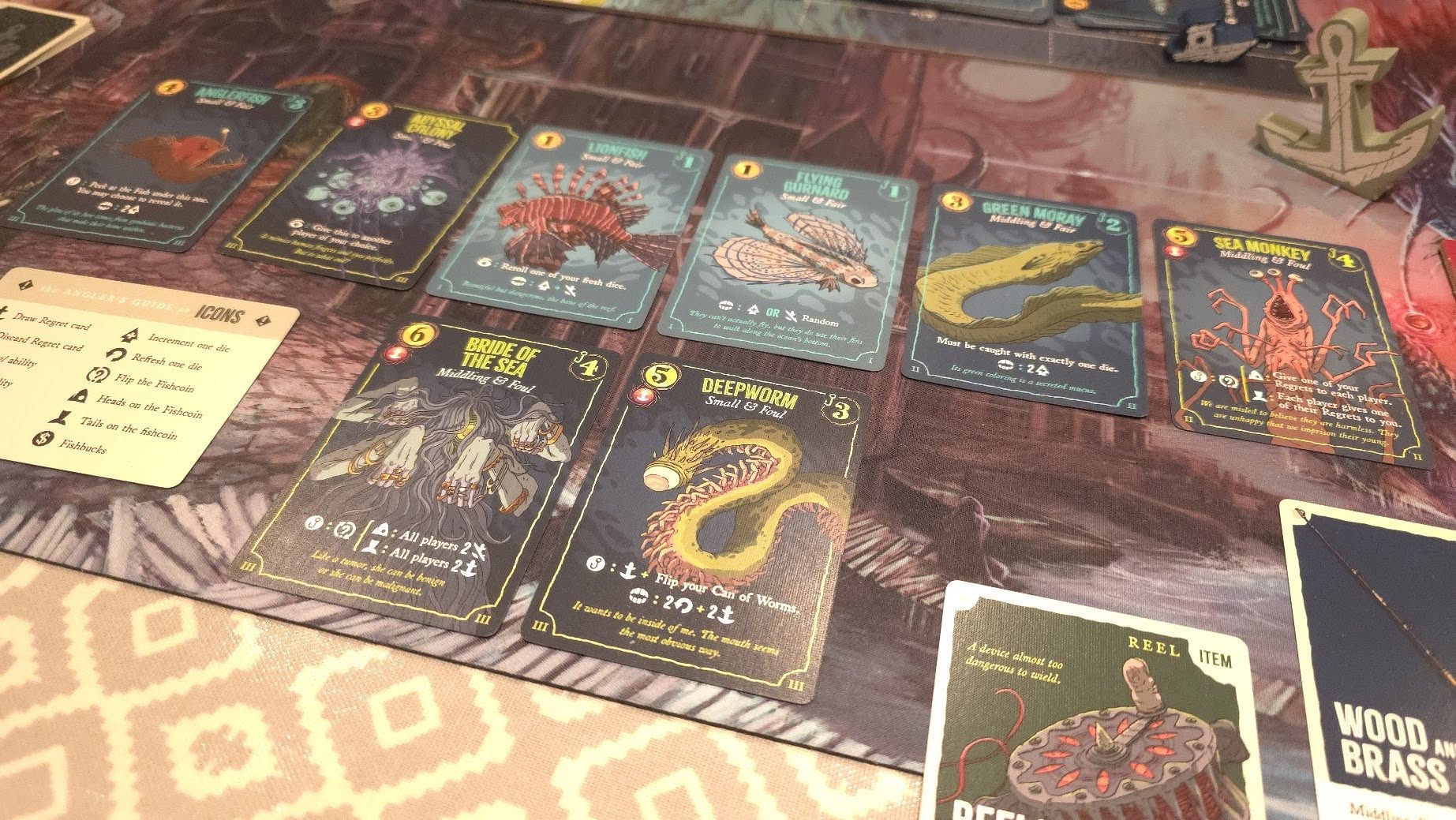
This balancing system of deciding whether you’re going to go for fair fish or foul fish, and therefore where you’re going to keep your Madness level, is really important and a key mechanic. Do you try and get all foul fish and heavily lean into Madness, knowing though that you’re most likely going to lose a ton of stuff at the end due to regret? Do you try and keep your Madness level low, focusing instead on fair fish, which are usually slightly lower scoring overall but come without the negatives? Or do you try and keep it all in the middle?
Players may pass when they can no longer act or choose to stop. Once all but one player have passed, the final remaining player gets two extra turns, then the day ends and the next one begins. This is a really key mechanic, as it can be used offensively and defensively when you can see what your opponent has left dice-wise.
This then continues throughout your week, and on certain days you get bonuses like some extra money or an extra die. After the final day, everyone reveals the total value of their Regret cards. The player with the highest regret suffers a penalty and must discard one mounted fish. Final scores are then counted from fish still in hand, mounted fish with multipliers applied, and remaining Fishbucks. The highest total wins.
Quite a lot is laid out on the table, but the actual core ruleset of Deep Regrets is relatively simple. It only took us about 10 minutes on our first play to read the rulebook and then get stuck into what felt like a competitive game, as opposed to occasionally thinking, “I’m not really sure how to play this type of game,” which you sometimes get when you play a middleweight or heavyweight game for the first time. That’s definitely to its credit. This feels like a much heavier game to play, in a good way, than the reality of how complex it is, and that’s a massive positive in itself.
As we played the game, I always felt like all of my decisions mattered. I felt like what I had in front of me were some really key choices I had to make, but at no point did I ever feel like I didn’t have enough time. One of my key criticisms in our recent reviews of Wingspan and Finspan was how quickly those final rounds ended, and how you wished you had more time to do things. Here, I felt everything was there, my decisions mattered, but didn’t overly restrict me. I also really like the double go after the first person initiates the end of the round, as I felt like I could still get the key things I wanted done and I wasn’t penalised.
While it doesn’t play like Wingspan, in terms of complexity, if you’re playing with an older kid who really likes Wingspan and they can play Wingspan, this is roughly the same level of complexity. So if you can play Wingspan, you can do this, obviously with the slightly gruesome artwork aside.
I also want to talk about the components. I wasn’t actually expecting anything special here, but in reality I thought the components of Deep Regrets were incredible. The cards have the same super premium linen feel as those that you generally only get in premium productions. The wooden tokens, such as the anchor first-player token, the ship meeples, and the metal coin that you use to do coin flips, are the sort of things you normally only get in fancy Kickstarter editions, and all of these things come in the standard version of the game. In fact, there is only a standard version of the game, but it feels like a deluxe version.
The artwork is beautiful. There are over 100 cards, and every single one is hand drawn with an amazing art style, really cool plausible fish, and gruesome scary fish. The whole thing has such an amazing feel to it, really adding to the Lovecraftian vibes. Jack’s a massive fan of that kind of mythology, and he was really excited to fish up the Kraken, for instance. We’ve already ordered the mini expansion, which includes the big man Cthulhu himself, and I can’t wait for the Even Deeper Regrets expansion, which is due to add river fishing and the loch, to see if you can fish up the Loch Ness Monster.
Sometimes lighter weight games land well with the kids and we really like them, but considering the amount of games we have available to us, some games I know probably aren’t going to get played more than once or twice, even though we do genuinely like them, and I still end up recommending them on here. Deep Regrets is different in that this is probably one of my favourite lighter weight games I’ve played in quite a while, to the point where we’ve already played this again when I already had enough to do the review, which is quite unusual. Normally I’ll play a game the number of times where I feel like I have enough information to make a confident review and judgement, then we may come back to it in future if we like it. Whereas this, we’ve already played multiple times more than we had to, because it’s really that good.
It also doesn’t massively overstay its welcome. It’s a really nice length, takes about an hour to an hour and a half depending on how many people you’re playing and how long you take, but once you get going and know what you’re doing, turns are quick and there’s not a lot of waiting around.
I also want to give a quick mention to the solo and cooperative mode, which is a genuinely interesting addition rather than something thrown in to tick a box. In this version of the game, you take on the role of researchers trying to catalogue every strange creature in the sea across multiple plays. Instead of competing for points, you are working to catch fish, record their details, and gradually unlock new equipment for future attempts. It becomes more of a campaign-style puzzle where each trip out helps you learn more about the depths and improves your chances next time. It is a clever twist on the main system and gives the game a lot more longevity, especially for people who enjoy solo gaming or want a more thoughtful shared experience.
This is only the second game I’ve ever played from Tettix, the publisher, and I am so impressed by both the quality of the production and the game itself. I also love the fact that it comes in a smaller box than it needs to. This feels like a full-sized big board game, but it comes in a Carcassonne-sized box, again much to its credit.
If your child can play a game such as Wingspan and handle that level of complexity, they can play Deep Regrets. And while there is definitely some content in terms of themes that may be inappropriate for young children, have a look online, take a look at the cards, send me a private message if you want me to show you the worst of them and I’ll send you some photos. If you’re happy with that, then this is a fantastic game for older kids and teenagers, and it’s getting a very high recommendation from me.
* Please double-check you are happy with the content before you consider purchasing it for your kids
Disclaimer: Thank you to Tettix Games for kindly gifting us a copy. We have not been paid for this review and all of our thoughts and opinions are our own.