 Matthew Bailey
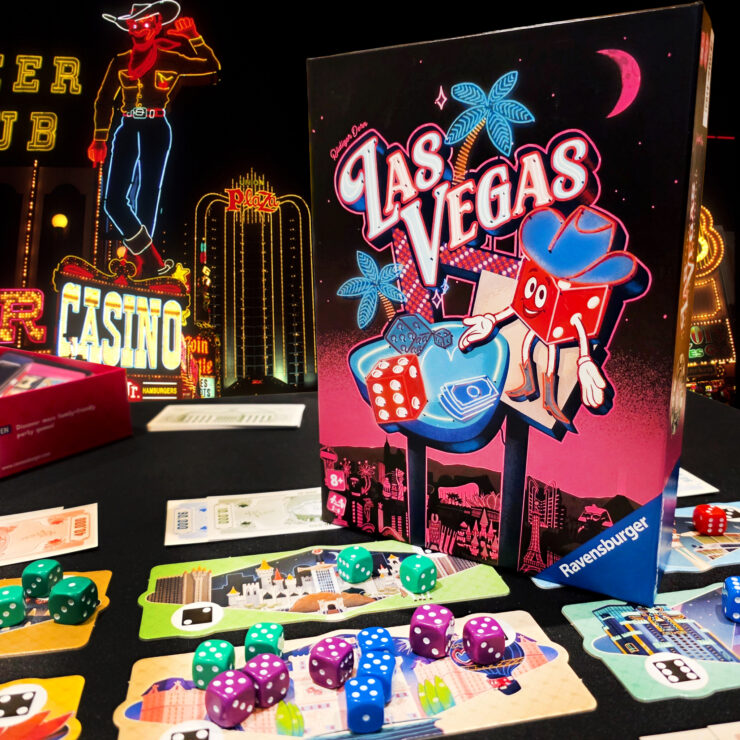
Today we are going to be talking about Las Vegas, a brand new dice-rolling game from Ravensburger that, whilst coming with an obviously slightly adult Las Vegas theme, is absolutely perfect for family groups. It was a massive hit, even with Henry(4), who is not quite as into core gaming yet as his older brothers. This was a game that captured his imagination, and not only did he play well and stay focused throughout, he actually grew quite confident as the game went on.
The way the game works is relatively simple. You set out six different casinos, each one with a numbered space for dice. You then randomly draw out two notes ranging from $10,000 to $100,000, going up in $10,000 increments, so that each casino has two different notes attached to it from the start. This sets the casinos apart, as usually one of three things will occur: either there are two middle-of-the-road or two high-value notes, in which case these become hotly contested casinos; there are two low-value notes, meaning no one is that interested; or there’s a high and a low, meaning people are interested, but only if they win.
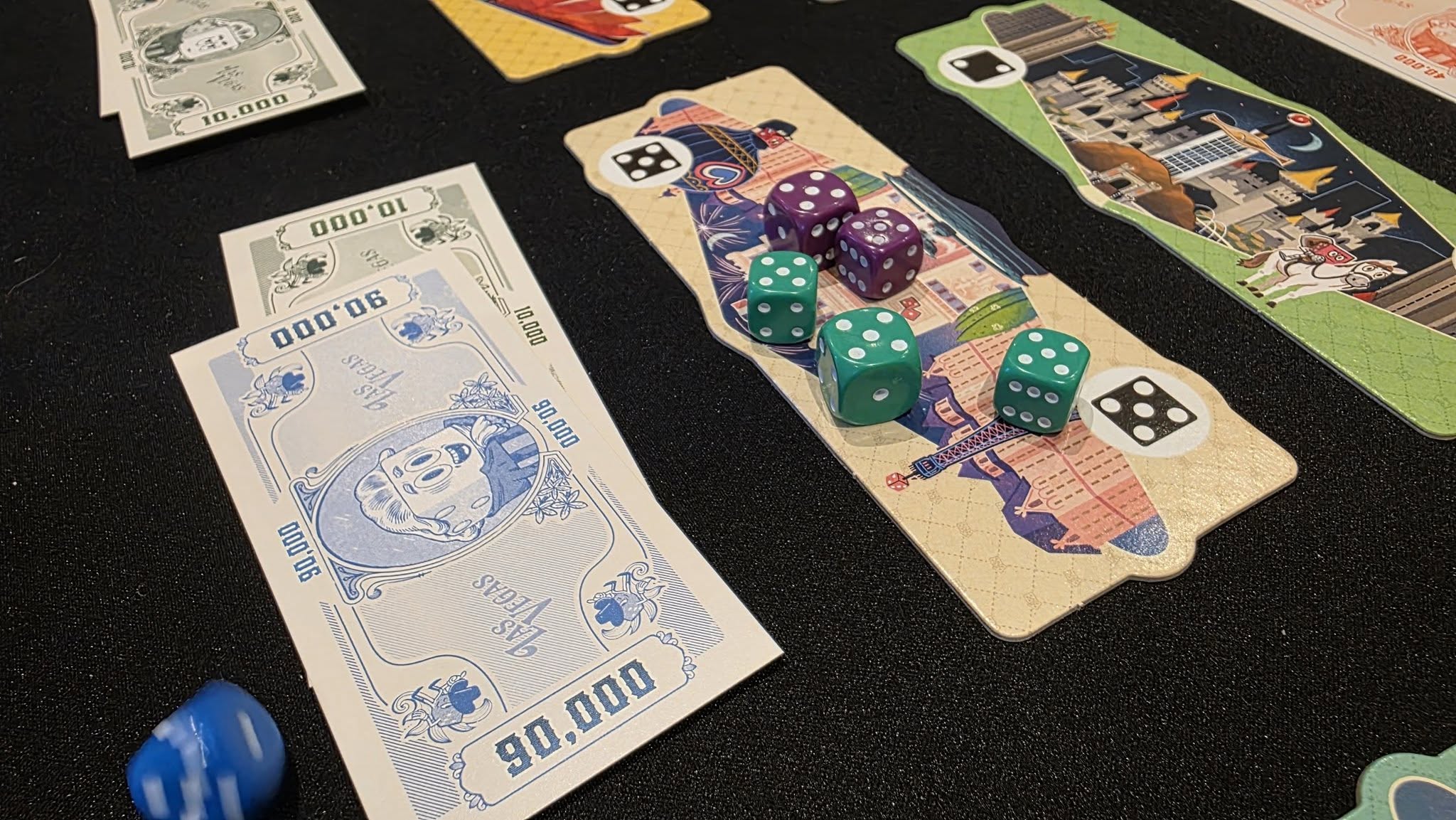
On your turn, you are going to roll seven of your dice, one of which is larger and counts as two. You then place all dice of one number onto the matching casino, adding one point per die (or two for the larger die). What you’re essentially trying to do is have the most dice on a casino in order to win it and take the note of your choice, with the person in second place taking the second-best note.
This is where the genius of the game comes in. Obviously, you want to go for those higher-value notes, but is it worth it if you have to spend four or five of your dice to get them? Is it worth chasing that $100,000 when actually an $80,000 on a less contested casino next door might be a much more reliable option? Quite interestingly, Henry quickly realised that it wasn’t worth getting into battles.
Instead, he spread his dice out across the lower-value casinos, and while some of us were fighting over an $80,000 or $90,000, he quite happily hoovered up $40,000s and $30,000s over and over again.
Here lies the key mechanic: while you’re trying to win a location, if there is a tie, no one gets anything. That means you can spend all of your dice battling over one casino, only for neither of you to get that coveted $100,000 note.
You keep playing until everyone has run out of dice. This can mean some players get back-to-back turns, and saving dice for later in the round, when you can clearly see where the best opportunities are, is actually a really strong strategy. Again, something Henry did really well, whether intentionally or not. He quickly realised that placing multiple dice in one turn wasn’t always the best move, and generally opted for singles where possible.
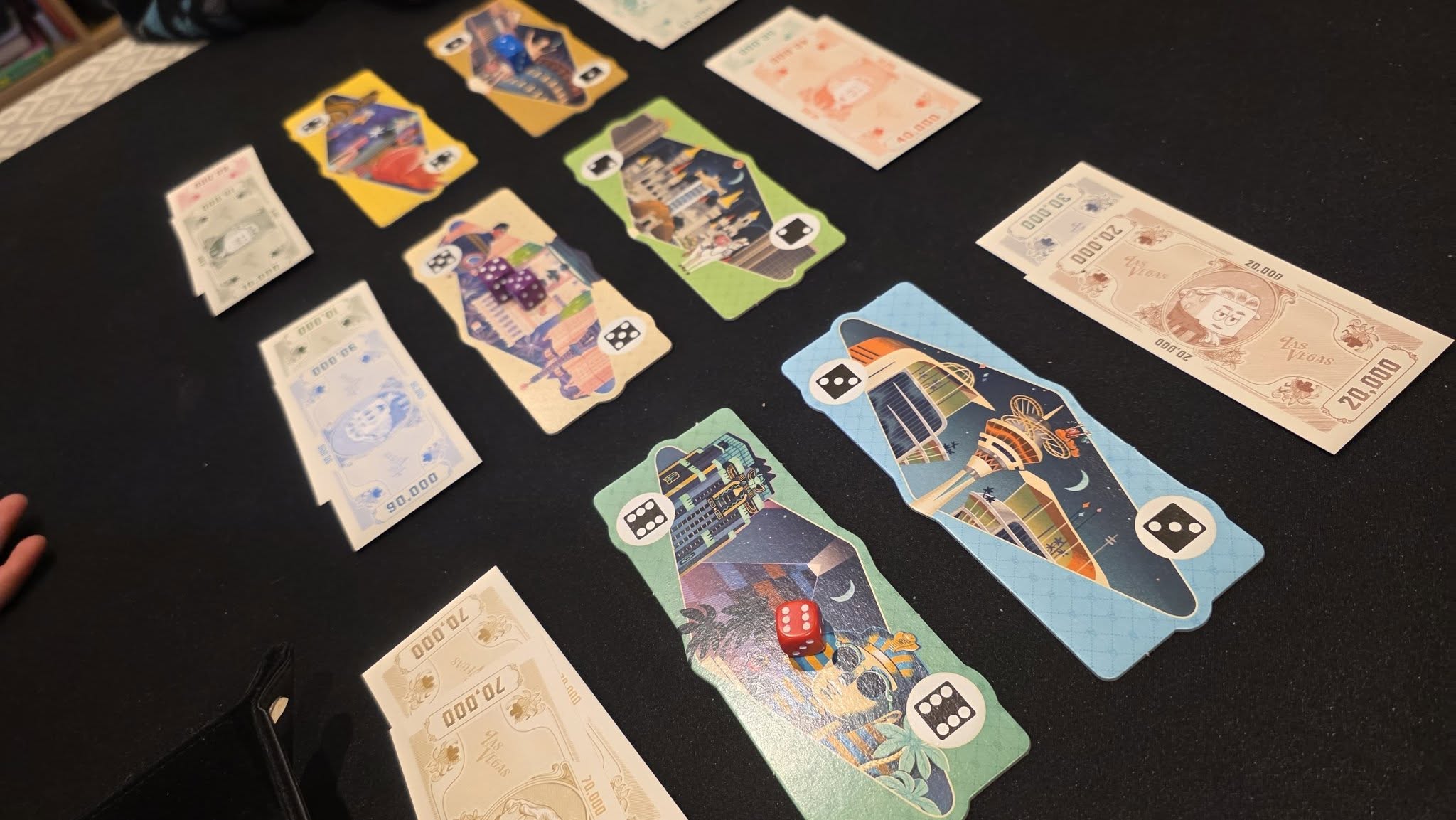
Once the round finishes, the notes are handed out. First place takes their pick, second place takes the remaining note, but if two players tie for first, no one gets anything. If two players tie for second, only first place gets paid. It means those contested casinos always carry a risk.
You play three rounds, at which point you total up the money to see who has won overall. Henry won both games we played today, absolutely crushing one of them with over $500,000, while I came second with around $280,000.
Everything is nicely produced. If I’m being picky, this is the kind of game that would have been lovely to see a more deluxe version of. That’s not really Ravensburger’s style, but slightly higher-quality dice and nicer notes would have elevated it further. That said, for what it is, everything works really well.
These kinds of dice placement and betting games are always great with mixed-age family groups. “Roll For It!”, which we’ve reviewed in the past, is a personal favourite of ours, and Las Vegas is definitely another one to consider adding to that pool. You could absolutely play this after dinner with a group of non-gamer adults, and all of your kids could join in as well.
Great stuff.

Disclaimer: A copy of Las Vegas was kindly gifted to us by Ravensburger. We have not been paid for this review, and all of our thoughts and opinions are our own.