 Matthew Bailey
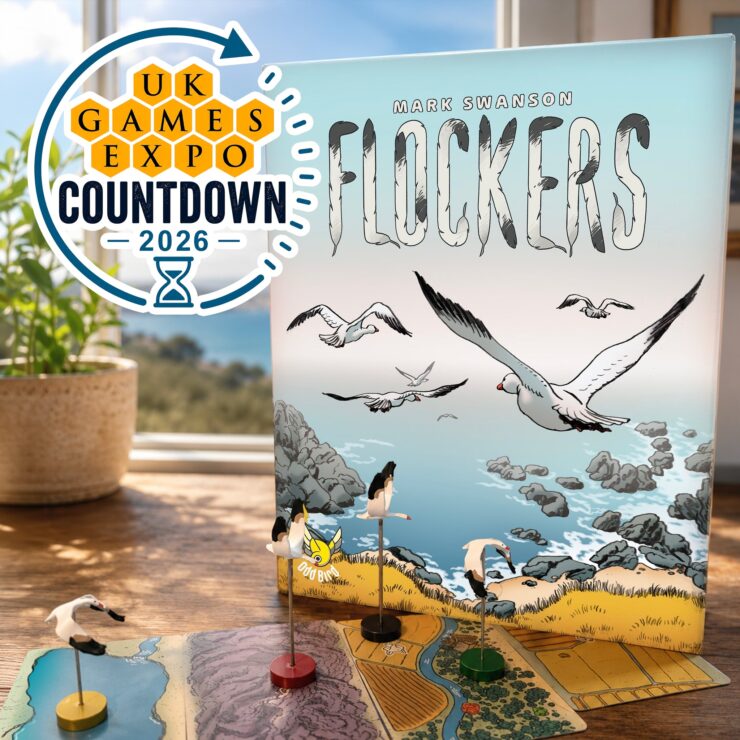
Today I’m going to be looking at Flockers, a really cool new hand management strategy game based around the idea of geese flocking together.
I’ve had this game on my table for about a month now, but wanted to wait until the crowdfunding campaign launched before talking about it, as there would have been no way for any of you to actually pick it up. Long story short, Flockers is a really interesting and different game that I’ve thoroughly enjoyed, and I genuinely can’t think of much else I’ve played that feels quite like it in terms of how it plays out… let me explain.
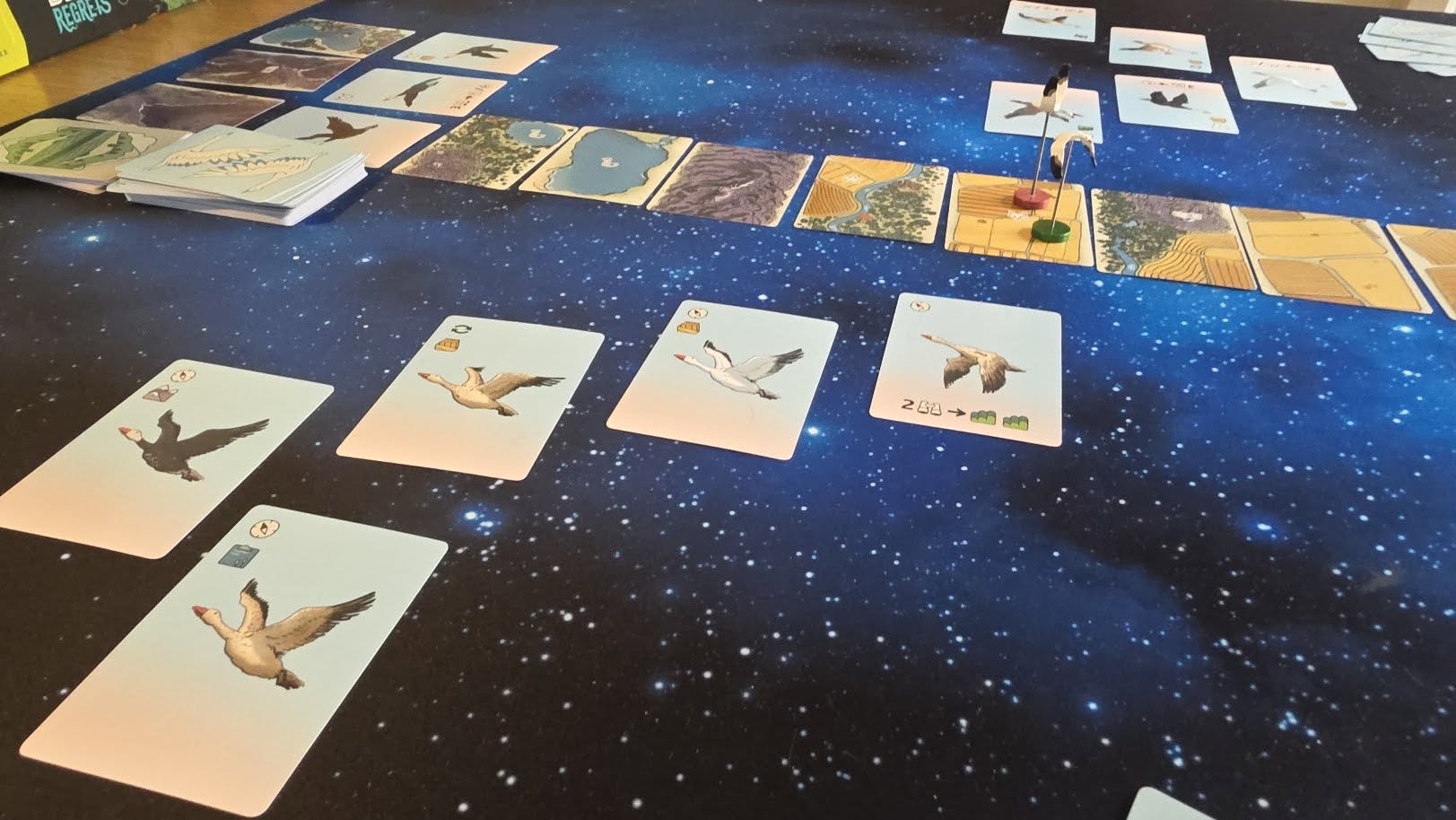
Essentially in Flockers you are building a formation of migrating geese and trying to guide your flock south further and quicker than everyone else. At the start of the game a flight path of terrain cards is created in the middle of the table and you begin with a hand of five bird cards. Over the course of the game you will add birds into your personal flock, which creates a V-shaped almost flowchart-like arrangement of cards that activate abilities and help you move efficiently across the different terrain types.
On your turn you simply play one bird card from your hand into your flock. The first bird you play becomes your lead bird and every other bird has to be added to create said V formation branching off from it. Your flock can never contain more than seven birds at a time, so managing the size of your formation is a really important part of the game. After playing a card and resolving any effects, you refill your hand back up to five cards from the shared display.
Most bird cards contain actions. The main one is Fly, which lets you move your flock token along the shared terrain path. To do this you follow the terrain symbols shown across your flock in order from the front to the end, matching them to the terrain spaces ahead of you. If your flock lines up well you can chain together quite a long movement in a single action. Other actions let you Navigate, which adds new terrain cards onto the route ahead, or Graze, which removes birds from your flock to make space for future turns. Some birds also let you swap positions within your formation or trigger the action of your lead bird again. A lot of these cards are triggered by having multiple birds of the same colour in your formation, which leads to a nice little bit of set collection that adds to the strategy.
It’s got this kind of engine-building element, but with a really key difference in that you’re trying to build this efficient engine to get your birds to cover ground quickly, but once you’ve covered that ground, you’ve already covered it so you don’t need that engine anymore. So rather than building this ongoing engine that gets better as the game goes on, it’s a really interesting concept where you find yourself building this ever-changing engine that constantly needs to become what you want it to be. Alternatively, you can try to manipulate the terrain ahead of you so that it already matches the sort of engine you’ve built with minimal changes. It’s a really interesting feel that I can’t think of many other games having, and I really liked that. Quite often when we play games I can pick out mechanics and say “right, well that mechanic is from this game and that mechanic is from this game”, but this really did feel like something unique. While I’m sure some of you can probably think of something quite similar, nothing immediately came to mind for me and I saw that as a big positive.
As the game goes on you will also run into encounters on the terrain itself. Foxes can remove birds from your flock, Bald Eagles target juvenile birds, and Decoys force you to reshuffle your formation. North Wind spaces can help push you further ahead along the migration route. Because your flock layout directly affects how you move, these encounters can completely change your plans mid-game.
All of this is really important because while you can lose birds as you go, this is also actually a necessity. The reason for this is that your flock can only ever contain seven geese and, as you have to place one each turn, the only way to remove geese is by playing certain cards or moving in certain ways. If you find yourself with seven geese in your flock and no way to remove one, you have no way to play another card and as such your game ends immediately. This is quite a brutal bit of strategy and, as you get into the second half of the game, it becomes just as much about managing what’s in your hand and on the table to make sure you don’t get yourself stuck in a situation where you physically cannot play any more cards and are therefore effectively out of the game.
What’s interesting though is that if you do get into that situation while ahead, you could theoretically still win. Even though the other players continue to play without you, if they cannot move further than you before ending their own game in the same way, you can still come out on top. This might be the only slight issue for smaller children, as it’s not too difficult to accidentally lock yourself out and this forms a major part of the strategy. Again, this was another thing that made the game feel really unique and unlike much else I’ve played before. I super enjoyed this aspect and it added a lot to the minute-to-minute gameplay, especially in the second half of the game.
The game ends once somebody reaches or passes the tenth terrain card or when nobody can continue adding birds to their flock. Everyone else gets one final turn and then the person who has travelled furthest south is the winner. Ties are broken by the size and makeup of the remaining flock.
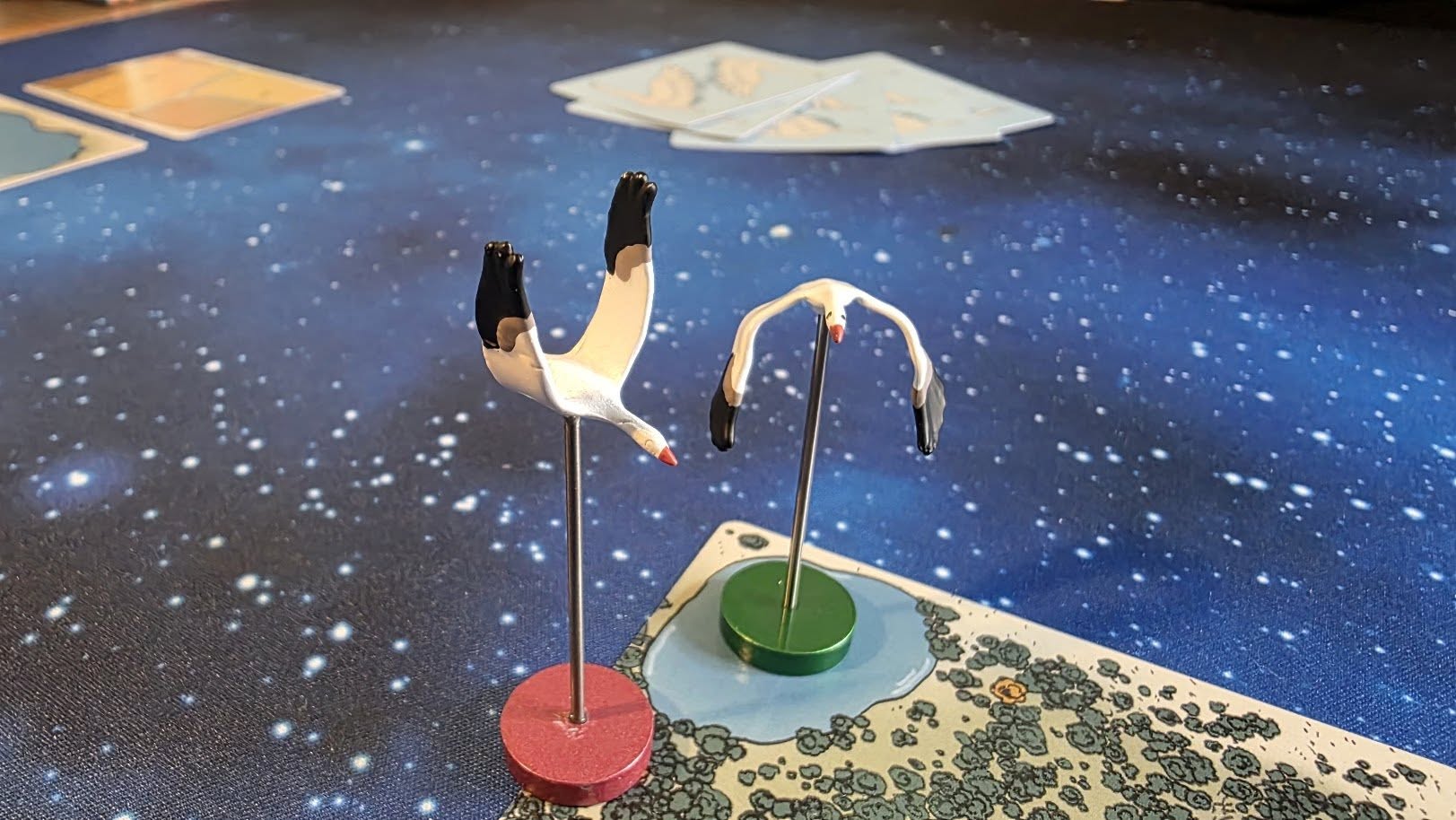
Components are really high quality and the cards are lovely. There is also a really nice playmat that I don’t have here but is available through the crowdfunding campaign, and the metal bird miniatures are beautiful and some of the loveliest player counters I’ve come across in quite a long time.
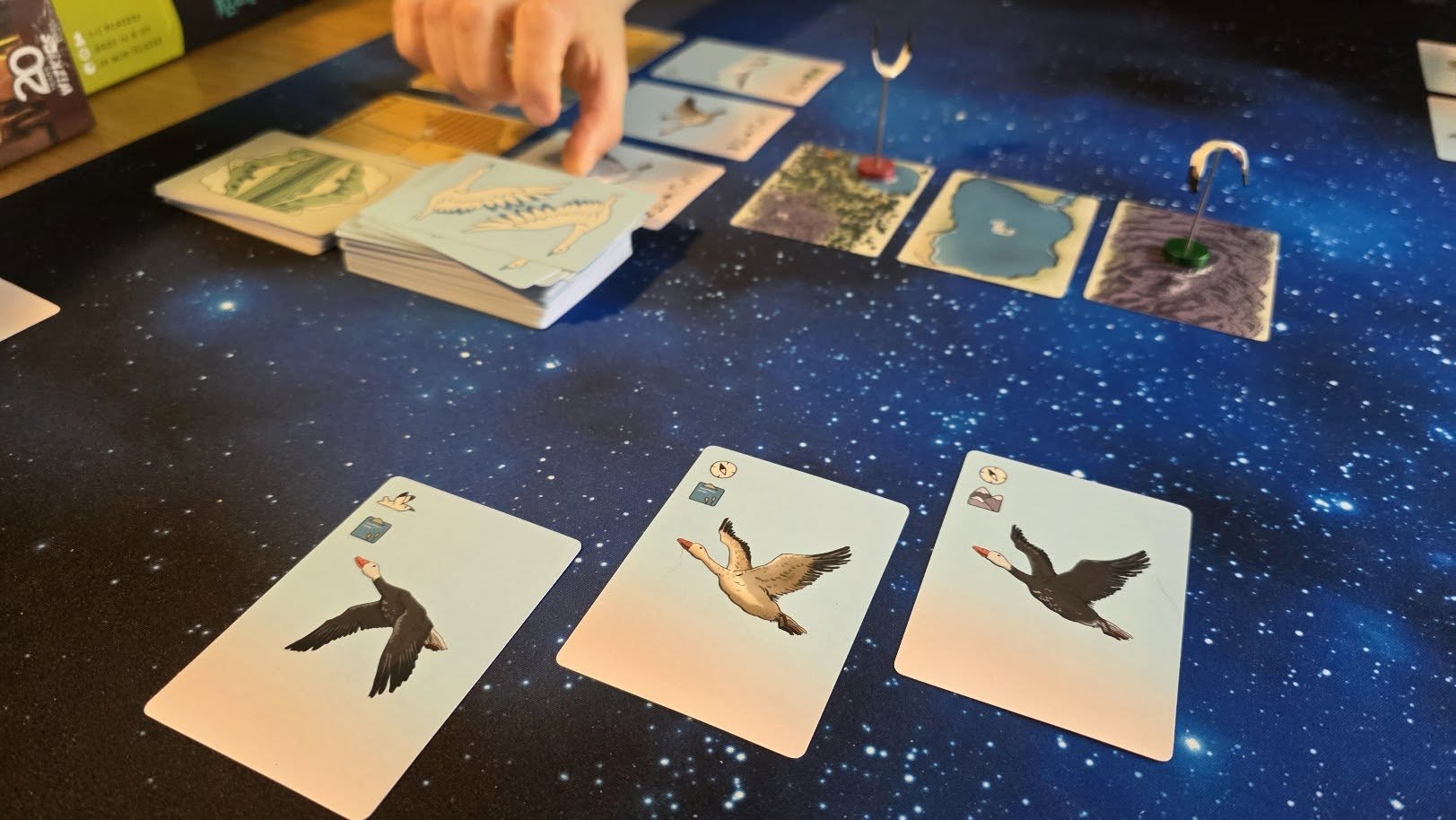
The tiniest of gripes, and you can tell it’s a really good game when this is my main one, is that while I really love the artwork, the colours of the geese could have been a little more distinct. Bearing in mind you are meant to be matching colours in order to trigger a lot of the abilities, the white, grey and beige tones can sometimes blend together a little, especially in darker or warmer lighting. Alternatively, small markers on the cards to make the colours clearer could have helped. But this really is a minor issue.
The whole thing feels really lovely to play and I super enjoyed it, as did one of my friends I played with and the boys. There is an awful lot to like here. The components are great, the game feels really unique and it has some genuinely unusual ideas wrapped up in a familiar shell. That means this definitely has a place on your shelf if you like these kinds of deck management and engine-building strategy games, because it’s kind of a little bit of all of those things without really being any of them at the same time. It’s a really unusual game, but in a really good way.
It’s currently out on Gamefound as a crowdfunding campaign and I will put a link in the description below. There are still around three weeks left on the campaign at the time of writing, so there’s plenty of time to back this if you are keen. If you’re really interested there are also some expansions available, although I must admit I haven’t had a chance to test those yet. I would however recommend potentially picking up the playmat, as I definitely wish I’d had that while playing.
A really massive positive recommendation from me on this one, and definitely one to keep an eye on.
Disclaimer: A copy of Flockers was kindly gifted to me by the publisher. I have not been paid for this review and our thoughts and opinions are our own.



 Nicola Asker