
 Matthew Bailey
With half term rapidly approaching, I am hoping to get as many of the small-box games out of the way early, in case people are going away for half term and are looking for something to take with them.
With that said, today we are going to be looking at The Necrohamster, a quick, engine-building, point-salady card game (I know that’s not an amazing description, but go with it) where you are competing to summon an army of undead creatures, including skeletons, spirits and zombies, using their different abilities to build up the most valuable collection before the game ends. You do this by drawing creature cards, discarding cards to pay their summoning costs and using the abilities of your summoned creatures to gain an advantage over your opponents.
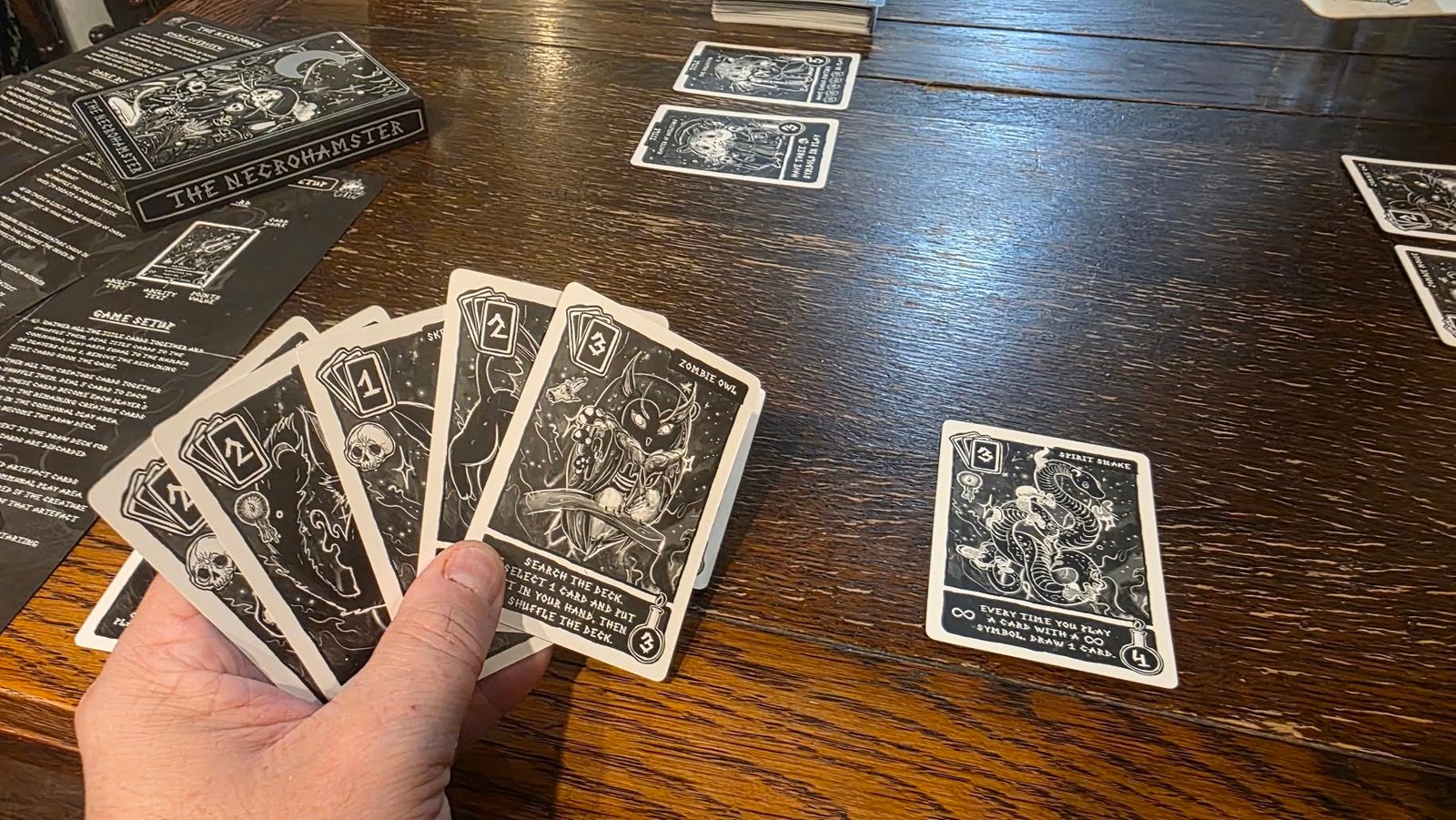
To set up, you shuffle the creature deck and deal five cards to each player, placing the remaining cards face down as a draw pile. You also shuffle the Title cards and place one more than the number of players face up in the centre of the table, alongside any Artefact cards required for the creatures being used. Each Title has a particular condition you need to meet to claim it, providing an additional way to earn points.
Each round consists of three phases: drawing, summoning and activating abilities. During the draw phase, everyone draws three cards, apart from the first round, when this phase is skipped. During the summoning phase, you simultaneously choose a creature from your hand to summon, although you can also choose to pass. Each creature has a summoning cost, which you pay by discarding the required number of other cards from your hand. Once paid for, the creature is placed face up in front of you, where it remains in play and contributes towards your final score.
I really like the fact that the cards are also used as the cost. It means you have to make decisions without things becoming overly complicated, and it usually ensures you don’t end up with a hand where you are unable to play anything.
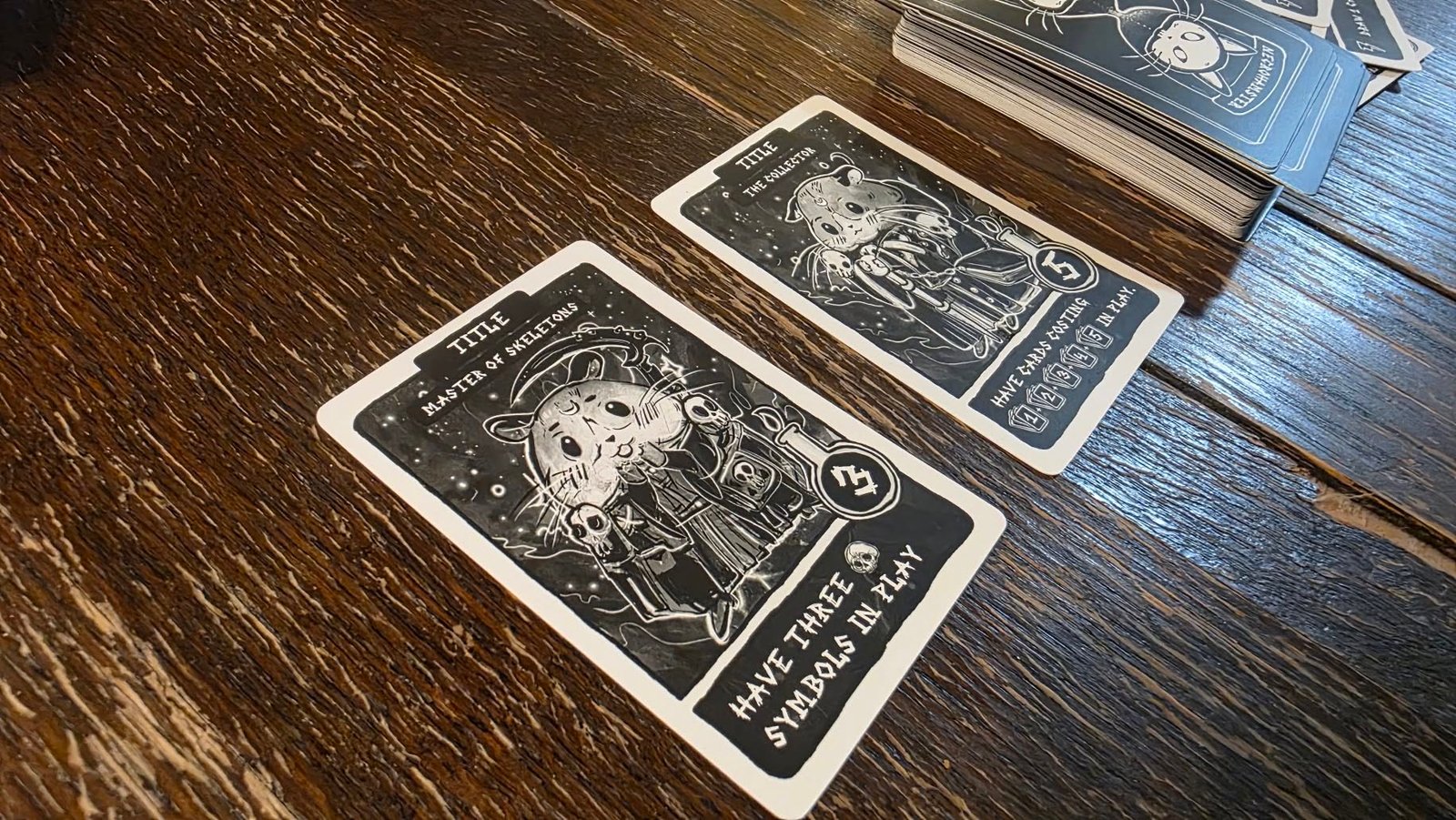
The ability phase is where the mini engine you are building comes into play, as you activate the effects of your summoned creatures, starting with the first player and continuing clockwise. Different creatures have different abilities, some providing immediate effects and others remaining active throughout the game. These can allow you to draw additional cards or provide other advantages, while certain creatures can also gain control of Artefacts that offer their own abilities and points. You can also claim one of the available Title cards as soon as you meet its requirements, giving you another reason to think about which creatures you are summoning rather than simply choosing the ones worth the most points.
What’s good here is that while you can really think about what the best play is, you can also happily play it a bit more casually and still have a good time, making it suitable for younger and much older card gamers alike.
Play continues until someone summons their eighth creature, at which point you finish the current round and total everyone’s points from their creatures, Titles and any Artefacts they control.
It all works well, and the artwork on the cards is great (we have had a lot of black-and-white aesthetics so far this spooky season). Overall, as you can see, this is a really positive review, but both Toby and I (he was my chief co-reviewer here) wanted a little extra.
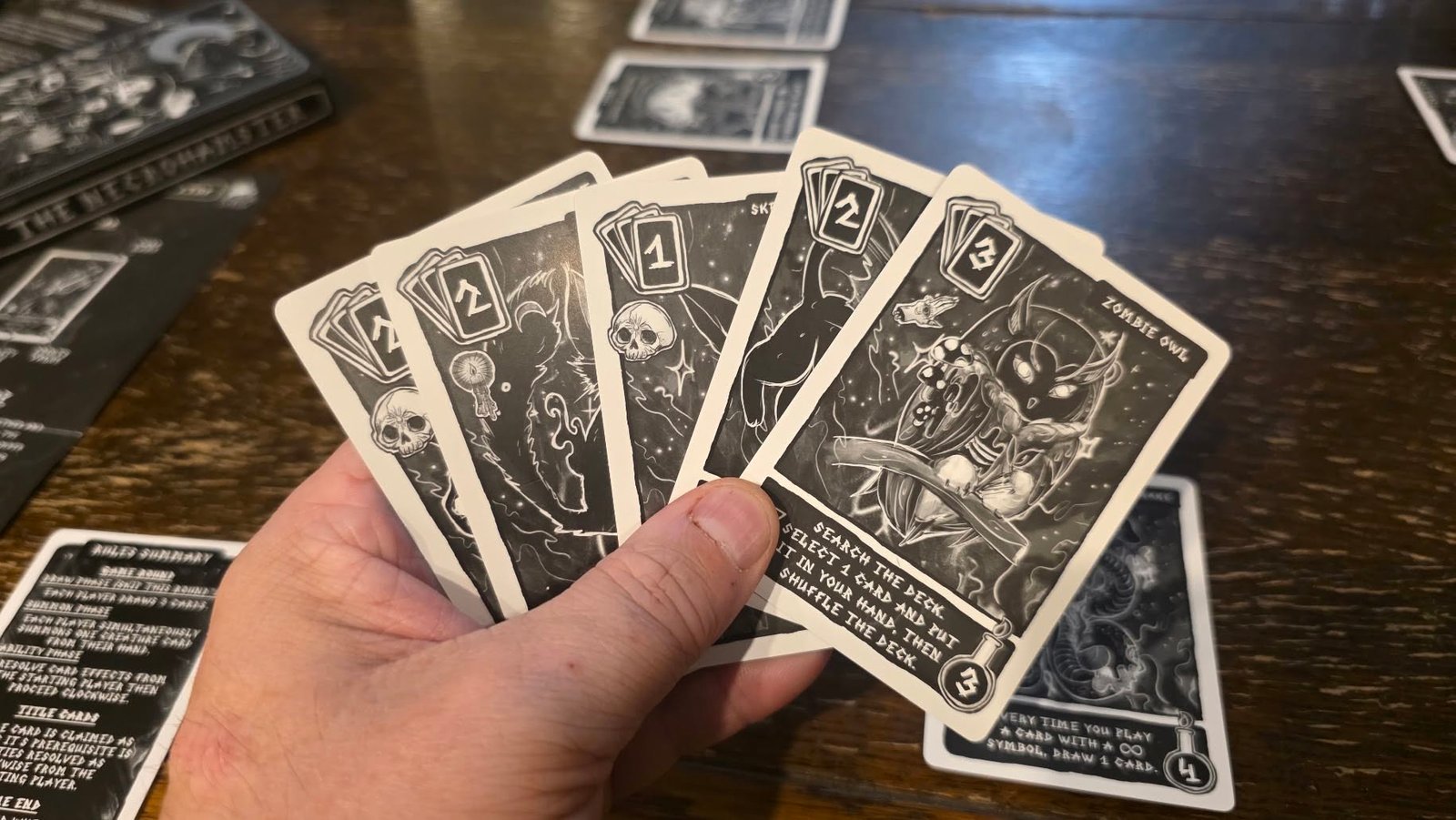
I think one of the biggest issues is the length (bear with me here). The problem is that it’s not quite short enough or table-space-friendly enough to be the sort of game you would play at a restaurant while waiting for your food, and it takes up a bit too much space to play on a plane or in a car. Yet, for a proper family game night, it might leave you wanting more…
If you like the artwork and enjoy simpler games, there might be something here for you, but I suspect many people will find it fun but forgettable fairly quickly.


