 Matthew Bailey
A few months ago I reviewed Deep Regrets by Tetix Games, and it has become one of mine and Jack’s favourite middleweight games to play. The artwork is beautiful, the gameplay is great, and generally it’s a really good middleweight game to play with older kids.
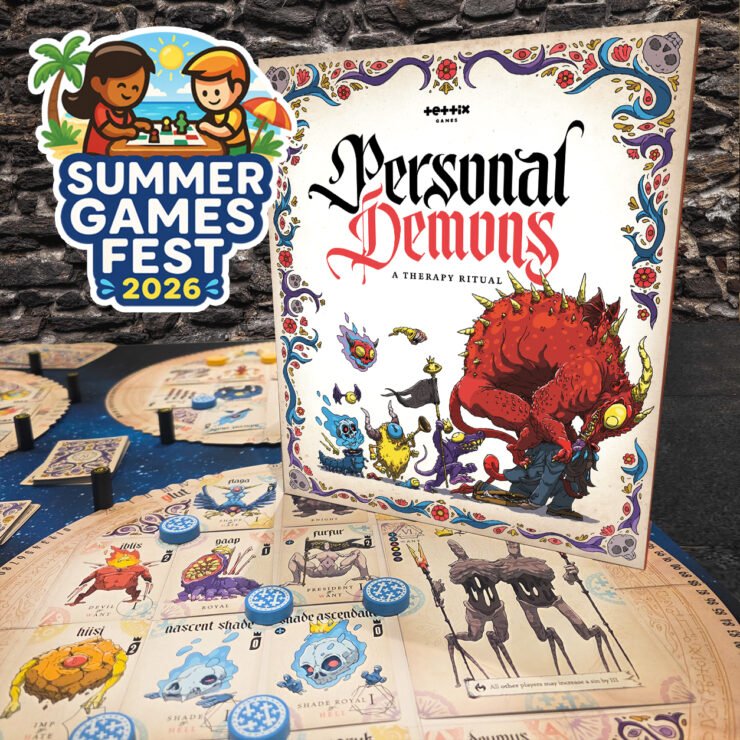
Today I am going to be looking at Personal Demons, their brand new game due to launch on Kickstarter in September (don’t worry, I’ll do a reminder if you’re interested), all about joining a therapeutic ritual to overcome your inner demons.
Personal Demons is played over three rounds, with each round made up of a Summoning Phase, a Scoring Phase and an End Phase. One thing that works really well is that there is a separate deck for each round, so the Demons that you summon get progressively stronger but also progressively trickier to summon as the game progresses. This works well and means that you don’t get stuck with a hand of Demons that you physically can’t summon because they have too many requirements right at the beginning of the game.
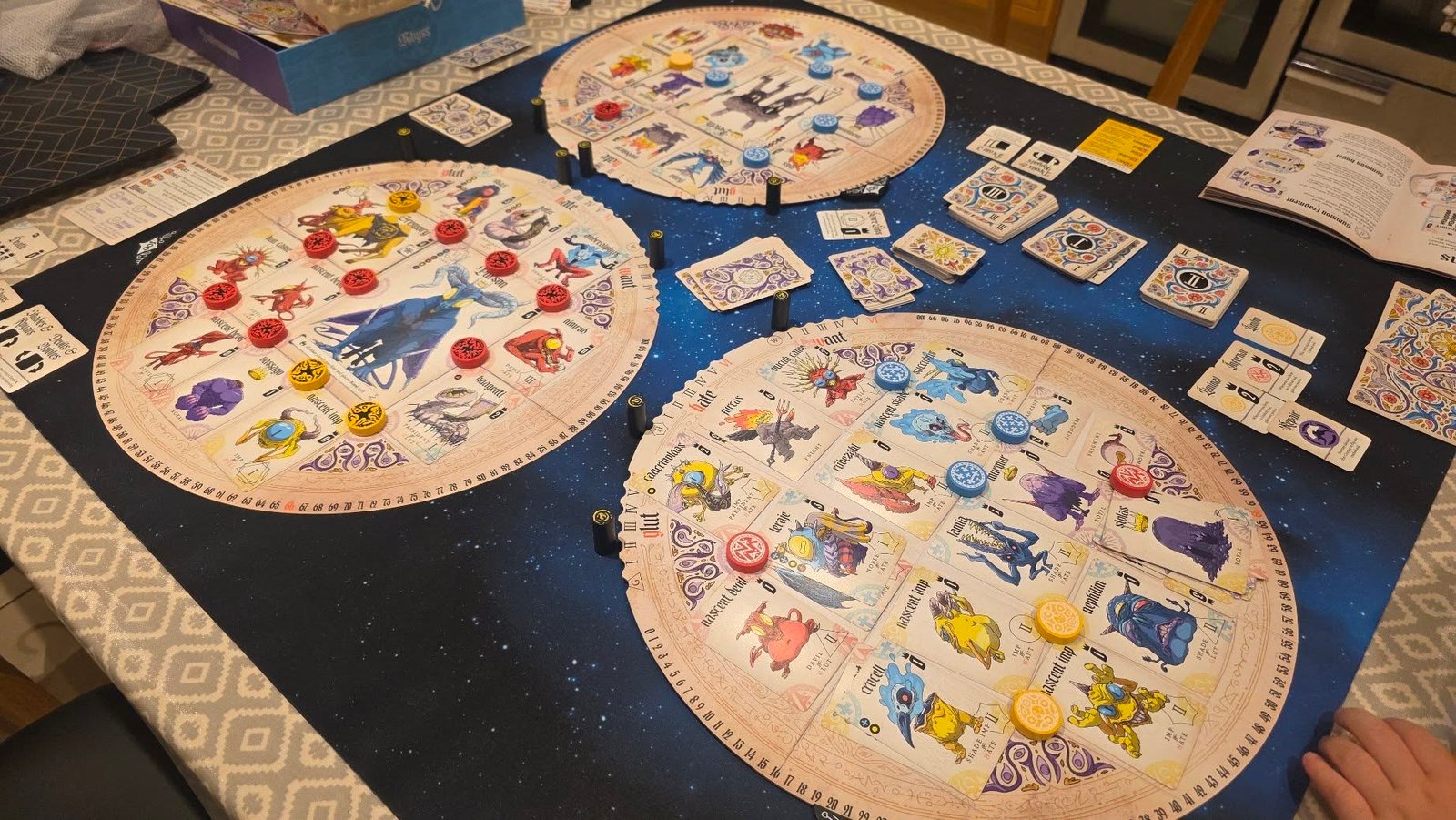
At the start of the game, place all of the wooden seals into the bag, shuffle the three round decks separately and prepare the Royal, Fragment, Fear(a one-time score item) and Courage (extra scoring bonuses) decks. Each player takes a score marker, places it on zero, receives a summoning board and a Fear card, and four Personal Demons, from which you choose two to keep before returning the others to the box. Finally, deal each player six Demon cards, and you are good to go.
During the Summoning Phase, everyone secretly chooses one card from their hand and places it into their summoning circle. Once everyone is ready, reveal the cards together and double check the card’s seal requirements are met by the coloured seals currently on your board. This is normally only a thing in the later rounds, as the earlier round Demons don’t have requirements.
After revealing, each player checks whether they have created any valid seals by arranging Demons so that the coloured corners on their cards form a complete circle of one colour (purple is wild).
Whenever you complete a seal, place the matching wooden seal onto it. Seals are never spent, they simply stay on your board and count towards summoning future Demons and scoring at the end of each round. As well as summoning a Demon, you can play a Demon face down and use that to gain a cracked seal. This Demon obviously then doesn’t have any colours, so you don’t want to have too many of these on your board, but you can use this cracked seal to summon something else that has a requirement, something which becomes quite useful later in the game if you don’t quite have everything you need to be able to summon potentially your larger Personal Demons.
When you play a Demon, most Demons give you points on your three various sins, and these sin points are used to buy things during the next phase.
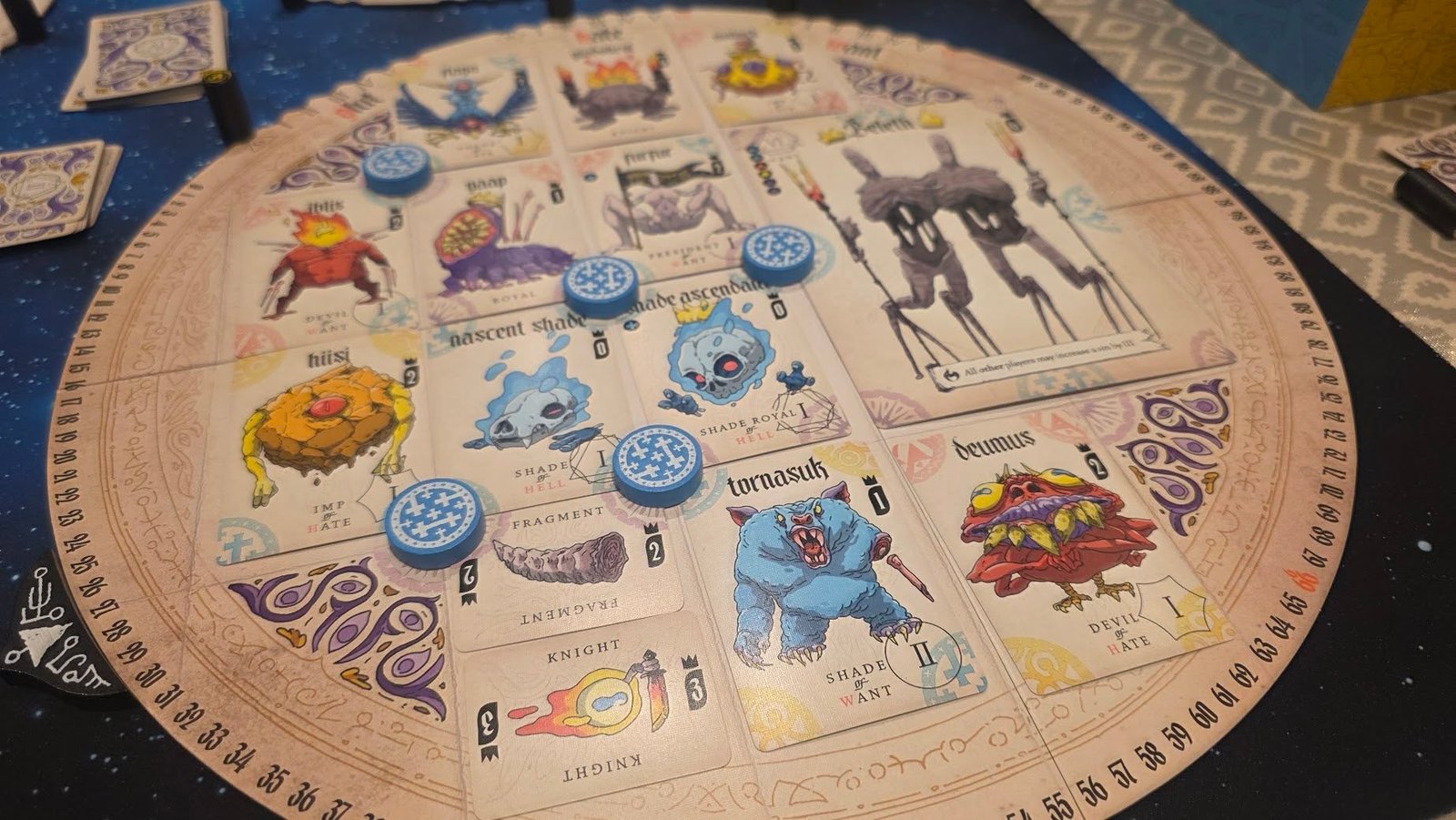
After this you may also take one optional bonus action, such as facing your Fear card to score it immediately (based on the amount of seals you have of a colour) and remove it from play, summoning a Fragment (which costs two of a sin) and acts as half a card, drawing from the Royal deck (which costs four of a sin), which gives you either a Demon with lots of purple seals or a straight six points, or, later in the game, summoning one of your powerful Personal Demons or Colossal Demons if you meet their requirements. These cost six of a sin and are either twice or four times the size of a regular card and essentially lay over Demons you already have in order to replace their seals. The seals on these Demons are quite often purple and usually they’re worth quite a high value, meaning getting these Demons out is really key to scoring well in the later stages of the game. Plus, they look awesomely cool on the table when you put one out.
Building your board efficiently is important and probably the main key strategy element of the game, as valid placements become harder to find as the game progresses, and while you can of course layer one card over another, you don’t want to be doing this too many times, as you’re essentially just treading water.
Once you have all completed that turn, you pass your hand of cards to the player next to you and the turn begins again with whatever you have in front of you. I really like games with a drafting element, as I think they add a lot to what you can do. It stops a certain element of analysis paralysis, as you can only really play with what is in front of you and can’t think too many turns ahead, as you don’t know what cards will be back in your hand when that deck rolls back around.
Once every player has played all six turns, move to scoring. First score all active seals, then score any Knights on your board, before finally scoring Courage cards, which act as an extra scoring rule that everyone has different. You can pick up more Courage cards at the end of the round or any time someone plays a Personal Demon.
You then start the next round with the new deck of Demon cards.
After the third round, score one final time. The player with the highest score wins the ritual, unless someone finishes on exactly 66 points, in which case they immediately win by achieving the game’s hidden “Perfect Parity” ending. This is a really cool potential win condition and works really well if someone is quite a bit behind going into the latter stages of the game. It’s extremely hard to do and, in the games I’ve played, no one managed to do it, even though one person tried once. But if you did manage to, I could imagine that being an amazingly fun moment, kind of like shooting the moon when playing Hearts. There was that small element of panic when Toby and I realised that’s what Jack was trying to do, but luckily he just couldn’t quite get the maths to work and ended up with 68.
I absolutely adore Personal Demons. I love Deep Regrets, and Personal Demons is quite different in terms of what it is as a game. It’s also a lot lighter, and you could definitely play this with much younger children than I would recommend Deep Regrets for. This game definitely could work as a first step into slightly more middleweight games and could definitely be played, with a little bit of explanation, with non-gamer family members.
Obviously, for a particularly sensitive child, some of the Demons you might think are a bit scary. None of my kids had a problem with anything like that, so I had no issue at all playing this, but I would say have a look at some of the artwork and see what you think. There’s nothing overly gory or inappropriate outside of the monster artwork.
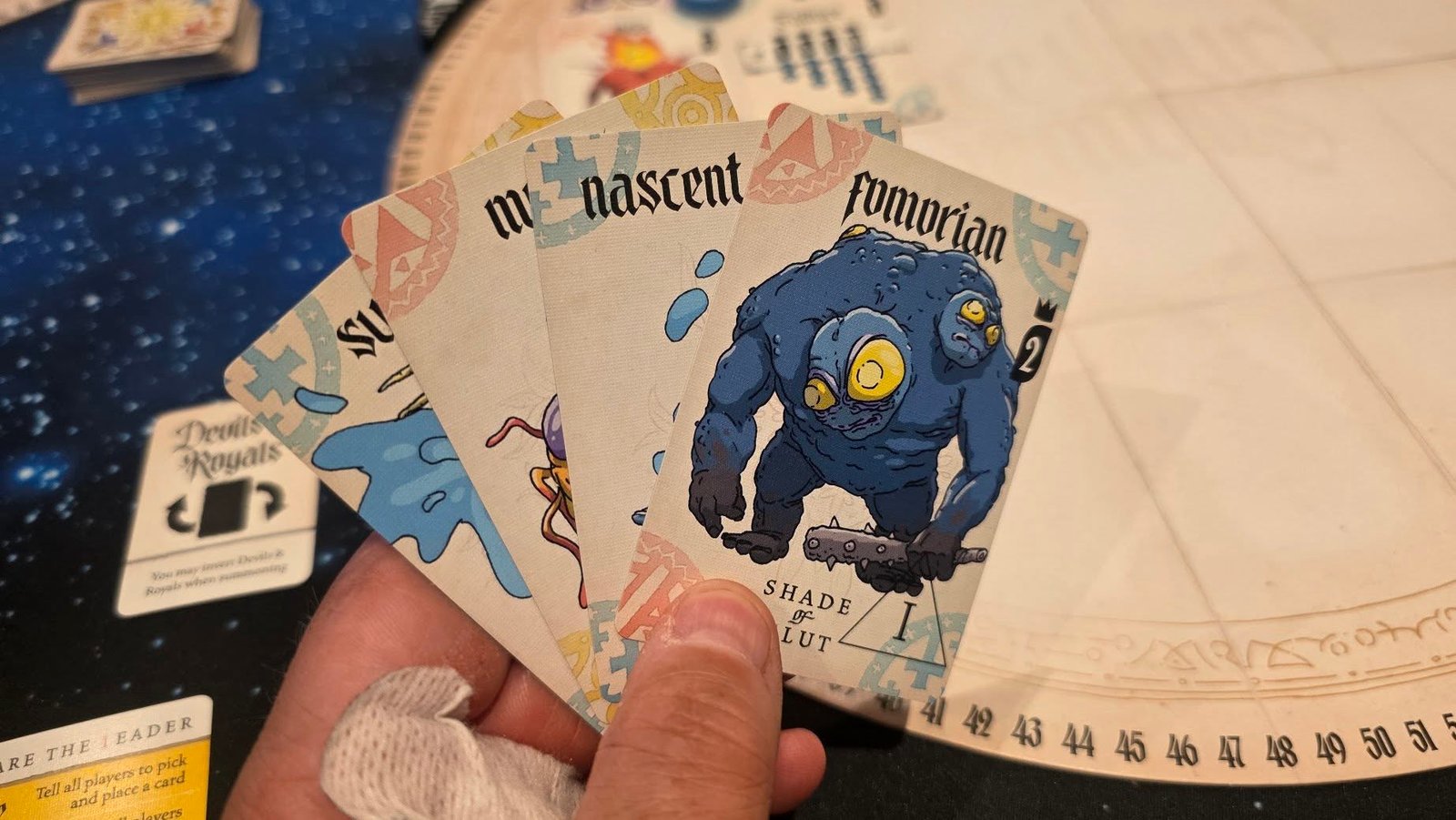
Talking about the artwork, it is beautiful. I love the artwork for Deep Regrets, I love the artwork for this, it’s so well drawn, and the fact that your board is circular. I really love the way that the score trackers work by going on the outside of the board, which is really cool and unique, and the whole thing has amazing table presence. I will say there is one negative: it does take up a lot of space. We’ve got a big table that we use to play games on, and three or four of us playing this did take up a decent chunk of that table. You definitely couldn’t play this on a small coffee table, for instance.
Personal Demons is such a fantastic game and the boys absolutely loved it.
This is going to get an extremely strong recommendation from me. I will try and remember to do a shout-out when the Kickstarter goes live in September if anyone is looking to get hold of it, and hopefully it should enter retail next year.