 Matthew Bailey
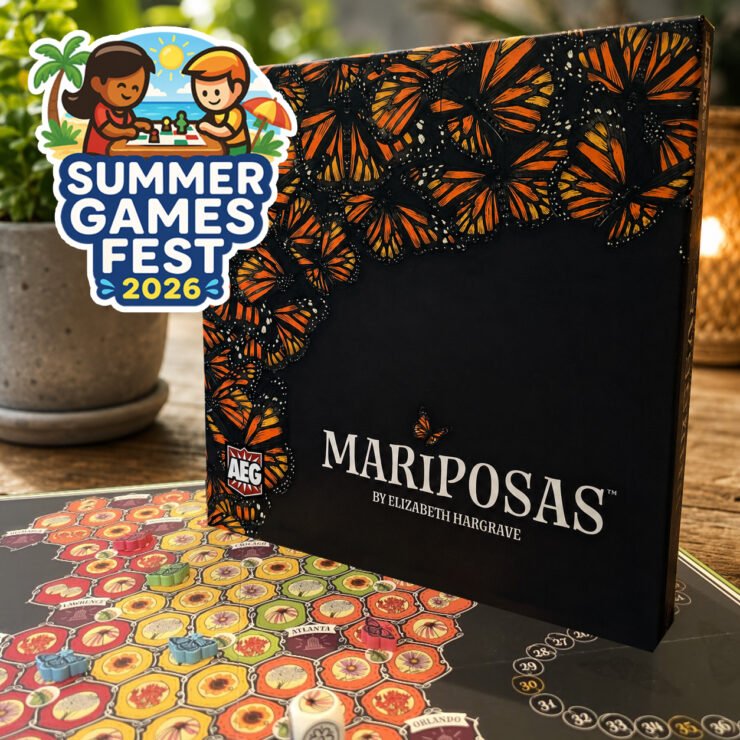
As usual, when I do some older games, I’m always really keen to include all the games that I really want to say something about that, for whatever reason, I haven’t in the past. Today we’re going to be looking at quite possibly what I think is one of the most underrated games of all time, and that is Mariposas by Elizabeth Hargrave, who is more well known for producing the Wingspan series.
Mariposas was actually one of the reasons why I started reviewing games at Little Board Gamers in the first place. Even though Mariposas was released to a reasonable amount of fanfare coming off the back of the popularity of Wingspan, it went out of the public eye very quickly, and I really don’t think it ever got enough praise for what it sets out to do, how different it feels compared to a lot of games out there, and just how beautiful it is.
I originally reviewed this all the way back in August 2021, so almost five years ago. Here we are, and it’s about time to finally do a proper review of Mariposas, in my opinion one of the most underrated board games of all time.
In Mariposas, you take control of a family of monarch butterflies as they make their incredible migration across North America. One of the things that I love so much about this game is just how thematic it is and how accurately it tells the story of the truly remarkable multi-generational migration of monarch butterflies. Every spring, monarch butterflies leave their overwintering sites in Mexico and spread across the United States and into southern Canada. In autumn, the migration heads back towards Mexico. Amazingly, no single butterfly makes the entire round trip. As they travel north, they reproduce, their offspring continue the journey, and it typically takes four or five generations before the final generation makes the return journey back to Mexico. It’s genuinely unbelievable, and the way the game recreates this is so thematically brilliant that you could genuinely use it as a teaching tool as well as simply a game to play.
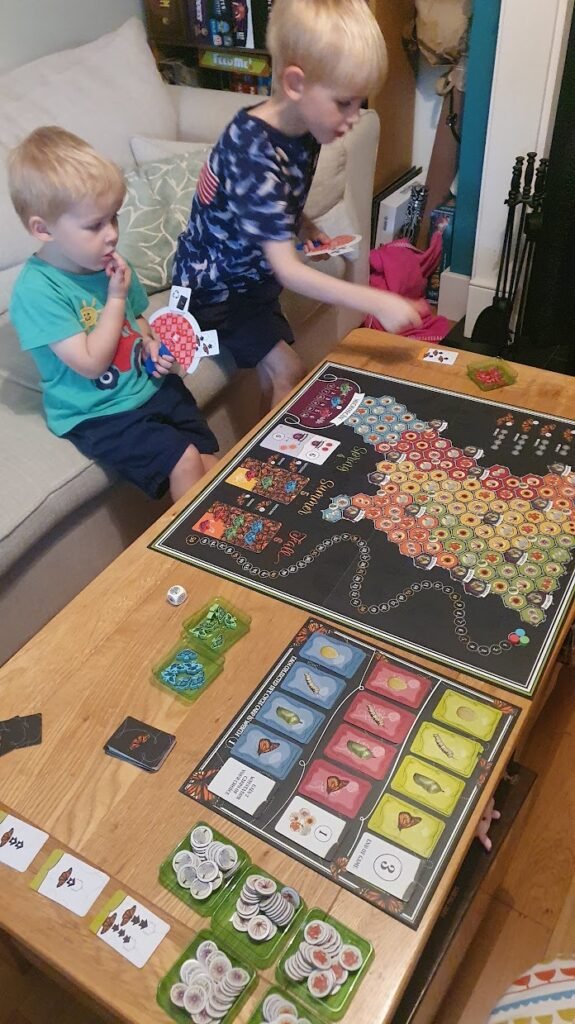
The game takes place over three seasons—spring, summer and fall—with your aim being to spread your butterflies across the map before eventually bringing the later generations back to Mexico to score the biggest rewards. This is a really cool mechanic because, generally, you’re trying to get as far away as possible to score the most points, but the further away you travel from your starting point, the less time you have to get back. It creates a really interesting risk-versus-reward decision of just how far you’re willing to push before making the return migration.
Setup is fairly straightforward. The large map is placed in the middle of the table, seasonal scoring objectives are randomly selected, each player receives a hand of action cards and a collection of butterfly markers, while flower tokens, waystations and the various decks are arranged around the board.
On your turn, you play one action card, carry out the movement shown on it and then draw back up to two cards. Different cards provide different movement options, such as letting you move one or more butterflies varying distances around the map. If you have multiple butterflies in play, you can often split those movements between them however you like, which leans into the tactical decisions of whether you send one butterfly further or spread them out more.
As your butterflies land on different spaces, they’ll collect flower tokens or discover waystations. Flowers are used as a resource throughout the game, while waystations provide useful bonuses, life cycle cards and occasional one-off movement cards that can be saved for the perfect moment. Completing sets of life cycle cards can also unlock permanent abilities that help for the rest of the game.
Whenever one of your butterflies lands beside milkweed, you have the opportunity to hatch the next generation by spending the appropriate flower tokens. Your butterfly family gradually grows through four generations, with each new generation becoming increasingly valuable. Eventually your fourth-generation butterflies can even become double butterflies, making them especially powerful for scoring later in the game. This is also a really key mechanic, as your older butterflies eventually die off, so if you don’t manage to breed and get newer butterflies onto the board, you’ll eventually lose all of your pieces and won’t be able to complete the migration.
The game is split into three seasons, each with its own scoring objective that is revealed as the game progresses. Spring lasts four rounds, summer five and fall six, with players scoring seasonal goals at the end of each phase before preparing for the next stage of the migration and losing those older butterflies.
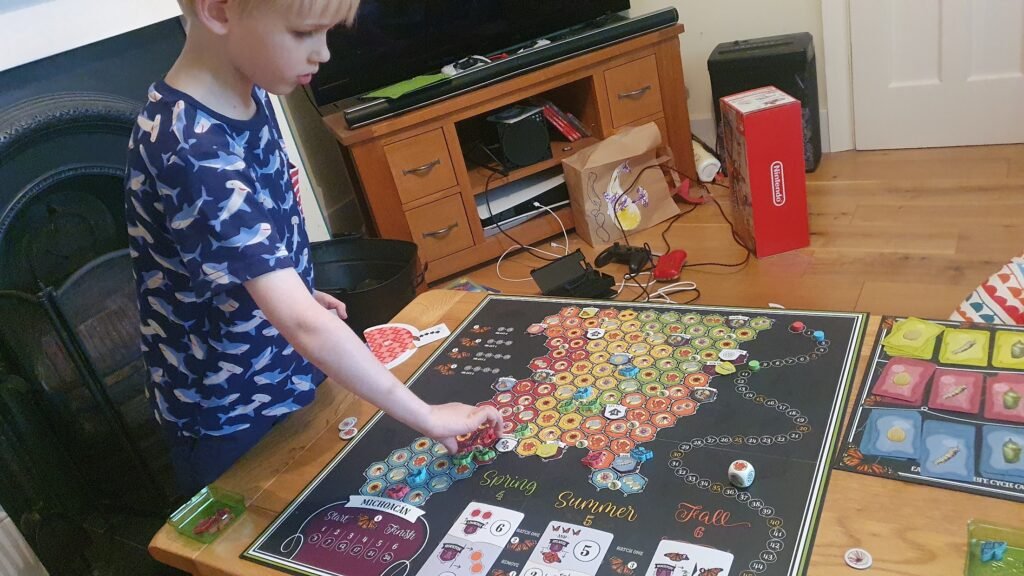
Once the final season comes to an end, players score the last seasonal objective, points for the fourth-generation butterflies that successfully made it back to Michoacán (which is where that risk-versus-reward mechanic really comes into play), along with any life cycle cards they’ve collected during the game. The player with the most points is crowned the winner.
And I’ve already said it, but I’m going to say it again: the way this works thematically is absolutely outstanding, and the game is genuinely quite simple to play. In the original review we wrote back in 2021, Jack was six and Toby was just three when we played this. Jack was absolutely fine with it at the time and Toby still got the general idea, even though he was obviously a little on the young side. It’s definitely a game that you can play with kids much younger than it says on the box.
I love the artwork. The dark black colours contrasting against the vibrant colours of the monarch butterflies work really well. The way everything is illustrated and the iconography, are also excellent. Another reason why it works well with younger children is that there’s very little reading to do. Everything is done with symbols and iconography, so you don’t need to be a particularly strong reader to play and join in. Even though there’s a lot of strategy involved, it still has that classic family-game feel of moving pieces around a board collecting things. Because of that, introducing someone who isn’t a massive board gamer isn’t particularly difficult, and as such it works really well as a step up from the simpler games that children are likely to have played.
Component quality is really nice. Everything is well made, the wooden butterfly pieces are lovely, and it all looks fantastic on the table.
When I originally reviewed this, I gave it a Yes, but to be honest, in 2026 this is still a game that’s in my collection many years after I bought it. It still finds its way onto the table from time to time, and I genuinely believe this is one of the most underrated games ever made. Elizabeth Hargrave is a top-tier game designer, and it’s really surprising that, after the massive hit that was Wingspan, none of her follow-up games have quite reached the same level of mainstream attention. Mariposas absolutely deserves to.