 Matthew Bailey
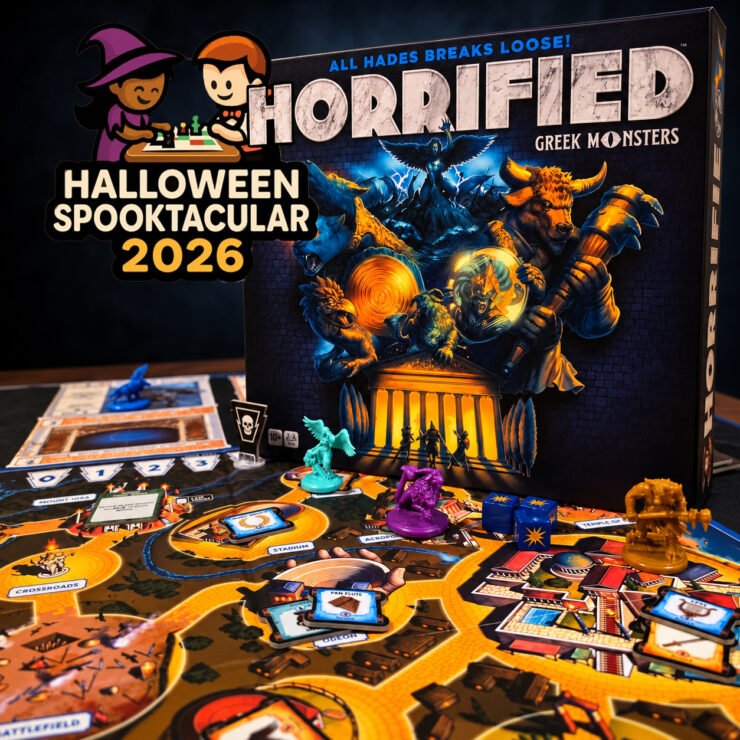
After a break of a few days due to a few sick children this week and a new boiler installation, today we are going to be following on from our review of Horrified (which we really enjoyed) by looking at Horrified: Greek Monsters. We’re going to skip American Monsters, as I do not own it and, oddly, it is more expensive in most shops than the other games.
Horrified: Greek Monsters follows almost exactly the same rules as the original Horrified, so rather than go through everything again, I would recommend reading our review of the original game if you haven’t already, as that covers the basic gameplay in considerably more detail.
Before I start, I am going to say that this is the theme my boys liked the most, and the Greek monsters theme definitely appeals to them more than Universal Monsters (it seems modern kids do not come across Dracula, Frankenstein’s Monster and the Invisible Man that often).
Once again, you are working together to defeat a selection of monsters before the Terror Level gets too high or you run out of Monster cards (which, usually, at least for us, seems to be the bigger issue).
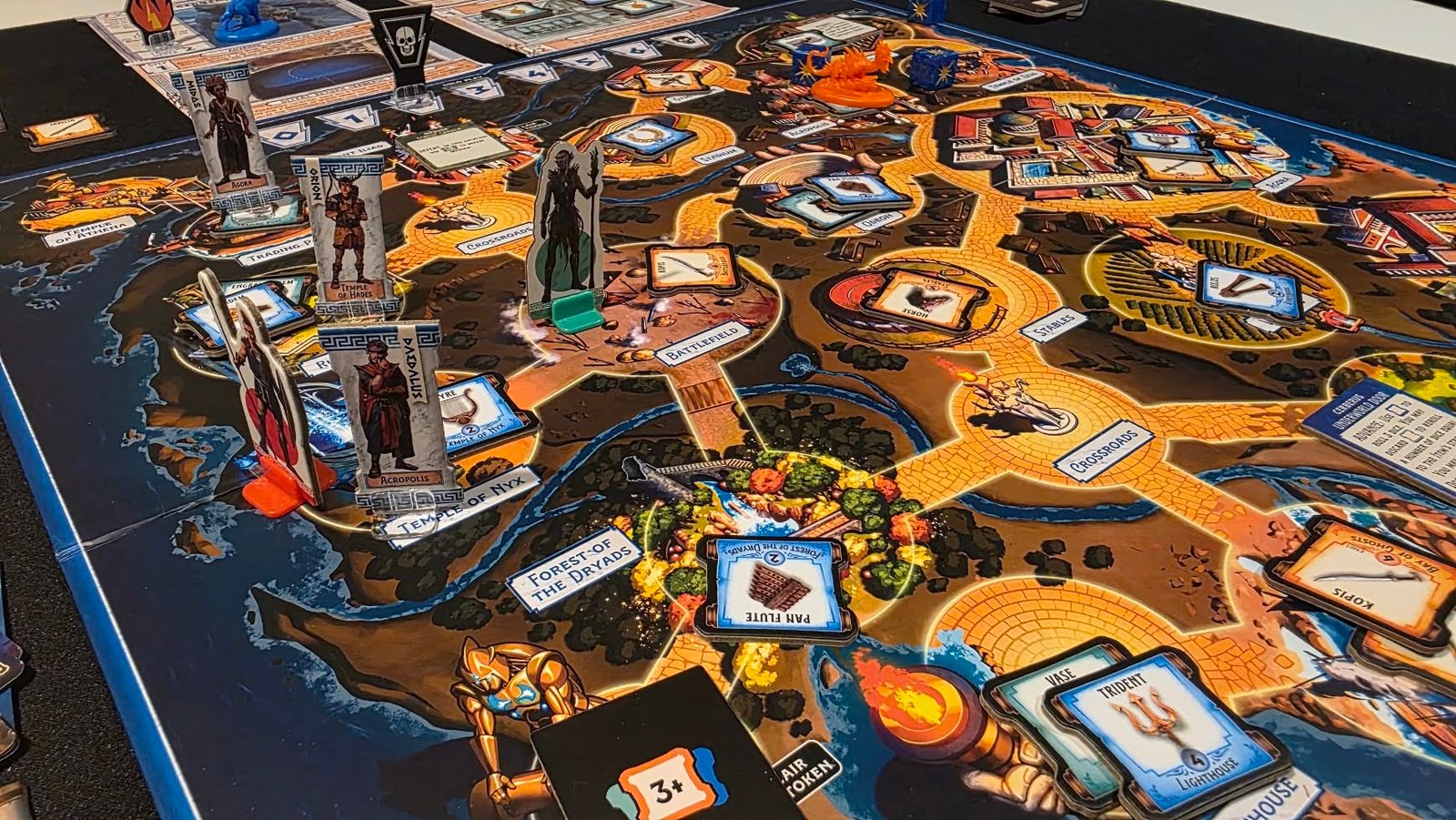
You each control a hero with their own special ability and a set number of actions per turn. You move around the board, collect items, rescue people (now called Legends rather than Villagers, and they are cool characters from Greek history and mythology, which can spark some fun educational moments) and complete objectives to defeat the monsters. After each player’s turn, a Monster card determines what happens next, including which monsters move and attack.
The biggest differences are the monsters themselves, the items and the introduction of hidden lairs.
Firstly, and this is a small change, but I prefer the map in this one. It’s functionally very similar, but we generally found the artwork of the locations easier to navigate than the Universal Monsters’ town locations.
Like the original game, the colours of items are used to complete objectives. My usual whinge about colours looking really similar under dark “living room” lighting applies, but it isn’t too bad. These items are used to complete the monsters’ objectives, with some requiring particular colours and others needing combinations of items or items from specific places.
There are also four hidden lairs scattered around the board. You can spend items with a combined strength of at least three to reveal them, discovering which monster’s lair is underneath. Generally, monsters require you to find their lair before you can complete their objectives, and this adds an extra gameplay element at the beginning.
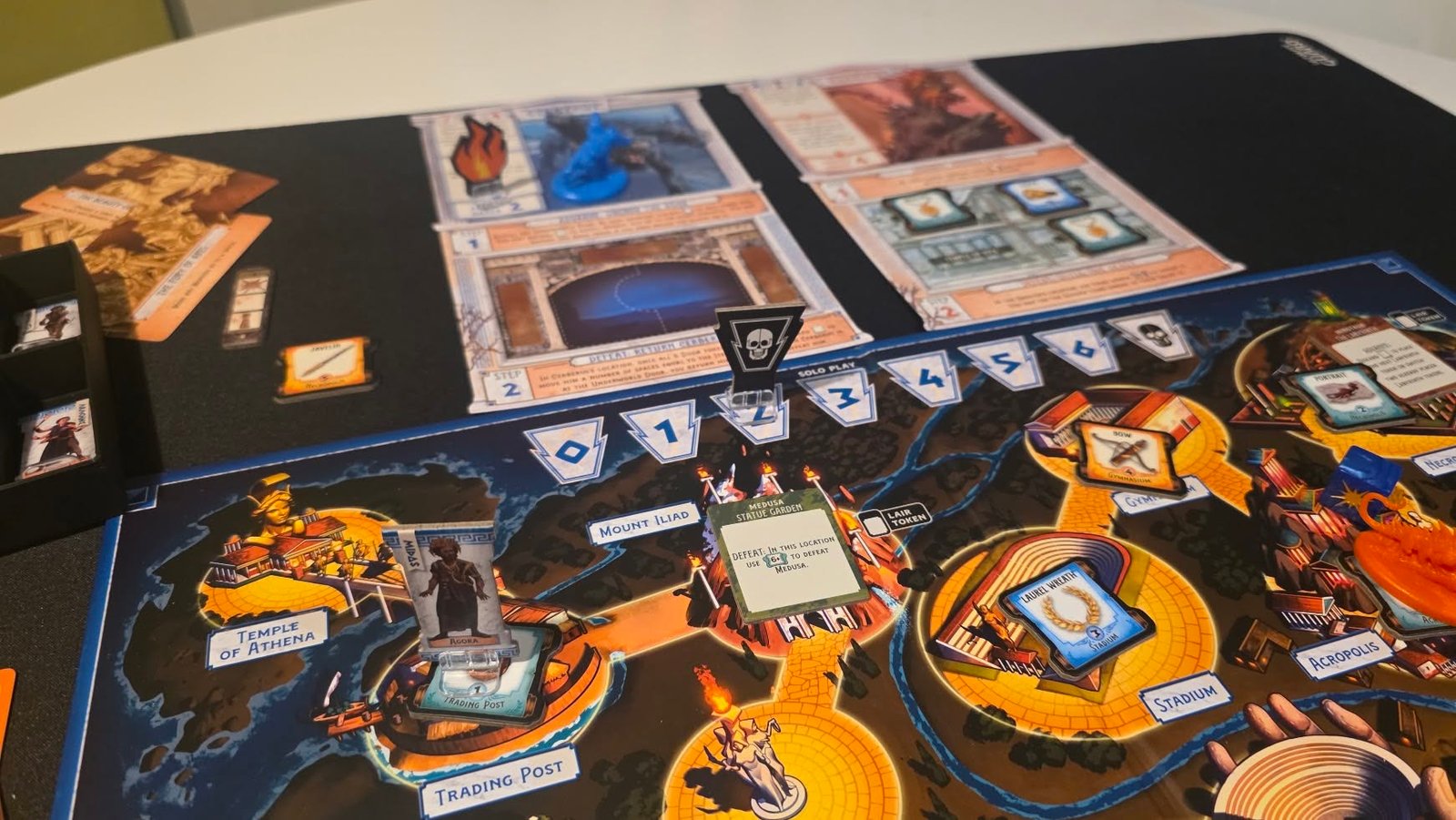
Otherwise, the overall gameplay remains largely unchanged, with the same two-phase turns, Perk cards, monster attacks and cooperative decision-making.
As with the original game, each monster has its own unique objective, and this is where most of the variety comes from.
Basilisk: You need to visit the different temples to bless items before confronting the Basilisk. You then need items with a combined strength of at least 30 to defeat it, with blessed items being worth extra. This is a fun one that works really well, and due to the amount required, there normally needs to be one character focusing on it. One of the heroes has an ability that lets him warp to lairs (which tend to be near the temples), making this a lot easier.
Cerberus: You must discover the entrance to the Underworld and unlock five doors by rolling particular combinations of dice. Once all the doors are open, you need to collect enough items to return Cerberus to Hades. This is one of my favourites, and with the addition of the ability to reroll by using a green item, it gives it a bit of a King of Tokyo vibe that works well.
Chimera: You need to find the Chimera’s cave and put its three heads to sleep by collecting and placing the correct items. Once all three heads are asleep, you can confront and defeat it. Simple, but works well.
Medusa: You need to manoeuvre Medusa into four different mirrors around the board, gradually weakening her. Once she has encountered all four, you need to find the Statue Garden and lure her there to finally turn her to stone. I really like the idea of “kiting” the monsters, and Medusa is such a cool character from mythology.
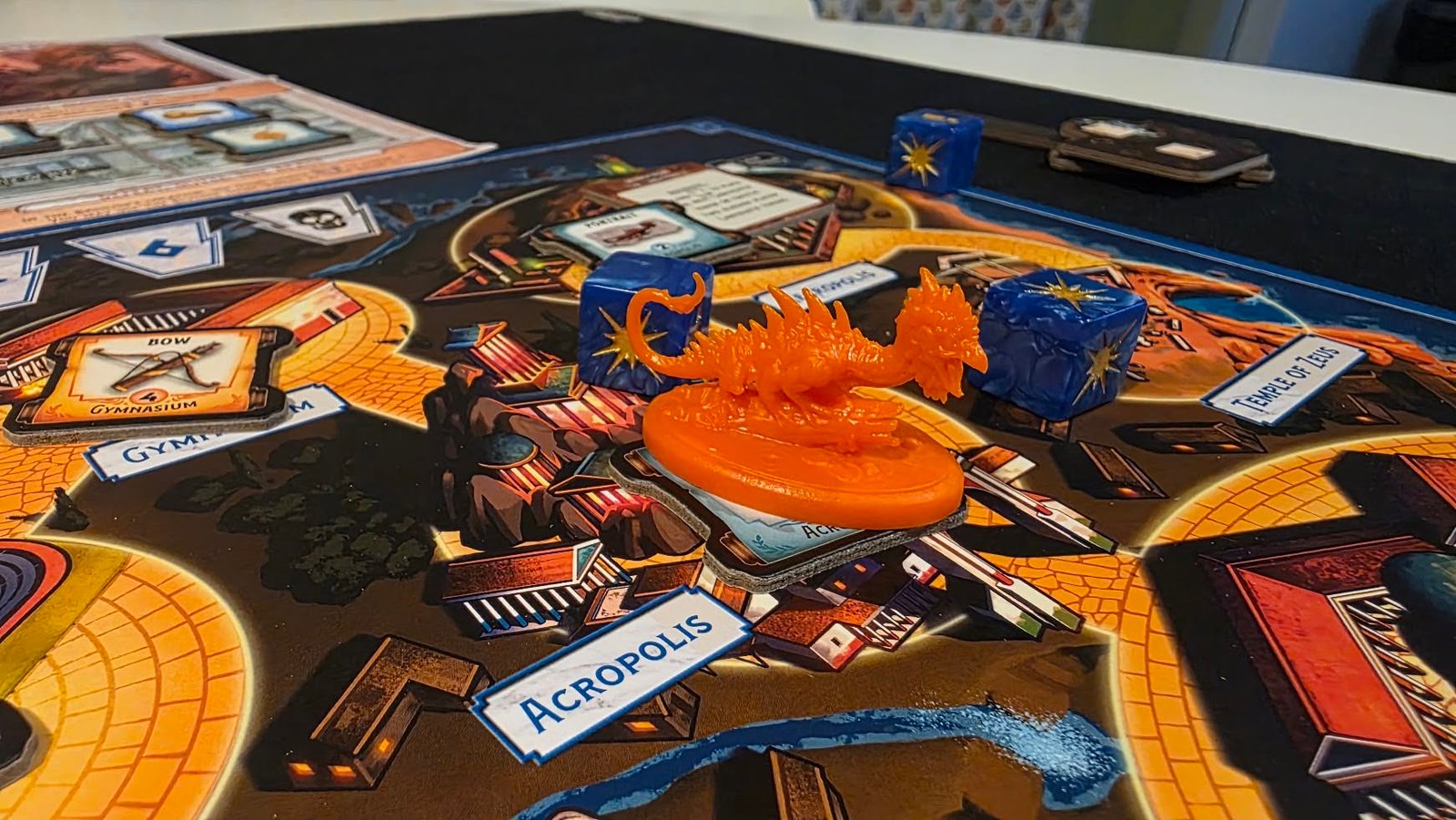
Minotaur: You must discover the Labyrinth and then build it by placing and rearranging maze pieces. Once the Labyrinth is complete, you can lure the Minotaur inside and trap it. A little extra mini-puzzle works well, and the Minotaur is probably the best miniature.
Siren: You need to work out the correct musical tones to counter the Siren’s song. This involves revealing and matching pairs of hidden tone tokens before finally silencing her. Another minigame that’s quite different from everything else and quite fun thematically.
Just like the original Horrified, you win by defeating all the monsters you selected at the beginning of the game. You lose if the Terror Level reaches its maximum or if you run out of Monster cards.
Essentially, if you already know how to play Horrified, you will be able to jump straight into Greek Monsters with very little additional learning. The main thing you need to understand is how each of the six new monsters works, as their different objectives are what really distinguish this version from the original.
Overall, we really liked Greek Monsters, and currently we would rank this one above the original. However, I think it’s very theme-dependent rather than one game being inherently better than the other. If you particularly prefer Dracula and Frankenstein’s Monster to Medusa and the Minotaur, then that will probably decide which set to pick.
World of Monsters is coming up mid-next week as we approach Halloween!
Current Bailey Household Horrified Ranking
1) Greek Monster
2) Universal Monsters (Original Horrified)