 Matthew Bailey
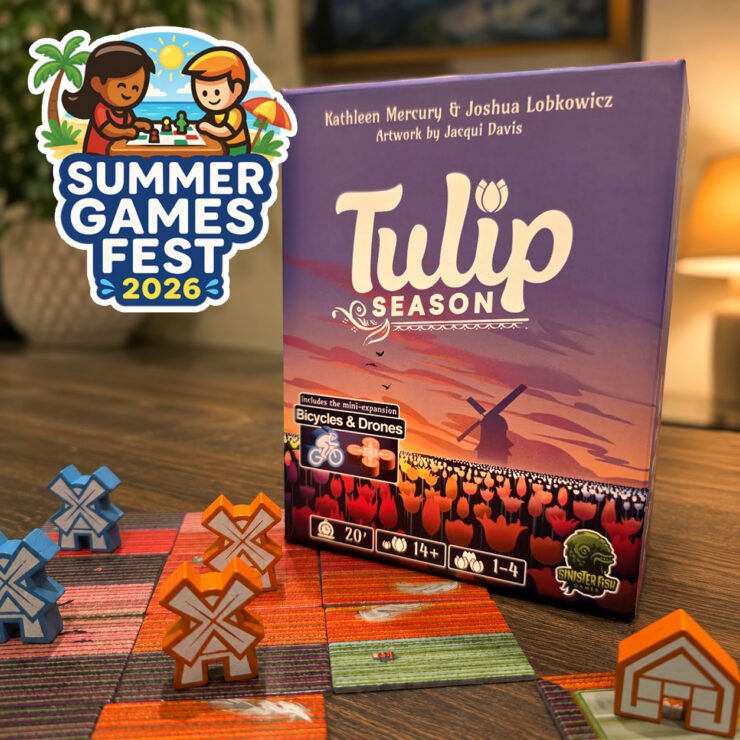
Today we are going to be looking at Tulip Season, a charming tile-laying game that feels like something between Carcassonne and a Button Shy game from Sinister Fish Games.
I first played this quite a while ago now but the game has been out of stock since the UKGE and is now finally available to buy on Sinister Fish Games’ website.
In Tulip Season, you’re gradually expanding a shared tulip farm by placing flower tiles, creating colourful fields and positioning windmills to score points. Along the way, you’ll also have the opportunity to build a greenhouse that provides additional scoring opportunities, as well as piloting a drone and going for a cycle if you choose to use the included expansions (which I suggest you should from the start).
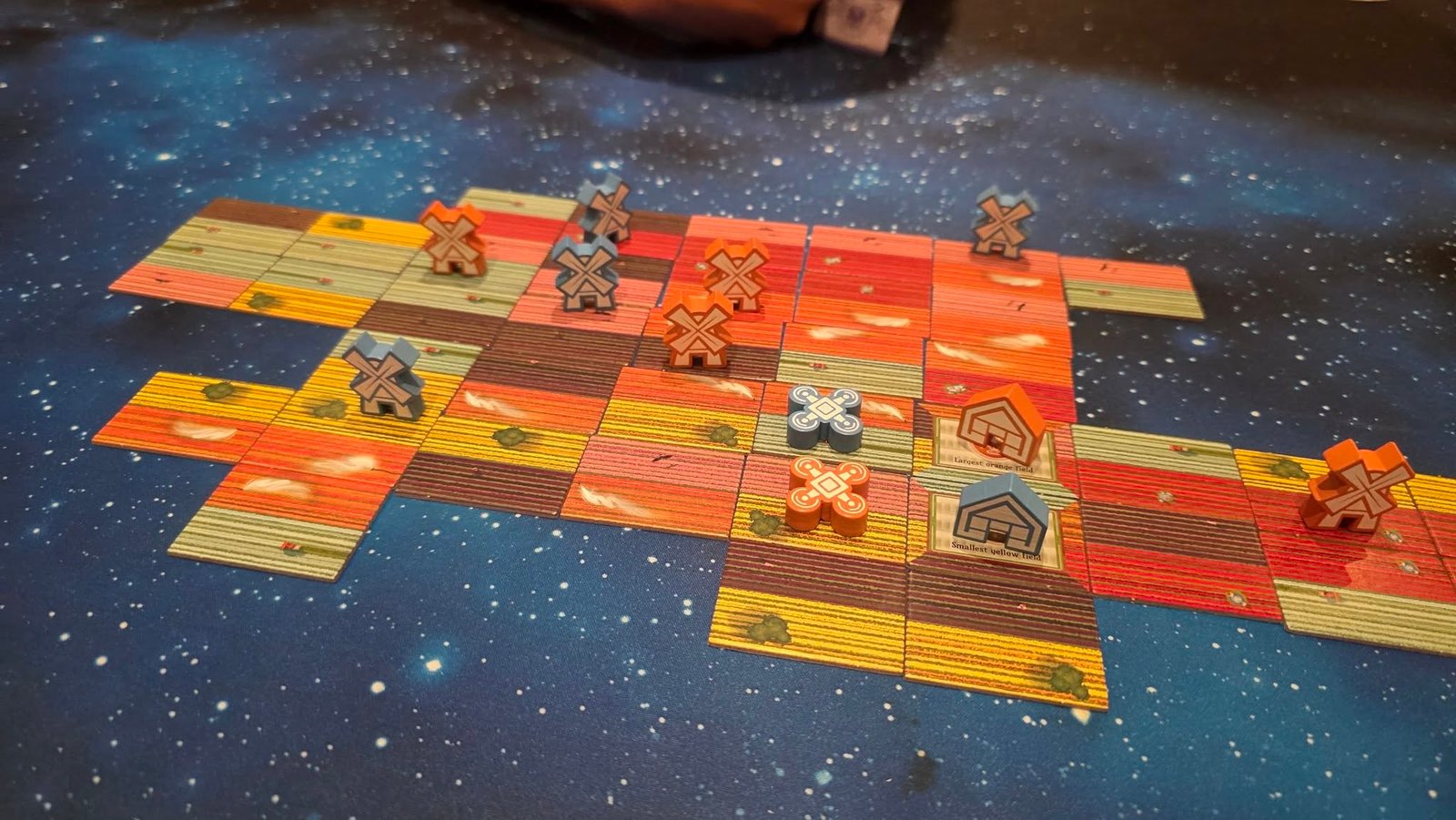
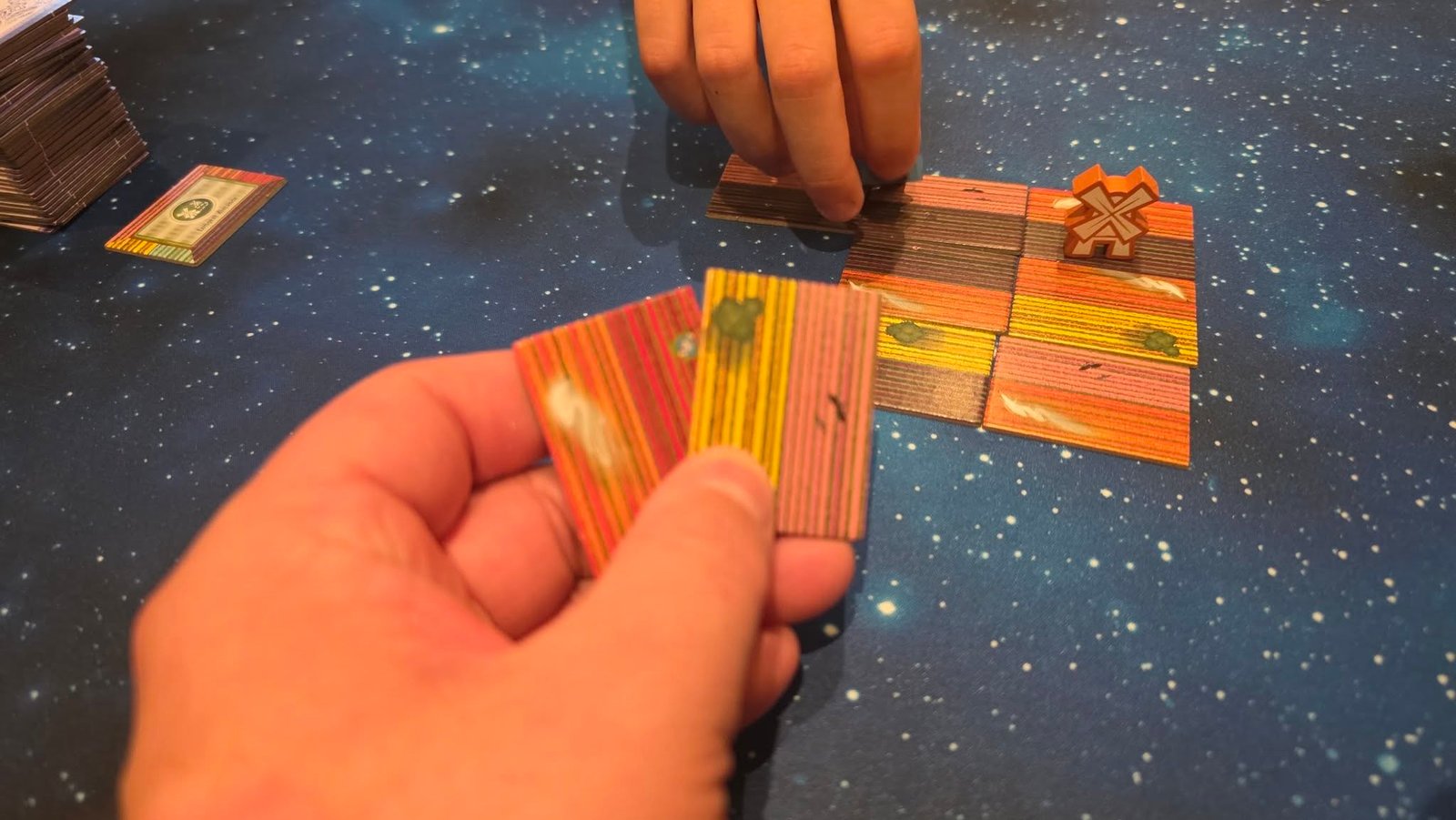
You start the game by laying out four tiles, ensuring that no colours are orthogonally touching, giving every player two flower tiles and two greenhouse tiles.
On your turn, you’ll choose one of three actions.
The first is Grow, where you place one of your flower tiles adjacent to the existing tulip farm. After placing the tile, you may place one of your windmills onto one half of that tile, provided the field doesn’t already have one. You then draw a replacement flower tile into your hand. This is one of the main ways you score, by creating bigger tulip fields.
Alternatively, you can Build. This lets you place one of your greenhouse tiles into the tulip farm using the same placement rules as flower tiles before adding your greenhouse to it. You can only build one greenhouse during the game. Your greenhouse scores points for matching coloured fields around its edges, while every greenhouse also introduces a shared scoring objective that everyone competes to achieve. A really cool part about that is you can place it early and start trying to gain points from colours, or you can keep it until later, complete the objective and place it before others know what the shared objective is. I like this hidden-until-later shared rule, and it’s not a mechanic you see very often. It adds a nice hidden element to the game.
Your final option is to Relocate. Remove one of your existing windmills from the board, return it to your supply, then draw a flower tile and place it face down in front of you. Each face-down flower tile is worth one point during end-game scoring. This is unusual as it initially feels like you’re skipping a turn to move a windmill, but as well as getting the extra field (which improves your options), it also gets you an extra point, which is often all you get on all but your best turns.
The game ends once the hidden ending tile is revealed and everyone has taken the same number of turns. Then the final scoring begins.
Each field containing one of your windmills scores points equal to the number of flower tiles that make up that field. Face-down flower tiles collected through the Relocate action are each worth one point. If you built your greenhouse, you’ll also score for matching coloured fields around it, along with any greenhouse objectives you’ve achieved. These objectives reward achievements such as having the most or fewest fields of a particular colour, using the fewest different field colours, or having the shortest or longest distance between your windmills.
Also included in the box are the Bicycles & Drones mini-expansions, which are fully compatible with the base game. The Bicycles expansion has you moving a bicycle around the edges of the tulip farm whenever you choose not to place a windmill, with your final score based on the distance to your nearest windmill. This adds a fun spatial element to the game, which feels quite different from the other scoring methods.
The Drones expansion allows you, once per game, to place a drone instead of moving your bicycle, rewarding you for matching coloured fields in the surrounding eight tiles.
We played with both expansions and, as they’re included in the box and add very little extra complexity, I’d recommend using them from your first game. They feel like they should just be included in the main game.
Component quality is decent, and everything packs together in a really nice-sized box, making it perfect to throw into a bag and take on holiday this summer. You do need a reasonably sized table to play on, but not quite as big as you would for something like Carcassonne. I do think Carcassonne could learn quite a bit from the box size, as clearly you can get all the tiles for a regular edition of Carcassonne into a box this big.
Using Carcassonne as an example, that’s kind of how the game feels. It feels very Carcassonne. As I’ve already stated, I would 100% recommend playing the game from the start with all the expansions, as they add a little bit of extra complexity and give you some extra options. Without those expansions, it feels a little like you don’t always have many options, and it can sometimes get to the point, especially towards the end of the game, where you’re just adding one point to each of your fields every turn.
Where I think Tulip Season really excels is that, while there is a fair amount of strategy, it’s actually a really simple game to play, and it’s a really good entry point for kids looking to play a slightly more complex, but still entry-level, tile-laying game. Alternatively, it’s great for friends or grandparents who don’t have much board gaming experience.
We really liked Tulip Season. It’s a sweet, charming little game that’s reasonably priced and an absolute joy to play. For me, I think I would have liked a little more complexity and potentially some variation in the tiles, such as double tiles or maybe even quad tiles, but perhaps that’s the sort of thing that could come with an expansion. For people looking for a lovely, charming small-box tile-laying game at a reasonable price, especially as a relatively entry-level game for those who are new to hobbyist board games, Tulip Season is a really good shout.
Disclaimer – A copy of the game was kindly gifted to me by Sinister Fish. I have not been paid for this review, and all thoughts and opinions are our own.