 Matthew Bailey
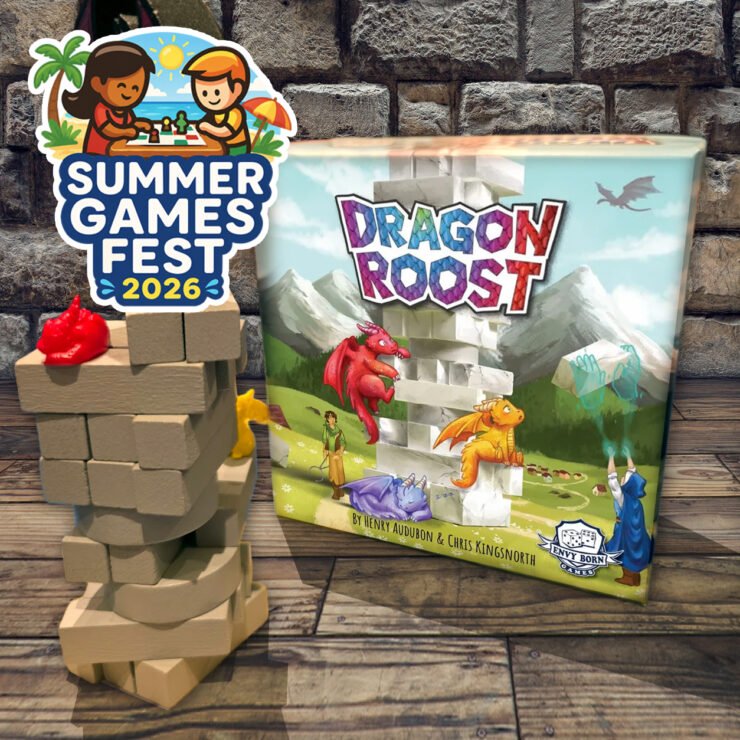
Today we’re going to be looking at Dragon Roost, a small-box dexterity game from Envy Born that has lots of really cool ideas but doesn’t quite, in my opinion, get over the line.
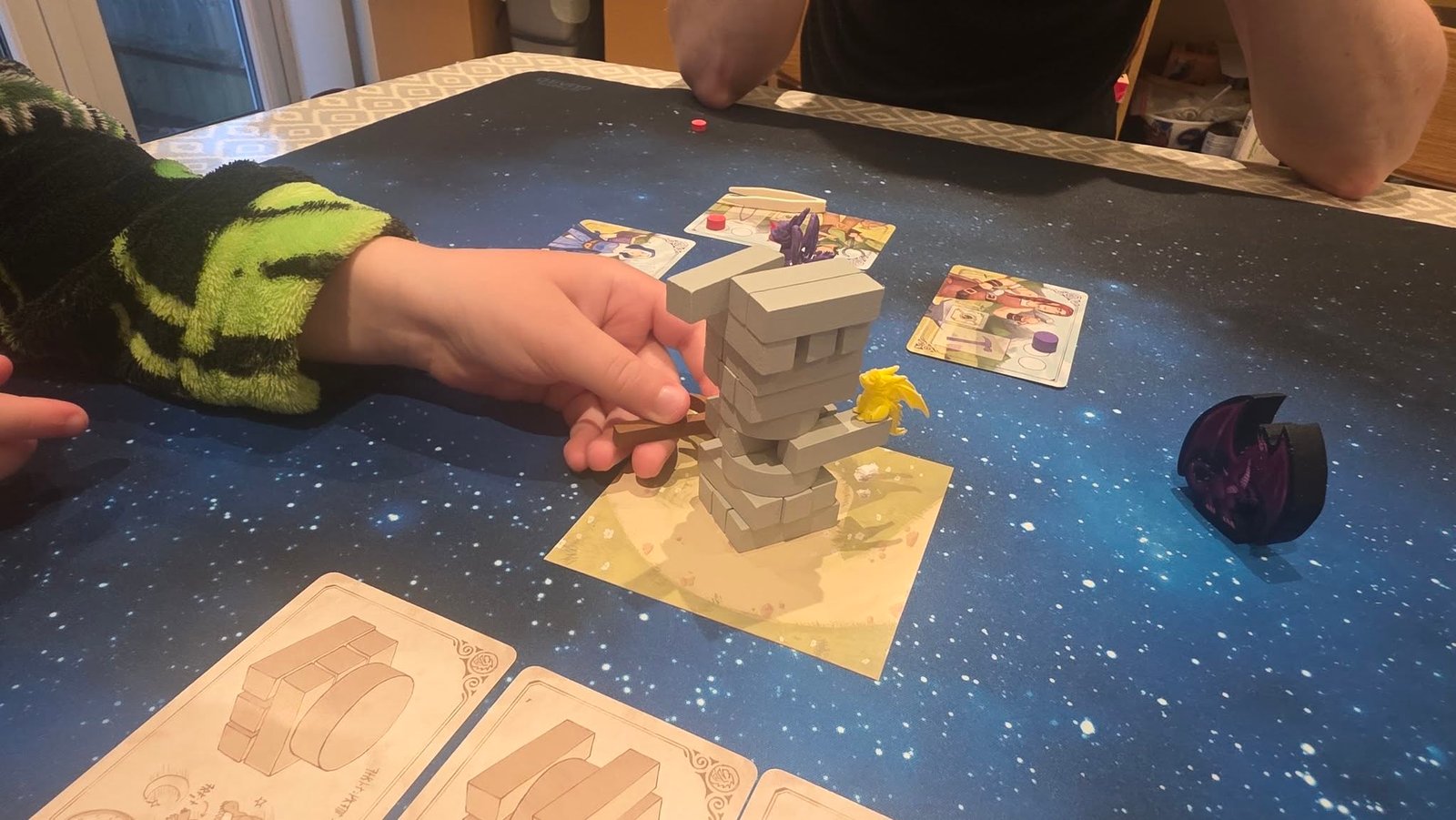
In Dragon Roost, you reshape the blocks in a wooden tower, much like you’re doing in Jenga, so that there is enough room for three baby dragons to sit on the tower before the mother returns. To win, all three baby dragons must be safely placed on the tower before the mother dragon goes on the top, and if any dragon falls at any point, the game is over.
To set the game up, build the tower using three of the one-star tower cards, choose three of the four available tools, which all have different mechanics, place the matching action tokens on each tool card, and place a baby dragon beside each one. The unused tower card and tool are returned to the box. I like how this works because it means you can’t do the same thing every time, and it does give some sense of variety to each game as a particular tool gets left out.
On your turn, you either use one of the available tools to manipulate the tower, place a baby dragon onto the tower, or, once all three babies have been placed, place the mother dragon. Using a tool costs one of its action tokens, and once a tool has no tokens left it cannot be used again until its matching baby dragon has been successfully placed.
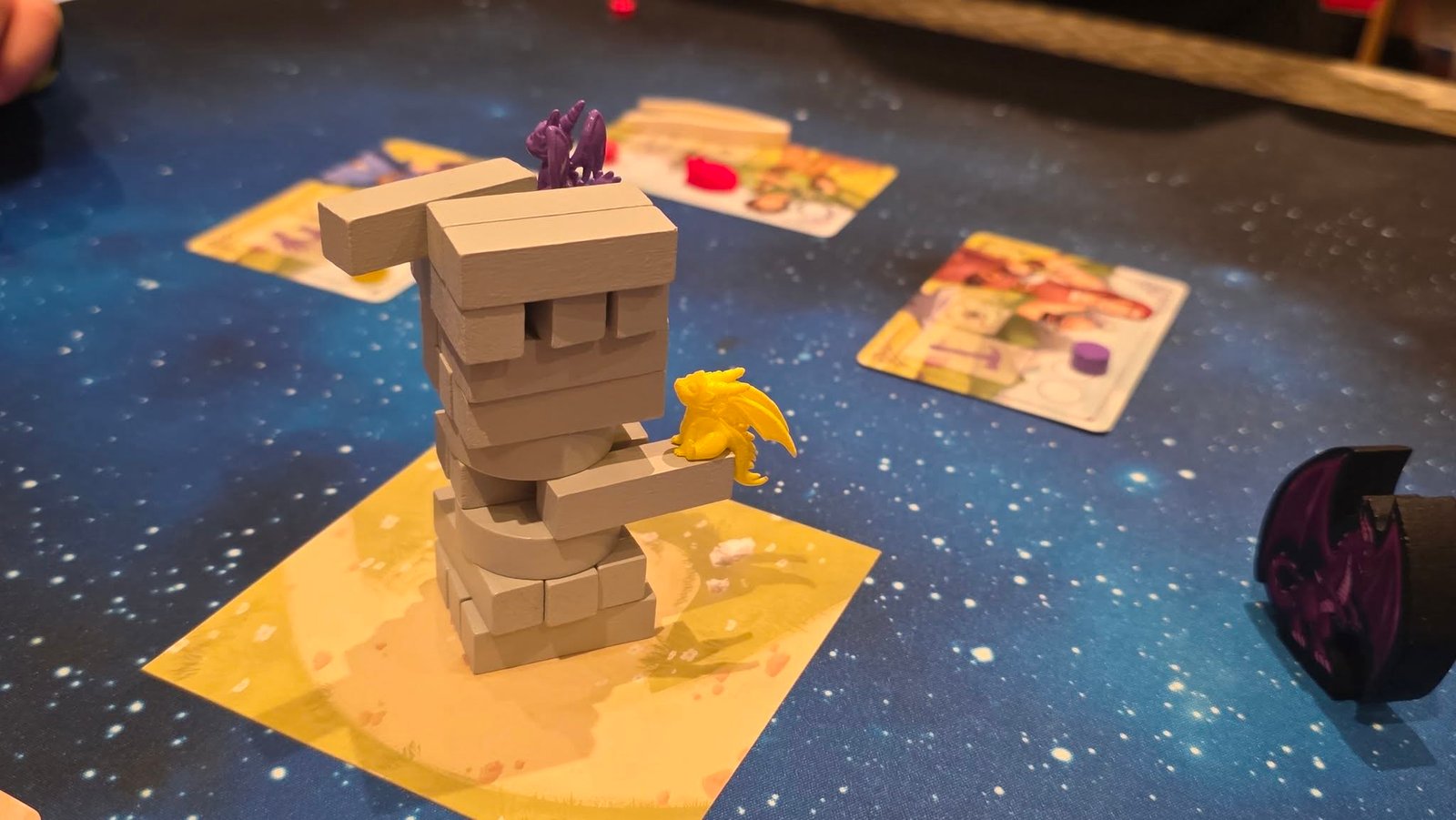
Each tool works differently. The hammer lets you tap a single piece as many times as you like, the tongs can grab and move a single block or disc, the chisel pushes one piece in a single direction, and the wizard’s hands allow you to grip and move pieces. Pieces falling from the tower do not end the game, although you cannot reuse removed pieces to build a second tower.
When you choose to place a baby dragon, you must balance it on the tower using only your fingers. Baby dragons cannot be placed on the very top or bottom layer, and once you pick one up you must attempt to place it. If it stays balanced, you refill all of the matching tool’s action tokens. If it falls, the game ends immediately.
An easy way for me to describe this is to imagine a game of Jenga with fewer blocks, with the tower already looking like a half-played game to begin with. You then have to move one block just enough so that you can rest a dragon on it.
Once all three baby dragons are safely on the tower, the next player attempts to place the mother dragon on the top layer. If she stays in place and none of the baby dragons fall, everyone wins. If the mother dragon or any baby dragon falls, the game is lost.
That’s kind of it, and therein lies the problem. You can play this entire game literally in about two and a half minutes, and once we’d played it five or six times we were kind of done and felt like we didn’t really need or want to play it again. The different tools add a nice little bit of variety, and most of the tools are things we have seen in various Alley Cat Games, and the components are really nice. It’s unusual that the dragons themselves are plastic yet the mother dragon is a wooden meeple, but whatever, and it all comes in a really nice box. There’s just not enough here. I don’t know exactly what else I want, but I want more gameplay. I need more dragons, more ways things can go wrong, or some sort of card or power element. There’s just not enough here to make this something that we wanted to play more than once or twice.
Sure, it’s really sweet, it’s really cute, and I think a lot of people playing this at UK Games Expo, which is where we first saw it, could easily come away really enjoying it. But once you’ve got it at home and you’ve got those chances to play it, unfortunately it just doesn’t hold up to long-term play. There are definitely the building blocks of a good game here; it’s just not quite there.
But… having said that, I could see this being worth a play in a board game café.
Disclaimer – The game was kindly loaned to us by Envy Games via the UKBG Review Circle.