 Matthew Bailey
Before I start talking about everything I saw at the UK Games Expo, I really need to squeeze in, no pun intended, a review of a game that I played the prototype of last week but haven’t had the chance to write up. With the crowdfunding campaign ending in 24 hours (sorry, I have only had the prototype for just over a week; hopefully, there will be a late pledge), if I don’t get it out now, no one will have a chance to back it beforehand. If you’re interested, I’ll put the link in the comments below.
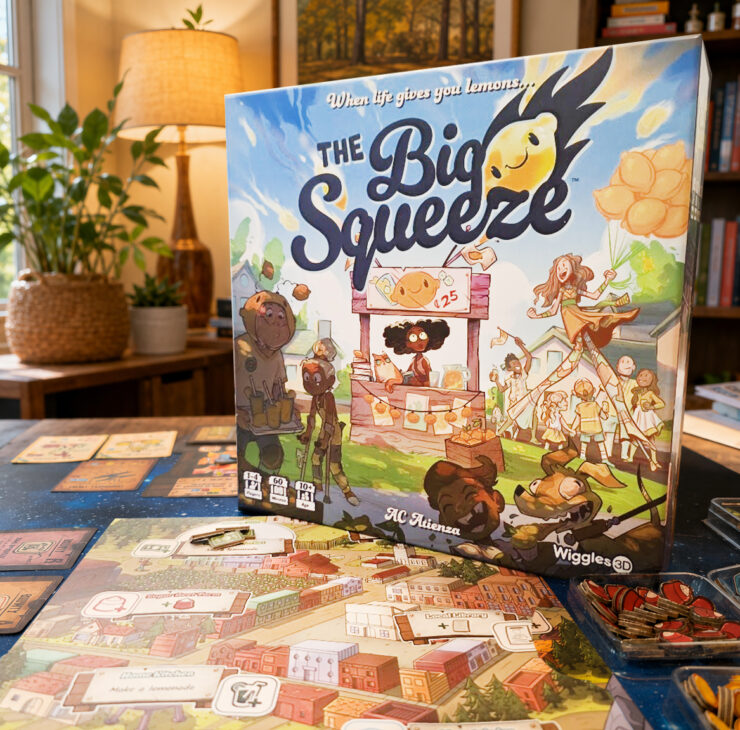
In The Big Squeeze, players run lemonade stands in the town of Rinddale, collecting ingredients, making lemonade, selling it for money, and improving their businesses before an impending apocalypse changes everything, except lemons, which somehow seem to survive.
At the start of the game, each player receives a character with a unique ability, an upgrade board, a pawn, and three recipe cards. One recipe is placed into their stockpile, while the others remain in hand. Players also begin with one lemon, one sugar, and one ice token.
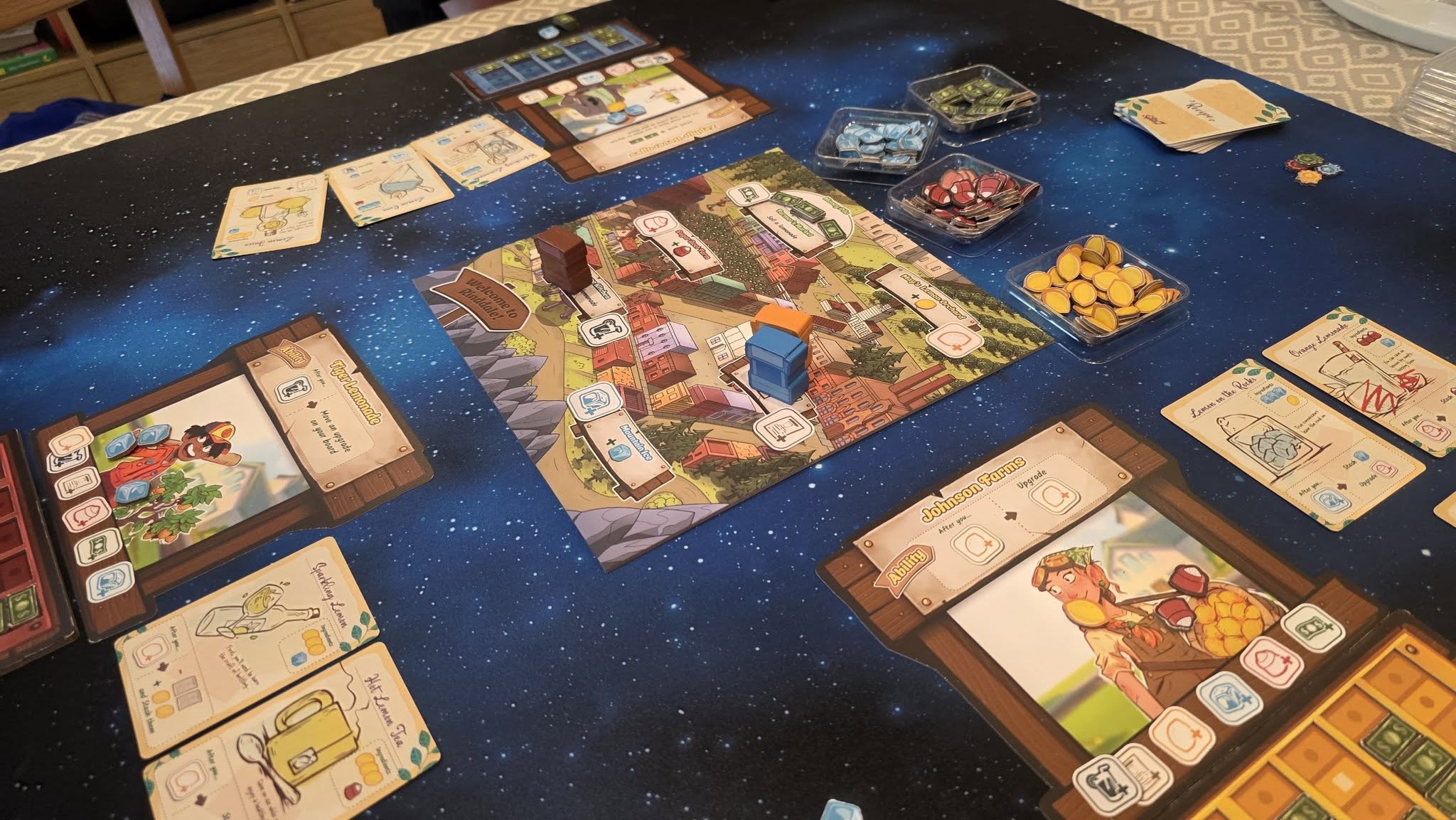
On your turn, move your pawn to any location on the board except the space you currently occupy, then carry out the action shown there. Locations allow you to collect lemons, sugar, ice, draw recipe cards, make lemonade, or sell lemonade.
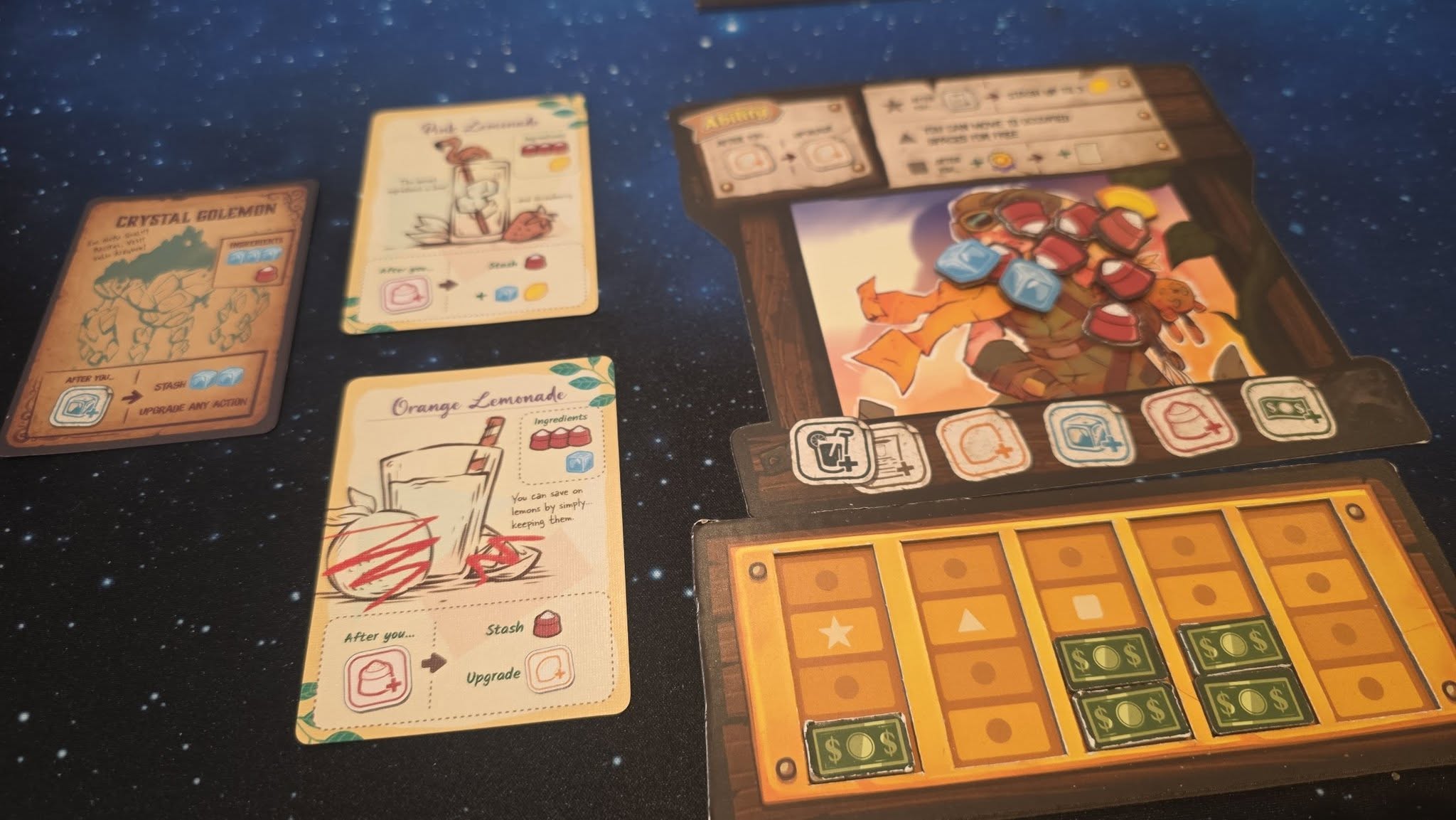
To make lemonade, play a recipe card from your hand and pay the ingredients shown on that card. The completed lemonade is placed into your stock area. There is no limit to the amount of lemonade you can have in stock. When you sell lemonade, move one lemonade from your stock to your sold area and take money from the central money pile. The money can either be invested into upgrades or stashed beneath your upgrade board for later.
Upgrades improve the actions available on the board. Each note invested beneath an action increases the effectiveness of that action whenever you visit the matching location. As players create new lemonade recipes, they also gain additional abilities that can be triggered after specific actions have been completed.
The first phase of the game continues until the central money pile is exhausted. Once this happens, the current round is completed and the apocalypse begins. Players must choose two lemonade recipes to keep and stash them safely. Anything you have successfully stashed is also safe, and all other ingredients, recipe cards, lemonades, and upgrades are discarded. This is a key point in the game, as you need to decide whether to push hard in the first half or hold things back to get a strong start in the second. It’s all about balance.
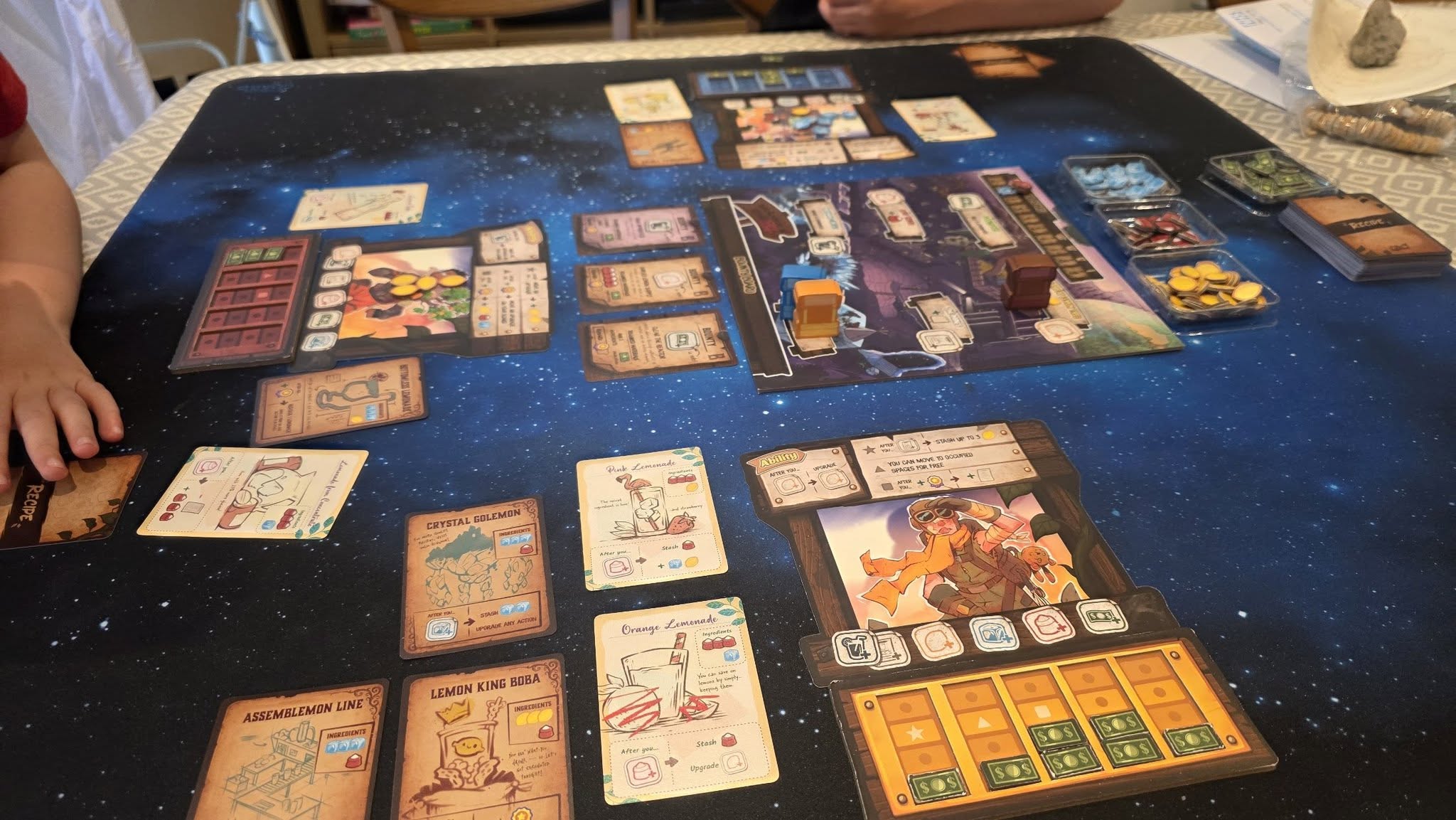
The game then enters the second phase. The board is flipped to reveal a new post-apocalyptic side, players retrieve their stashed resources, and a new deck of forbidden recipes is introduced that is more powerful than the recipes in the first half. Players can now complete bounty objectives to gain fame, and fame is ultimately what wins you the game.
The game ends when a player reaches the required amount of fame based on the player count. Finish the current round, then the player with the most fame wins. If there is a tie, the tied player who has sold the most lemonade is declared the winner.
It’s quite an unusual way to play a game in that it is split into two halves. In the first half, you’re building your resources and developing your engine, but you know that at some point you’re going to have to give up most of that and start again. You want to put yourself in the best possible position, and finding the balance between advancing enough without overcommitting is a tricky challenge.
In the second half, everything is a lot more powerful, and it is possible to catch up if you play well. Obviously, having a really strong start and being in the lead at the end of the first half is going to put you in a very good position.
The best way I can describe how this feels to play is with a Gladiators comparison. You know when you watch Gladiators and the contestants spend the first 80% of the programme competing against the Gladiators to earn points? Even if they’re miles ahead, those points only translate into seconds of advantage in the Eliminator. It gives one player a significant advantage, but at the end of the day, if the other player is quicker and performs better in the Eliminator, they can still win. Weirdly, that’s exactly how playing this feels. In the first half, you’re doing a lot and can be performing really well, but just because you’re ahead in the first half doesn’t mean you’re definitely going to win the second. It simply gives you a really good head start.
The first time I played this, I wasn’t quite sure about that system. Part of the reason this review didn’t go up three or four days ago was that I wanted to make sure I gave the game a fair assessment. After repeated plays, I ended up really liking it. It’s unusual, takes a little getting used to, but it works very well.
This is just a prototype that I’ve played, but all of the components were excellent, the artwork was wonderful, and everything worked really well. I’ve no reason to believe the final product won’t be just as impressive.
I really like The Big Squeeze, the boys like The Big Squeeze, and I think it is distinctive enough with its two-phase system that even if you’ve already got quite a few games in this genre, this is one that could definitely earn a place on your shelf. If you like games with strong comeback mechanics, this is one that does it in a very unusual and interesting way.
Definitely one to keep an eye on. At the time of posting this review, there are just over 24 hours left on the crowdfunding campaign over on BackerKit, so if you’re interested, you might need to get a bit of a wiggle on. I’m really sorry I didn’t get the review out earlier, but I only received the prototype about a week ago and didn’t want to rush out a review without properly getting the chance to play it. With the UK Games Expo taking up quite a bit of my time this weekend, there simply weren’t enough hours in the day.
Disclaimer: A prototype copy of the game was kindly provided to us by the publisher. All of our thoughts and opinions are our own.
Backerkit Link – https://www.backerkit.com/c/projects/wiggles-3d/the-big-squeeze-your-lemonade-stand-vs-the-apocalypse