 Matthew Bailey
Note : This is a heavily storyline specific game as such I will not give any storyline specfiics and all photos are from the early stages of one game. There are some very minor spoilers in order for me to be able to explain the game but these are kept to a minimum.
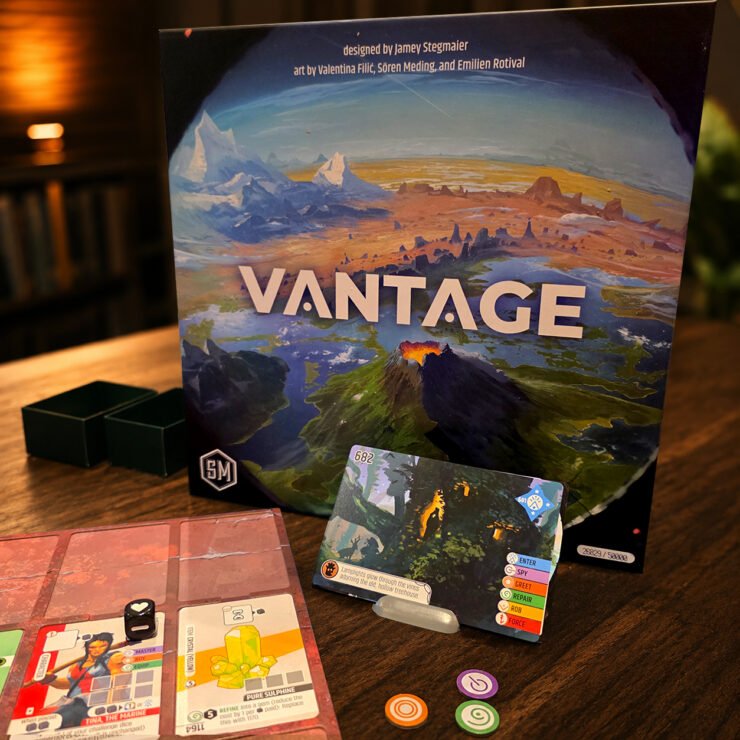
Having reviewed an extremely lightweight game for young children about treasure hunts around the house yesterday, today we’re going to look at something at the opposite end of the spectrum, and that is Vantage from Stonemaier Games, a moderately heavy, but not overly complex game that is essentially a giant choose-your-own-adventure book.
Vantage has received one of the most mixed receptions I’ve ever seen a board game receive in the online community since its release. As someone who is always keen to play storytelling and cooperative games with my kids, and a firm believer that even heavyweight games can work cooperatively with children if you’re willing to help them with their turns, I felt it was important to try Vantage and see what makes it tick. While it succeeds in some areas, unfortunately for me it doesn’t quite add up to the sum of its extremely ambitious parts.
To play the game, you and your fellow explorers crash onto an uncharted alien world after responding to a message from an unknown being called “The Traveller”. Each player begins in a completely different location. While you’re working together towards a shared mission, every player sees the planet from their own unique perspective, meaning only you can look at your current location card while describing what you find to the rest of the group.
I’m going to talk about thematic immersion quite a lot in this review because that’s clearly what this game is aiming for. In reality though, it also falls down on that front quite often. I understand the idea behind not being able to see where your teammates are because you’re not physically together, and that’s fine. However, it takes something away from the experience when all you’re really hearing is a vague description of what’s going on somewhere else. Most of the time, that information doesn’t actually matter because unless you eventually visit that location yourself, it has little impact on your own experience.
With kids especially, it’s hard to care about what’s happening outside your own area. In practice, it often feels like you’re playing three solo games at once rather than one cooperative game together. I’ll go out on a limb and say that for someone who enjoys solo games, this might actually be a better experience played alone. When played with others, it often feels like a solo game where you simply have to wait for your next turn.
Equally, you crash-land on this alien planet and, rather than doing the obvious things like finding shelter, locating food, figuring out what happened, and working out how to get home, you’re quickly drawn into various side tasks that feel a little strange for a game that leans so heavily into its theme.
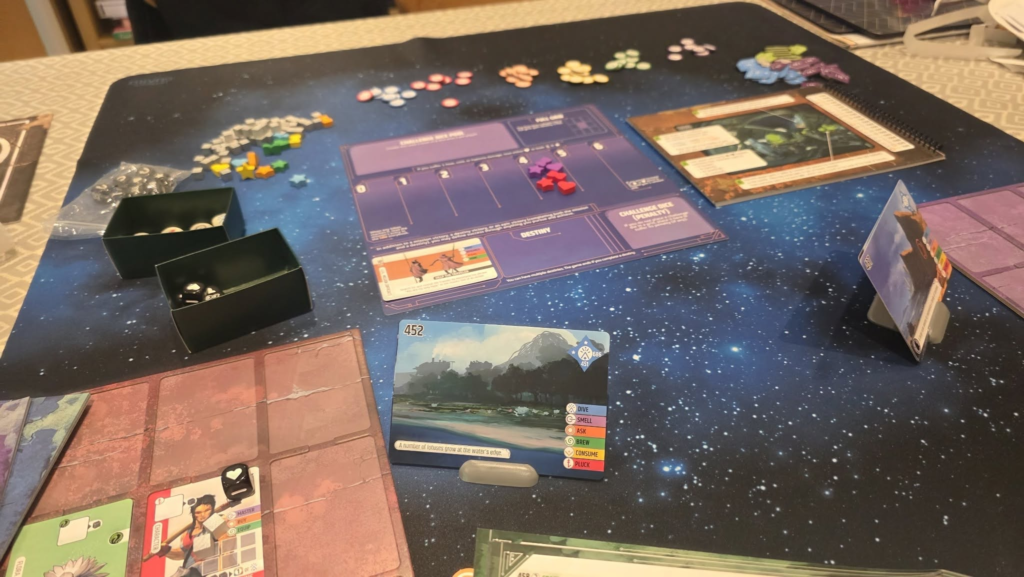
On your turn, you’ll generally choose one of three actions. You can perform a location action (which you can only do once at each location) from your current area, use a card action from a card you’ve collected, or depart to travel to a new location. What’s unusual is that you always succeed at the action you choose. The challenge comes from dealing with the consequences.
Every time you perform an action, you roll challenge dice. These dice have six faces: two are blank, one returns the die to the pool, which sounds good but actually delays your next refresh, and the remaining faces can damage one of your three main resources: Health, Time, or Morale.
To mitigate this, you’ll place the dice onto slots on cards in your growing 3×3 grid around your character. As you discover new cards, you’ll gain more places to store dice, new abilities, and ways to support your teammates. I do like the fact that players can share some of that burden, although I’m not entirely sure how it works thematically. If I’m trying to swim across a lake, it’s a little odd that a teammate on the other side of the island can somehow help me mitigate negative impacts on my time or health.
After choosing an action, another player looks up the relevant storybook entry and reads out the cost and a brief description of what you’re attempting. Players can spend matching skill tokens to reduce that cost before challenge dice are rolled. The more difficult the action, the more challenge dice you’ll need to roll.
This is another area that took me out of the experience, and the boys completely agreed. It doesn’t matter what you’re doing, everything is resolved in exactly the same way. There may be more or fewer dice depending on the difficulty, but the same system handles everything, whether you’re fighting a giant alien spider or simply walking through the door of an abandoned hut.
Based on the outcome of the dice, both situations could damage your Health, Morale, or Time. That feels strange. I appreciate that harder actions require more dice, but it doesn’t feel right that climbing a flight of stairs can potentially hurt me more than the giant monster that attacked me five minutes earlier.
Here it’s worth mentioning that the game has what’s called “The Universal Rules of Fun”, which essentially is that you can basically choose to change or interpret the rules how you want and this is how you are meant to mitigate those “died talking to someone” moments basically meaning that you cant really lose as you can just decide to ignore it and move on anyway.
As you explore, you’ll become involved in quests and other activities that can take up a significant amount of time. I also found it slightly frustrating that you only get a single action on your turn. I often felt like I wanted to do more. We didn’t experiment with it, but I found myself wondering whether a house rule allowing three actions before passing to the next player might improve the pacing.
Once the dice have been resolved, the storybook reveals the outcome. This might lead to new discoveries, useful equipment, encounters with inhabitants of the planet, or entirely new locations to explore.
This is one of the stronger aspects of the game. There were genuinely fun moments where we found something interesting or uncovered an unexpected situation. However, because you have very little idea how to achieve the overall objective, you can sometimes feel like you’re wandering without purpose. I think this is where personal taste will make a huge difference.
For us, we like having a goal and at least some understanding of how to work towards it. While there are things you can do to speed progress towards the endgame, you can also spend hours simply wandering around without feeling like you’ve achieved very much.
The group wins by completing the mission established at the start, uncovering a destiny, or achieving both. However, if any player’s Time, Morale, or Health reaches zero, the expedition is in serious trouble, and there are situations where the game can end very suddenly. You might be doing brilliantly in your own corner of the world, only for someone else’s mistakes to bring the entire expedition crashing down after two or three hours of play.
It doesn’t bother me personally, but it is worth mentioning that there is a lot of reading in this game. When I say a lot, I don’t mean the rules are particularly complicated. Once you’ve understood the structure, “Vantage” is actually fairly straightforward to play.
The issue is that almost every turn involves searching. You’ll choose an action, find a specific number in a book, read the entry, possibly make choices, roll dice, then be directed to another entry or asked to locate a card from one of the game’s enormous decks. There are over 3,500 cards in the box. They’re well organised and numbered, but finding things still takes time.
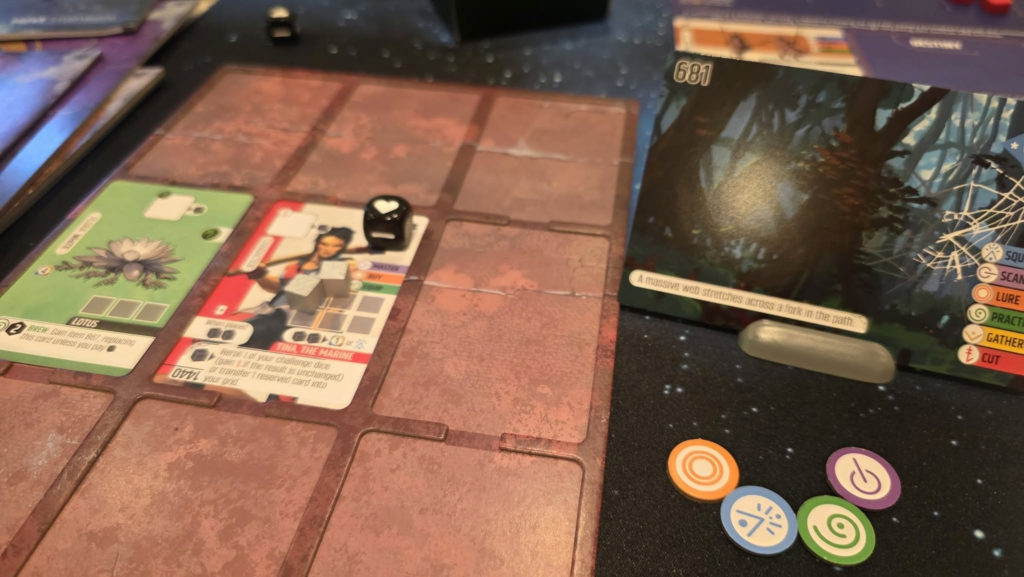
As a result, much of the game consists of searching through books, cards, and decks. Very little text actually appears on the cards themselves, so it never quite feels like the game gets moving.
Up to this point I’ve been quite negative, and you’ve probably already looked at the rating and assumed this game is heading towards a low score. However, it’s going to receive a Maybe, and a very unusual Maybe at that.
Normally, our Maybe rating is our middle-of-the-road score, our average game. In this case, though, it genuinely means “maybe”. I think there are people out there who are going to absolutely adore “Vantage” for what it is.
This is a massively open-ended, extremely ambitious game built around exploration and discovery. You can go almost anywhere, investigate whatever interests you, and create your own journey through the world. It genuinely provides a sense of freedom and sense of discovery. Rather than following a fixed storyline, you’re free to wander, investigate strange landmarks, help other players, pursue personal goals, and gradually piece together the secrets of a vast alien world.
To enjoy it, though, everyone needs to be on the same wavelength. You need a group willing to embrace the journey, see where things go, and enjoy the process more than the destination.
This review has probably come across as very negative, and I don’t entirely mean it to. For the right person, there is a lot to love here. I can absolutely see why reactions to “Vantage” have been so varied.
For most children and teenagers, though, I think this is going to be a tough sell unless they’re deeply invested in choose-your-own-adventure storytelling and creating narratives in their own heads.
Even then, the fact that you’re free to go where you want but don’t always have full control over what happens when you get there creates a tension that may frustrate even the most patient or imaginative child.
Ultimately, I didn’t massively enjoy playing “Vantage”. It never quite drew me into its world or made me care deeply about what was happening. Perhaps if I played it many more times that would change, but I’m generally of the opinion that if a game requires a dozen plays before it becomes enjoyable, there may be some underlying issues with the design.
So despite what has probably sounded like a fairly critical review, I’m still giving “Vantage” a Maybe. If you’re exactly the sort of player this game is aimed at, there is an enormous amount here for you to discover. However, I suspect that for most Little Board Gamers, it probably won’t be their cup of tea.

*But only if the concept really appeals