 Matthew Bailey
As we all start the new school year, I’m going to run a little mini-series called “The Back to School Septembetacular”, where we’re going to be looking at a number of games over the next week or so that have educational elements to them. Today I’m really excited to be talking to you about Codenames: Critical Role Adventures, which sits firmly in the camp of helping children with their words, vocabulary and understanding of language.
Now, I first heard about this a little while ago and, I’ve got to be honest, until the UK Games Expo I hadn’t really paid much attention to it. This was largely because I thought it was simply a reskinned version of Codenames, based around words that were largely to do with the Critical Role IP. But, as it turns out, Codenames Adventures, as I’m going to refer to it from here on, is actually a campaign game using the core idea of Codenames to complete missions and fight monsters.
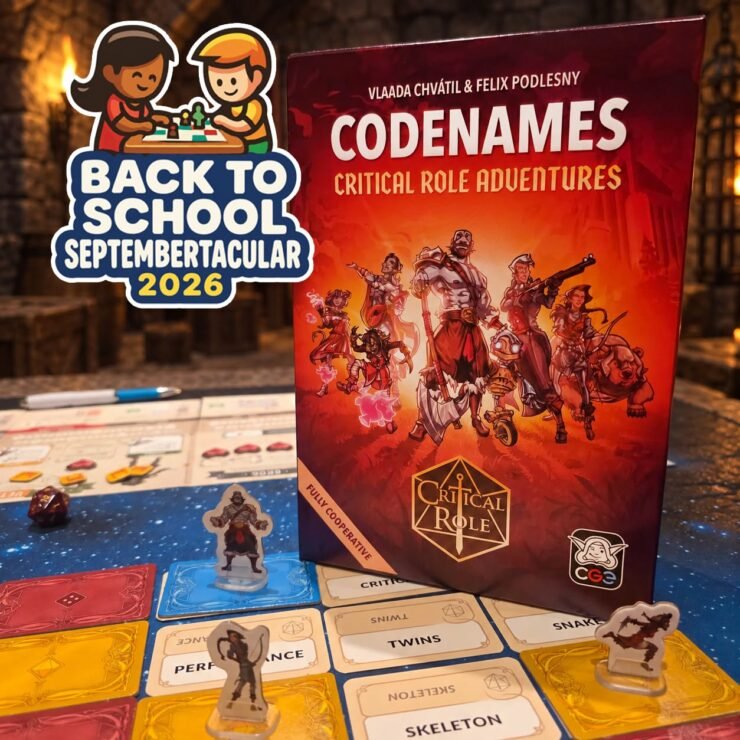
I did mention to CGE that I think the general messaging behind the marketing for this has been a bit iffy. While I do think the retail packaging is better than the packaging that was first shown at the UK Games Expo, I think a lot of people are going to pass on this thinking it’s simply a reskin of Codenames, as opposed to its own thing. To be honest, it couldn’t be further from the truth, and it actually works really well.
Codenames: Critical Role Adventures takes the familiar clue-giving idea from Codenames (which, for the purposes of this review, I am going to assume you know how to play) and turns it into a fully cooperative campaign game. One player takes on the role of the Game Master, or GM, and this can be switched around each mission, while everyone else works together as a party of three heroes. You always have three heroes regardless of how many players are actually playing.
This was one of the first things that concerned me about the game. If you’re only playing it as a pair, I worried it wouldn’t play particularly well, but actually it works absolutely fine. Really, the GM is just the clue giver and the other player is the guesser, just like if you were playing a normal version of Codenames. I’ve played a two-player campaign of this and I’ve also played it at three, and we simply swapped the GM each time. It worked really well.
If you’ve played Codenames: Duet, you have a little bit of an idea of how this works, but actually I think Codenames: Critical Role Adventures works better in terms of creating a cooperative Codenames experience.
Across a campaign, of which there are three, each offering branching paths for more replayability, you’ll take on a series of missions, with your heroes gaining XP, unlocking new abilities and carrying their progress from one adventure to the next.
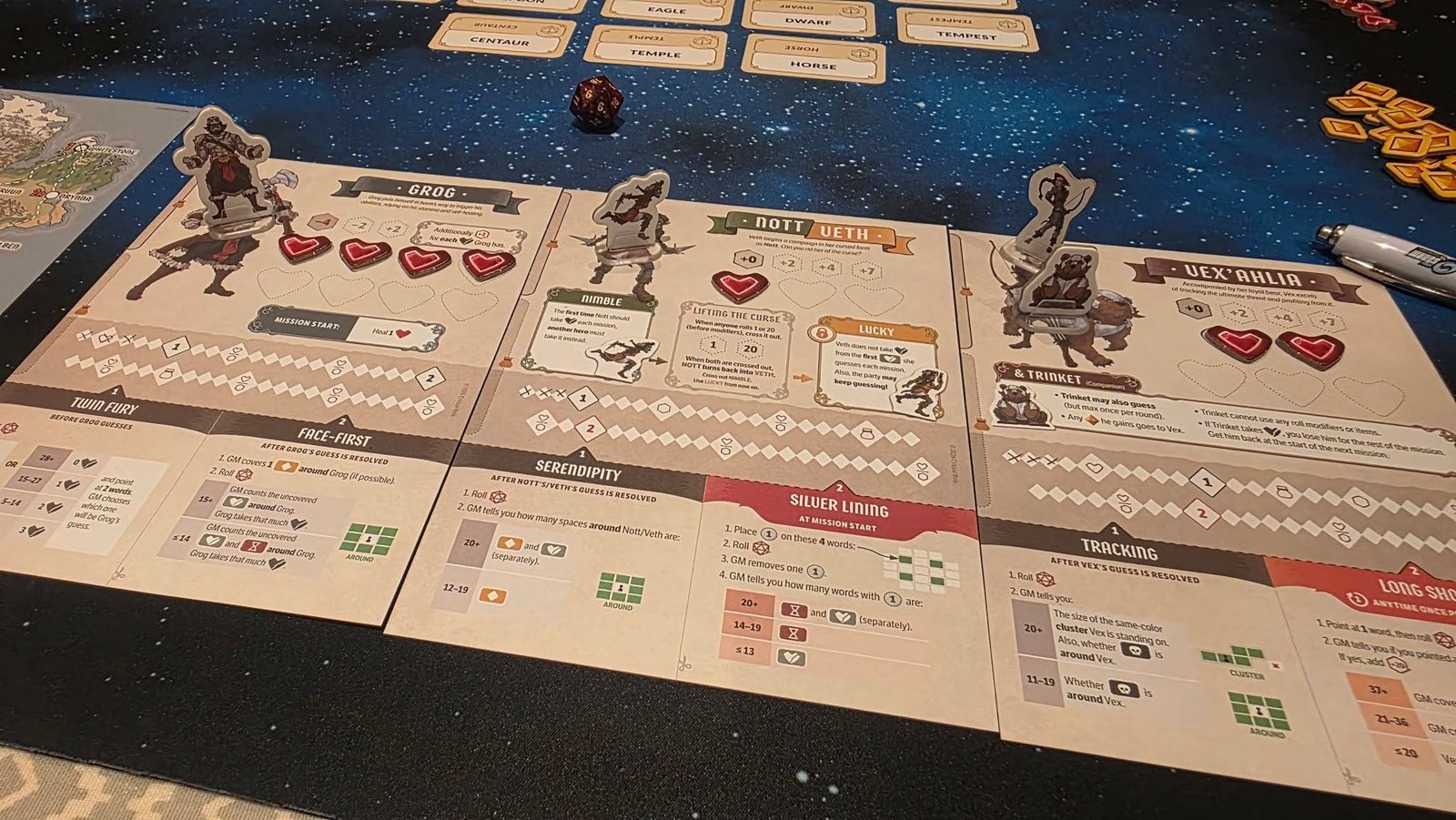
Each round starts in classic Codenames fashion, with the GM giving a clue made up of one word and one number. The word links to one or more cards on the table, while the number tells the party how many cards the clue is meant to relate to. The GM then has to keep a straight face and leave the rest of you to argue about what on earth they meant. This is where Codenames always works best with two debating guessers, but one is also absolutely fine.
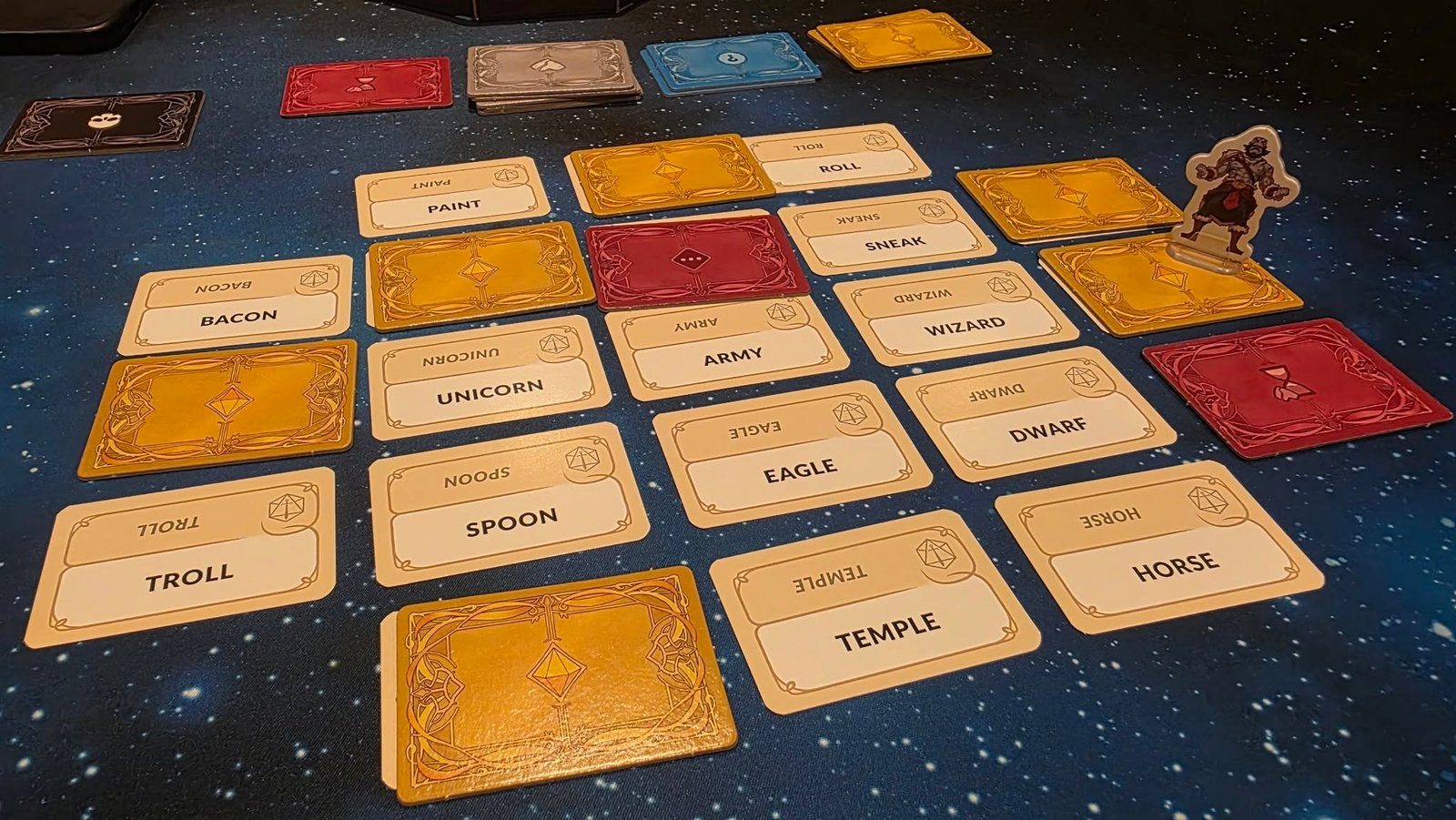
The guessers then choose which word they want to guess and, importantly, which hero is going to make that guess. You place that hero’s standee onto the chosen card and the GM reveals what type of word it was.
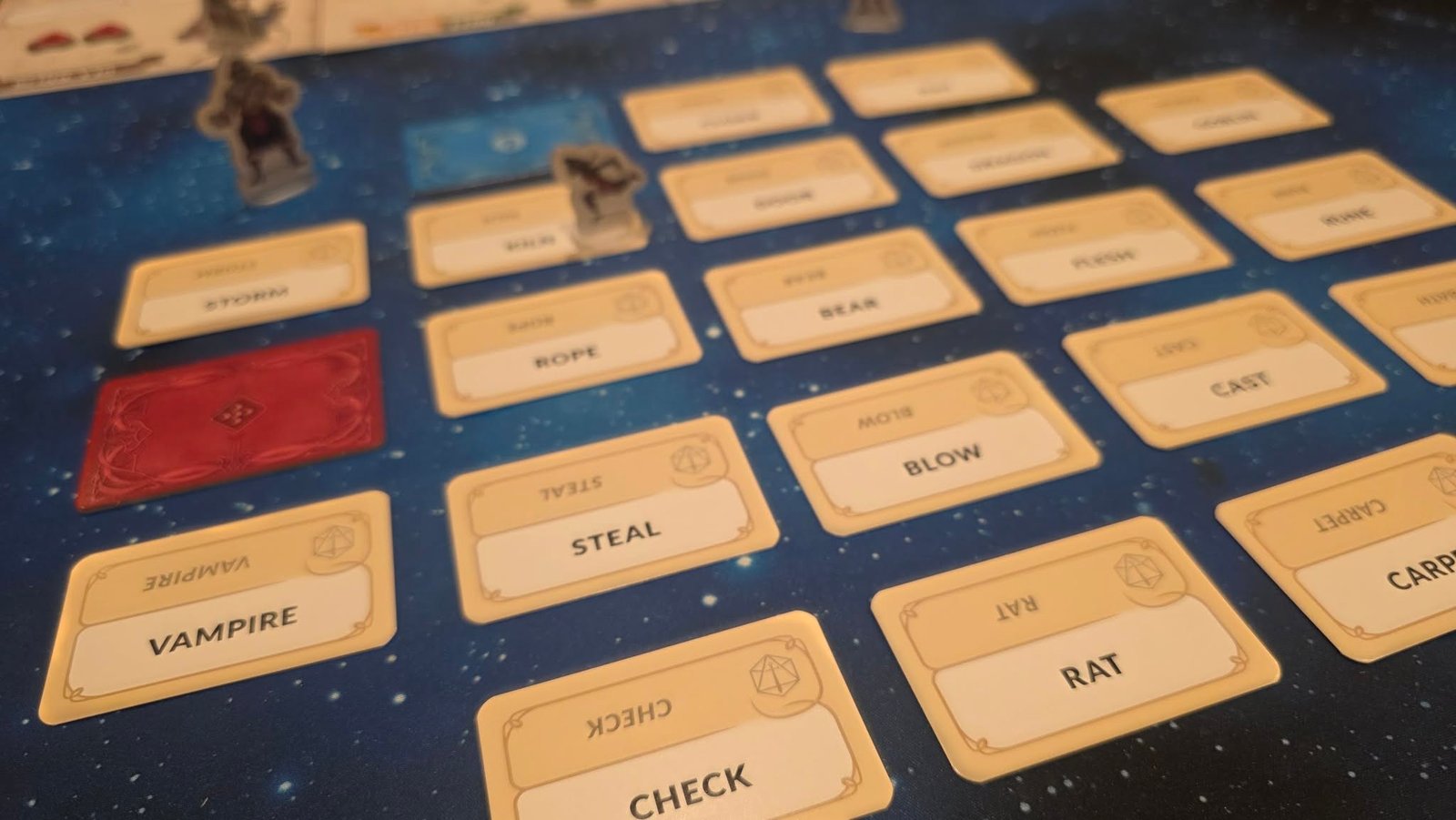
At the start of a campaign, you choose three heroes and they stay with you for the whole journey. For each mission, one player becomes the GM, or clue giver, and sits opposite the players, or guessers. You lay out 21 word cards, while the GM secretly takes a key card showing which words are different colours.
The reason you might choose different heroes here is that they have different abilities and different health pools. You might want to use certain heroes when you’re less convinced it’s going to be the right word, while other heroes might be better when you’re confident you’ve got it right.
Gold and blue words are the ones you want. Gold words earn the guessing hero XP, while blue words trigger a special effect that changes depending on the mission you’re playing. If you get a guess right, you can keep going and, unlike standard Codenames, there is no fixed limit on how many correct guesses you can make in a round.
This really changes the dynamics of how the game plays, and I like it. Sometimes you can afford to be a bit more risky and, on other occasions, you actually need to be if you’re going to beat the mission.
Of course, things get rather less pleasant when you get it wrong. Grey words deal one damage to the hero who guessed them and end the guessing phase. Burgundy words also deal damage, but additionally eat into the amount of time you have left to complete the mission, which can be disastrous. Guess the black word and that’s it: mission over.
You can also choose to stop guessing once you have made at least one guess. When the guessing phase ends, you check whether you have completed the mission objective. If you haven’t, the GM advances time by placing another burgundy tile onto the grid. This can cover up words before you ever get the chance to guess them, gradually reducing the number of words available.
You keep playing rounds like this until you complete the mission or… well… don’t.
A mission is lost if one of your heroes is knocked out, you run out of time or someone hits the black word.
Where things get much more interesting is what happens between missions. Heroes spend the XP they have earned to unlock permanent upgrades, including more health, better dice rolls for their special abilities, extra item slots and new character abilities. These abilities gradually give you more ways to manipulate hidden information on the grid, protect your party or bend the usual Codenames rules in your favour.
You’ll also pick up coins and items along the way. Coins can be spent at shops on equipment, healing and training, while items give your heroes either ongoing bonuses or handy once-per-mission abilities.
This is one area that feels like it could have been expanded a little to include better shops with more interesting special items, as we usually ended up healing and that was that. There also aren’t that many shops during a campaign.
One interesting decision is that your heroes do not automatically heal between missions, so a bad outing can leave you limping into the next one. Once a mission is finished, you update your campaign map, read the epilogue and choose where to head next, gradually making your way towards the campaign finale.
While I said at the start that this is very much a campaign game, and you could of course play it over multiple sessions, in reality the individual games of Codenames are quite short. In much the same way that, when you play regular Codenames, you normally play quite a few games during one sitting, every time we’ve played this we’ve ended up completing an entire campaign in one go.
You normally end up playing around seven to ten missions, depending on how well everything goes, but it is very doable in a single game session if you want to. There is, of course, the option to leave it and come back to it, but these are not 10 to 20-session campaigns like you would see in something such as Gloomhaven, or even something a little more modern and medium-weight such as Labyrinth Chronicles or Ticket to Ride Legacy: Legends of the West.
I really like Codenames: Critical Role Adventures and, outside of the base set, I think this is probably my favourite way to play Codenames.
While I really like regular Codenames, you need a minimum of four people to play it normally and, in reality, I don’t think Codenames really gets good until you have six players. That’s quite hard to achieve on a regular basis for most groups.
This, however, works with two and starts to get really good in terms of having that discussion aspect at three players. It means you can get a really good version of Codenames at a much lower player count than you can with the base game.
Now, while I realise this is obviously cooperative and Codenames: Duet also exists, I actually think this is the better game. The adventuring and light RPG elements really do add to the experience, and the later missions get quite tricky.
You need to start using your abilities to manipulate information in order to get a better idea of what the correct words might be. At some point, the clues the GM gives you are only really half of what’s important. The other things you can do to manipulate the information become just as important when it comes to working out which words are correct and which aren’t.
The artwork is simple but nice. The Codenames-style word cards have obviously been deliberately designed so that you can mix them in with any other version of Codenames. Maybe they could have put some artwork on the tiles, but I don’t mind. I understand why they’ve done it and it’s absolutely fine.
As with quite a few CGE games, there is no real insert in the box whatsoever, and one of my first tasks as soon as I bought it was to 3D print myself an insert. However, the relatively simple production presumably saves a bit of money and, to be honest, it’s actually quite a good price, being fairly easy to pick up for around the £30 mark.
I think Codenames: Critical Role Adventures is a really good little game that I would 100% recommend to people who are interested in wordplay. Playing something like this with your kids, where they’re improving their vocabulary and understanding of language without really thinking about it, is also top stuff.
Definitely my favourite cooperative Codenames, and a really good one to get us started for the new school year.
Disclaimer: A copy of Codenames: Critical Role Adventures was gifted to us by CGE. All of our thoughts and opinions are our own.