 Matthew Bailey
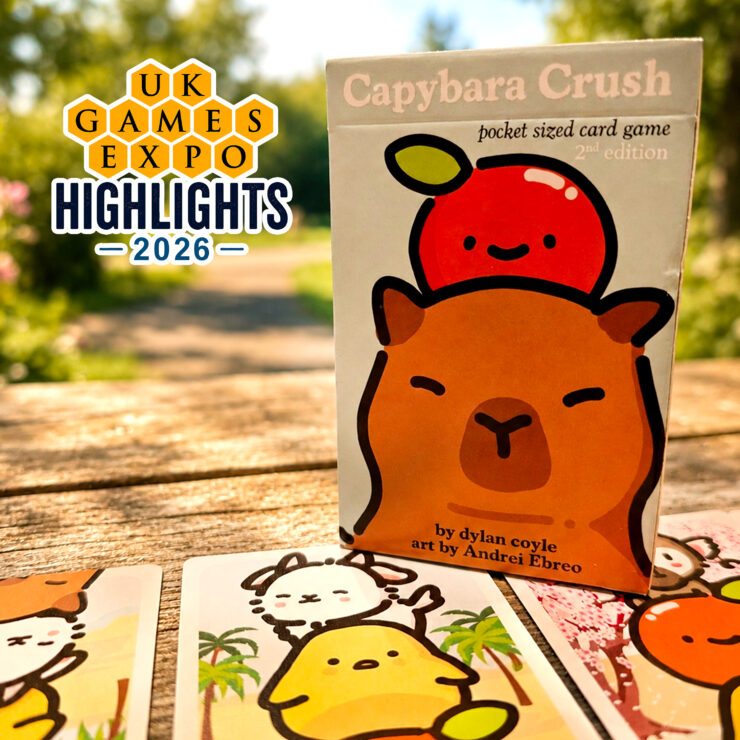
Today we’re going to be looking at Capybara Crush, an adorable puzzle card game from the makers of “Otter”, a game that we reviewed as part of our countdown to UK Games Expo content a little while ago.
In Capybara Crush, you’re building a herd of capybaras and placing critter cards on top of them to create scoring chains. At the start of the game, each player begins with two capy cards (as the rulebook calls them), a favourite critter card, which you have a sneaky, cheeky peek at before spending the rest of the game trying to remember which one it was, three stars and one card in hand. Five critter cards are placed face-up in the centre of the table to form the river, where you can get new cards from.
On your turn, you follow three simple steps. First, draw one card either from the river or blind from the top of the deck. Next, play one card from your hand. You can either place it on top of an empty capy as a critter card, or add it to the end of your herd as a new capy card on either side, up to a maximum of eight capys.
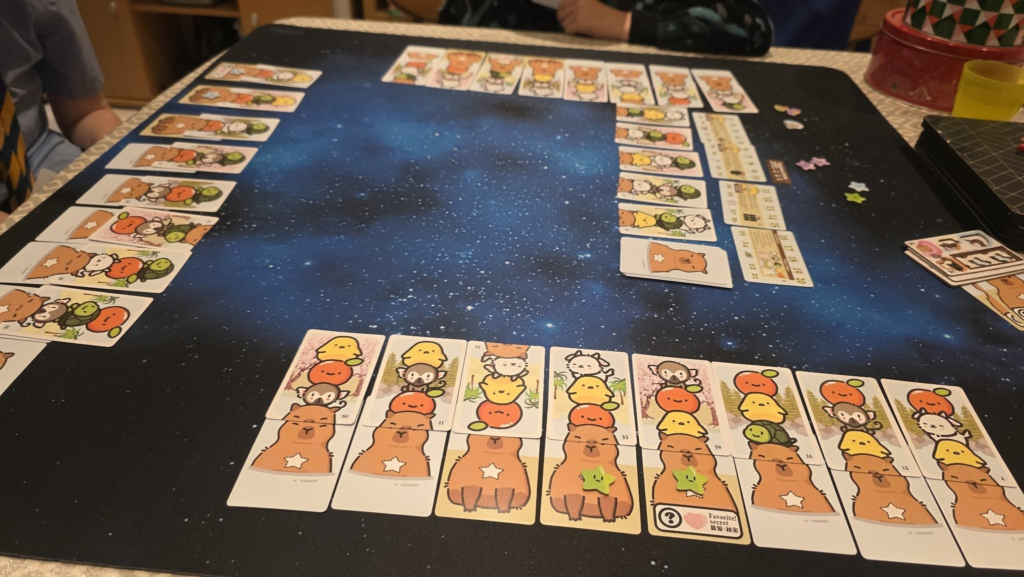
The fact that you have to play a card every turn is really important because it means that the game lasts an exact number of turns. Equally, you end up using pretty much all of the cards in the deck, which is really interesting because you know you’re going to see almost everything. If you’re really good, you can kind of work out what’s left in the deck, although on the playthroughs we had we didn’t get anywhere near that level of skill. If you wanted that extra layer of strategy to be there, though, it absolutely is.
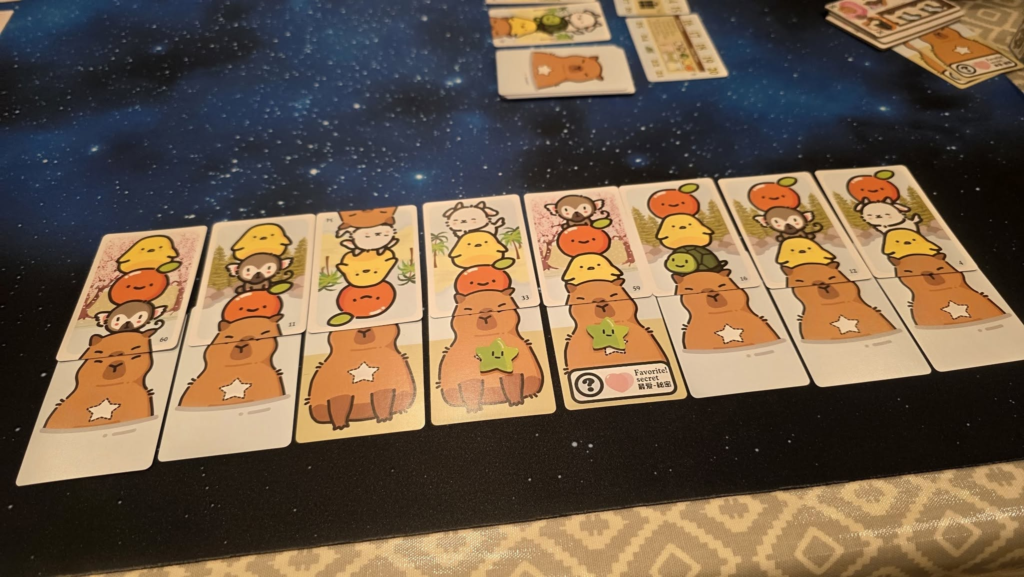
The main way to score points is by creating chains. Chains are made by matching either critter types or background colours. To count as part of the same chain, cards must be adjacent in your herd and the matching critters can only be on the same row or one row apart. Larger gaps break the chain, even if the symbols match further along your herd.
Generally speaking, we found it was relatively doable to get a really long chain of two critters, but getting that third chain to give you some all-important scoring was where the difficulty really came in. Equally, trying to then match up the backgrounds as well became a real mind puzzle.
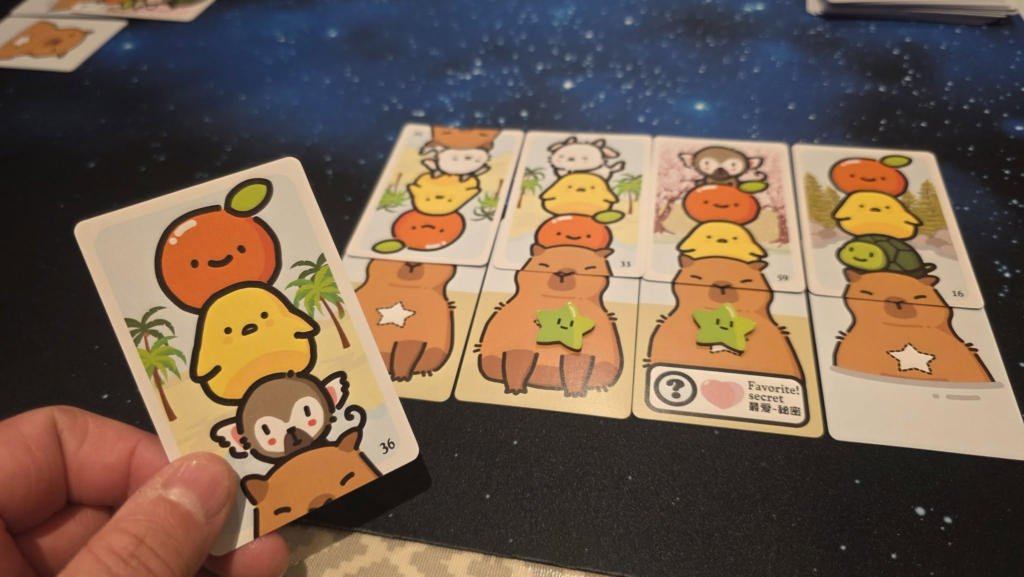
The fact that you have to lay a card every turn also creates some really interesting decisions. Sometimes you find yourself in this odd situation where you need to pick up a card you actually want to use in your chain, while every other pickup is filled with cards that you don’t really need at all. Those less useful cards then become your back-to-front capy cards. It’s a really weird dichotomy. You’re looking for the best feasible cards you can find in the river, but you’re also looking for the worst feasible cards for your own strategy. Alternatively, if you’re feeling vindictive, you can take cards that would be beneficial to your opponents and use those as your capys instead.
This is a really unusual mechanic, but it works really well and gives the game quite a unique feel compared to a lot of other card games where you’re building chains or making sets.
Stars can be spent during your turn to activate special powers shown on the score track. Using a power does not replace your normal turn, so you still draw and play cards as usual. The available powers vary from game to game and can do things such as turn cards upside down, move capys and their attached critters, or allow you to refill the river.
The game ends as soon as any player starts their turn with ten capy cards and ten critter cards in their herd, although the exact amount changes depending on player count. During scoring, players gain points equal to the length of their longest chain for each critter type and each background type. You also score one point for every card featuring your favourite critter and one point for each unused star remaining on your capys. The player with the highest total score wins the game.
All of the games we played were tight. As I previously said, you generally end up with two long chains and then you’re trying to maybe get two shorter chains of another animal going in order to make it work. In all of the games we played, it was close and usually there were around five points separating first place and last place, which meant it was genuinely quite exciting right until the end.
The quality is good and everything fits really nicely back into a really tiny box, which is always welcome. I will say, though, that for a game with such a small box, it does take up quite a bit of space on the table. That’s not a problem, but this isn’t the sort of game you could play in a restaurant. This is a take-on-holiday-and-play-at-the-table kind of game, as opposed to something you could play on a train or in the airport.
It generally feels quite unique. There’s nothing I’ve played that massively springs to mind as being exactly like this. It’s very puzzly, you’re trying to lay everything out, and it’s generally quite low stress once you realise that you’re not trying to pick up every single card that’s good for you. Instead, you need to pick up half the cards that are good for you and half the cards that aren’t so that you can use those as your capys. Once that clicks, the stress levels kind of disappear and it turns into a really nice, cosy card game. Equally, the fact that the games generally end up being quite close means that it works really nicely.
For those of you interested, there are also solo rules included.
Much like “Otter”, we really like Capybara Crush. It’s a really good card game and I am really looking forward to playing other games from Dylan Coyle, as what I’ve played so far has been excellent.