 Matthew Bailey
Game at a Glance
- Players
- 2–4
- Playing Time
- 20–30 min
- Box Size
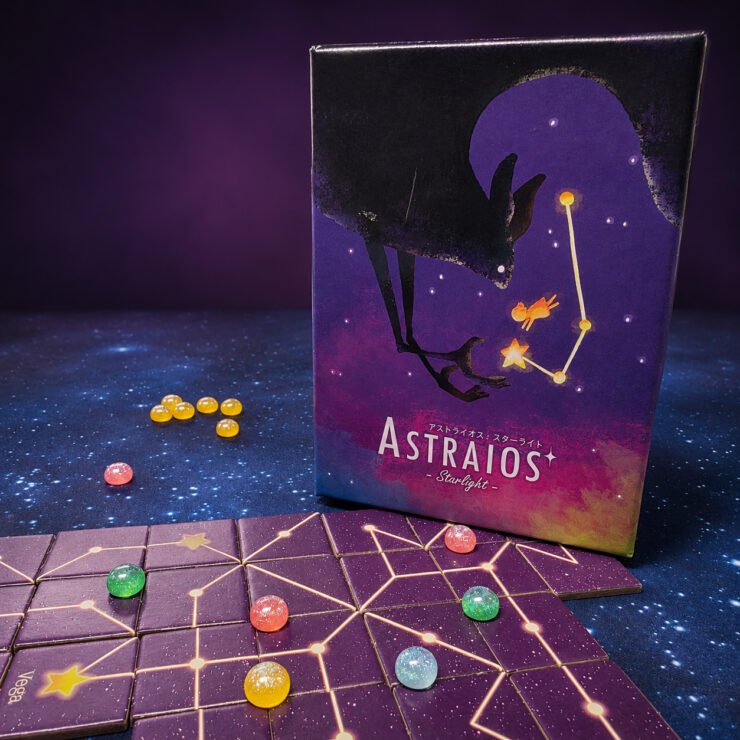
Today we are going to look at Astraios: Starlight, a really simple pocket-sized tile-laying game that basically plays like Carcassonne with only towns and a lot faster… which, if you know what you are getting into, isn’t necessarily a bad thing.
In the game, you take turns connecting stars and creating constellations in the night sky. Your aim is to complete constellations, claim them as your own and collect more points than your opponents based on the stars in each constellation.
To set up, shuffle the 60 star tiles face down and place one tile in the centre of the table to begin your night sky. Each player takes three tiles, which are placed face up in front of them so everyone can see what is available. You also receive eight nebula tokens in your chosen colour.
I am going to stop there and have a little moan about the blue and green nebula tokens. Now, it’s an ongoing thing I moan about when token colours look similar, but the blue and green tokens in this game (which have a pearlescent sheen to them to make it even harder) are so similar in colour that it’s super hard to see the difference, even under bright light. So my recommendation is to only use one of those colours if you are playing with four players, and if you do use both, ensure blue and green are on the same team.
Anyway, back to how the game plays.
On your turn, you choose one of your three tiles and add it to the growing night sky (my usual space playmat worked great for this). Tiles can be positioned next to existing tiles, but you must follow the connecting line rules. You cannot simply place tiles anywhere you like, as the lines must connect correctly or leave the possibility of being connected later.
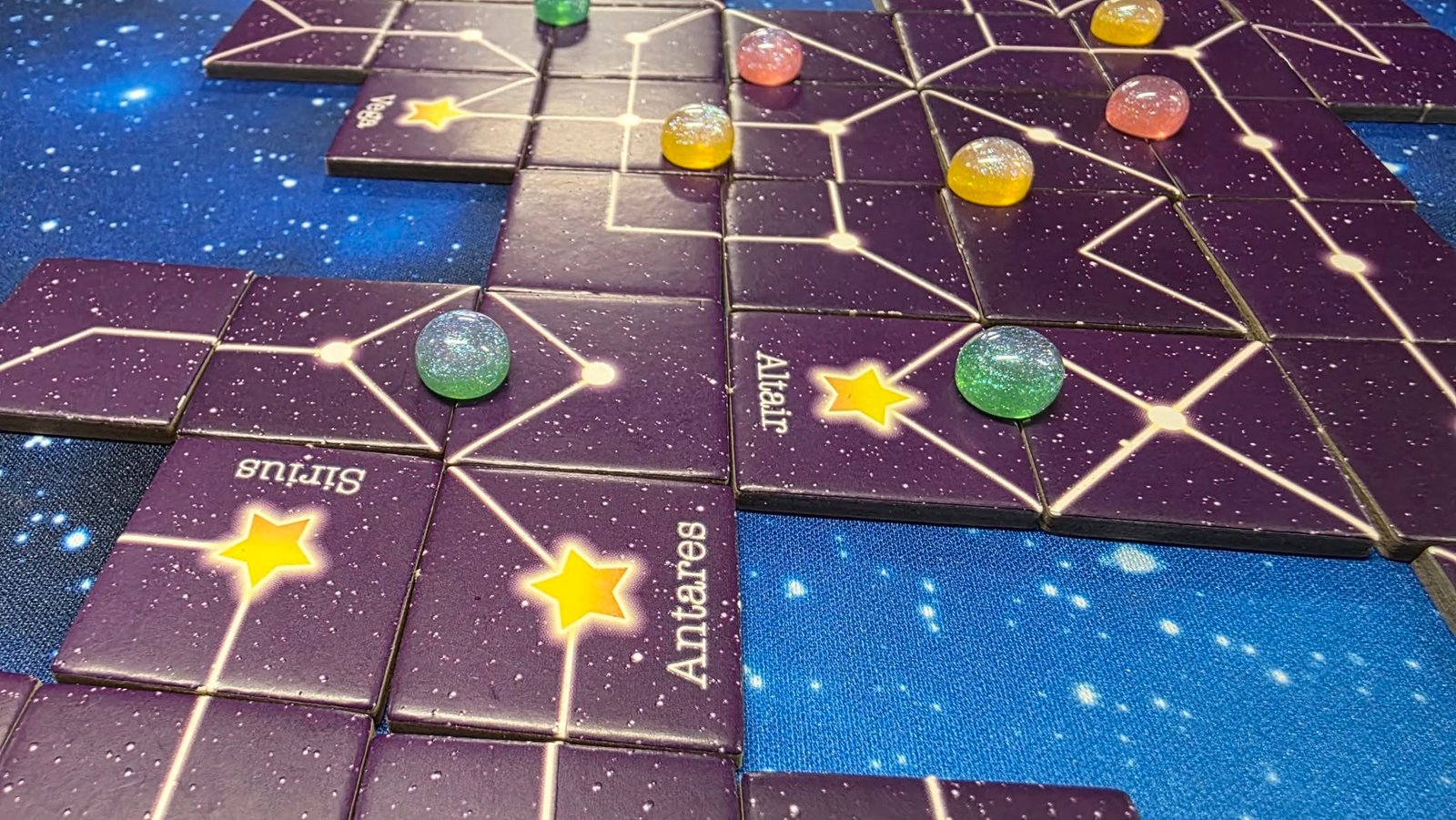
The idea is to use these lines to create enclosed shapes, forming constellations. Whenever you complete a constellation, you place one of your nebula tokens inside it to claim it as your own. If you manage to complete multiple constellations with a single tile (which I don’t think ever happened in any of our games), you can claim them all, provided you have enough tokens remaining (running out of tokens was also never an issue).
There is also a clever little twist. If the player immediately before you completes a constellation, you can choose to move an existing tile instead of placing one from your hand. You cannot move tiles that are already part of completed constellations, and you must ensure that moving a tile does not leave any others isolated. This gives you an opportunity to change the layout and potentially interfere with your opponents’ plans.
After placing a tile from your hand, you draw another to bring your collection back up to three.
Once all the tiles have been played and no further actions remain, you count up the stars inside your claimed constellations. Small stars are worth one point each, while the larger named stars are worth three points each. Whoever has the most points wins.
One thing that is really strange is that you can play the game with up to three players competitively, all against all, but when you get to four players, you have to play in two teams. While working in teams works perfectly fine, it is a bit weird. I think the reason for this is that, inherently, going later does have its disadvantages, and I suspect the team format is there for balance. Perhaps it just wasn’t balanced enough with four players all against all, but if you really want to, you could probably play it that way anyway, and I don’t see why it necessarily wouldn’t work.
Visually, the game is really nice. The tiles look great, and I’ve already mentioned my issues with the colouring of the nebula tokens, but otherwise everything is fine.
Oddly, one complaint I do have is about the box. It’s pocket-sized, which is great, and it can easily fit into a bag, which really complements the fact that this is essentially a very fast Carcassonne-style game. However, the box lid is quite shallow and rather loose, meaning that if you put this in a bag and, like me, you’re not the sort of person who normally puts an elastic band or anything else around their boxes, the lid is probably going to come off.
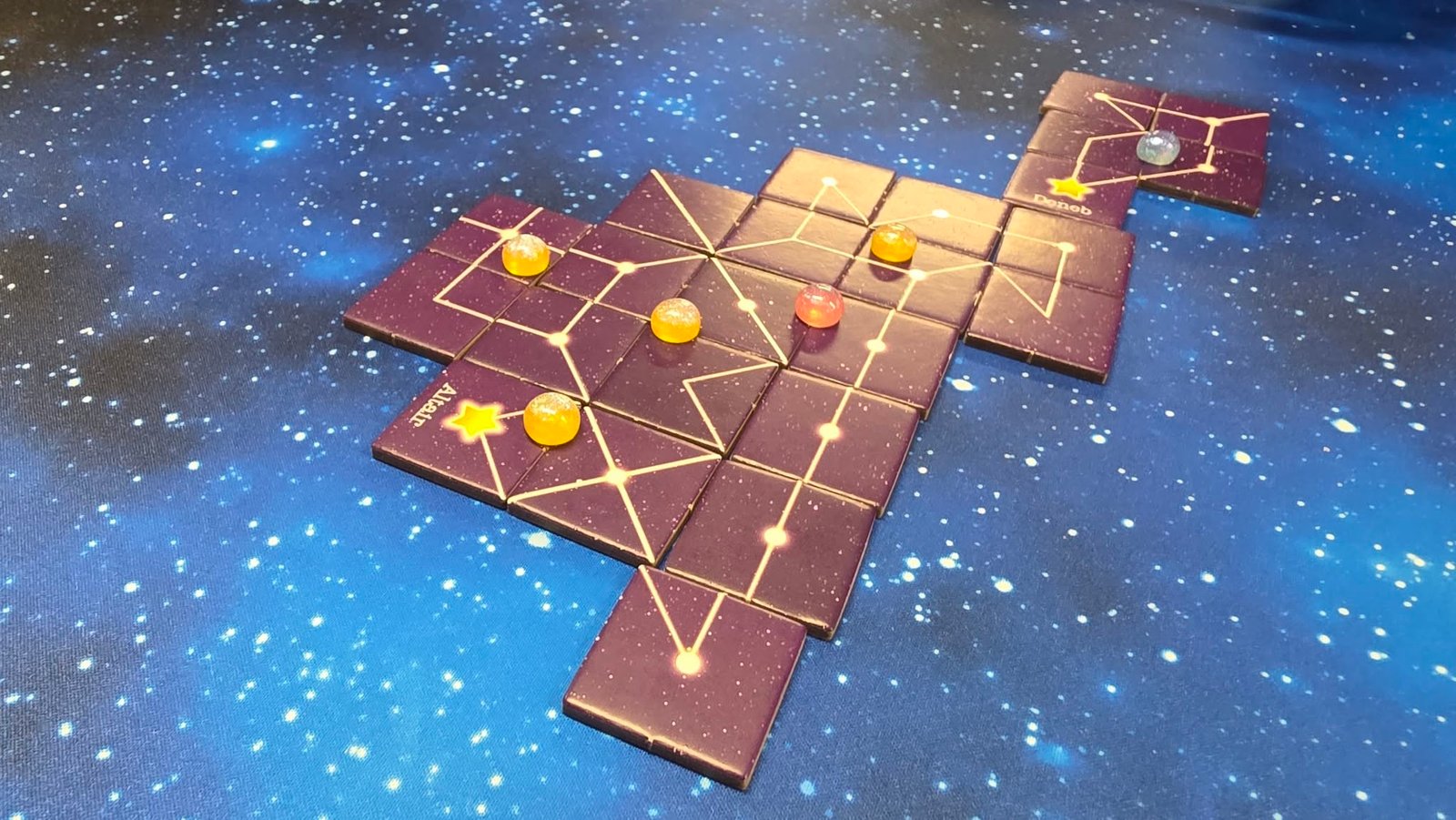
When this arrived in the post, the lid was already off, and I was originally worried that I’d lost half the pieces. Luckily, I hadn’t, but it’s something to be aware of. This box definitely could have had a tighter lid, or perhaps it could have been a tuck-top box instead. I don’t know.
The gameplay itself is really good fun, and you know exactly what you’re getting. It’s basically like playing Carcassonne with three players or in two teams of two, where you’re just trying to complete cities, and that’s pretty much it.
It works really well as a quick little game that doesn’t take very long. Obviously, though, as it’s a tile-laying game, it does take up quite a bit of space, so it’s not the sort of thing you’re going to play in a restaurant or probably on a plane.
But if what you’re looking for is a much quicker, more portable, tiny version of Carcassonne (and I’m actually quite surprised they’ve never done a pocket-sized Carcassonne, but that’s a question for another day), then it’s a good shout.
There are definitely stronger tile-laying games out there, and this isn’t one I would come back to regularly, but for what it is, it’s a good little game.
Disclaimer: A copy of the game was loaned to us by Phantomlab via the UKBG Review Circle. All our opinions are our own.