 Matthew Bailey
Game at a Glance
- Publisher Age
- 7+
- LBG Recommended Age
- 6+
- Players
- 2–3
- Playing Time
- 20–60 min
LBG age recommendations are based on children familiar with modern board games, with adult guidance where appropriate. Every child is different.
At the time of posting Aster is a few days away from finishing on Kickstarter. I have only just received it but managed to get all the needed plays in quickly.
I really like abstract strategy games, but as is very often the case with games in the Bailey household, we are playing with three people. Abstract strategy games don’t normally work particularly well with three players, especially those that are symmetrical, as they are often designed primarily for two players.
Aster, which is on Kickstarter now (and actually, at the time of writing this, ends in a few days, so I really need to squeeze this review in), is probably the best symmetrical abstract strategy game I’ve ever played at three players. In fact, I would say it plays better at three players than two. Let me explain.
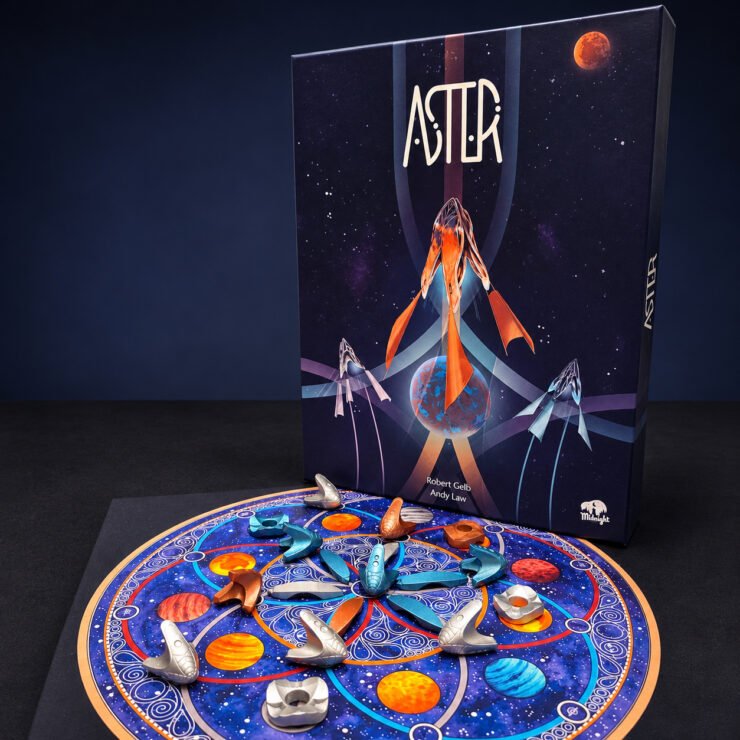
In Aster, you are competing to spread your influence across the stars by moving your ships, known as Skysails (but you will end up calling them ships), around the board, establishing Castras (bases) on planets and eventually placing your Asters in the centre to claim victory.
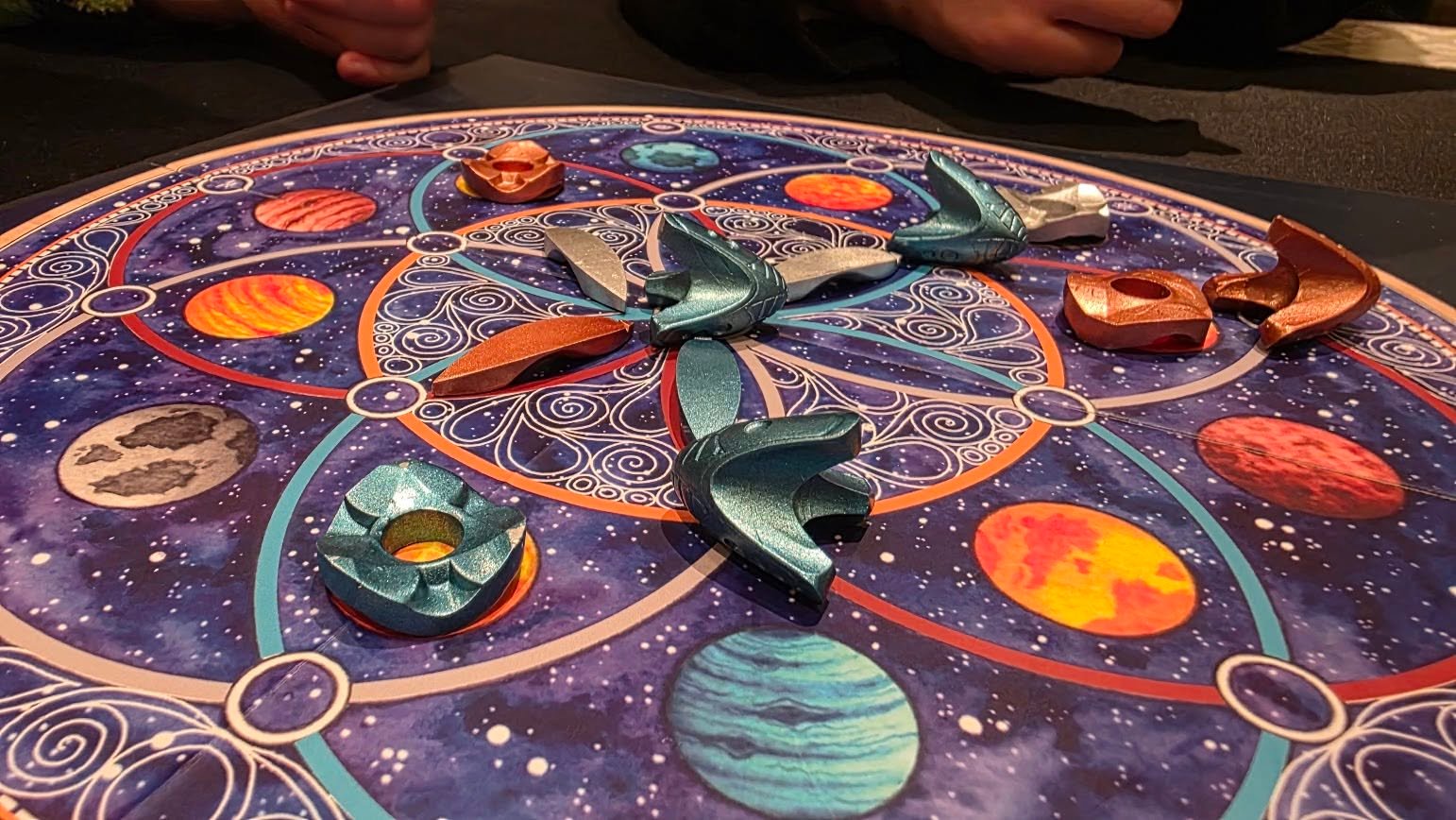
To set up, each player chooses one of three faction colours, which determine where you can move in the game, as you can only use your own colour and the neutral gold spaces. However, in a two-player game, you can also use the unused faction’s colour.
On your turn, you have two options. Most of the game is spent taking the first option, Sail & Castra, which consists of two actions.
First, you take a Skysail action, moving or attacking with one of your ships. Skysails have a value of one, two or three, represented by the number of dots on them. This is a really cool use of the pieces, as you rotate them, with their indents telling you what level they are. Love that.
Interestingly, the stronger your ship, the less movement it has. Three-dot ships can move one space, while two-dot ships can move two spaces and change rings at intersections. One-dot ships can also move two spaces but have the additional ability to travel between special Whirl spaces, allowing them to jump across the board.
You can also attack an opponent’s Skysail by leaping over it as you move, draughts-style. This reduces its value by one, meaning a three-dot ship becomes a two-dot ship, and so on. If a one-dot ship is attacked, it is destroyed and removed from the board. Alternatively, if your ship begins its turn next to an opponent’s Castra, you can destroy that instead, although your ship loses one value in the process, making it a risky action.
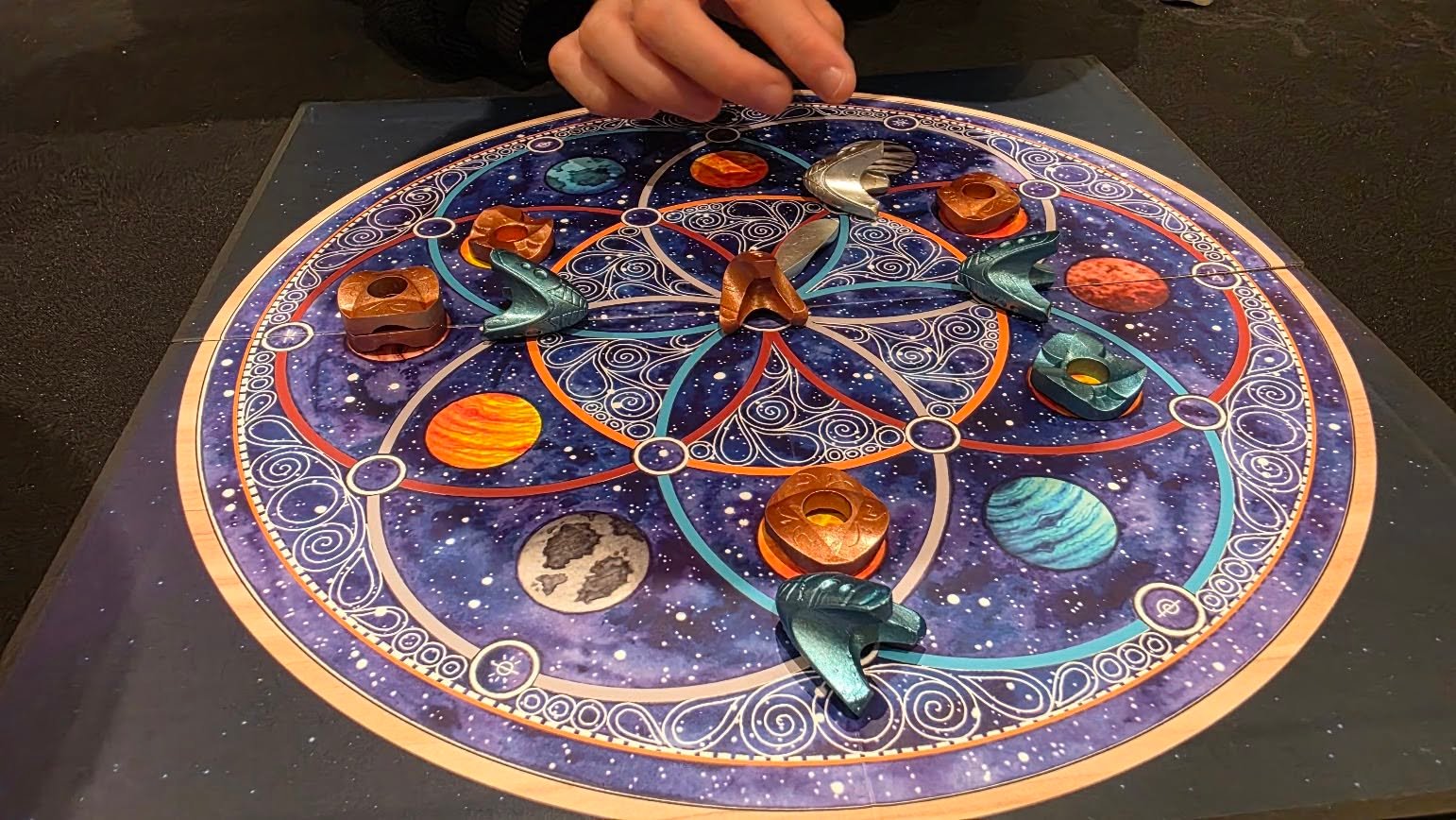
Once you have completed your Skysail action, you take a Castra action, choosing from three possibilities.
You can place a new Castra on an available planet, add another to a planet you already occupy, or convert one or more of your Castras into a new Skysail. The number of Castras you sacrifice determines the strength of your new ship, up to a maximum of three. These Castras must be stacked or on adjacent planets (and they stack beautifully, more on that in a bit), and your new ship is placed next to one of the planets you removed them from.
If an opponent’s Skysail is next to one of your Castras, you can attack it, reducing its value by one without losing your Castra.
If you have no Skysails on the board, you simply skip the Skysail action and go straight to your Castra action.
Your second main turn option is to place an Aster (which basically represents your line of influence and is your main winning condition). To do this, you must begin your turn with one Skysail in the very centre of the board and another on the surrounding neutral ring. You can then place one of your petal-shaped Asters between these two ships, provided the space doesn’t already contain an opponent’s Aster.
Doing this reduces the value of both ships by one, potentially destroying them if they only have one dot remaining. This means you need to think carefully about when to place your Asters and whether sacrificing your ships will leave you vulnerable.
The aim is to be the first player to place four Asters in a two-player game or three Asters in a three-player game.
There is also a sudden-death rule if players reach the same number of Asters just before victory. In this situation, you can place an Aster on top of an opponent’s existing Aster, with the first player to do so winning the game. This actually happened in most of the games we played.
Aster is a game that I actually think works particularly well with younger children, in that the ruleset isn’t too complicated and you can play this with a relatively limited amount of strategy, just making moves as you go. It has a very draughts-like feel to it, but when you get deeper into the game and really start to think about and plan moves ahead, and try to gauge what the other player is going to do, it starts to become a lot more tactical.
Quite often, the way to win isn’t to slowly gain your Asters. It’s to plan ahead and try to do everything in a couple of turns, as placing an Aster early on can leave you vulnerable later.
As I said at the start of my review, abstract strategy games, especially these symmetrical ones, often don’t work very well with three players, yet this one works really well.
The circular board is great, and the whole concept of the concentric rings works well. It means that positioning really adds to your strategy. It’s not too complex, and you could teach a young gamer how to play this relatively quickly.
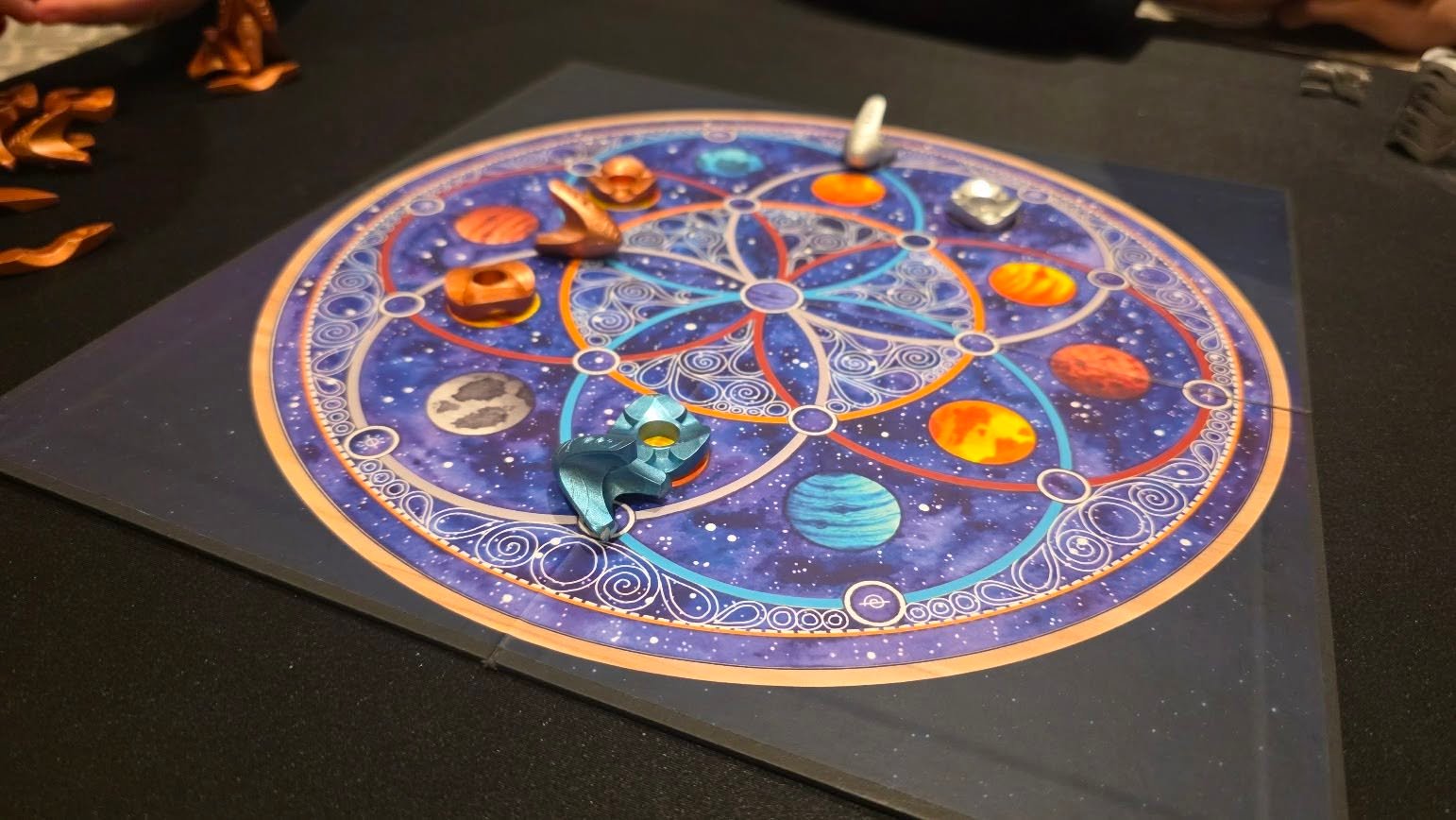
Visually, the game is really impressive. The circular board stands out really well, and the pieces have a really nice colour to them and are designed really nicely as well. They all fit together beautifully, which the designers openly admit has nothing to do with gameplay. It just gives you something to fiddle with while you play, which is a nice touch.
It’s worth mentioning that the pieces I have played with are pre-production pieces, but from what I’ve seen, the pieces in the final version will actually be even better than these ones.
If you like abstract strategy games, and especially want one that plays really well at three players, this is a really good suggestion and definitely a game that I know will get a lot more play in our house.
Here is the link ot the Kickstarter – https://www.kickstarter.com/projects/midnighttradingco/aster-a-game-of-skysails-strategy-and-stellar-influence
Disclaimer – A prototype copy of Aster was kindly provided by Midnight Trading Co. for the purpose of review. All of our thoughts and opinions are our own.