 Matthew Bailey
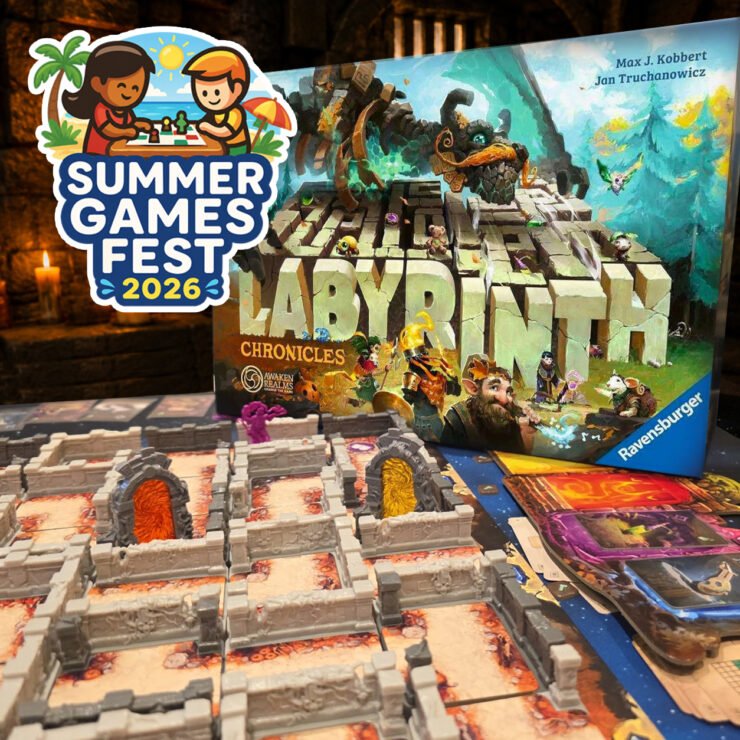
Today I am really excited to talk to you about Labyrinth Chronicles, produced by Awaken Realms in partnership with Ravensburger as part of their Classics Reimagined series, which isn’t its actual name, but that’s what I’ve been calling it! It’s a game I purchased a few months ago from the Kickstarter, but I didn’t want to rush out a review as this is a campaign game, and I wanted to make sure I had a really strong overview of the game before I gave you my thoughts.
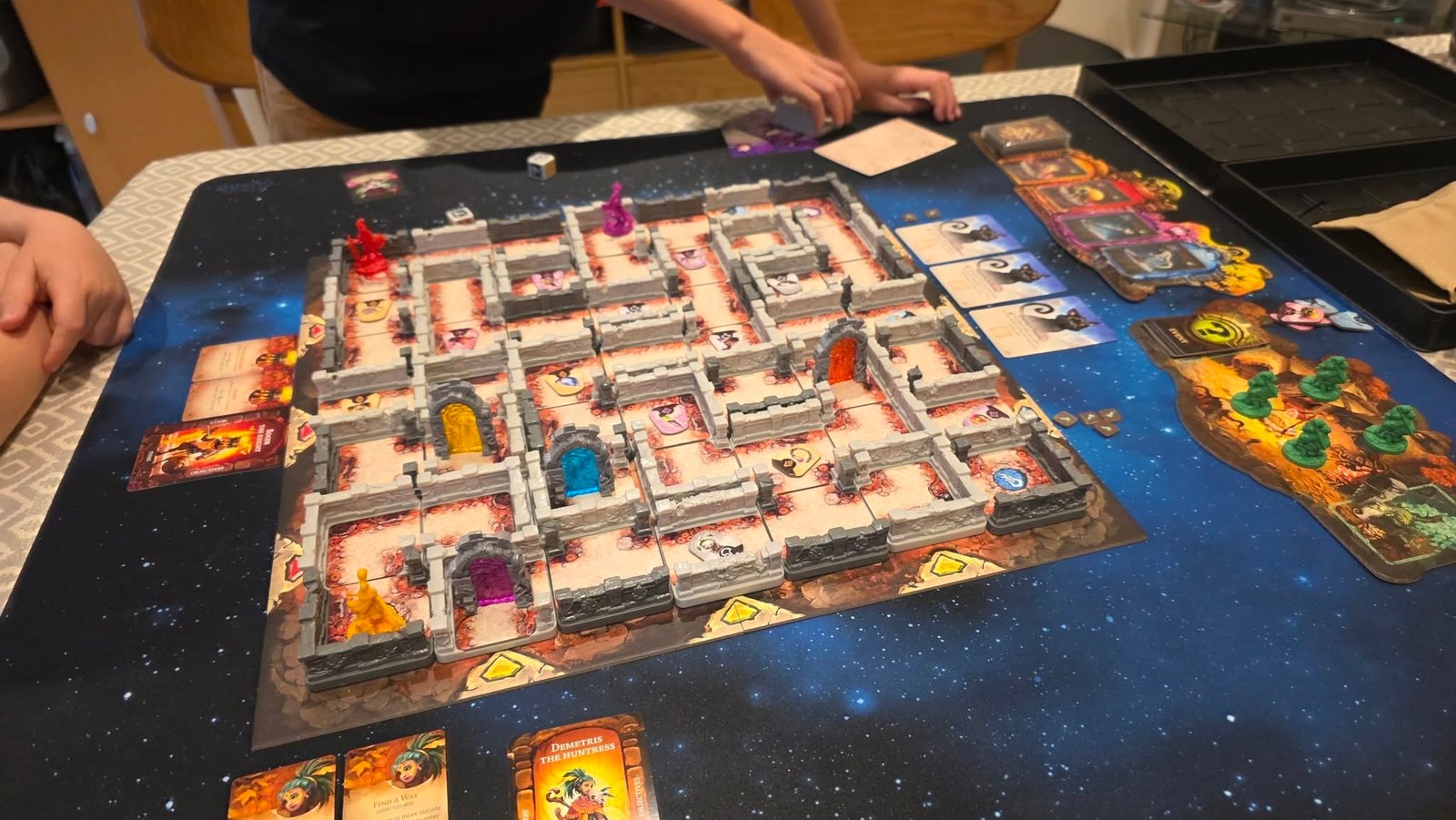
Firstly, it’s worth mentioning that there will be some extremely light spoilers in this review, but I’m going to try and keep them to the absolute minimum. All of the photos you can see are from the first two games that we ever played, and later mechanics I’m only going to talk about in general terms to give you an idea of how the game progresses, as opposed to giving you anything too specific. The sense of discovery in this game, and the constant extra things being added, is partly what makes this campaign so enjoyable.
Before we even start, it’s worth saying that this can be played as a really high-end version of the normal game Labyrinth, and for that it’s wonderful. The pieces are really nice, everything is ultra-premium, and what I really like about this is that it’s taking a relatively simple game and making a really high-end version of it.
If you as a family really enjoy playing normal Labyrinth, even if you think you’re not going to play the campaign (but why wouldn’t you? But let’s go with it!), this is something that would be a really lovely thing to own as a focal point for your gaming collection.
Don’t get me wrong, this is expensive. Generally it goes for about £130, which, while expensive as far as family-weight board games go, is about where I’d expect a big-box game like this to sit. Based on everything I’ve played, though, I think you are getting a lot of value in the box.
Before we even start, I’m also going to say that if you don’t like Labyrinth, this isn’t going to be something that suddenly changes your mind. But if you really like Labyrinth, or even if you kinda like Labyrinth (which is where I sat: I like Labyrinth, but I don’t LOVE it), there is a lot here to enjoy.
I am gonna split this slightly lengthier-than-normal review into two sections…
IF YOU HAVE NEVER PLAYED LABYRINTH, START HERE
At its core, Labyrinth Chronicles is built around the same basic idea as Labyrinth, of which there are many reskins currently available, and I suspect the vast majority of you either own one or have played Labyrinth.
The basic concept of Labyrinth is that you are trying to find treasures in an ever-moving labyrinth of maze tiles. The board is made up of a grid of maze tiles, with some fixed in place and others able to slide around. One tile always sits outside the board, and on your turn you can push this spare tile into one of the marked rows or columns. This shifts the whole line across and pushes another tile out of the opposite side, which then becomes the new spare tile. You can rotate the tile before inserting it, allowing you to change the shape of the maze and open up new routes around the board.
Movement itself is very simple. Your character can travel as far as you like along any continuous connected path, so there is no dice roll or movement ‘points’ to worry about. If the maze connects all the way from where you are standing to the other side of the board, you can move there in a single action and hopefully claim some treasure.
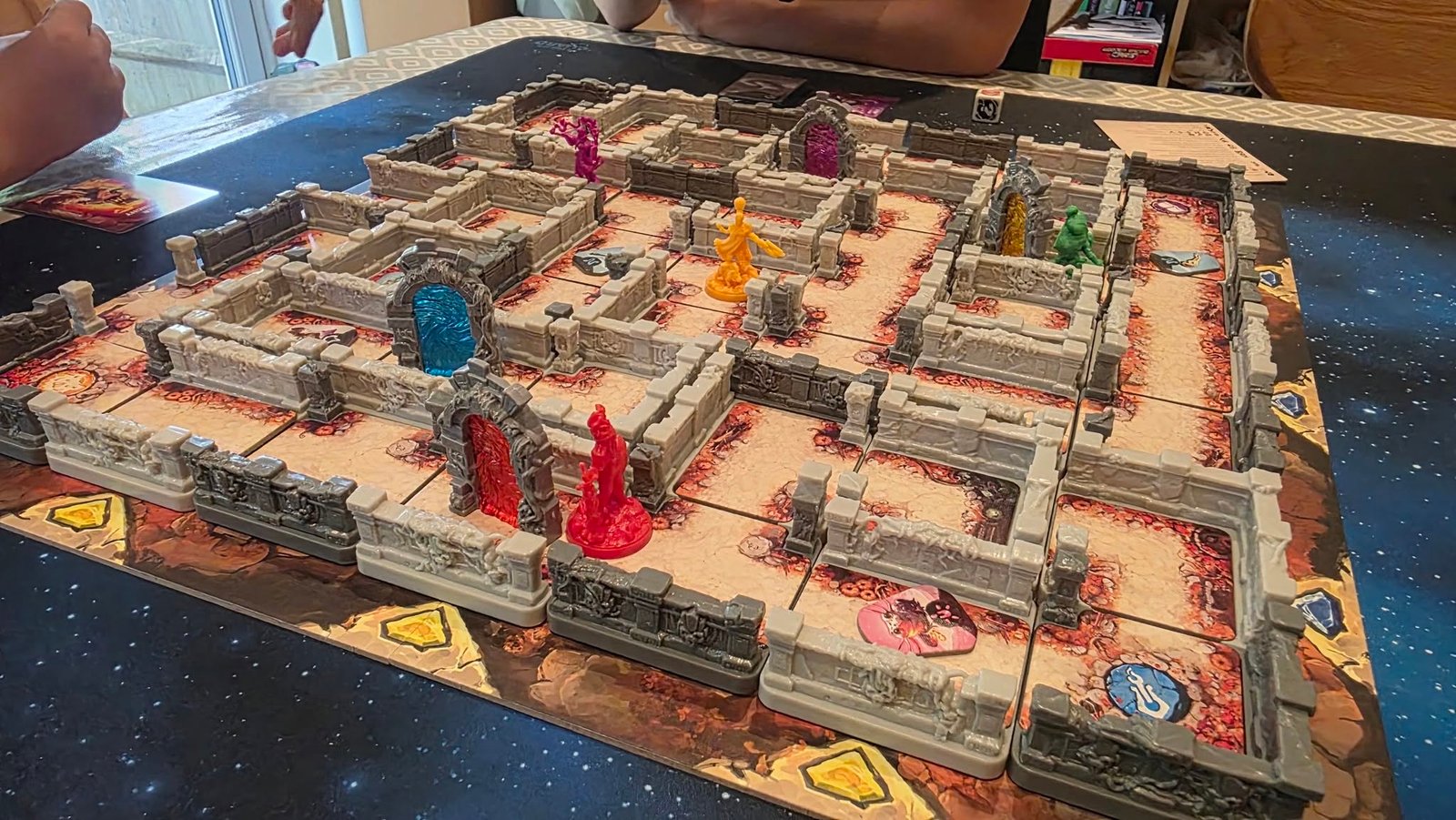
This means the main puzzle comes from looking at the current layout, working out where you want to get to, and then deciding how shifting one row or column will change the available routes. On your turn you can perform one Move and one Shift, in either order, so you can move somewhere first and then alter the maze, or manipulate the board before travelling through the route you have just created.
The reason you are doing this is that each player is trying to find a series of treasures hidden around the maze. You are dealt cards showing the treasures you need to reach and, one at a time, reveal the next one you are looking for. By shifting the maze and moving your piece along the connected paths, you try to reach the matching treasure before moving on to the next card.
Once you have found all of your treasures, you then need to make your way back to your original starting space. The first player to collect all of their treasures and return home wins.
IF YOU KNOW LABYRINTH, START HERE
Where Labyrinth Chronicles changes things is that this familiar maze puzzle is turned into a cooperative campaign. Instead of simply racing around the board collecting your own targets, everyone is working together across a series of games to collect Items, rebuild Fairy Vale, which is ravaged by a usually friendly dragon in the opening moments of the narrative, and progress through an ongoing story.
During each expedition there are four coloured Portals in the Labyrinth, each linked to an Item card on the Portal board. Your main aim is to reach these Portals and collect the Items before the Goblins get to them. Whenever an Item is collected, a new Item card is revealed and that Portal moves to the Echo token matching the new card, so the locations you are aiming for continually change as the game progresses.
Unlike normal Labyrinth, where the items are fixed to the tiles, these Items, both in terms of their potential location and the Portal location, aren’t fixed, which allows all sorts of movement shenanigans later.
Goblins, which are the main antagonists at least at the start, add a bit of pressure to this. During the Labyrinth Phase at the start of each turn, you roll a die which can either trigger an Event (which normally isn’t great) or activate a Goblin Looter. When a Looter is activated, it appears at the matching Portal. If one is already there the next time that colour is activated, it steals the Item instead.
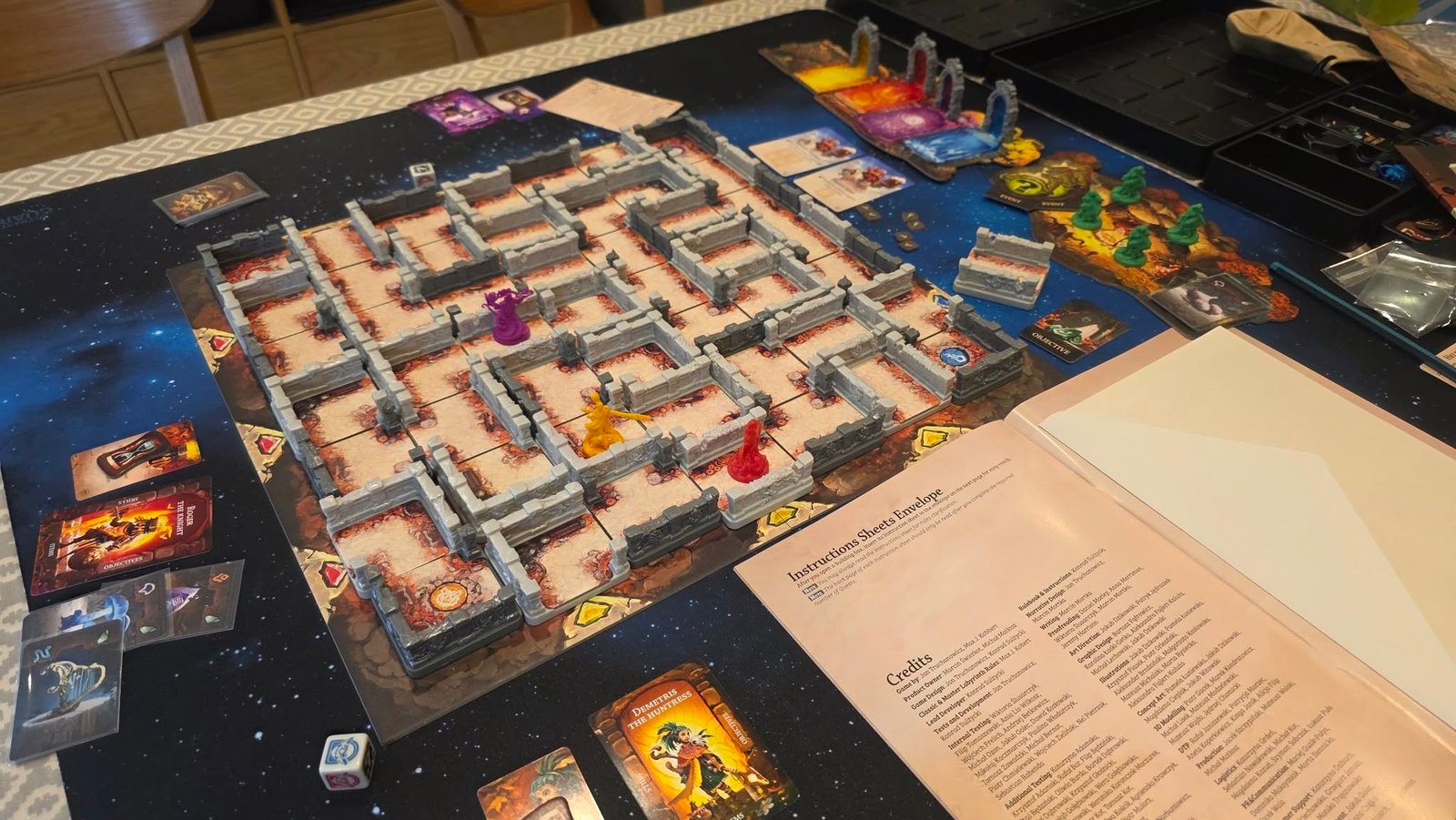
One thing I will say is that there is no blank side or really any positive outcome, which means it’s constantly adding pressure. This is fine, but I think having a blank outcome would have been nice to occasionally give you those ‘thank the stars for that’ moments.
You can deal with Looters by ending your movement on their tile, which knocks them out and sends them back to the Goblin board. Later in the campaign, additional enemy types are introduced, but I won’t go through those here and will leave them as a surprise.
The biggest difference, though, is what happens between games. Every Item collected by the players earns a Crystal, and those Crystals are kept as your campaign currency. You can then spend them in the Shop to rebuild buildings in Fairy Vale or buy Scrolls that give you useful one-use effects during future games.
Repairing buildings is how much of the new campaign content is unlocked. Each building has its own box containing things such as new Skills, Quests, Objectives, Village cards and other components. You won’t open every building during a single campaign, so the choices you make about what to rebuild also change what becomes available later.
What is really cool with these is that you get a magnet of each building, and the inside of the box lid has a magnetic scene, so you can stick the magnets onto the box lid, physically rebuilding your village as you play.
Skills give characters extra abilities or additional ways of manipulating the maze, such as an instant out-of-turn movement or the ability to warp around the side of the map through gaps, while Objectives provide extra opportunities to earn Crystals. Quests give you additional goals to complete during your expeditions, and completing them can unlock further parts of the associated building, getting you progressively more stuff.
These form an album of buildings which ends up being really cool.
There is also a larger Chapter system running throughout the campaign. If you collect enough Crystals during a single expedition, you can complete a Chapter and read the corresponding part of the story. Chapters can introduce new rules, Items, Events and enemies, gradually making later games different from your first few trips into the Labyrinth.
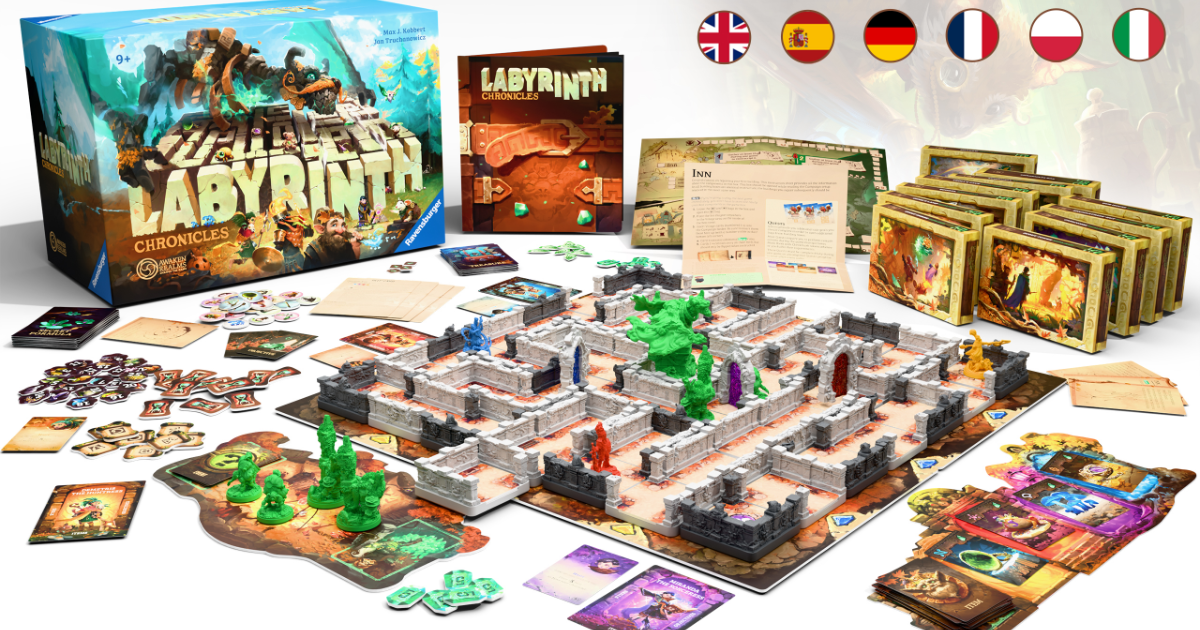
Everything unlocks at a reasonable pace, and we were pretty much getting something new every single game, which I think is important in campaigns like this.
The Goblins have their own campaign progress as well. Every Item they steal moves them further along the Goblin track at the end of the game, with certain spaces triggering penalties or additional story events.
So mechanically, you still have the familiar Labyrinth puzzle of sliding tiles around to create connected paths. Chronicles then builds a cooperative adventure around it, adding changing objectives, enemy pressure, character abilities, unlockable content, village building and a story that develops over multiple games.
It all works exceedingly well, and the whole thing is a really high-quality experience to play.
In terms of the components, they are wonderful. Each of the tiles is replaced with a full 3D tile, which you can paint if you want to. We don’t generally paint our board games, purely because of the sheer number of different games we play, but I have seen painted versions of these and they look absolutely wonderful.
Because you’re generally moving walls around, though, the grey walls work absolutely fine, and the fact that there are nice cardboard floors to the tiles makes everything look really pretty anyway. The miniatures are cool and the colours are fun, making a nice distinction between everything, while all of the artwork is really good.
Overall, the whole thing is extremely fun to play, and this is a really good way of bringing a fairly simple family game into a high-end, quality product.
I absolutely love Labyrinth Chronicles. It’s worth saying that I’m not a massive, massive fan of Labyrinth. I like Labyrinth, and I think it’s a reasonably decent game, but it would never be my number one choice. However, all of the elements that go into this campaign game really bring the whole thing together, and I can’t see myself playing any version of Labyrinth except this one again.
The campaign is really well done, and if you have younger kids and are looking for a first step into a larger campaign game, but don’t quite feel you’re ready for something more meaty like Descent or Gloomhaven, then this is definitely one I would recommend.
At about £120-ish, it’s not the cheapest, but you are definitely getting your money’s worth in this box compared to other big-box games I have purchased and played for around a similar price point. I really hope we can see some more lighter family games converted into high-end products by Awaken Realms.