
 Matthew Bailey
Temple Twist – A fun, clever dexterity puzzler that works best in its base modes, but doesn’t quite make it to must-buy territory.
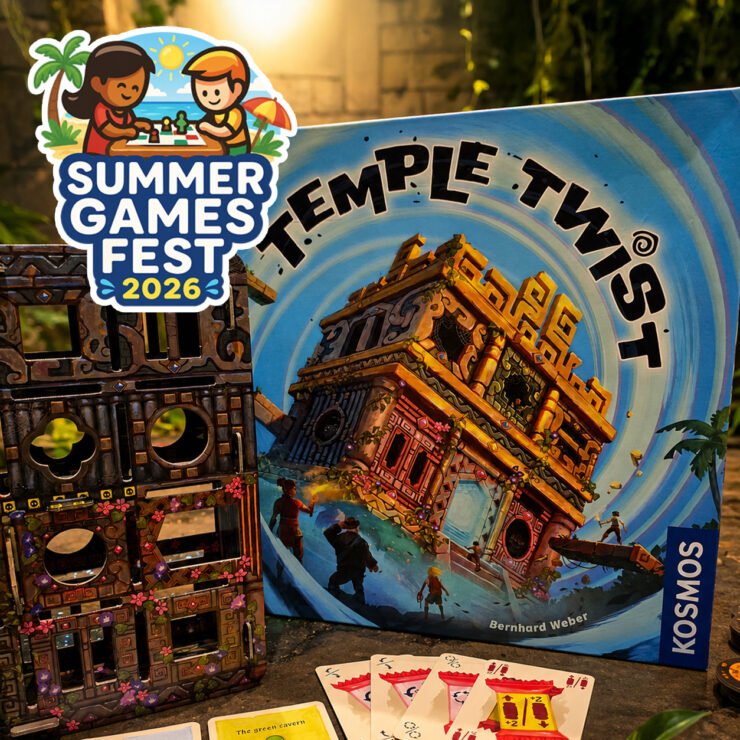
Today we are going to be looking at Temple Twist, a cooperative spatial dexterity puzzle game from Kosmos that the boys and I have been playing this week.
Essentially, in Temple Twist you are all working together to explore an ancient temple and escape before you run out of energy (cards available for you to use). Your explorer is represented by a big dice inside the temple, but you can’t move the dice directly. Instead, you have to move it around by rotating the entire temple and manipulating the walls inside. If you like Zelda-style action RPG video games, it plays a lot like those types of puzzles where you have to slide things, usually on an icy surface, to get a statue to end on a sigil on the floor and open a door to the next area.
At the start of the base game, two room cards are revealed along with a door card showing the exit you will eventually need to reach. Five movable walls are placed inside the temple and the action cards are divided between the players. These cards are effectively your group’s energy, so once they are gone, you are in trouble.
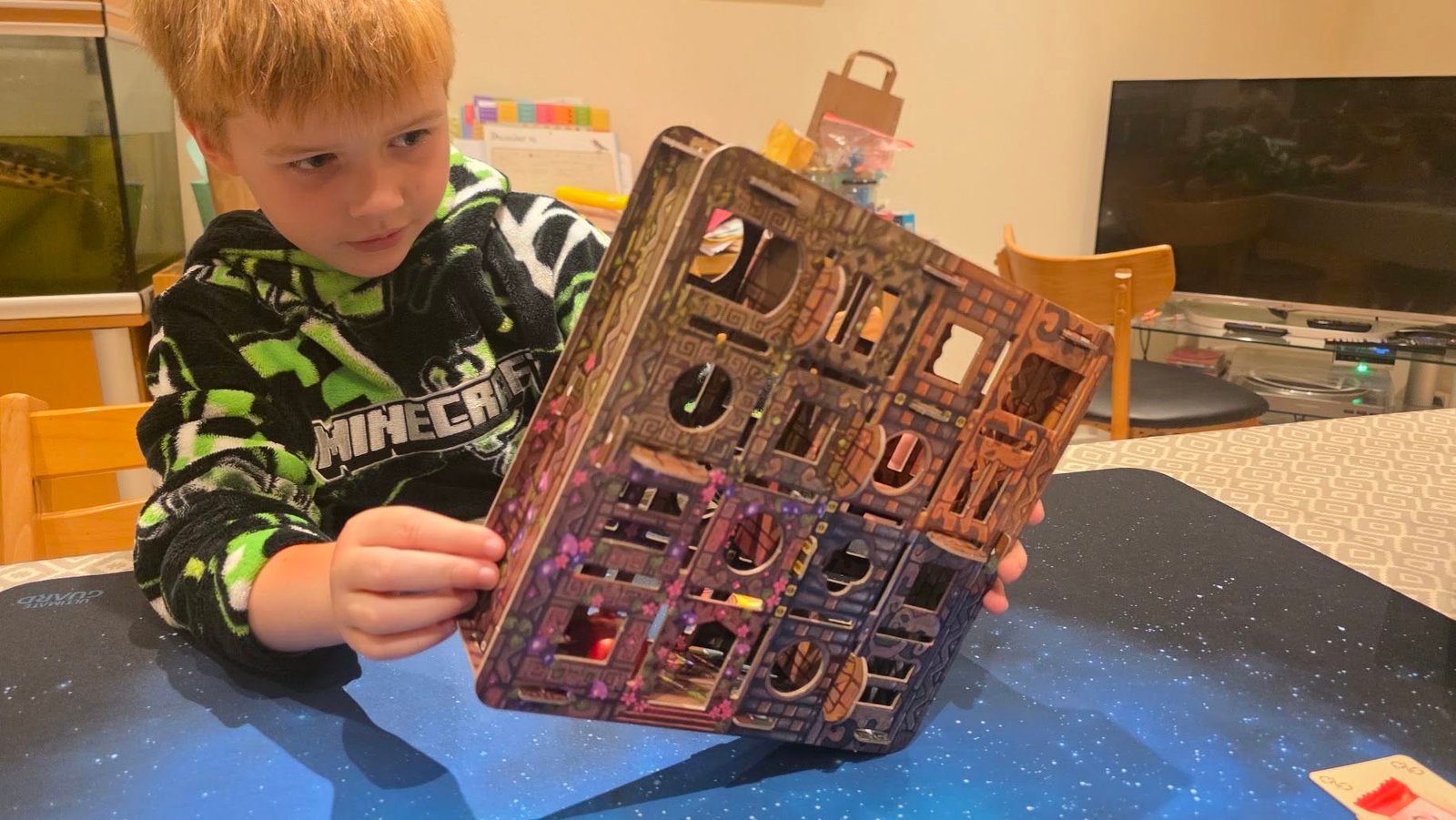
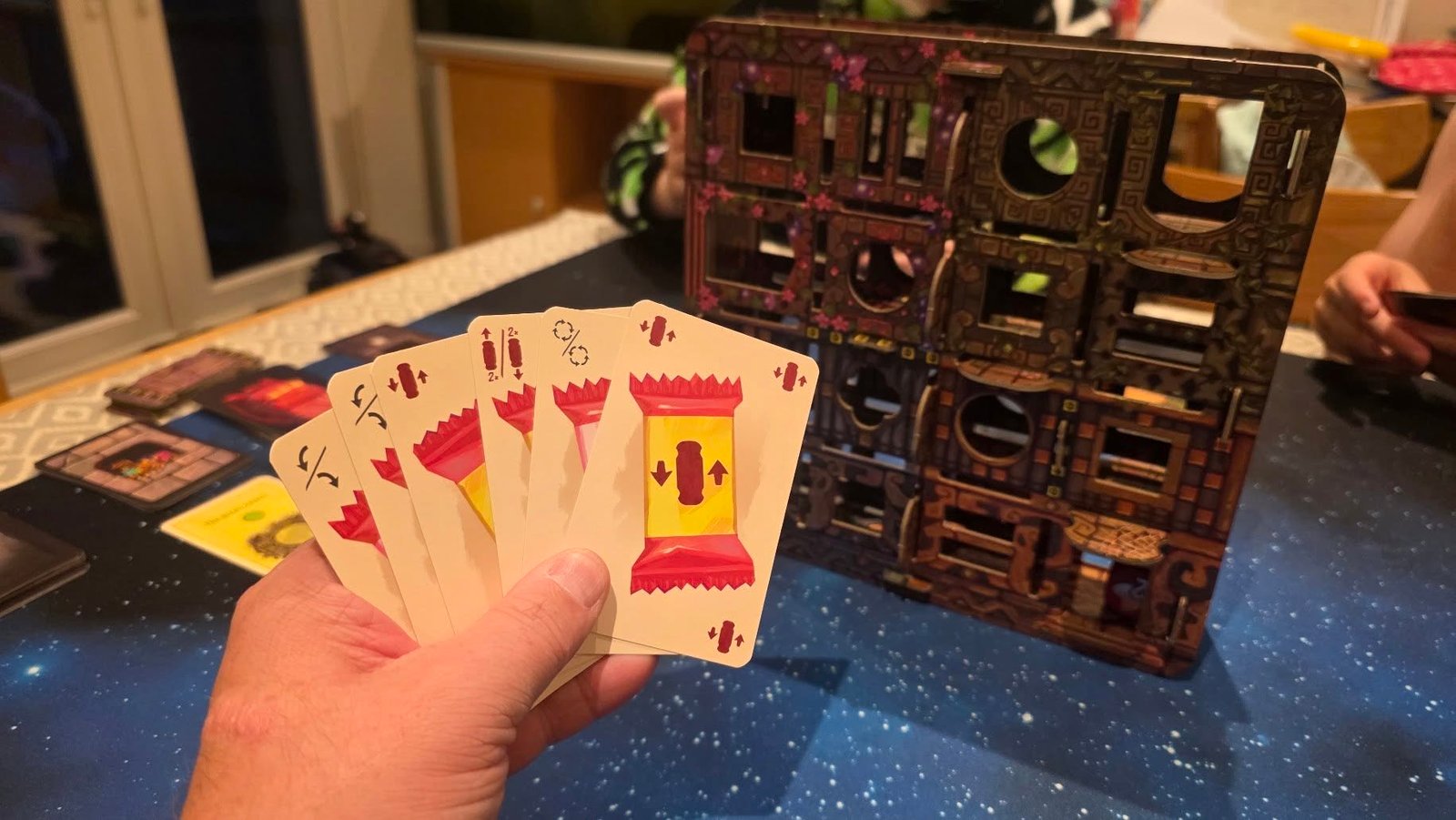
On your turn, you must play one action card (even if you don’t want to). Depending on the card, this might let you rotate the temple 90 degrees, rotate it several times, add or remove walls, or move an existing wall to a different position. As you turn the temple, the explorer dice tumbles through the rooms, with the walls helping you guide where it ends up. You don’t have to use the full action shown on a card, but the card is still discarded once played.
If the dice finishes a turn inside one of the revealed rooms, that room has been successfully explored and its card is turned over. Once you have visited all of the required rooms, you need to guide the cube into the room containing the exit shown on the door card and rotate the temple so that this door is at the bottom, allowing your explorer to escape.
There is a restriction on how you can communicate, which makes things a little trickier. You can discuss where you want the explorer to go and your overall plan, but you cannot tell the other players which action cards you have. There are a couple of tokens that loosen this slightly, including a one-use swap that lets you exchange an action card with another player and a communication token that lets you reveal limited information about the types of actions you have left. Of course, with younger players you can happily just ignore this and play as you want.
If you explore all of the rooms and escape through the correct door, you win the game. If someone starts their turn without an action card to play, you fail. When this happens, you get two additional action cards for your next attempt, giving you a little more energy to work with.
It’s a simple, fast game that works well, although the difficulty is so dependent on the initial card draw that some games may be close to impossible and others may be completable in literally one turn. A way to mitigate that would have been a good idea.
It all plays well though and feels good. One thing I was less keen on, but the boys liked, is that I kind of want it to be more of a puzzle game and less of a dexterity game. Due to the fact that the cube is much smaller than the spaces, you can kind of encourage it to fall how you want when you twist the temple and definitely have it end up in ways that the puzzle part of my brain knows shouldn’t really work. This is all fine and well within the rules, but if you are looking for strictly a puzzle game, this might annoy you a little bit.
Once you have the base game down, Experienced Mode lets you increase the difficulty by adding more rooms to explore and introducing Challenge cards. These add extra rules to the round, such as rooms you aren’t allowed to enter, having fewer movable walls, forcing you to visit rooms in a particular order or adding Slimy, who must be kept away from your explorer. For every additional room or Challenge card you add, you also receive two extra action cards. They are small additions but add to the experience, and this was generally our preferred way to play the game.
There is also an Expedition Mode, which links a series of games together. Expedition cards determine how many rooms you need to explore and introduce additional rules, while the symbols on the explorer dice itself now become important.
Once per expedition, you can guide the dice into the Chamber of Destiny and activate one of its visible symbols. These can give you extra action cards, snack tokens, return previously used cards to your hand or even allow you to escape through any exit. Snack tokens provide additional one-off abilities, and unused snacks and action cards earned along the way can carry over into later expeditions.
I really like the inclusion of this but, to be honest, it feels like a legacy game kind of pushed into a game that doesn’t need it. This is a simple, quick cooperative puzzle game that’s enjoyable, but I couldn’t see myself playing a campaign of this over multiple sessions or hours.
Finally, there is a Pro Mode that brings the cube activation and snack system into the regular game, but removes the normal supply of bonus action cards, meaning any extra energy has to be earned through the dice itself.
It’s a really good package that has a lot inside it. The component quality is really high and everything looks great on the table and feels sturdy. My initial hesitation that the temple itself wouldn’t hold up was quickly swayed when we started playing, as it feels well made and it all goes back in the box nicely once constructed.
Overall, I like Temple Twist, but it’s not quite a 100% definite recommendation. It’s a really simple game and premise that, when playing the simple game, is over a little too fast, but when playing the longer game feels a little bit bloated. I also wish the tunnels were tighter so you couldn’t wiggle the dice in ways it probably shouldn’t fall from a puzzle point of view.
I dunno, I think maybe I am being a little harsh. I think for some people this is a must-buy, but for us it’s a maybe, but 100% a board game café play kind of game.
Disclaimer – A copy of the game was gifted to us by Kosmos and will eventually be donated to ur school Board Game Club. We have not been paid for this review. We have not been paid for this review, and our thoughts and opinions are our own.




 Nicola Asker


