 Matthew Bailey
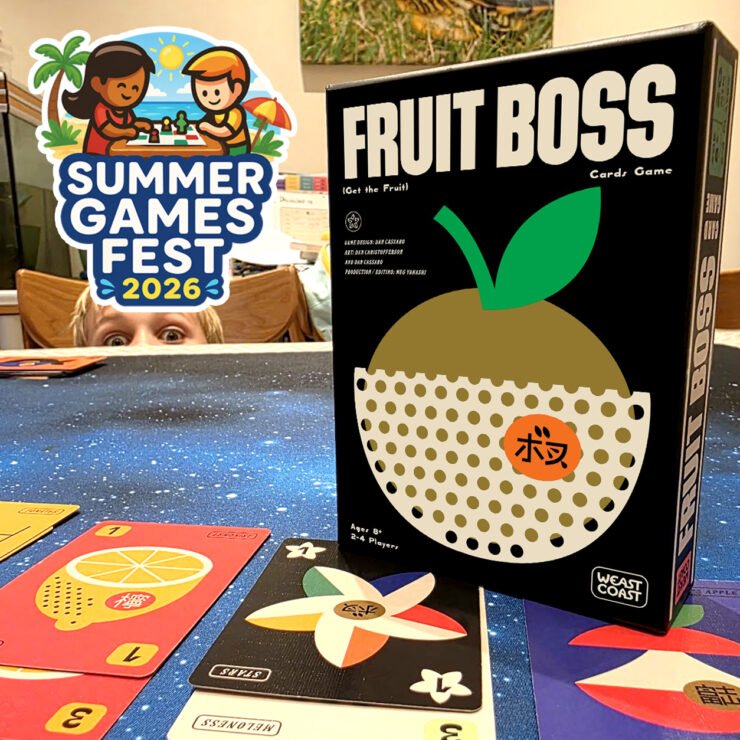
Firstly, I normally ask the kids to hide when I take the box photo to make it easier to crop out the background and put in something a little more exciting than my kitchen table, but I love this image of Jack doing a terrible job of hiding, so here we are…
Today we are going to be looking at Fruit Boss from West Coast Games, a really fun and quite simple, yet unusual, card game that landed on my doorstep just a few days ago. It immediately jumped to the top of the pile, we have really enjoyed playing it, and I’m looking forward to telling you about it today.
In Fruit Boss, you are new hires at a fruit trading company, trying to collect valuable sets of fruit over a number of rounds. The market is made up of five stalls, each of which can only contain one type of fruit at a time. On your turn, you can perform up to two actions, and these can either be two different actions or the same action twice. Once you are finished, draw back up to five cards in your hand.
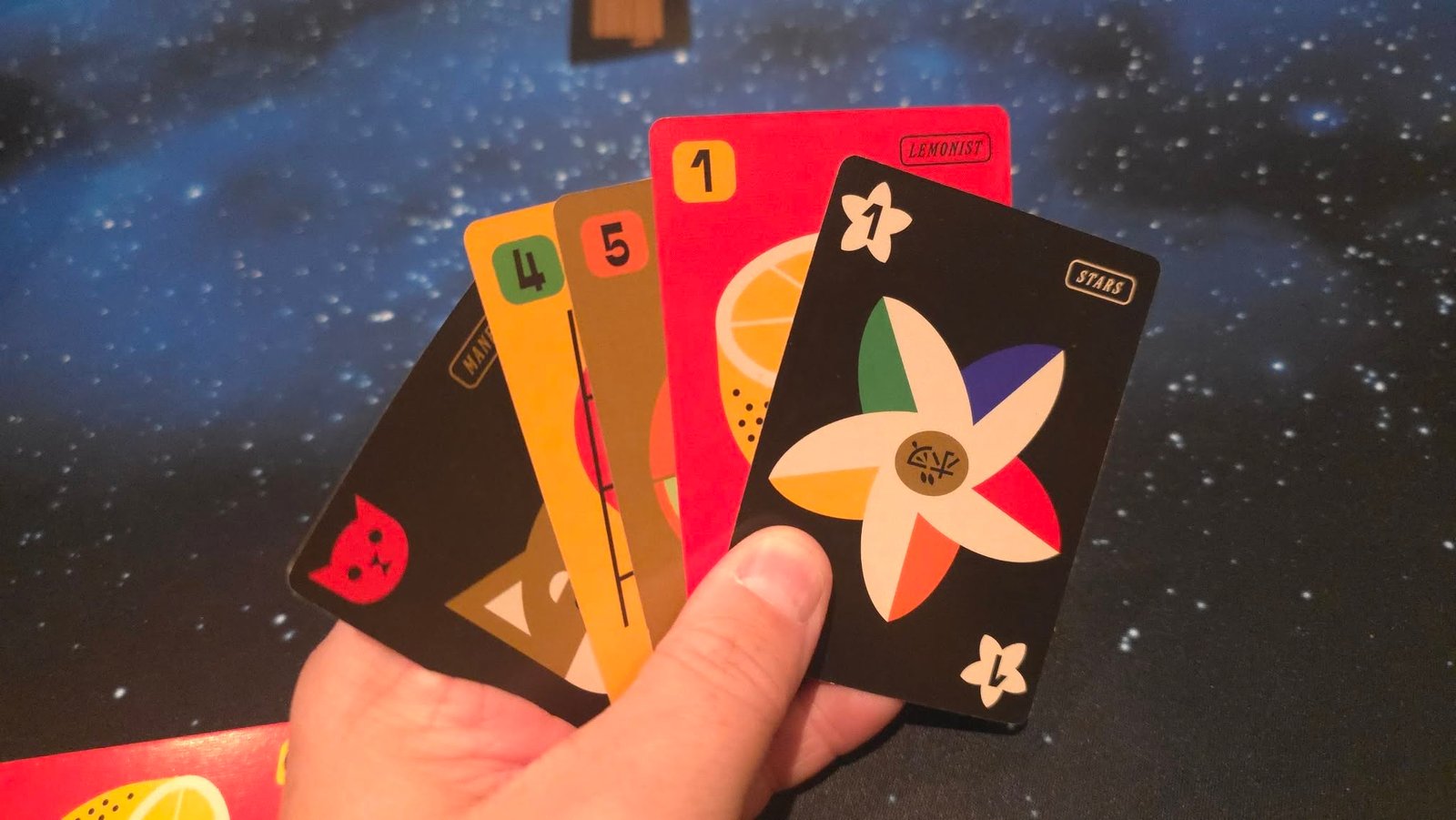
The main thing you will be doing is adding fruit cards from your hand to the market. As one action, you can play as many cards of the same fruit as you like into a matching stall, or start a new stack in an empty stall. The value of a stack is simply the total of the numbers shown on its cards. If the stack you have just added to is now worth at least two more than one of the stacks directly beside it (with at least two cards), you immediately collect that lower-valued stack and add it to your private collection.
This is a really cool mechanic because usually in games you’re trying to lay onto stacks or make sets and then collect those things, whereas here you’re actually trying to make a strong stack so that it’s stronger than the thing you want to collect next to it. But you also need to think about whether someone else can put an even stronger stack next to yours on their next turn and take it, potentially getting something even more valuable than the stack you just took.
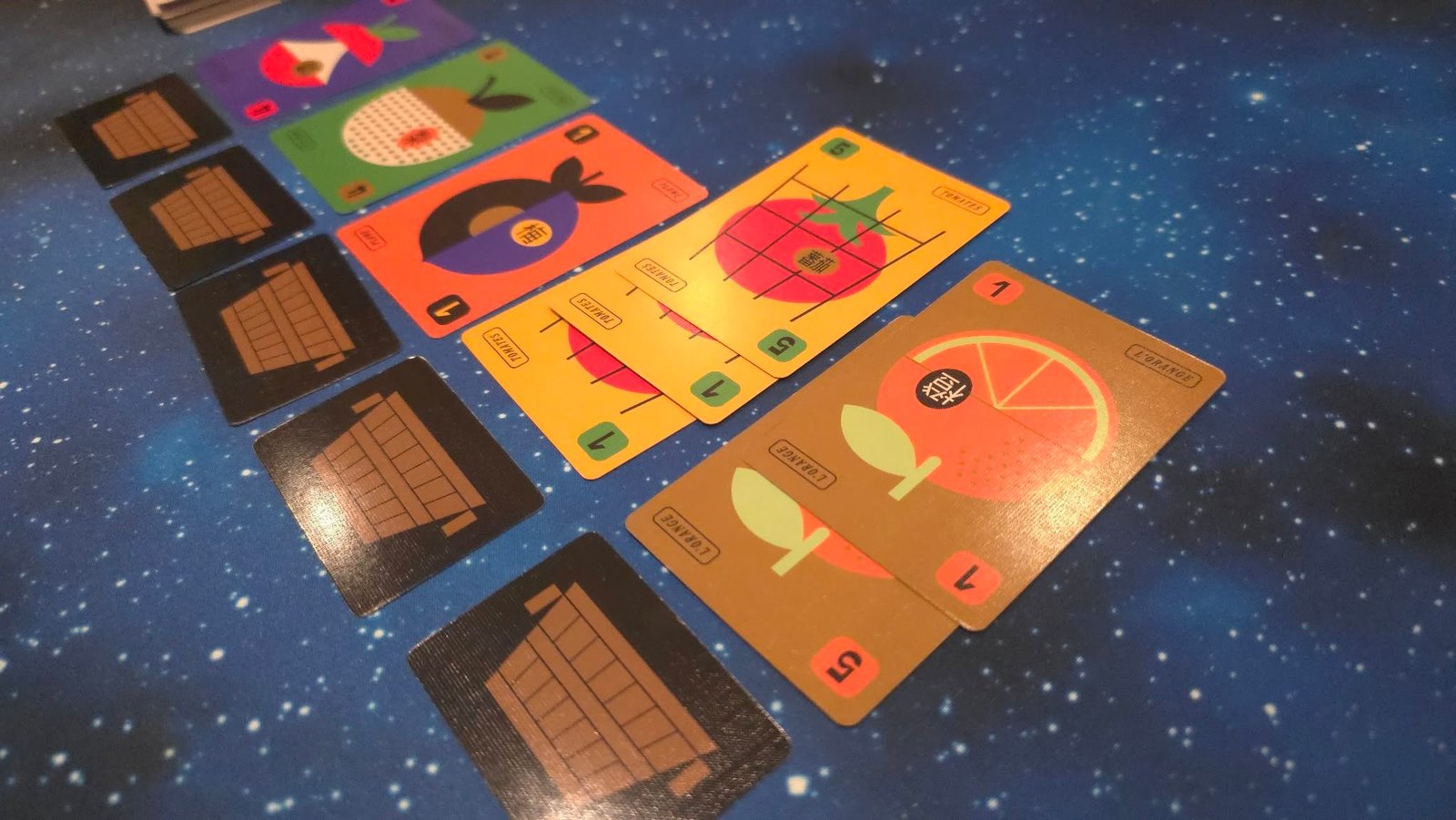
So it becomes this constant process of thinking about laying cards and collecting stacks, while also considering what other people are doing and where that could lead. It’s really simple to understand, and both boys (8 and 11) totally got how it works, but it creates some interesting decisions on your turn rather than simply laying cards and automatically taking the best stack. In some cases, taking a slightly less valuable stack can leave the market in a better position for you to potentially have a much better turn later on.
Alternatively, you can combine two stacks of the same fruit that are already in the market. Move one onto the other to create a larger stack and, if it is now worth at least two more than an adjacent stack, you collect that lower-valued stack as normal. This means you don’t necessarily need the right cards in your hand to increase the value of a stack. Alternatively, you can set up a better stack than was there before and then potentially take it with your next action.
You can also spend an action sliding a stack sideways into an empty stall. You can move it through several empty stalls if you want, but you can’t jump over another stack. Sliding doesn’t let you collect anything by itself, but it can change which stacks are sitting next to each other and set things up for another action.
There are also Maneki-Neko cards (which I am going to call cat cards). Playing one as an action lets you remove any single card from the market, regardless of its value, with both cards then going into the discard pile. If a cat itself appears in the market when the market is refilled, it has a value of zero and can be collected like any other single card. Instead of adding it to your collection, though, it goes straight into your hand. Star Fruit cards are wild and count as whatever fruit they are stacked with. You can play them alongside other fruit, collect them as part of a stack or combine them with other fruit in the market.
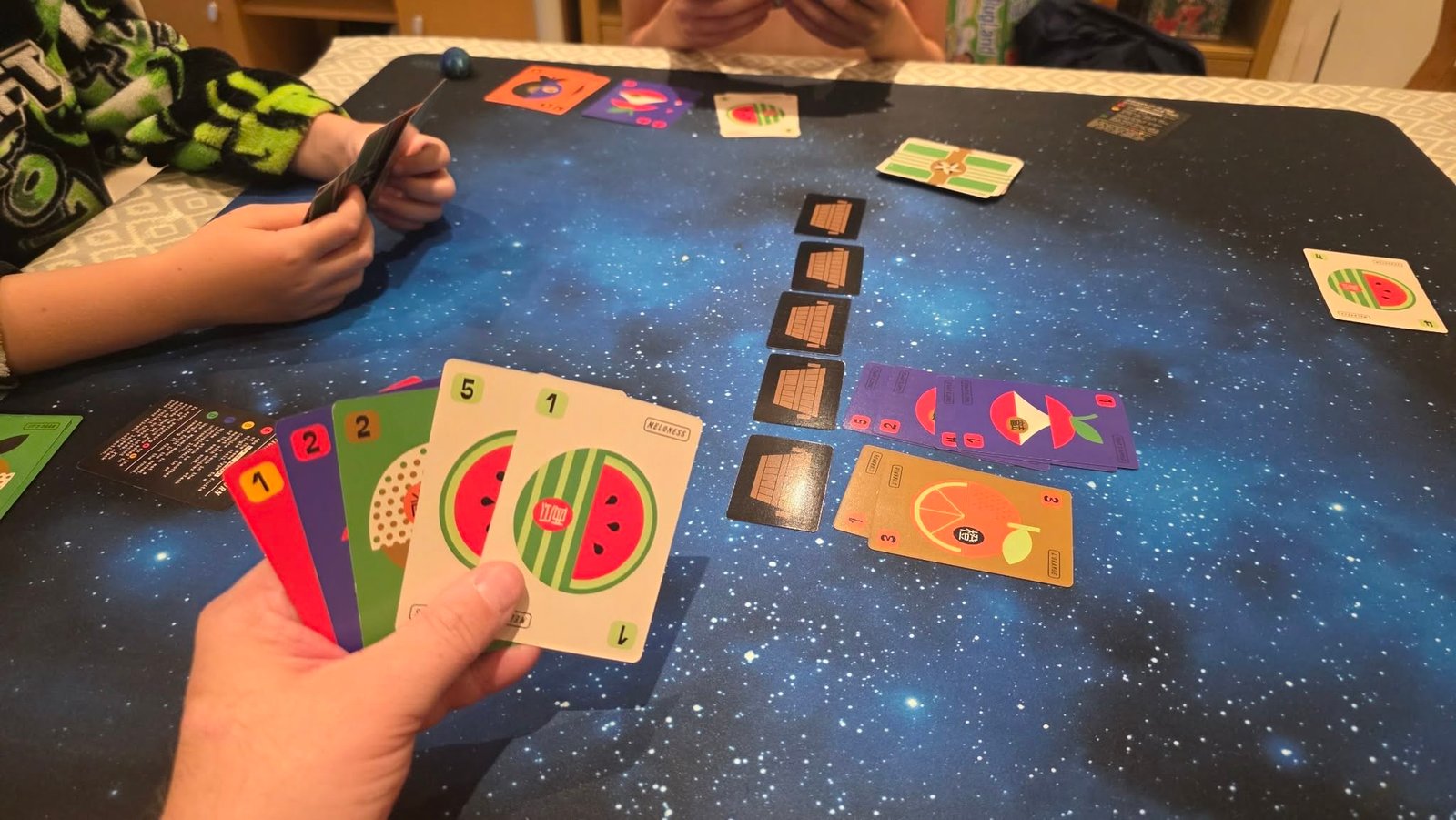
There is also a rule that stacks can only contain five cards, which works well as it means they don’t get out of control. If the market ever gets down to only one stack, it is automatically refilled, even if this happens in the middle of your turn, which can also be used to your advantage.
Once the final card is drawn from the deck, a fire sale begins. From this point onwards, you can collect single-card stacks rather than needing stacks of at least two cards. Once a player starts their turn with no cards left in their hand, everyone gets one final turn and the round ends.
You then group matching fruit in your collection and score them. For each fruit, take the highest-value card in the stack and multiply it by the number of cards you collected. However, you can only score three different fruit types. Any additional fruit types count against you instead, as do cards left in your hand. A cat left in your hand also eats one of your remaining cards, making that card count against you as well. The player with the highest score wins.
We have absolutely adored playing Fruit Boss. It’s really different to any other card game I’ve played like this. Sure, it’s got lots of similarities, and if you’re familiar with these kinds of games you’re going to pick it up fairly quickly, but it feels really different to play with its positioning, stack-taking and the fact that you’re not actively taking the stacks you’re laying cards onto. Equally, the fact that you’re trying to aim for certain different fruits works really well, and overall we had a great time, ending up playing several games on the afternoon it turned up.
Visually, the game is very striking, using a clean Japanese aesthetic crossed with a kind of 1970s VHS vibe. It’s easy to play and easy to understand, but there is actually quite a lot of depth in terms of strategy, thinking ahead and trying to gauge what others are going to do.
This is absolutely top-tier card gaming and a definite recommendation if you’re looking for a new travel card game to take on holiday. Fantastic stuff.
Disclaimer – A copy of the game was loaned to me by “West Coast” via the UKBG review circle.




 Nicola Asker