 Matthew Bailey
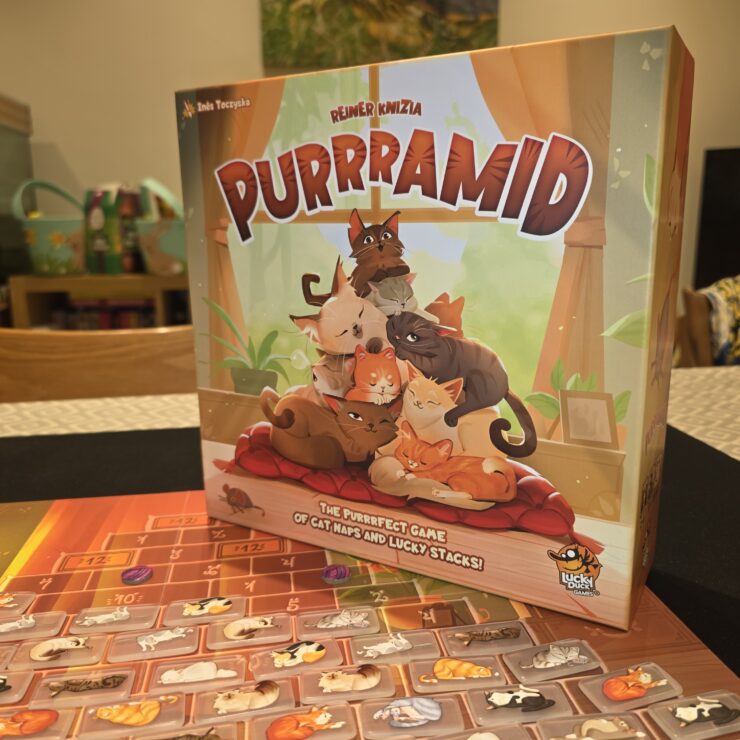
Today we are going to be looking at Purrramid, a push-your-luck tile-laying game from Lucky Duck Games that sees you building a pyramid of cats while trying to get rid of all of your tiles first.
In Purrramid, players are trying to use dice rolls to place their cat tiles onto the shared pyramid board, gradually building it upwards. This is a familiar mechanic, and people who have played games such as “Roll to the Top: Journeys” will feel immediately at home. Each player takes an equal share of regular cat tiles, the gold cat tiles are placed nearby (we will get to those later), and wool tokens are added onto every visible space marked with an 8. In a two-player game, some lower spaces begin pre-filled with cats, as otherwise the first few turns would drag a little. Once everyone has their tiles, the starting player takes the five dice and you are good to go.
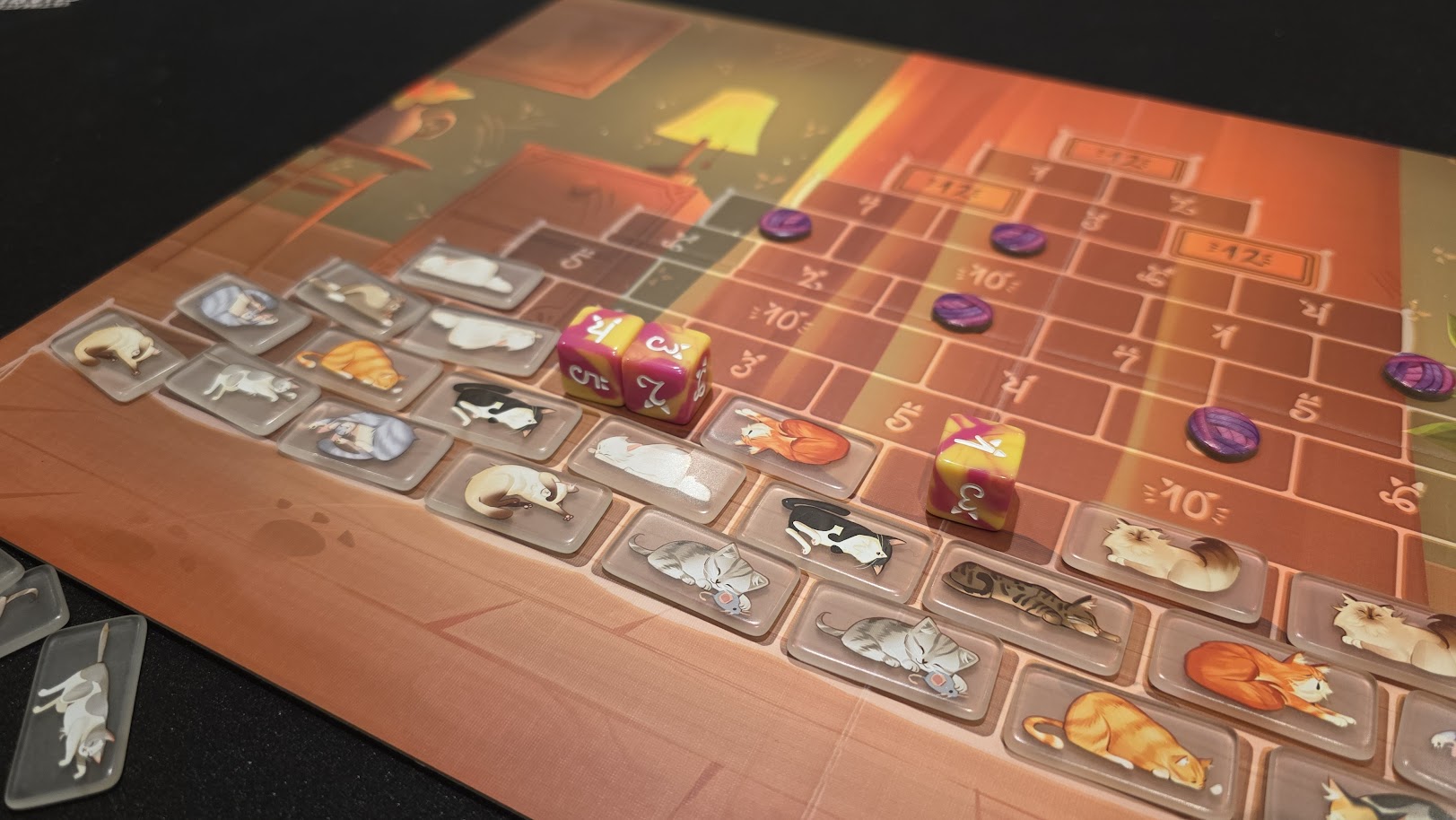
On your turn, roll all five dice and choose one empty space on the board. You place one or more dice onto that space so the total exactly matches the printed number there. For example, a 6 space could take a single 6, or a 2 and a 4. You then choose whether to stop or keep going, which is the game’s main push-your-luck mechanic. If you continue, reroll any dice you have not yet placed and claim another empty space in the same way. You can keep pressing your luck until you choose to stop or run out of dice to roll.
When you stop, all dice placed that turn must meet two conditions. First, every space with your dice must be connected to the others. Second, every occupied space must be supported, meaning it is either on the bottom row or fully resting on filled spaces beneath it. If both conditions are met, remove the dice and replace them with cat tiles. Most spaces take one tile, 10 spaces take two side by side, and 12 spaces take three stacked. If you cannot place any dice after a roll, or your final layout is unsupported or disconnected, you bust and place nothing that turn.
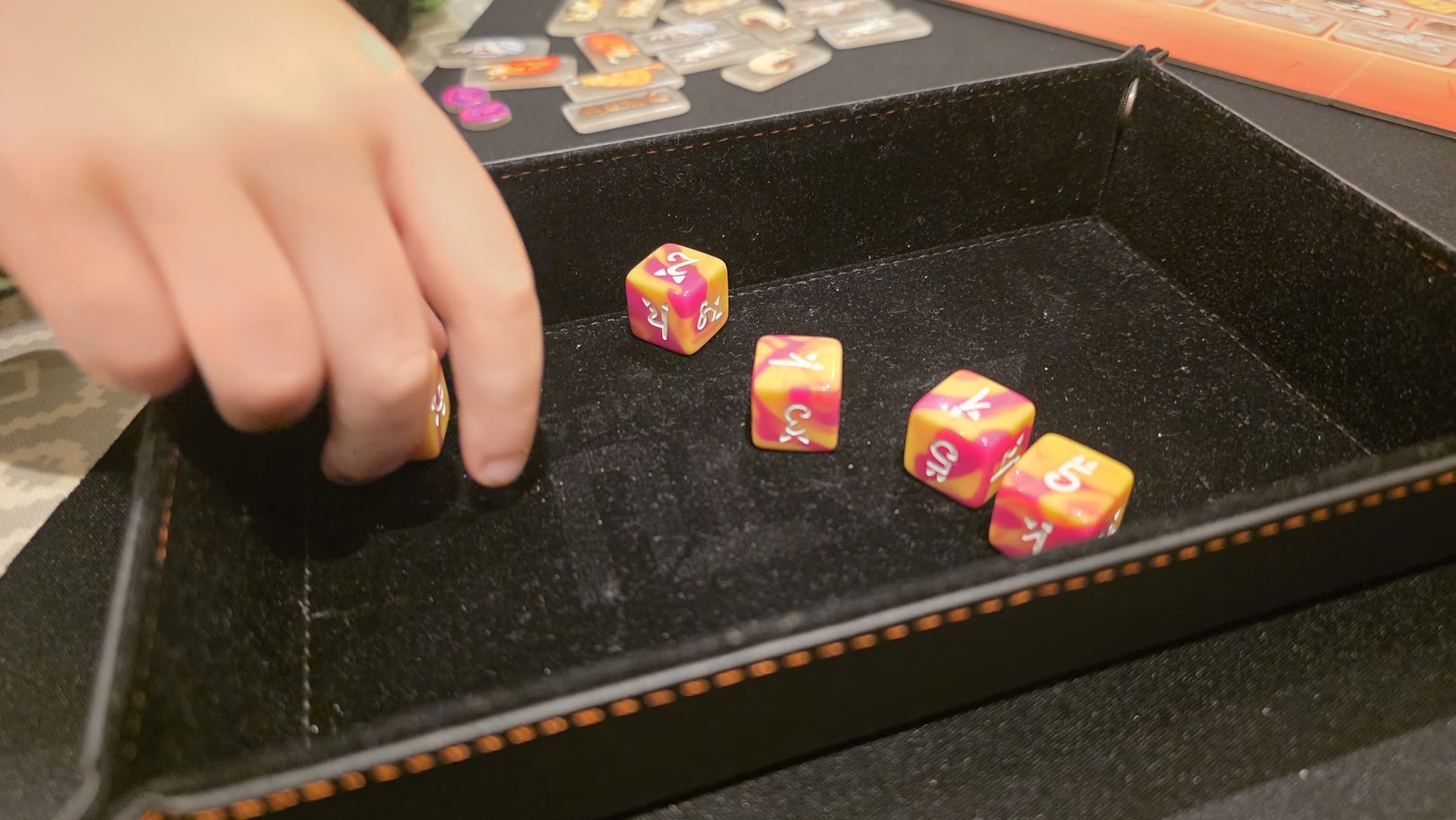
Whenever you successfully cover an 8 space with a cat tile, you collect its wool token. These can be spent later to reroll all dice from any single roll, which is extremely useful, and we found it was often worth aiming for these spaces. You may also use multiple tokens in one turn if needed. You can also earn a bonus turn if you used every die successfully that turn. Bonus turns work in the same way, but use one fewer die than before.
The first player to place all of their regular cat tiles becomes the winner, but the game carries on, and this is the bit I am not so sure about. That player now uses the gold cat tiles whenever they place more cats, while everyone else continues with their remaining regular tiles. The game ends when the board is full, a second player runs out of tiles, or the winner has placed all gold cats, which then gives you a score for how well the player won. It feels a little unusual. If you are playing a two-player game, it is likely you will not use the gold tiles at all, and with three or more players it becomes a slightly odd way of measuring how well the winner did.
We like Purrramid. It is a really simple push-your-luck game with lovely production values that make it feel more of an experience than it otherwise might. All of the components are really nice, although I will say that because the tiles are so smooth, while the game is lovely to play with, putting them back in the box is a bit of a pain. They are awkward to stack neatly and hold in place. This is a very minor criticism and not something that really affects the game itself.
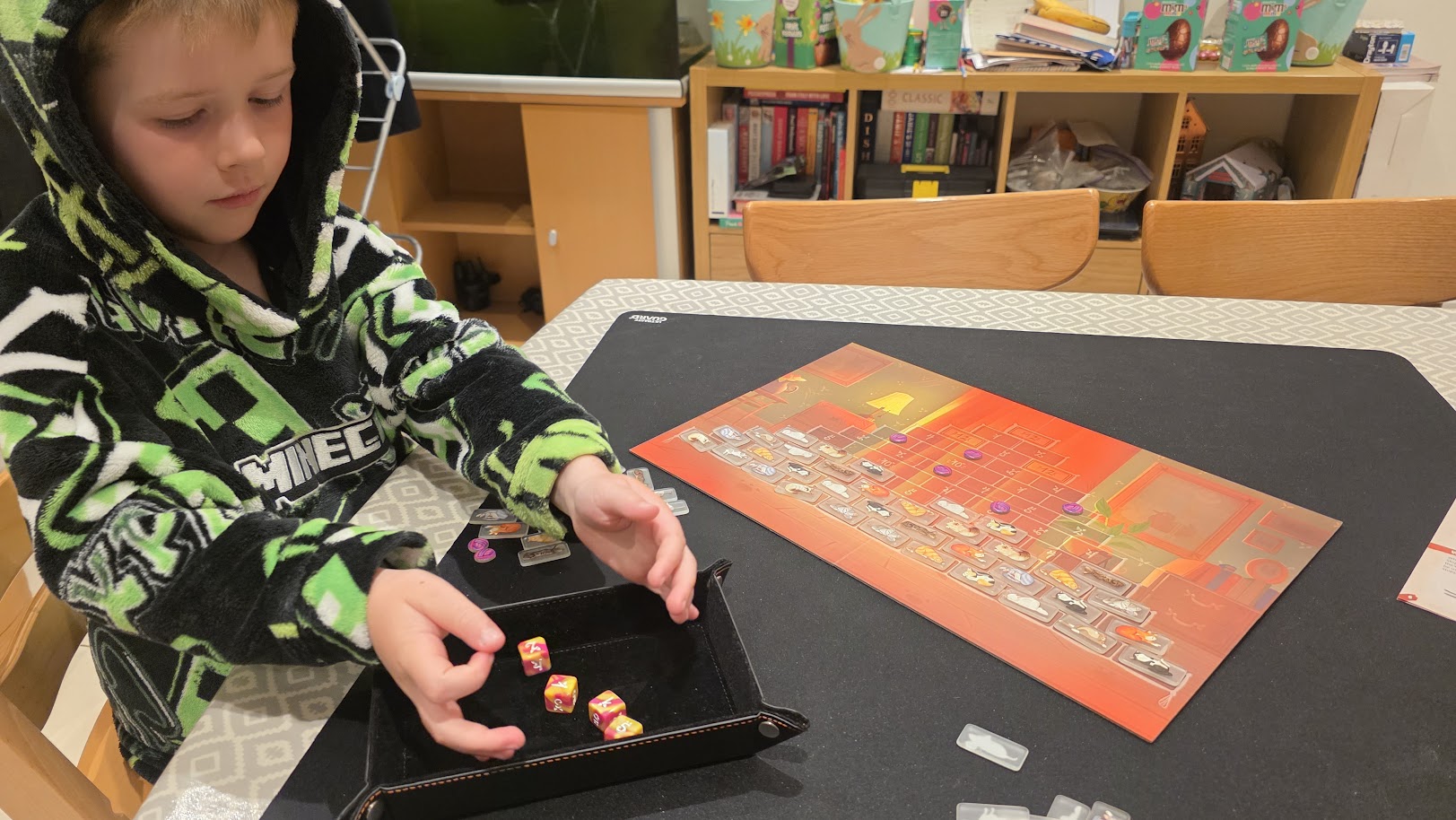
The game is super easy to understand and definitely could be played with almost anyone, assuming they have basic maths skills and can add up to 12. Henry, who is nearly 5, was perfectly able to do this. As with most push-your-luck dice games, you definitely need a dice tray, as otherwise stray rolls are going to knock over parts of the pyramid.
While the game works really well, there were a few things I was less keen on. The gold tile mechanic seemed really weird and basically just a win-more mechanic. It did not feel especially fun for either the winner or the players now battling for second and third while those turns were happening. In reality, we just scrapped those rules, and they were never an issue in a two-player game.
It also falls into a similar trap as many roll-and-writes that use this pyramid-style grid. Towards the end, you often end up with one awkward side left uncovered and can then only do one tile per turn, which slows everything down. It also became very apparent with around five turns left who was going to win in most of our games.
We enjoyed Purrramid, and it is a beautiful, cosy, relaxing game to play, but I think this is more of a “that’s lovely, shall we curl up and play something cosy?” type of game rather than one I would keep coming back to with the kids when there are more engaging push-your-luck games out there.
Disclaimer: A copy of Purramid was kindly provided to us by Lucky Duck Games via the UK Board Game Review Circle