 Matthew Bailey
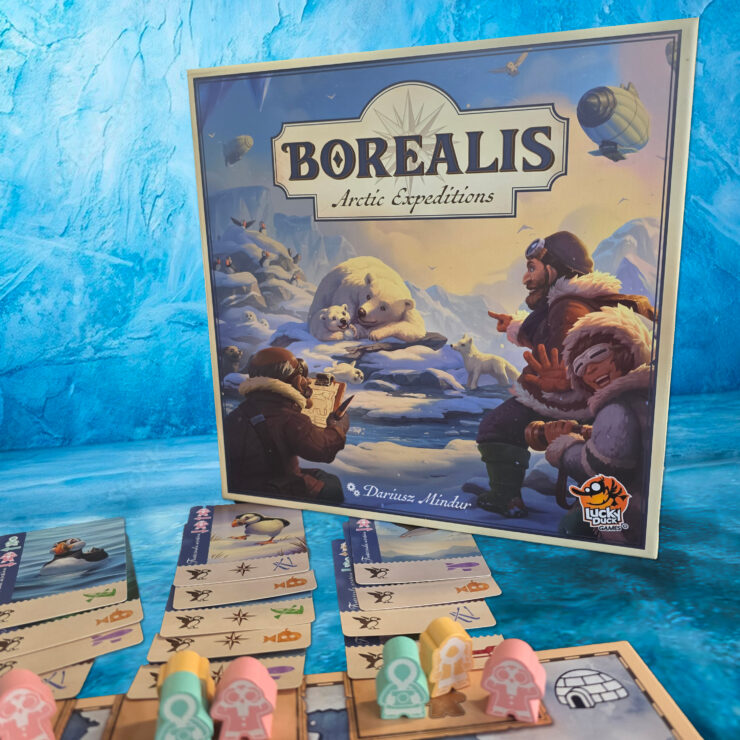
Today we’re going to be looking at Borealis: Arctic Expeditions, a new puzzle “point salad” game from Lucky Duck Games, which landed on my doorstep a week or so ago, and I have been really surprised by how much I enjoyed playing this with both my kids and a group of older teenagers.
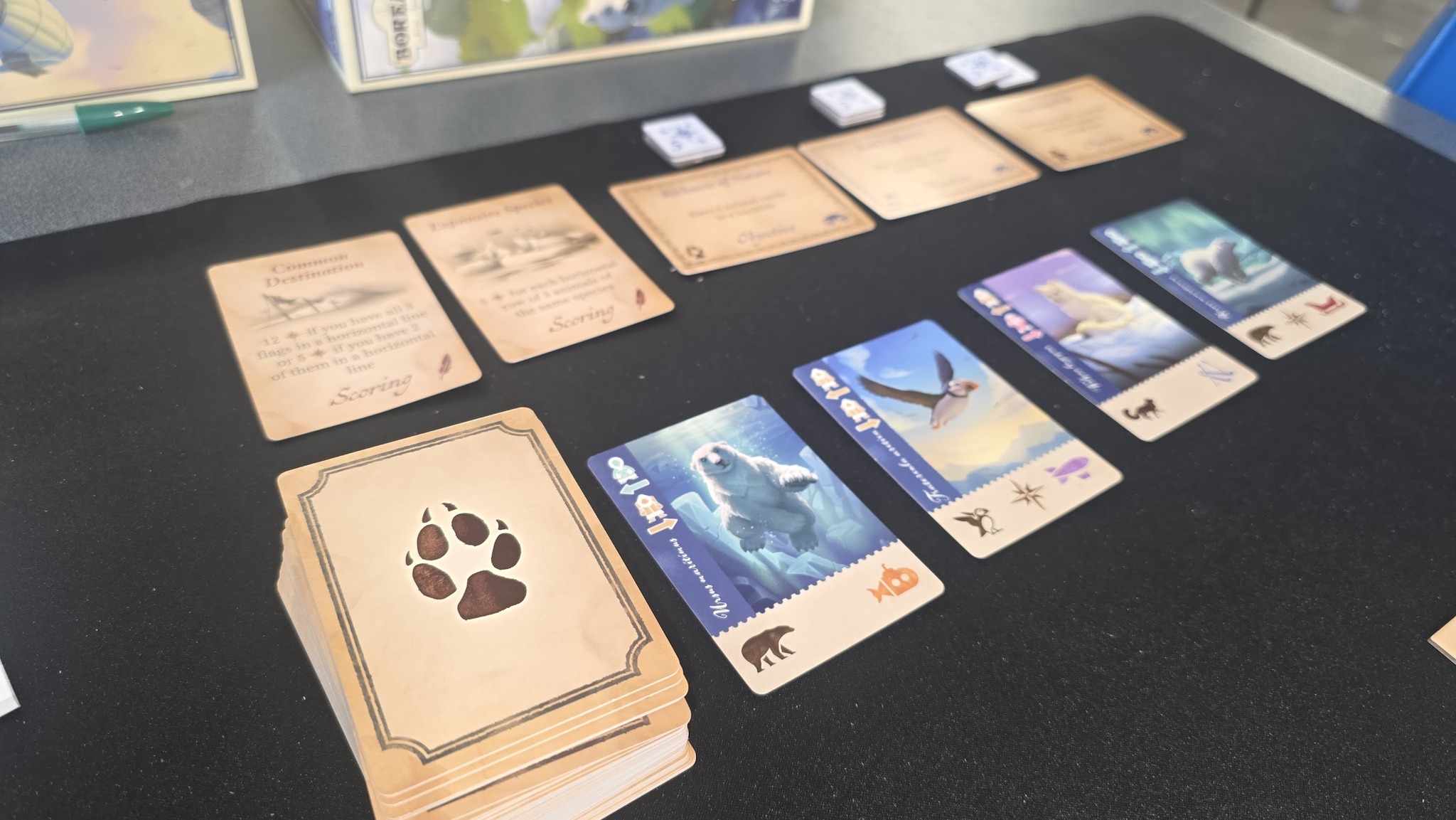
In Borealis: Arctic Expeditions, you lead a team of scientists exploring the Arctic, observing wildlife, and working to build the most successful expedition. Each player gets a board with three observation locations, with three of each colour scientist starting at those locations (nine overall), two camps, and a flag marker for each exploration track at each location. You set up the animal deck and reveal four cards to make a shared market, then deal four starting cards to each player. Reveal random scoring and objective cards as well, which give you more ways to earn points during the game.
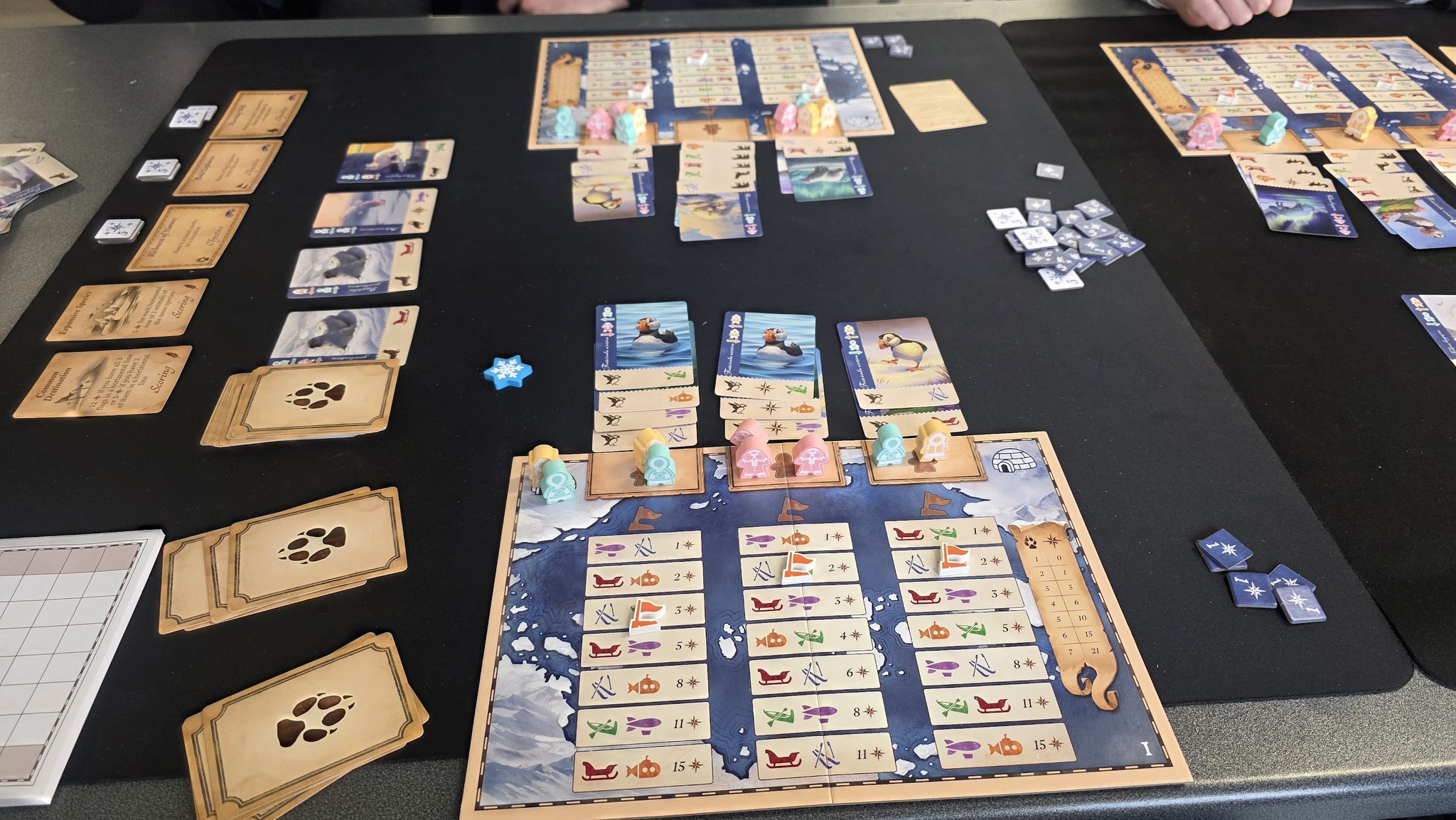
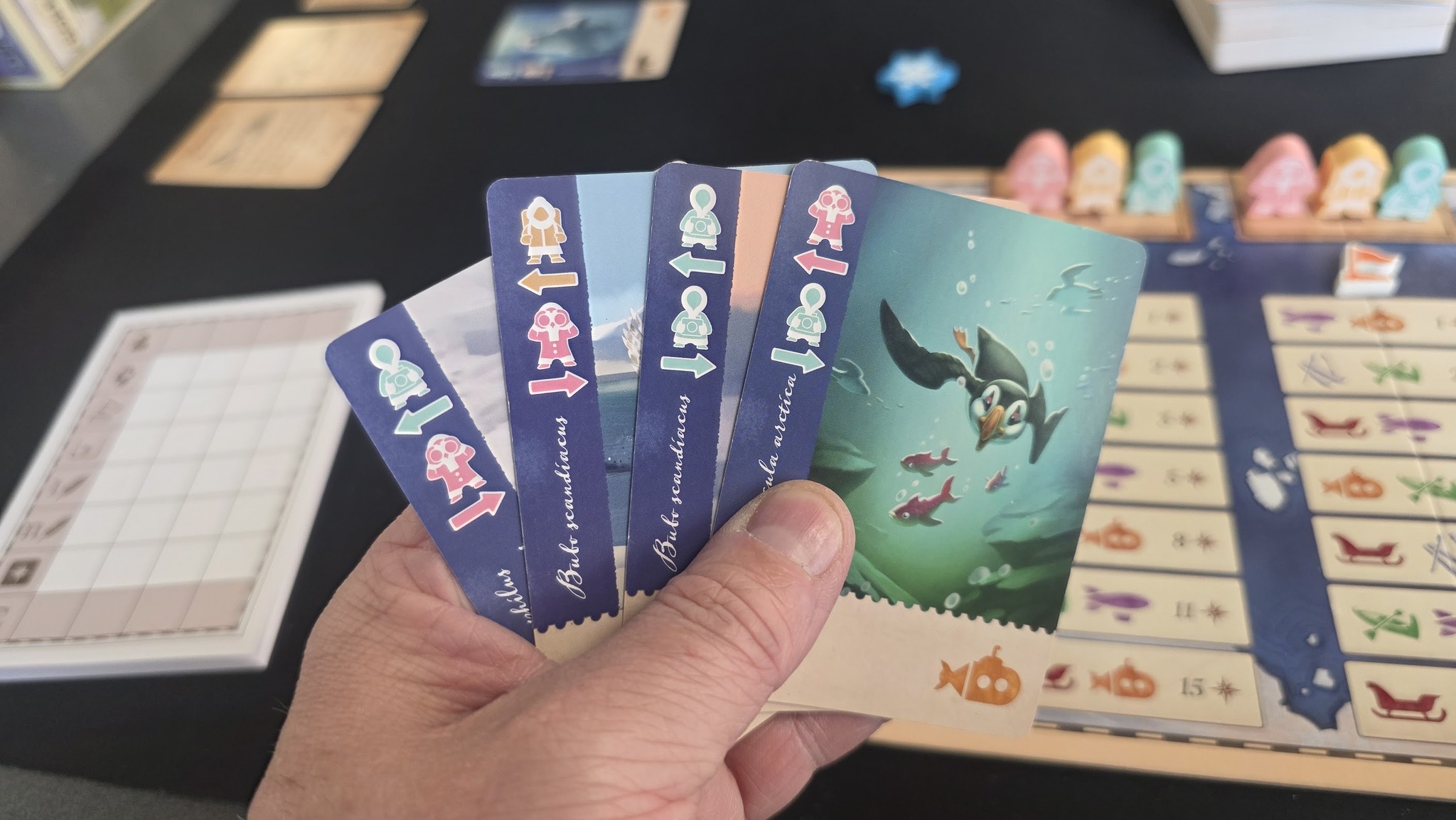
On your turn, you choose one of two actions. The main action is to observe an animal by playing a card from your hand into a matching location that has the scientists shown on the card. The card then tells you how those scientists move, thematically so they can “observe the animal from afar”, to another adjacent location or a camp if you go off the edge. Once you are in a camp on the right or left, they are locked there until you regroup, which I will explain in a bit. If the vehicle on the card matches the next space on that location’s track, move your flag forward. Already you can see that there are numerous ways of gaining points and numerous puzzles that you’re trying to line up all in one go, and this is actually what makes this game really appealing. Even though it’s not at all like it, it kind of feels like I’m playing some sort of puzzle game such as Tetris or Lumines, in the way that I’m trying to plan ahead, get all my pieces to line up nicely, and ideally maximise playing the right card with the right colour explorers in the right colour location to get everything to fit in nicely. While you rarely get to play optimally, it never feels bad when you can’t, and it always feels like you’re making meaningful decisions about what is going to be best.
After that, draw a new card either from the four face-up cards or from the top of the deck. If you do not like the shared market, you can spend a point token to refresh all four cards once during the round. I really like this mechanic. I like the fact that you’re spending points to refresh the cards, as opposed to in a lot of games where you miss a turn. It feels less punitive, even though obviously you are then getting fewer points further down the line.
Your other option is to regroup. You may discard any number of cards from your hand and draw back the same amount. You then gain one point token for each scientist currently resting in your camps. Finally, all scientists from both camps are moved together into one location of your choice, ready to be used again. This is another key way of gaining points, but because there are so many different ways to gain points, you can focus on completely different things. In one of the games we played, one person went all in on moving scientists from camps and back in, I really focused on getting matching numbers of the same species, and another player ended up trying to do the flags.
Once every player has taken a turn, a new round begins, with the same first player continuing to start. If the deck ever runs out, the discard pile is shuffled to create a new one.
Throughout the game, players can also claim objectives by meeting the requirements shown on the revealed cards. The game ends immediately when one player has seven cards stacked in a single location. Everyone else then takes the same number of turns so all players finish evenly.
Final scoring comes from sets of matching animals in each location, progress on your exploration tracks, symbols printed on cards in play, completed scoring cards, and any point tokens collected during the game. The highest total wins.
I really enjoyed Borealis: Arctic Expeditions, and actually so did everyone else. I’ve played it with Jack and Toby as well as my school board game group, and they all really enjoyed it. It’s really quite easy to understand, even though there’s a lot going on to think about. Once you’re locked into a particular strategy, you can definitely get the ball rolling. Equally, based on the final scores of most of the games we’ve played, where it’s been relatively close, there seem to be quite a few feasible strategies you can play, whether that be trying to focus on regrouping scientists as your main source of points, getting groups of animals, really focusing on the flags, or going for a mix of all of them.
It’s worth noting that there is basically, short of manipulating the market so that your opponents don’t get cards they obviously might need, very little in the way of player interaction. You’re not playing against each other, and you’re not really doing much to affect each other as you play. For us, that was fine. We are quite happy playing games like that, and we like the very relaxing puzzle atmosphere that this brings. This definitely is a cosy game to play on an evening without too much stress. I do appreciate that some people don’t particularly like games where there’s little player interaction, but obviously make of that what you will.
Really nice quality, everything is very well produced, and the artwork is lovely. The animals are nice, everything is cute, the meatballs are really good, and it was a very pleasant game to play, with it being the right kind of difficulty where you have to think without it frying your brain.
Overall, I really enjoyed Borealis: Arctic Expeditions, and while I don’t think everyone will enjoy it as much as we did, everyone I played with has enjoyed it, so it’s a confident thumbs up.