 Matthew Bailey
Game at a Glance
- Publisher Age
- 8+
- LBG Recommended Age
- 10+
- Players
- 3–6
- Playing Time
- 30–45 min
- Box Size
- Small
- Release Year
- 2026
LBG age recommendations are based on children familiar with modern board games, with adult guidance where appropriate. Every child is different.
Apologies in advance, but writing this review really got away from me and is way, way longer than I intended, but please take that as a good thing.
Continuing with our Magenta Weekend, we have Hilt, which is essentially the flagship of the set and is the only one that is brand new to the line and is already causing enough of a stir in that it is already sold out on CMYKs website for the first printing and number one on BGG’s hotness chart at the time of posting.
Hilt is actually a reimagining of a game called Condottiere that originally came out back in 1995 back when I hated board games because I thought they were all like Monopoly and Cluedo.
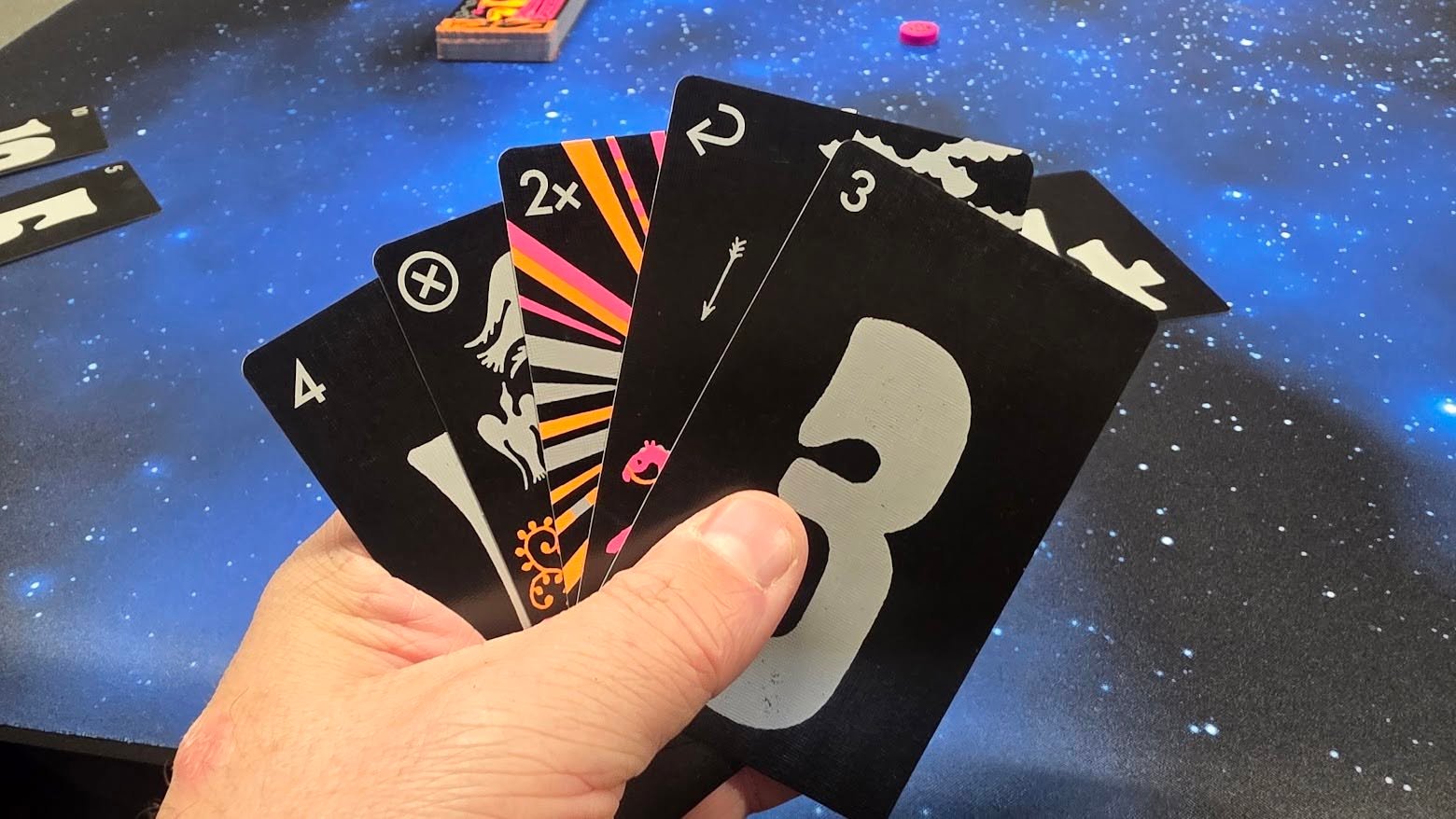
The general concept of Hilt is that you are competing in a series of battles, playing cards from your hand to try and have a higher total strength than everybody else. It has a distinctively poker feel to it in terms of how the raising and being out mechanics work but the interesting thing, and this is the bit my Toby 8 struggler with but older kids were fine however, is that just because you’ve won a battle doesn’t necessarily mean you’ve made a particularly good decision as you may have left yourself with nothing to play with next turn.
To set up, shuffle the deck and deal everyone ten cards, place the three different colours of chips somewhere within reach of everyone and give the starting player the Favor card (I am going to continue to spell Favour with the American spelling as per the game even though Grammarly is going bonkers at me to type in British English and is desperate to correct me and rephrase my sentence).
Whoever has the Favor card chooses which colour chip everyone is going to be battling over and places one in the middle of the table. Starting with the player to their left and going clockwise, you can either play a card face up in front of you or choose to pass. The Favor card also interestingly givs you a +1 advantage which sounds strange but mechanically gives a strong advantage and adds even more to the strategy.
There are two different types of cards in Hilt. Force cards are essentially numbered cards with values ranging from 1 to 10 that add to your overall strength, while Fate cards allow you to manipulate the battle in various different ways.
You continue going around the table, playing one card at a time and adding to the total strength in front of you. Once you’ve passed, any cards you’ve already played remain on the table, but you can’t play any more cards during that particular battle. It is therefore crucial to not overplay if you find yourself unable to win.
Where things start to get particularly interesting is with the Fate cards. These allow you to do all sorts of things, such as doubling the value of your Force cards, taking a previously played Force card back into your hand or even ending the battle immediately.
One of my favourite mechanics is the Winter card, which reduces the value of every Force card on the table to just one, regardless of its original value. All of a sudden, someone who has played five relatively low-value cards could be in a much stronger position than someone who has played a couple of tens. There are also Legend cards, which are worth ten strength and aren’t affected by Winter or the cards that double your strength.
Its mechanically easy to play but there is a lot to think about if you wanna do well.
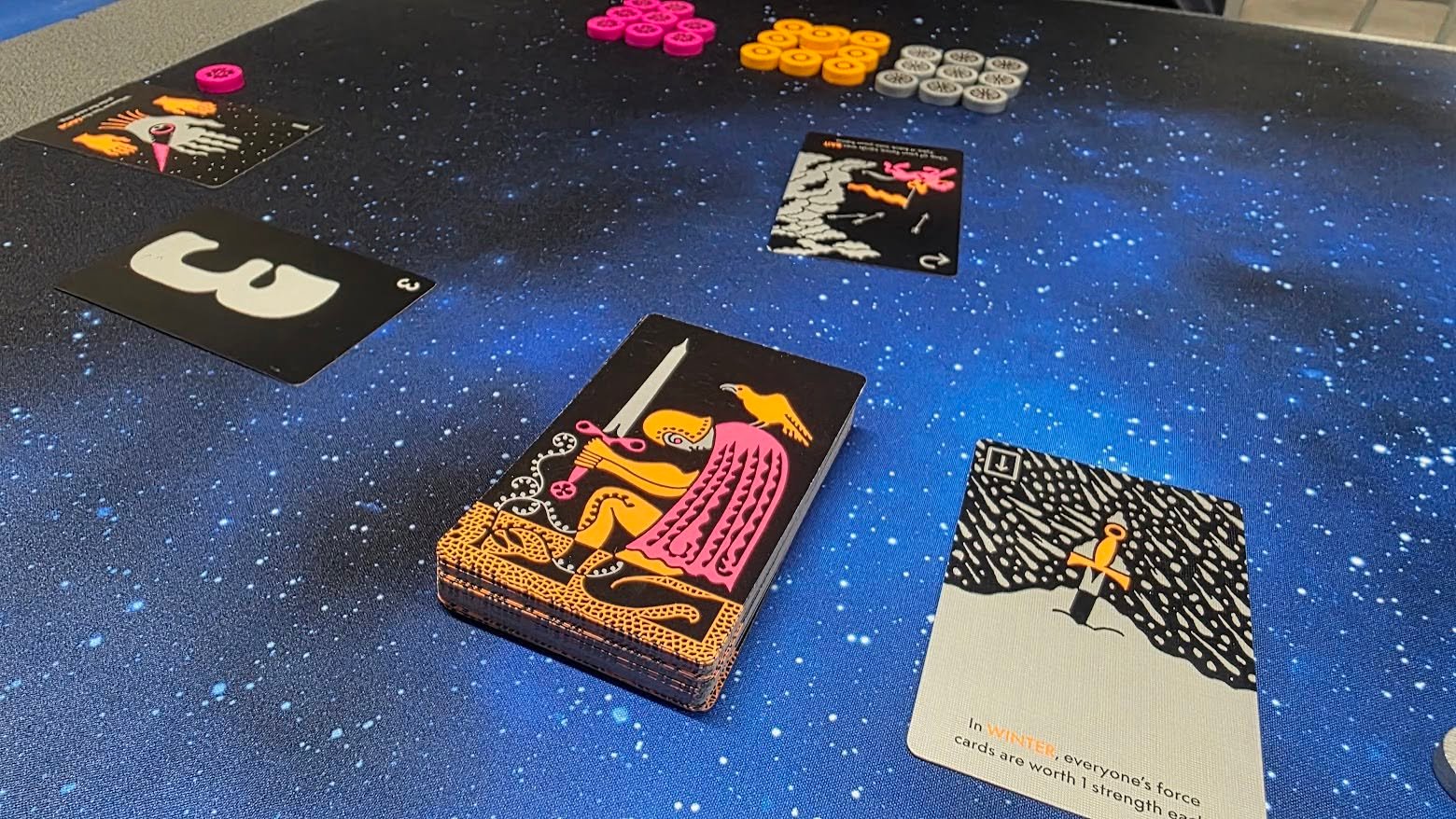
The Crows card immediately ends the battle, with whoever is currently winning taking the chip, while the Doves card ends the battle without anyone winning anything. Everyone essentially loses the cards they’ve committed, and you have to battle over the same chip again. This can be aprticularly devastating if everyone leads with their strongest card with you then laying the doves and restarting the round with everyone losing their high strength cards.
Once everyone has passed, you add up the total strength of the cards in front of you, taking into account any Fate cards that have been played. Whoever has the highest total wins the chip and takes the Favor card, which allows you to choose the colour of the next chip and also gives you the all important additional point of strength going into the next battle.
If there’s a tie which happens more frequently than you might think, whoever has played the fewest cards wins, followed by whoever has played the highest individual card.
Now, the really important thing about Hilt, and essentially what makes the whole game work, is that you don’t draw any more cards between battles meaning your hand acts as your main resource and knowing when to use them and when to fold is key.
If you’ve just spent seven of your ten cards winning a single chip, you’re potentially going into the next battle with only three cards while everyone else still has a decent-sized hand. Equally, if you’ve managed to convince someone else to spend seven cards winning a battle that you never really intended to win in the first place, you’ve potentially put yourself in a much stronger position going forward.
There was a really interesting moment in one of my Games where I has laid 2 strong cards and folded and Toby ended up using 5 cards in order to try and win that hand. His elation soon turned to inevitability once he realised the last turn or two would see him with no cards.
You continue battling over chips until only one player has any cards left in their hand. That player then discards their remaining cards, everything gets shuffled back together and everyone receives ten new cards, plus an additional card for each chip they’ve already won. If you only have Fate cards remaining when you pass, you can also choose to reveal and discard your entire hand, potentially bringing the round to an end a little bit sooner.
The first person to collect either three chips of the same colour or one chip of each of the three different colours immediately wins the game!
What I particularly like about the concept behind Hilt is that, on the surface, it’s an incredibly simple game. You’re essentially just playing numbered cards in front of you and trying to get a bigger number than everybody else, but the reality is that there’s an awful lot more going on than that.
It’s almost more of an auction game than anything else, with the cards in your hand being the currency you’re bidding with. How much is that particular chip actually worth to you, and more importantly, how much can you get someone else to spend on it without losing too much yourself leaving you free to cheaply get some other auctions later on. The actual amount of points you win a chip with is irrelevant and essentially you want to try and spend as few chips.
There is something particularly satisfying about playing a ten, encouraging someone else to play a couple of decent cards to try and beat you, and then using a Bait card to take your ten back into your hand before passing. You’ve effectively got someone else to spend a load of their cards without really spending much yourself… and yes I will happily screw my kids over to win a game and I know they would do the same…
Obviously, if someone already has two chips of the same colour, you can’t necessarily afford to let them win another one, and that’s where the different colours of chips become particularly important. You might find yourself having to spend a lot more cards than you’d ideally like to simply because you need to stop someone else from winning the game.
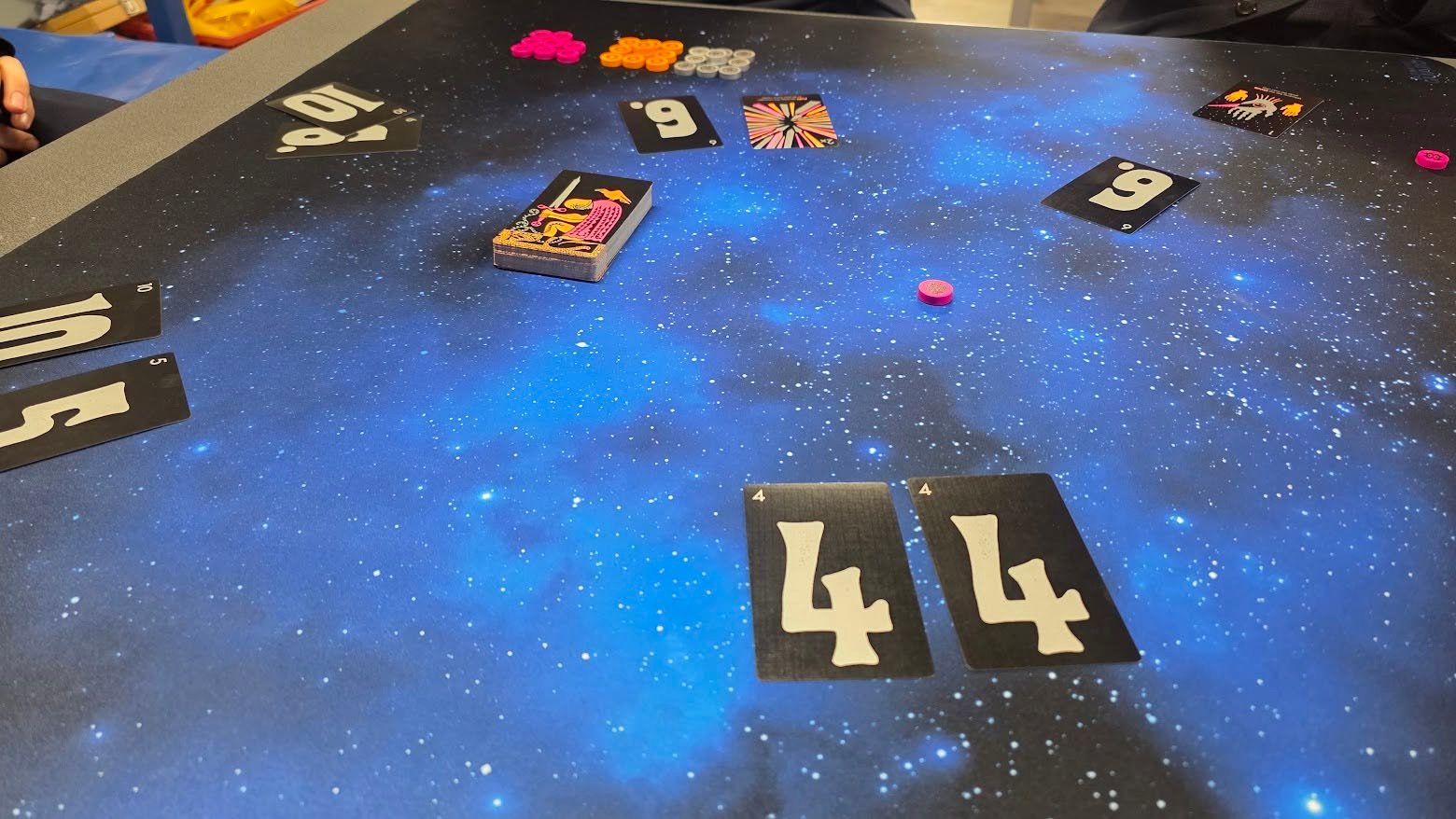
It’s also worth pointing out that you’re perfectly allowed to make deals with other players, although nobody is under any obligation to actually stick to them, which I think adds another interesting element, particularly at higher player counts (luckily have played this including all of the magenta games at multiple player counts).
From a playing with kids perspective, there is nothing particularly complicated about the maths involved, and most kids who are confident adding up a few numbers should be able to get their heads around how to play. What is significantly more complicated is understanding when to stop playing cards, when to let someone else win and how to manipulate the other players into spending more cards than they need to and this is the reason why while this game is playable with kids I think only older kids would be able to really get the full experience from it
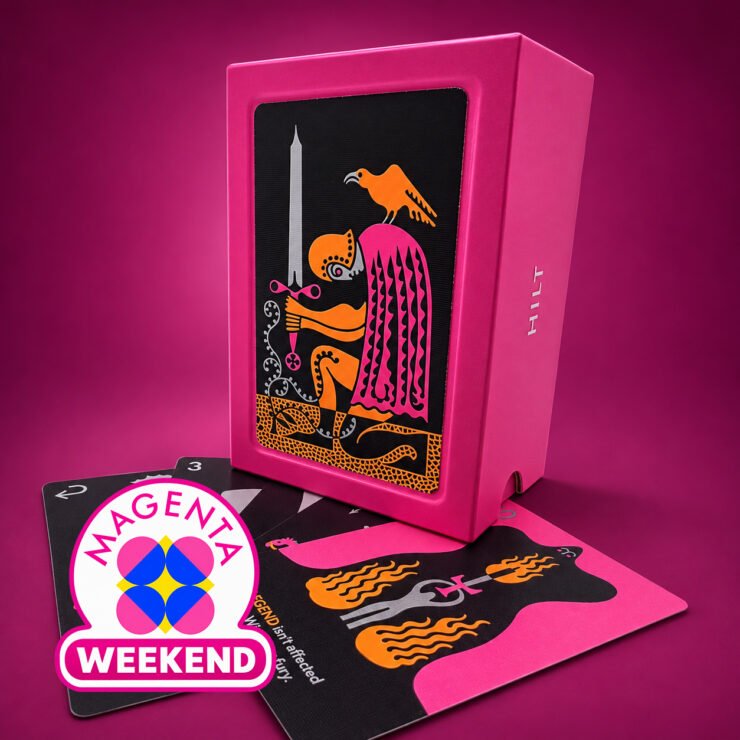
Visually, Hilt is quite different from some of the other games in the Magenta range. Whereas something like Fives is incredibly bright and colourful, Hilt has a much darker aesthetic, with stunning illustrations by Sophy Hollington (really want to start shouting out designers and artists more in this age of AI) that have an almost tarot card-like quality to them. The predominantly black cards with their big white numbers work particularly well with the brighter colours used on some of the Fate cards. As per the usual CMYK quality everything is well made and comes in high quality box and card stock.
There is obviously an element of luck in terms of the cards you’re dealt, and having someone completely undo everything you’ve been working towards by playing a Winter or a Doves card isn’t necessarily going to appeal to everyone. You do need to be the sort of person who enjoys a little bit of nastiness and direct player interaction in your games.
That being said, the fact that winning every battle is almost certainly not the best way to win the game is what makes Hilt particularly interesting. There are an awful lot of small card games where you’re essentially just trying to get rid of your cards or play higher numbers than everybody else, and I like that Hilt takes that relatively simple concept and does something quite different with it. There is a reason why Hilt has already caused such as stir and is sold out within days of being announced.
If you’re looking for a small-box card game that offers a little bit more tactical depth, particularly if you’ve got slightly older kids who enjoy bluffing and games with a decent amount of player interaction, Hilt is definitely worth a look.
Disclaimer: A copy of Hilt was kindly gifted to us by CMYK. All our thoughts and opinions are our own, and we have not been paid in any way for this review.