 Matthew Bailey
Game at a Glance
- Publisher Age
- 11+
- LBG Recommended Age
- 6+
- Players
- 3–4
- Playing Time
- 30–40 min
- Box Size
- Small
- Release Year
- 2026
LBG age recommendations are based on children familiar with modern board games, with adult guidance where appropriate. Every child is different.
The second game in our Magenta Weekend is going to be Fives, a trick-taking game with a little bit of Blackjack thrown in, where the general concept is that you are trying to win tricks to get as close to 25 as possible, going bust if you end up getting more than that.
To set up, give everyone five scoring tokens, shuffle the deck and deal 13 cards to each player. If you’re playing with three players, you’ll need to remove the cards numbered 10 to 13 from each colour and deal 12 cards each instead.
Whoever has the Magenta 0 starts the round, although you don’t actually have to play that particular card.
Going clockwise, everyone plays a single card, and you must follow the colour of the first card played if you can. If you don’t have a card of that colour, you’re free to play something else. It works much the same way as Hearts, which I think most of us remember from playing it on Windows back in the day.
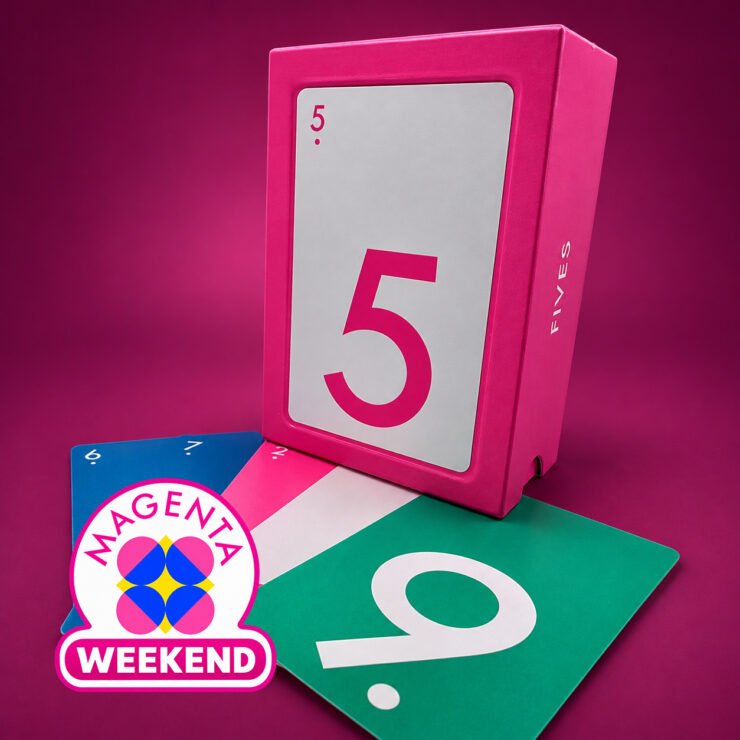
The highest card of the colour that was led wins the trick, although silver acts as a trump colour, meaning that even a low-value silver card will beat a higher-value card of another colour. This is particularly important in helping you manipulate your score. Where Fives gets particularly interesting is that the back of every card is a Magenta 5, and you can choose to play either side of your cards in certain situations.
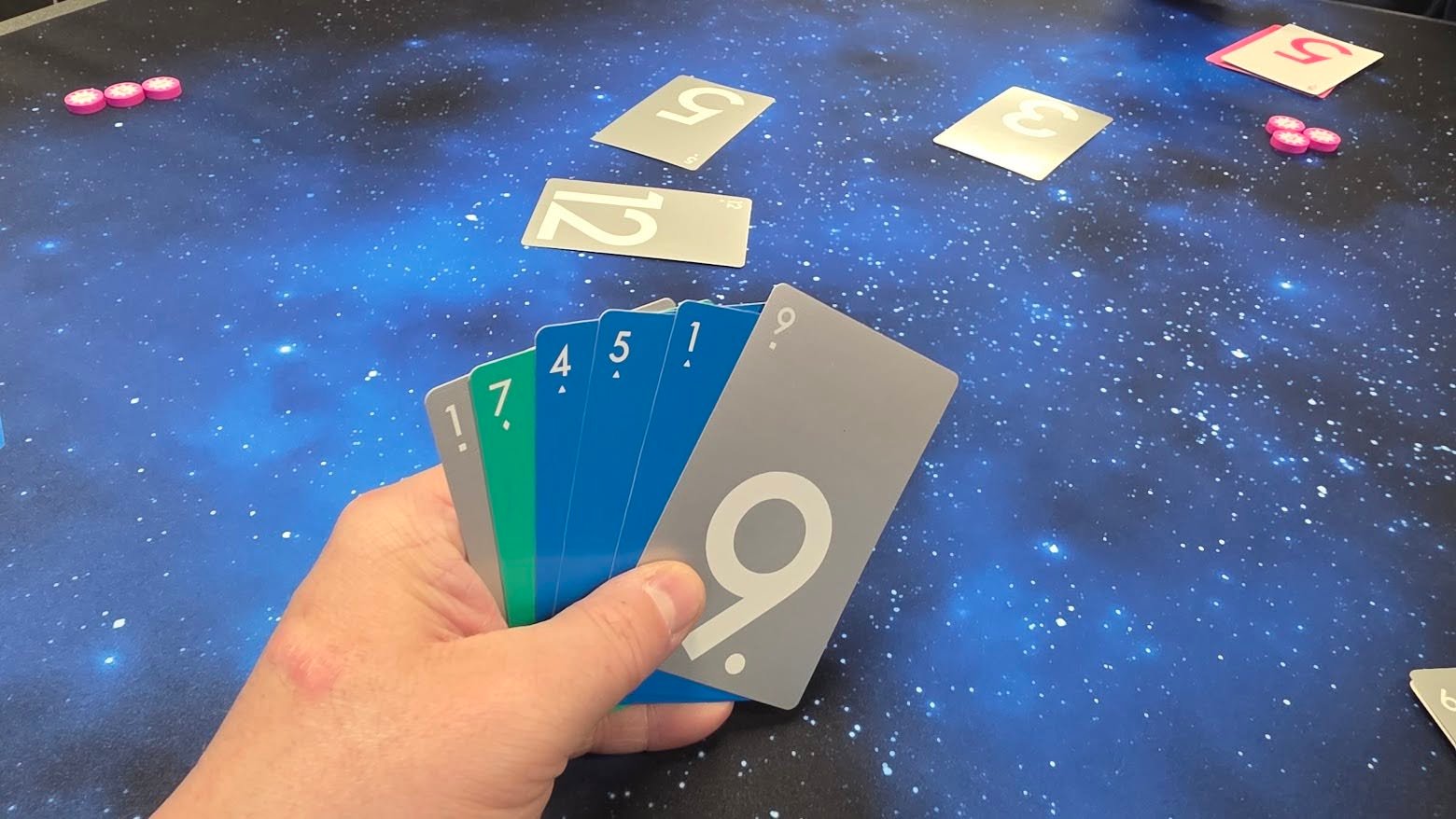
If you’re leading a trick, following magenta or don’t have a card of the colour that was led, you can choose to play any of your cards as a Magenta 5. Interestingly, if you have exactly one card left of the colour that was led, you must play that particular card but can choose to flip it over and play it as a Magenta 5 instead. Only one Magenta 5 can be played per trick.
This throws up all sorts of other tactical opportunities to manipulate your score because, unlike most trick-taking games, it’s not about winning or losing tricks; it’s about winning or losing the right tricks and getting the right number of points. It’s no coincidence that 25 is the score you are all aiming for and that 5 divides nicely into 25… all of a sudden, you realise that those fives become a lot more valuable.
When you win a trick, you collect all the cards played and place them in a pile in front of you, leaving your winning card visible on top. You then get to lead the next trick, which has both pros and cons.
Once everyone has played all their cards, you add together the values of your winning cards. In a four-player game, whoever gets closest to 25 without going over earns three scoring tokens, with second place earning two and third place earning one. In a three-player game, you earn two tokens for first and one for second.
Getting exactly 25 earns you an additional token, while going over 25 means you have to give one of your existing scoring tokens to the winner of the round. If players tie for a position, they receive the reward for the lower of the tied positions, and if there’s a tie for first place, any tokens lost by players who went over 25 are carried forward as a bonus for the next round, which can be particularly lucrative for the next winner. You then shuffle everything back together and go again.
After four rounds, whoever has the most scoring tokens wins! If there’s a tie, whoever got closest to 25 without going over in the final round takes the victory.
What I really like about Fives is that you can play this with anyone who’s familiar with even the most basic trick-taking game. Young kids can play it because it’s just numbers, and you can definitely play this with grandparents because the likelihood is that they will have played some sort of trick-taking game with a pack of cards at some point.
To be honest, there’s very little stopping you from playing this with a slightly adapted pack of normal playing cards, with Jacks, Queens and Kings being 11, 12 and 13 respectively. If you chose Hearts as your special suit, for example, the back of every card could be classed as a five of Hearts, with Spades being the trump suit. You’d just need to adapt one of the cards to represent the Magenta 0.
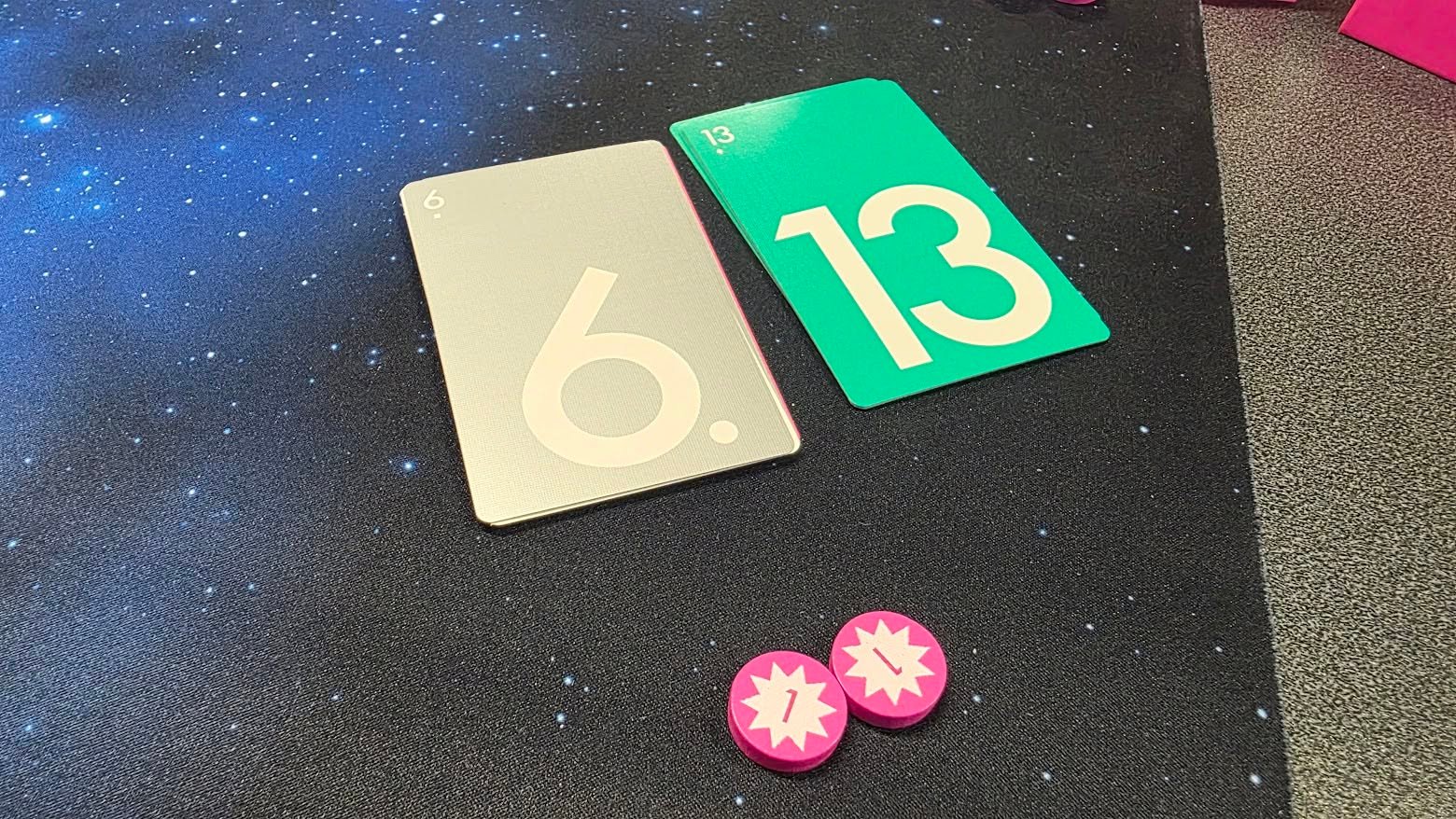
As with the rest of the Magenta games, the packaging is really nice. The box is only slightly larger than a pack of cards and is made of really strong, sturdy cardboard. The cards themselves have a lovely feel to them, the colours are bright and vibrant, and everything stands out well on the table.
I’ve played quite a few games of this now, and I actually really enjoy it. As time has gone on, I’ve started to enjoy it even more. On the surface, it’s really simplistic because all you’re basically trying to do is win tricks, but the reality is that the game plays more like Blackjack, where you’re trying to work out which tricks you want to win in order to end up as close to 25 as possible.
I would also say that, for kids, this is really good for practising some quick mental maths as you try to work out the best possible card to play. Having access to the Magenta 5 and silver being the trump suit gives you a lot more opportunities to manipulate the game than you often get in most simple trick-taking games.
I really enjoyed this, and it’s a strong recommendation. I was going to give it a Definitely, and I think the only reason I’m going to go with a Yes is that, while this is a lovely package and you could have a lot of fun with it, there is that niggling feeling that you could recreate this fairly easily with a pack of standard playing cards. As such, I think that makes a 100% definite recommendation a bit trickier.
Fives is a really good, simple trick-taking game with some different concepts that make it one of the more interesting ones I’ve played, and I’ve actually played a lot of trick-taking games in the last few months. Yet it’s simple enough that you could definitely get the grandparents playing this on Christmas afternoon.
Disclaimer: A copy of Fives was kindly gifted to us by CMYK. All our thoughts and opinions are our own, and we have not been paid in any way for this review.