 Matthew Bailey
Game at a Glance
- Publisher Age
- 10+
- LBG Recommended Age
- 8+
- Players
- 2–4
- Playing Time
- 45–60 min
- Box Size
- Medium
- Release Year
- 2027
LBG age recommendations are based on children familiar with modern board games, with adult guidance where appropriate. Every child is different.
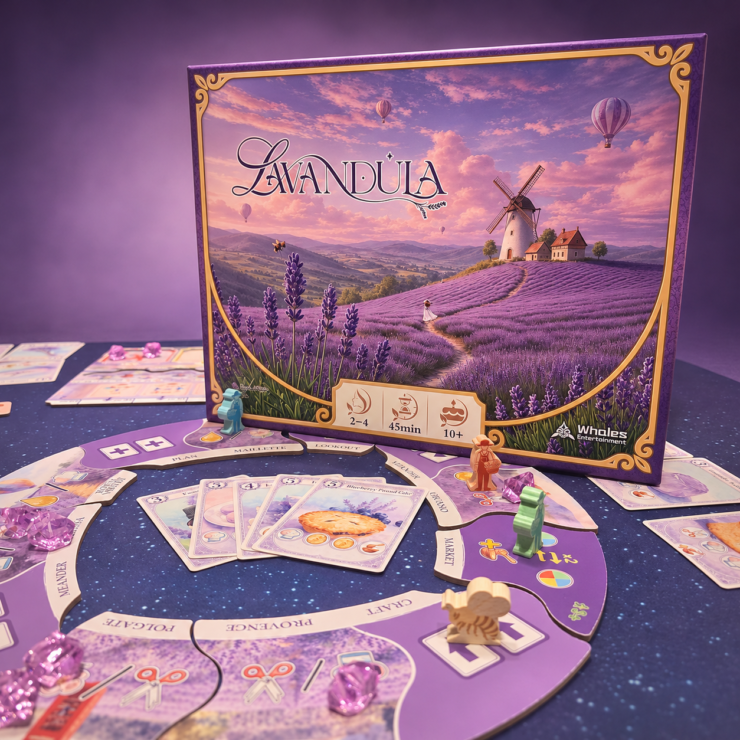
Today I’m finally going to be looking at Lavandula, a worker placement and order fulfilment game from Whales Entertainment, the company that produced the super cool 3D tile-laying game Vines and Flowers, as well as the Tailor Master games that are a big go-to in our house. Lavandula is on Kickstarter now, so I’m excited to share my thoughts and, overall, they’re really positive.
Firstly, for transparency, Whales Entertainment are in this group and have previously asked group members for feedback. This review, however, is completely independent. The version I played is mostly finished and gives a good idea of the final design.
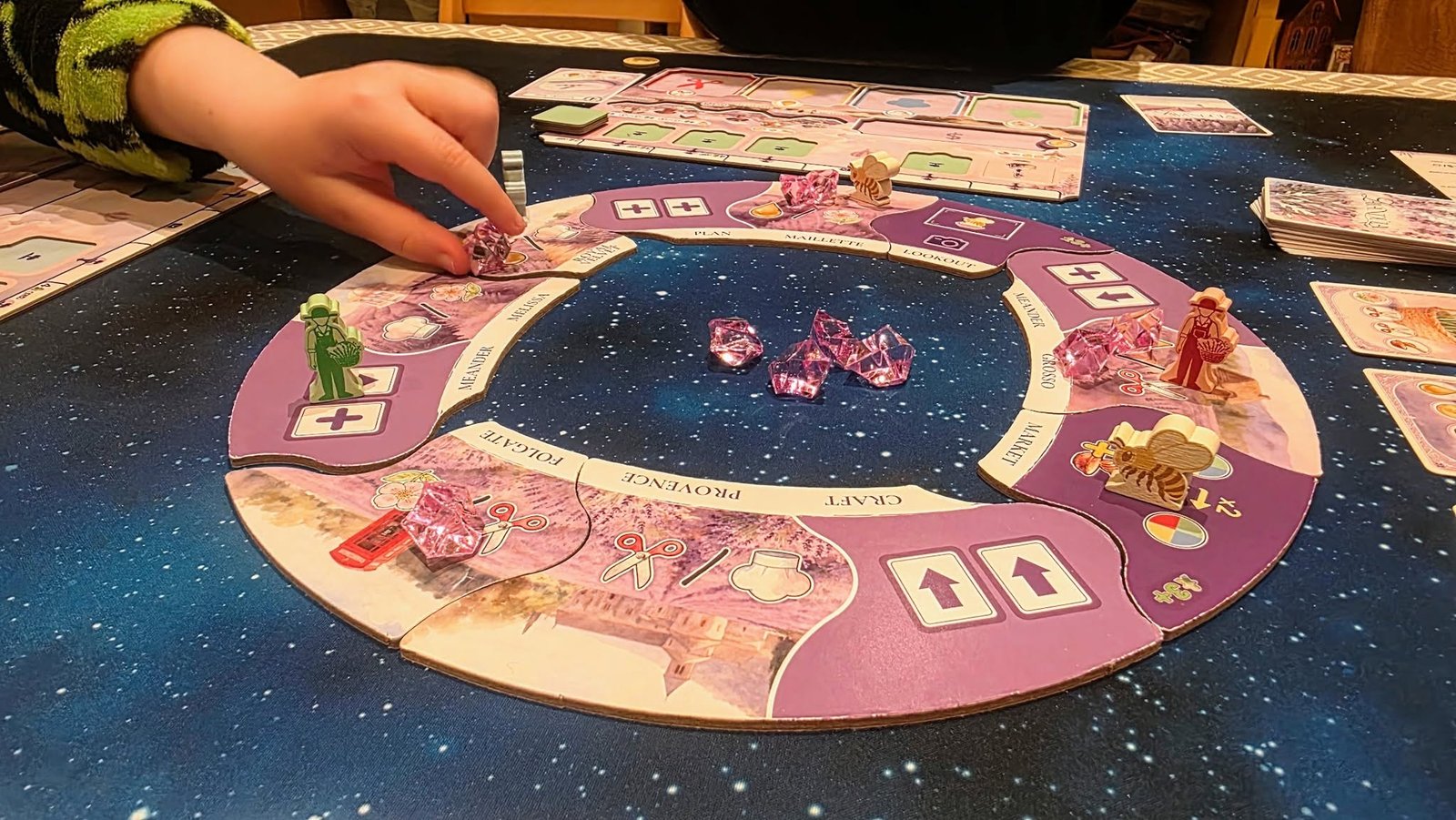
In Lavandula, you move between lavender fields, gathering what you need to craft items and putting together a bouquet of your own. You each start with a player board and two secret goals. In the middle of the table is a ring of lavender fields and action spaces, with a shared honey pot that anyone can dip into when crafting. One thing I really like is that the board is made up of separate sections, meaning every game is slightly different. The size of the board also changes depending on how many of you are playing, so everything feels tight.
On your turn, you move one or two spaces around the ring in either direction. You skip over other players and bees (we’ll talk about those in a sec) without counting the spaces they occupy, so a field that looks quite a way round the board can suddenly be within reach if the stars align.
If you land on a field with lavender in it, you choose what to do with one piece. You can collect it for crafting, choosing which of the two resource types shown on the field it will count as (I’m not quite sure what the scissors represent, but let’s ignore that). Alternatively, you can visit the field and add the piece to the matching spot in your bouquet. You can only add each variety to your bouquet once, and once you’ve put it there, you can’t spend it on a craft later. If the field is empty, you can plant instead. Roll the die to see how much lavender grows back and take a coin, leaving the fresh lavender for whoever gets there next.
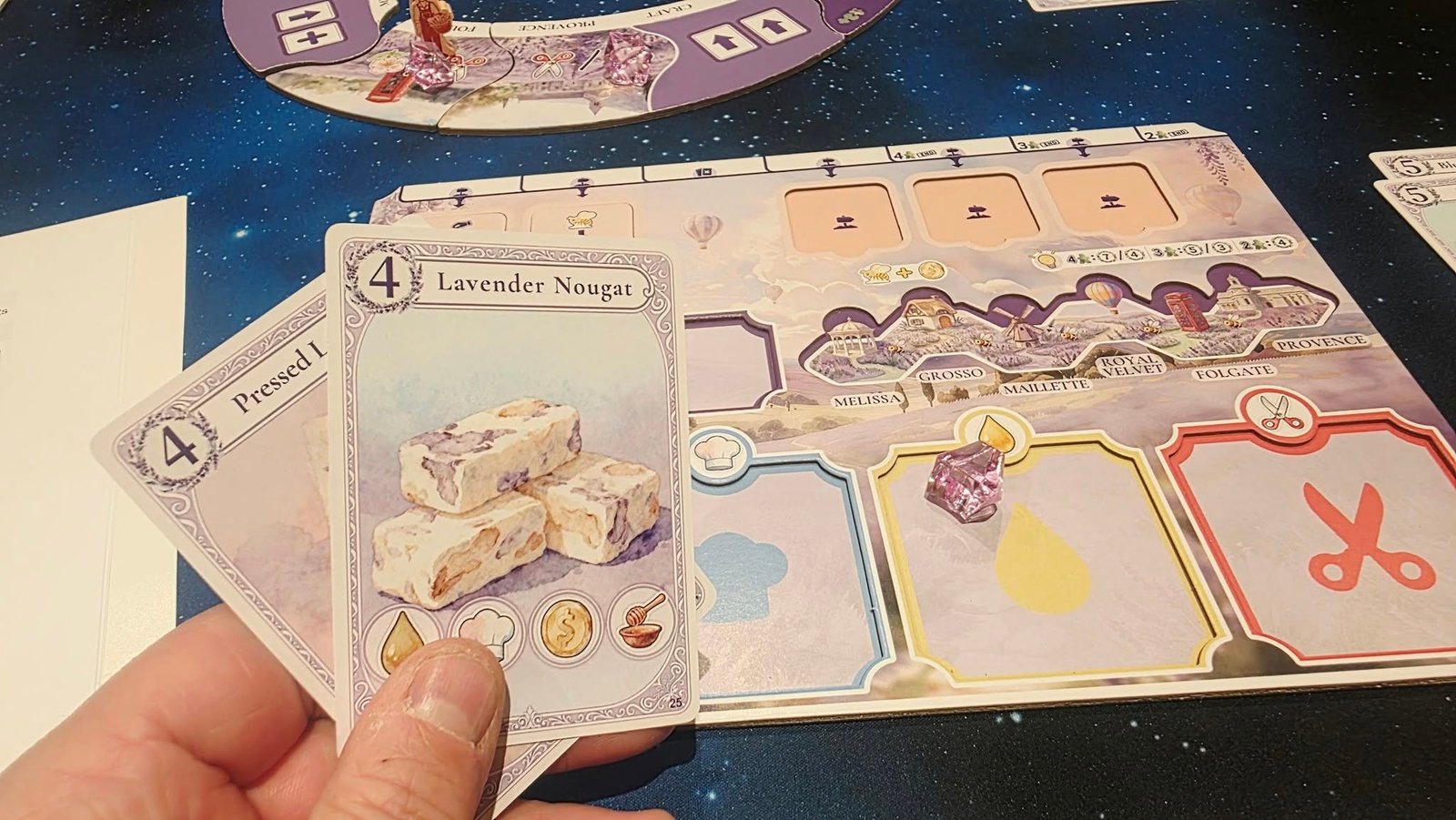
The action spaces are where you turn all that lavender into points. Plan lets you take up to two craft cards from the face-up display or the top of the deck. Craft lets you complete up to two cards from your hand by paying the lavender, coins and honey shown on them. Meander lets you take one card and craft one, in either order, so you can pick up something you like and make it straight away. If you’re one lavender short, two coins can cover it, but any honey you need has to come from the shared pot in the middle.
I think the honey pot is a really cool mechanic. I can’t think of another game like this that I’ve played where everyone shares one of the resources. It creates a lot of mind games because you can see which cards people are picking up from the display.
Deliberately using up the honey to make life difficult for another player is definitely the order of the day, if you want to play like that.
Now let’s talk about those bees. If you finish your move next to a bee, you must move it one or two spaces, and you can do this before or after taking your action. Land the bee on a field with lavender and it moves one piece into the pot as honey. Land it somewhere without lavender and one honey comes out of the pot, if there’s any left. That timing matters. You can move a bee first to make the honey you need, then spend it before anyone else gets a turn.
When you use your gathered resources to complete a craft, you gain points. Most crafts also let you choose a tool that gives you an ability for the rest of the game. These are extremely powerful, and I mean extremely powerful. It quickly became apparent that these are how you win the game. Some let you gain lavender when you take other actions, while others let you move further or share a space with another player. Your third craft works a little differently. Instead of choosing a tool, you choose which of your two secret goals to keep and discard the other.
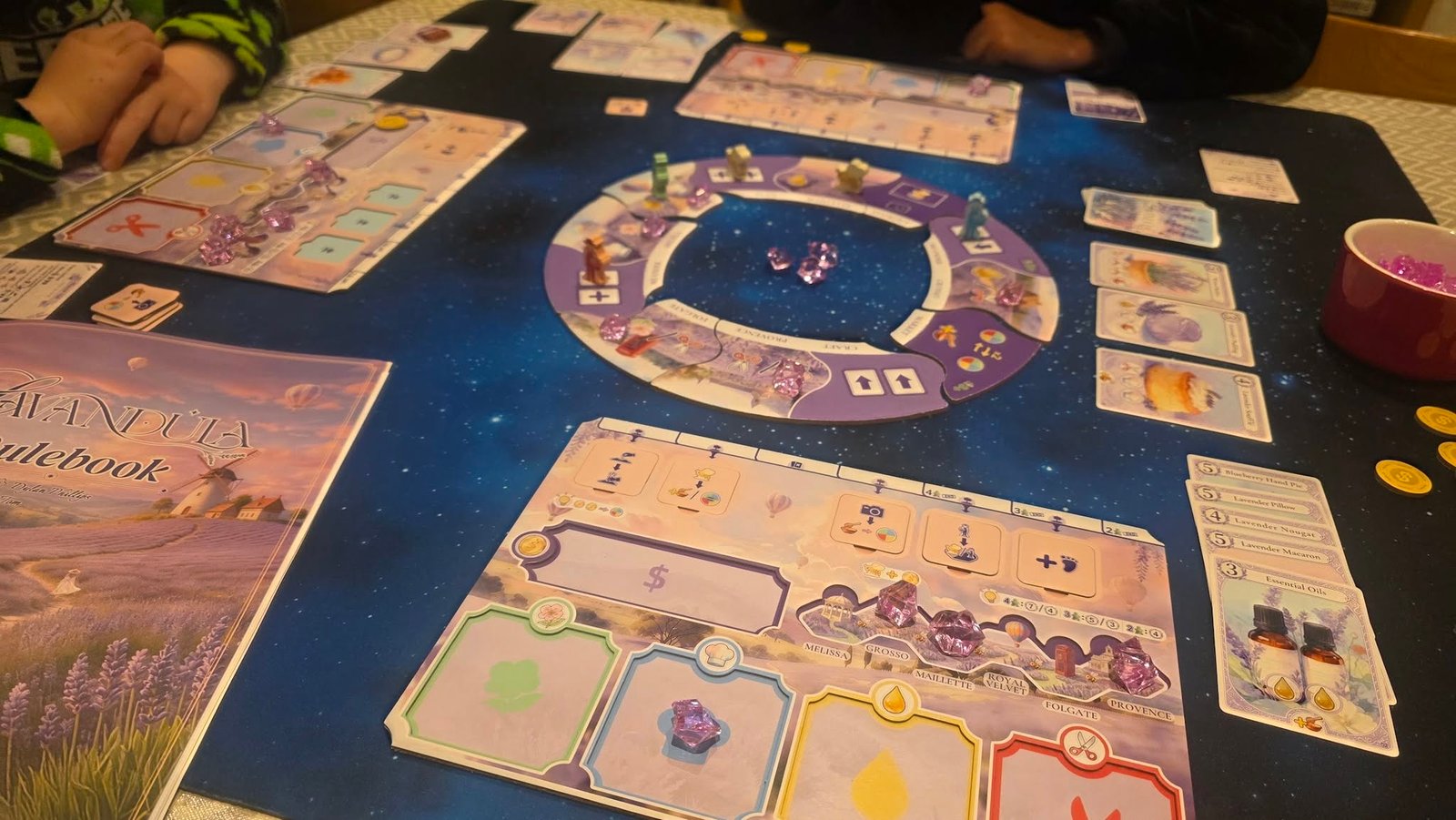
When someone fills all six spaces in their bouquet or completes enough crafts, you finish the round so everyone has had the same number of turns. The number of crafts you need depends on how many of you are playing. You score your completed crafts, any secret goals you still hold and bonus points based on how your bouquet compares with everyone else’s. There’s one last twist before you declare a winner. Whoever is in last place at that point gets one point for every honey left in the pot. If you’re tied for last, you each get the full bonus. It’s an ultra-odd mechanic, but it does mean you need to keep an eye on how much honey is left before you trigger the end of the game, especially if it’s close. Whoever then has the most points wins.
Lavandula feels familiar at first, but it has some interesting mechanics and moments that make it well worth a look, especially if you’re a fan of this type of game. The bees give you an unusual way to manage the board, and a big part of playing well is working out where you want them and what you need to do next.
Everything moves at a good pace and turns are quick, but the real standout for me is the tools. By the end of the game, their powers can turn you into a lavender-producing powerhouse.
Visually, the game is lovely. I know this is a weird criticism, but I almost feel they’ve leant a little too heavily into the lavender theme. The individual player boards are identical apart from the spaces the tools go in, and I’d have preferred each board to be a slightly different colour so they stand out from one another. It’s a small thing, but it is a lot of light purple.
That minor quibble aside, Lavandula is a really lovely, cosy strategy game, which is something I’m keen to feature more of on Little Board Gamers. It’s simple enough that most kids could happily play just by collecting lavender and making things. As they get older, there’s a decent level of strategy for them to grow into, particularly once they realise what they can do with those bees and tools. For me, there’s enough here that feels different to make it well worth a look.
A prototype copy of Lavandula was provided to us to play by Whales Entertainment. All our thoughts and opinions are our own.