 Matthew Bailey
Today we are going to be looking at Dice Miner, an older game that I actually owned the Collector’s Edition of a few years ago, but ended up selling almost immediately, having only played it once, largely because the box didn’t have the name of the game on the side and it didn’t sit nicely on my shelf (I know, I have problems).
Anyway, having now got hold of a standard copy, I decided to give the game another chance without the box situation clouding my judgement and, actually, it’s a really good little dice game.
The game is played over three rounds, with players gradually building up their own collection of dice. At the end of each round, you score all the dice you have collected before most of them are rerolled ready for the next round.
To set up, put all the dice into the bag and fill the mountain with 20 dice. This is really cool and fun to do. This is one thing where I actually prefer the standard edition to my previous Collector’s Edition. The Collector’s Edition has an injection-moulded piece of plastic, whereas this is a fun cardboard mountain that nicely folds down and allows the dice to slide into the spaces. Each player also chooses a Hero card, which gives them some additional die faces (it doesn’t make a massive difference to the game, but adds a bit of strategy you can lean into) that they can use throughout the game.
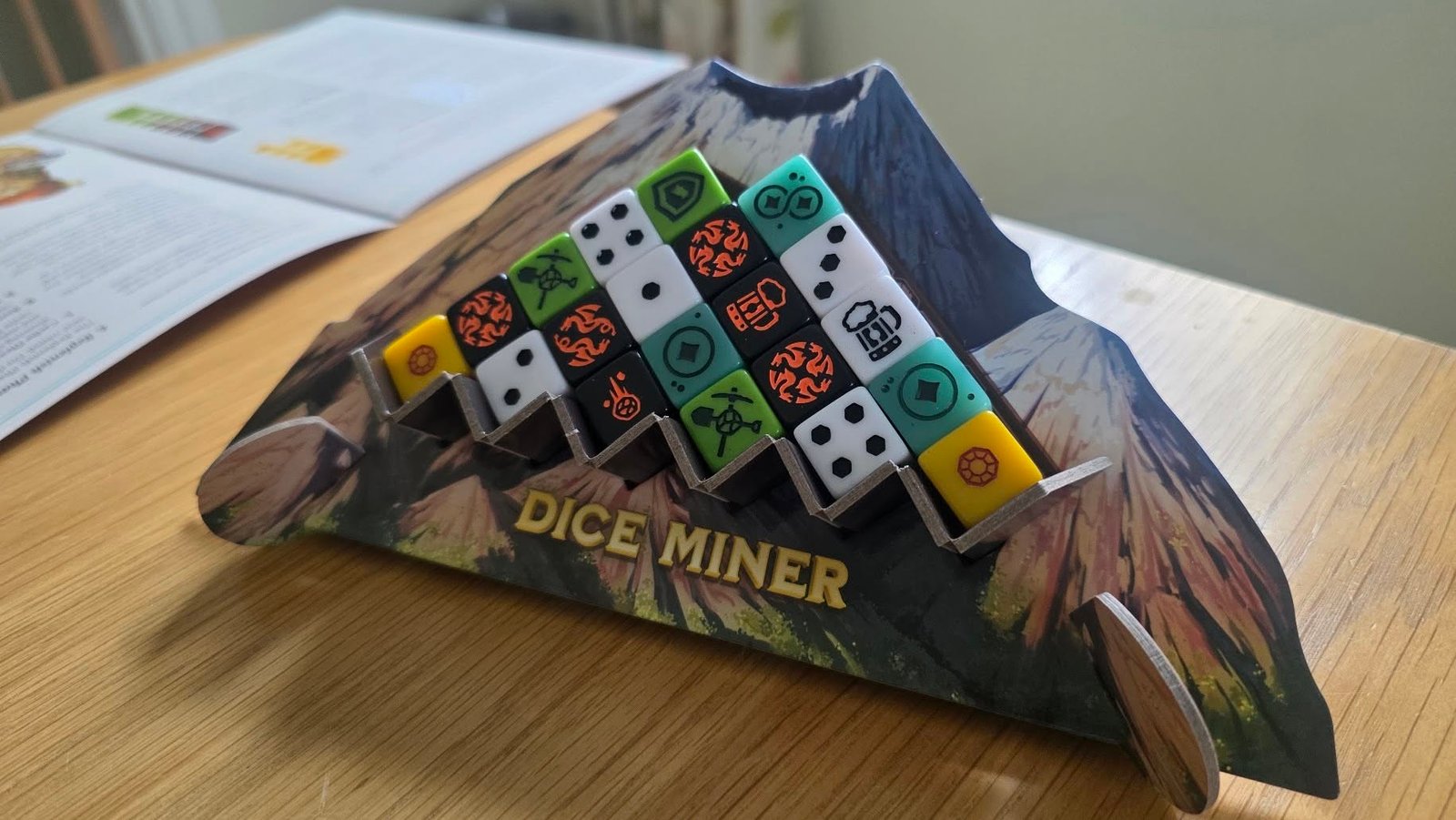
Each round begins with the Excavation Phase, where you take turns choosing dice from the mountain. Normally, you can only take a die from the top, meaning there can’t be another die sitting above it. Whatever face is showing when you take the die stays face-up as you add it to your hand. You continue taking turns until the mountain is empty.
There is one way to bend these rules slightly, which adds another layer of strategy, and that’s beer. If you have a die showing a beer symbol, you can give it to another player at the start of your turn, rerolling it before handing it over. In return, you get to take two dice from the mountain instead of one. This introduces an element of risk and reward, as you don’t know what you are giving them and could accidentally give them something good, even though you are getting two dice. These can even be taken from the side of the mountain, causing any dice above them to slide down into the newly created gap. This becomes a really important part of the strategy as you get more familiar with the game.
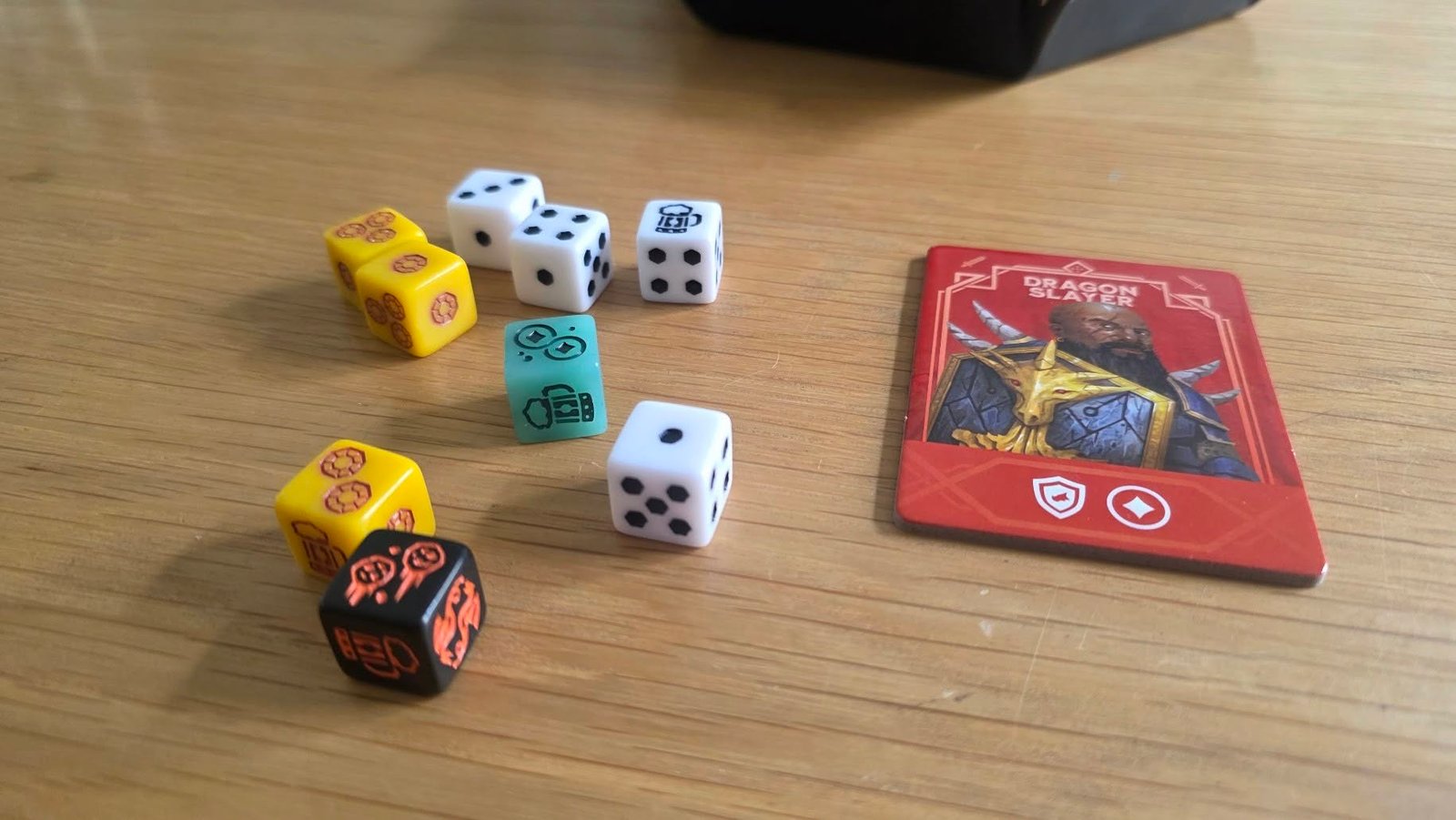
Once the mountain is empty, you move into the Magic Phase. Magic dice allow you to reroll other dice in your trove, with the number of magic symbols determining how many dice you can reroll.
Then it’s time to score, and each type of die works differently. “Tunnel dice” score by creating sequences beginning with a 1, so a 1, 2 and 3 would score six points. You can make multiple sequences if you have enough dice. “Treasure dice” score one point for every gem showing, with whoever has the most gems doubling their Treasure score (this is particularly devastating in a two-player game). Hazard dice show cave-ins and dragons and normally give you negative points, but tools and shields can make these negatives positive, with multiple matching tools multiplying the value. So, two pickaxes alongside four cave-ins would actually score you eight points rather than losing four.
Finally, some Tool dice show chests. These let you cache dice, keeping their current faces for the following round. Everything you don’t cache is rerolled, the player currently in last place becomes the new starting player, and another 20 dice are loaded onto the mountain.
After the third round, there is no replenishment. You simply complete the final scoring phase and whoever has accumulated the most points across the three rounds wins.
We really like Dice Miner. It’s a drafting, point-salad scoring game at heart, but it has a lot of personality to differentiate it from many others. It also looks great on the table and fits its theme well. Some of the mechanics are also quite unique, such as the dice placement and the way the beer system works, meaning there are lots of ways to score points as the game progresses.
Production quality is really good. Everything looks great and is well made, and I really like the cardboard mountain. The dice are good quality, which definitely makes a difference for this type of game.
Finally, it’s not worth getting the Collector’s Edition as the regular one is absolutely fine, but my biggest concern is that, even now, it’s quite expensive to buy at around £35 for a relatively light to very low-middleweight dice game. However, if you see Dice Miner second-hand, on a deal, or available to play at a board game café, this is a definite recommendation.




 Nicola Asker