 Matthew Bailey
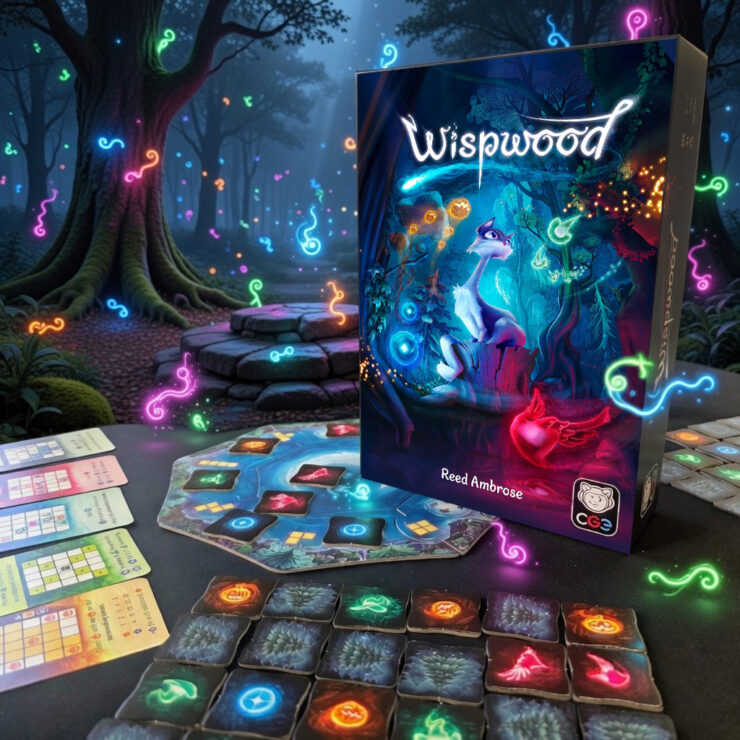
“Wispwood” is a game that has been on my radar for quite a long time now, having first previewed it back at the UK Games Expo last year. Released around the same time as “Gloomies”, both games offer a similar neon, night-time sprite style aesthetic, but the gameplay is relatively different, with “Wispwood” offering a cool tile-laying, point-gathering game that builds over three rounds. It actually reminds me a little bit of “Minecraft: Builders & Biomes”, but in a good way.
In “Wispwood”, players are building their own little forest, gradually filling it with glowing wisps while trying to arrange them in ways that will score points based on the goals chosen at the start of the game. As with most games like this, there are various ways the different wisps can score, but they all follow an overall theme that keeps everything fairly balanced.
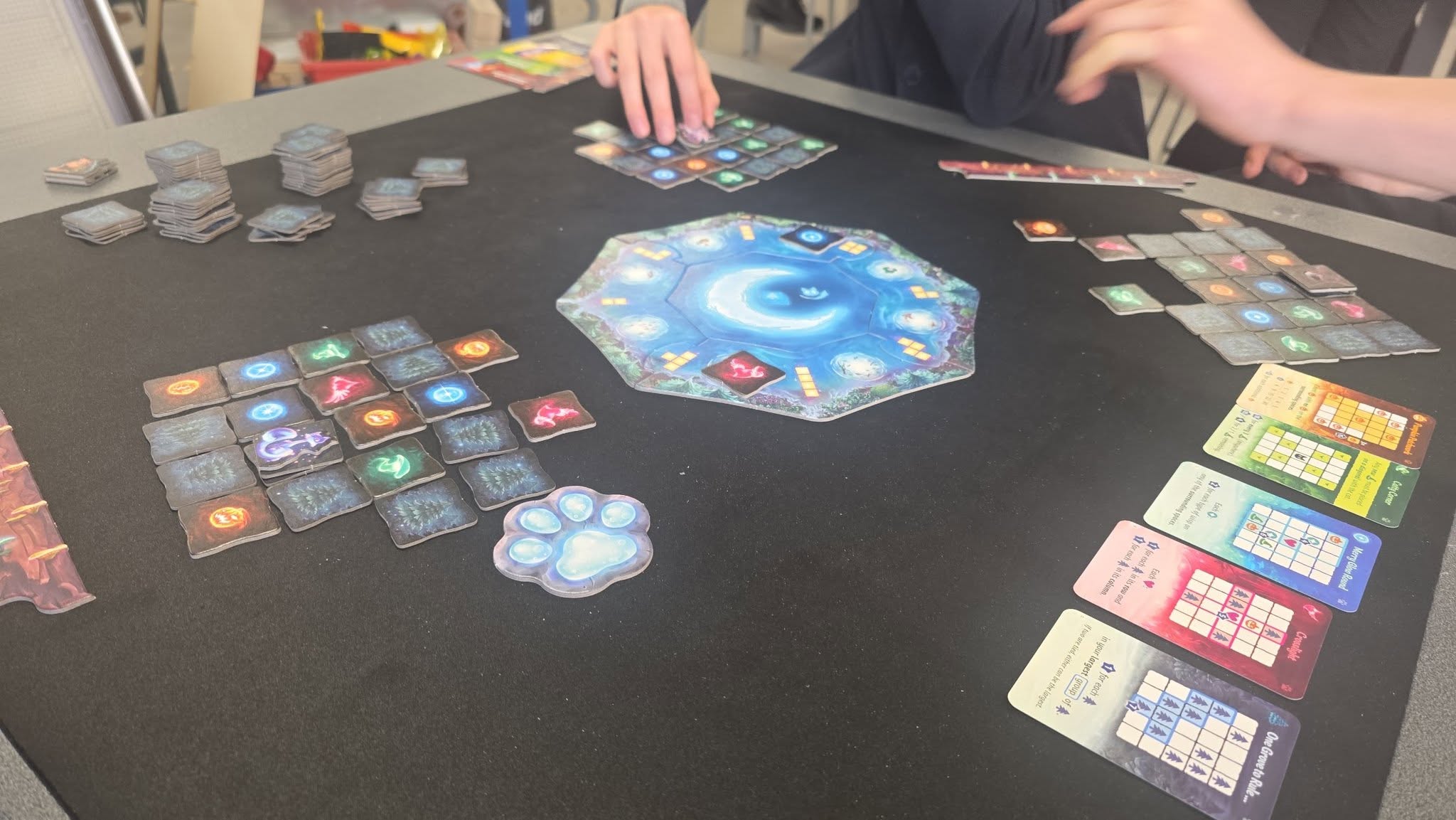
Everyone begins with a single tile in front of them, their cat sitting on a tree tile, which forms the starting point of their forest. In the middle of the table sits the pond, surrounded by a ring of face-up wisp tiles. These wisps come in four types and they are the pieces you will be collecting as the game goes on.
On your turn, you normally take a wisp from the pond. Each wisp sits between two different placement shapes shown around the pond, and when you take a wisp you must choose one of those shapes. You then take enough tree tiles to build that shape along with the wisp tile itself. The wisp can sit anywhere within that pattern, and the shape can be rotated or mirrored however you like. Once you have the pieces, you add that whole shape into your forest. The only real restriction is that at least one tile in the shape must touch a tile you already have in your forest, and everything must stay inside the current grid size for that round, think how you build in “Kingdomino”. There are also some little grid markers intended to help you keep track of your grid, but we generally found these unnecessary.
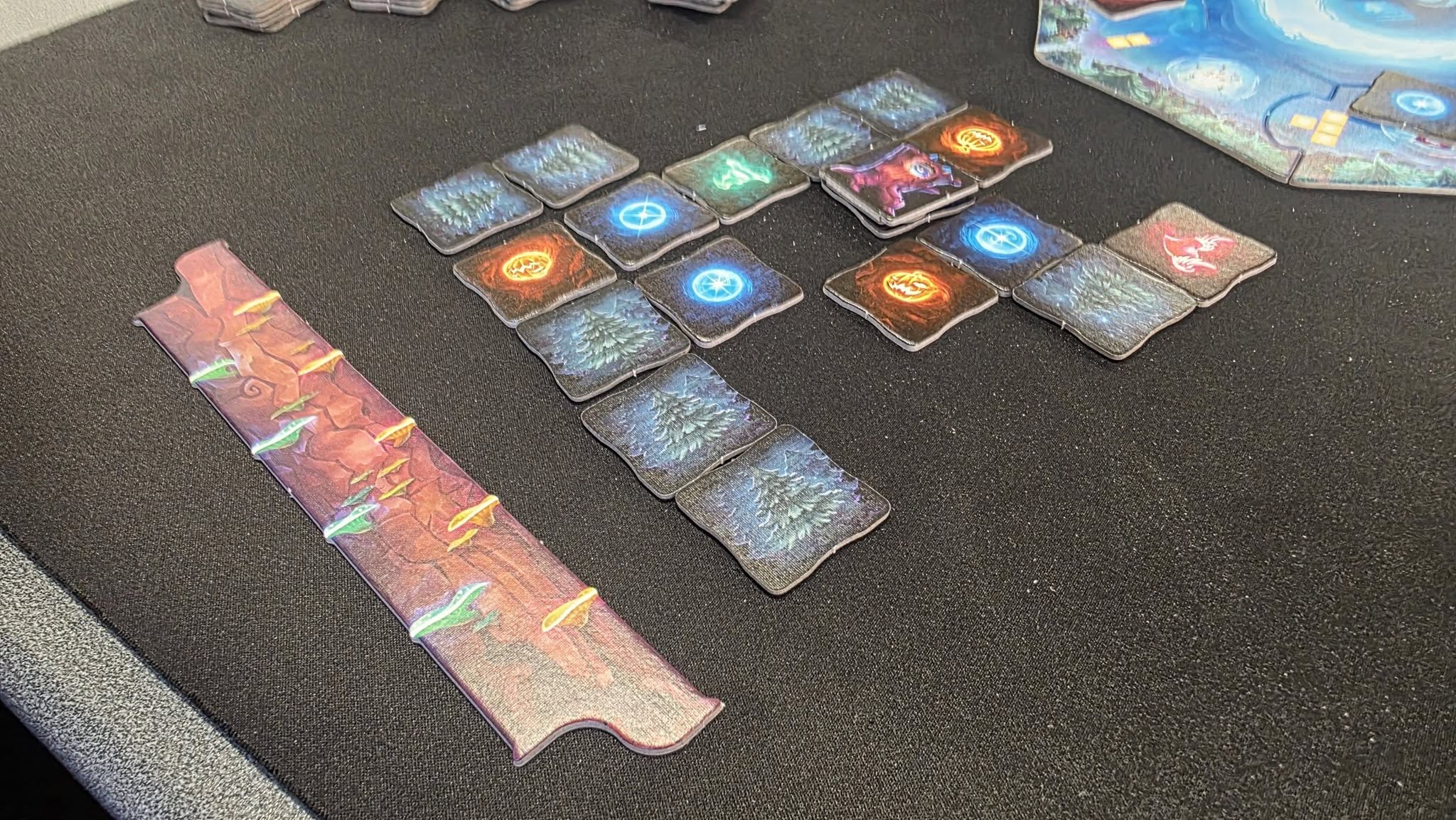
As the game progresses, your forest grows outward turn by turn. The first round is played inside a 4×4 grid, the second expands to a 5×5 grid, and the final round uses a 6×6 grid. Because you keep the wisps you placed in earlier rounds, the puzzle becomes more interesting as space fills up and you have to fit new shapes around tiles that are already there. This is one of the key things we all really liked about “Wispwood”, the points you gain can theoretically stack each round, but you can equally back yourself into a corner with poor choices early in the game.
Instead of taking a wisp, you can choose to take a tree turn. This lets you place one, two, or three plain tree tiles into your forest instead, which is useful for filling awkward gaps or preparing space for later turns, as tree groups can earn you points, as can completing your grid at the end of the round. If you have used your cat earlier in the round, this action also lets you flip the cat back to its ready side so it can be used again for its special ability.
Talking about the cat’s special ability, when the cat is ready you can hide it to either refresh the wisps around the pond or to ignore the usual restrictions and choose any of the available shapes when placing a wisp. This gives you a bit of control if the options around the pond are not quite what you need, and refreshing them is not particularly painful.
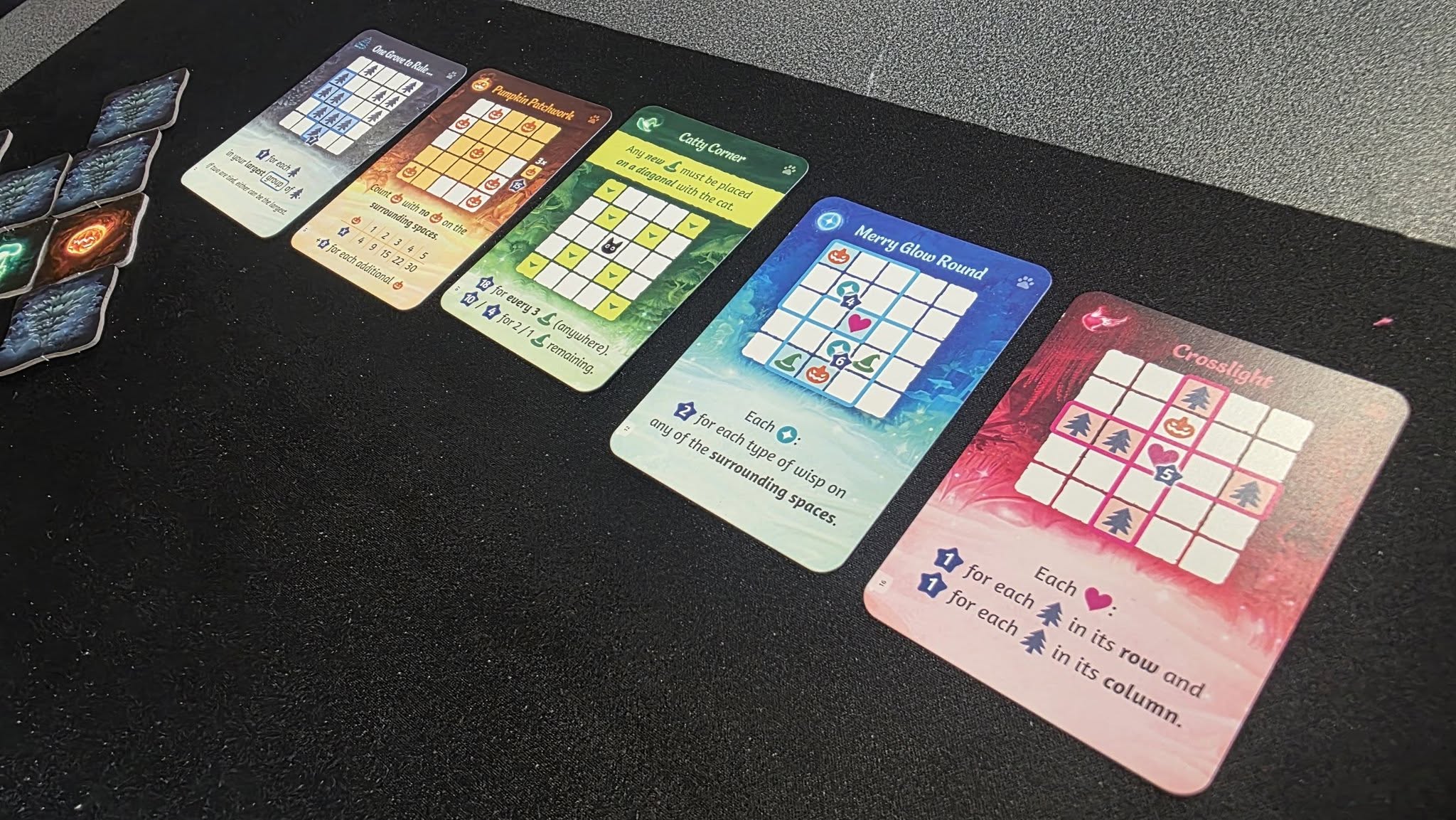
A round ends when someone completely fills their grid. All players finish the same number of turns, then everyone scores based on the goal cards chosen at the start of the game, which reward different patterns of wisps and trees in your forest. After scoring, the tree tiles are removed, the starting player marker passes to the next player, and a new round begins with a larger grid. After three rounds, the player with the most points wins.
Overall, the whole thing works together really well. It does not take up too much time, with the game stretching to around 40 minutes even with four players. Because of the ever-increasing grid each round, there are quite a few options open to you, and I never felt like I was overly forced into too many sub-optimal plays. It became more about working with what I had available to me rather than being disappointed that I was going to have to make some really bad moves.
The game is beautiful. The artwork is lovely, the wisps are really pretty, and everything is very visually appealing. This is definitely the sort of game I would love a deluxe version of, but that does not always seem to be a CGE thing. The cat tiles are double-sided and stick together, which is a cool idea. I do have a tiny bit of concern about their long-term durability, as they are essentially held together with a small circle of double-sided tape. Even after the first game we played, one of them had started to fray slightly at the edges. Overall though, it is a really nice package, although it probably could have done with an insert.
“Wispwood” does not do anything wildly unique, but what it does do is deliver an excellent and well-thought-out tile-laying game that is visually appealing, easy to understand, and still offers a decent amount of strategic depth. It gives you a good number of options on your turn without ever making you feel like you are forced into bad situations.
“Wispwood” is another strong release from CGE, and for fans of tile-laying games this is a really good choice.
Disclaimer – A copy of Wispwood was kindly gifted by CGE. All of our thoughts and opinions are our own.