 Matthew Bailey
CMYK as a company have really been firing on all cylinders over the last few years. Their video game adaptation Wilmot’s Warehouse was a massive hit for us a few years back, Hot Streak claimed our GOTY award for 2025, and the reskin of Quacks was also something we were very pleased to see.
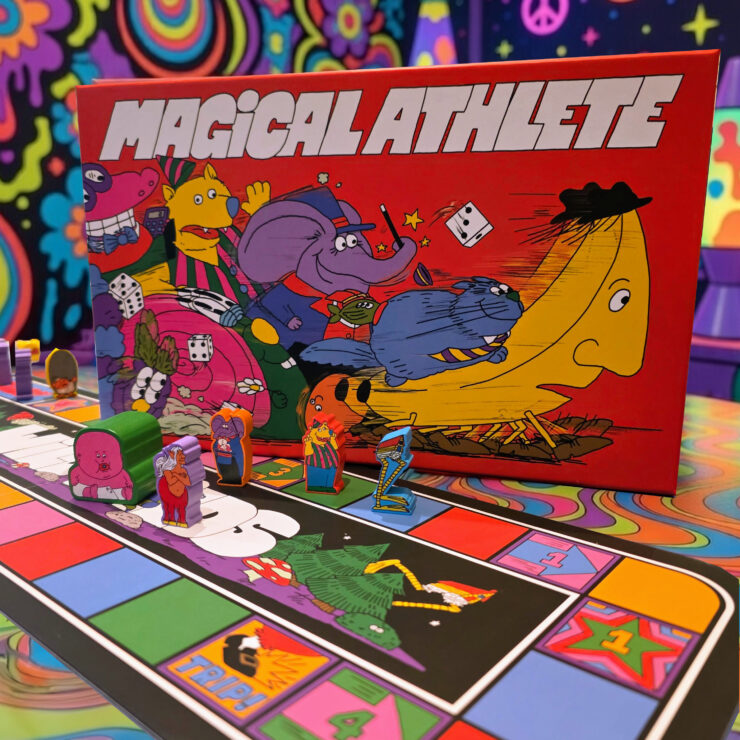
And now here we are with the current hottest ticket in town, the much talked about Magical Athlete. Magical Athlete is based on the original Z-Man Games release of Magical Athlete from 2003, which in my brain was not that long ago, until I realised it was actually 23 years ago and that I was getting old.
On the face of it, Magical Athlete should be a game that I do not like, but somehow the sum of all its parts makes it one of the most enjoyable games I have played so far this year.
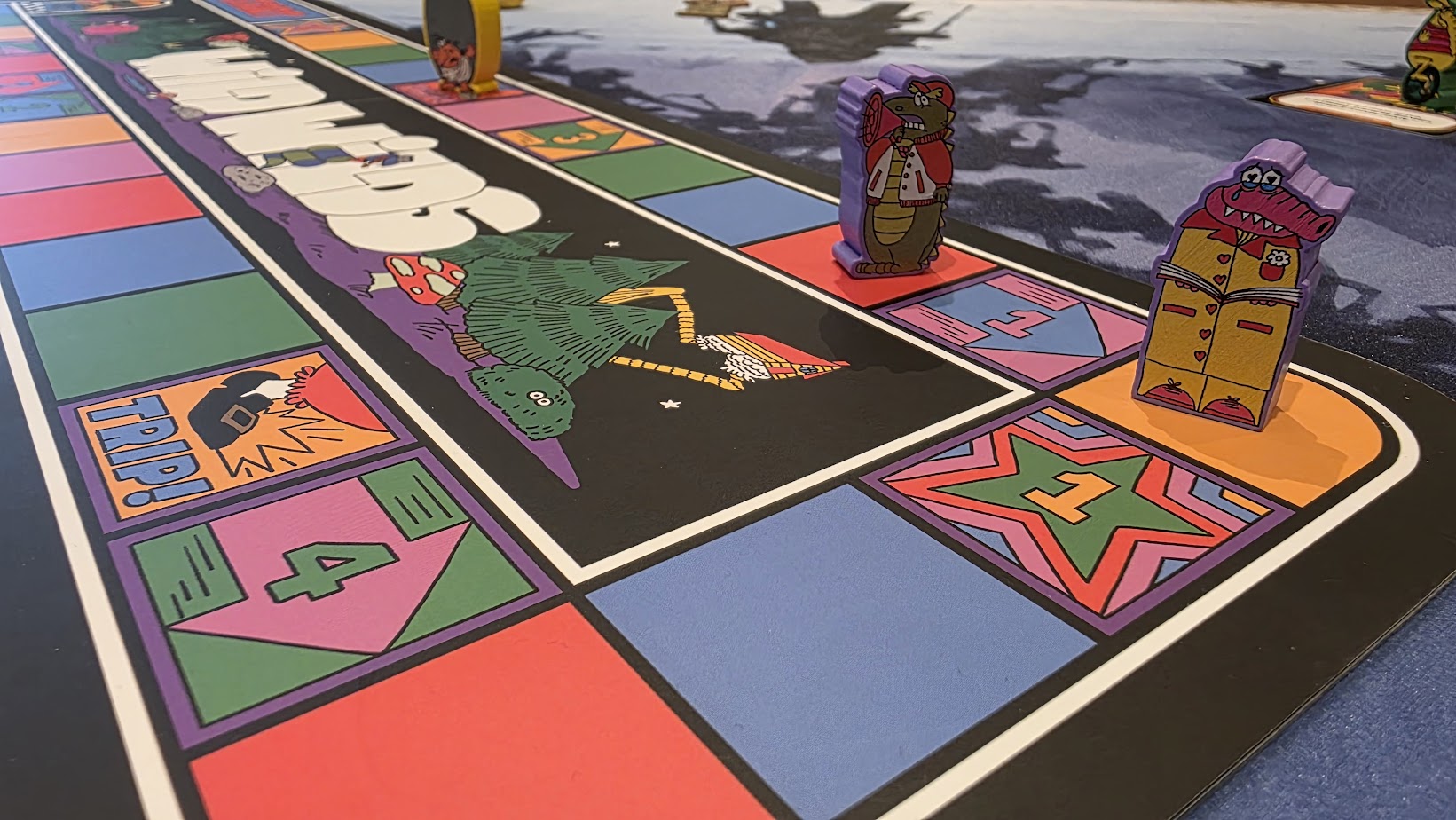
On the surface, Magical Athlete is a roll-and-move game like Candyland or Snakes and Ladders, but the small things it does are clever and make this game extremely compelling.
Magical Athlete is basically a racing game where a group of wacky competitors race around a track, each with their own unusual abilities that can dramatically affect the race. The aim of the game is to score the most points across four races by finishing in first or second place, or potentially picking up some extra points along the way.
You start by placing the racetrack in the centre of the table with the Mild Mile side facing up. Over the four races you play two on the standard track and two on the track with unusual spaces. Pour out the point chips and stack the gold first-place trophies and silver second-place rosettes so they are easy to access during play. Shuffle the racer cards and keep the deck nearby, then empty the bag of racer meeples, which are big, chunky and beautiful, next to the board. Each player also takes a die, which are also big, chunky and lovely.
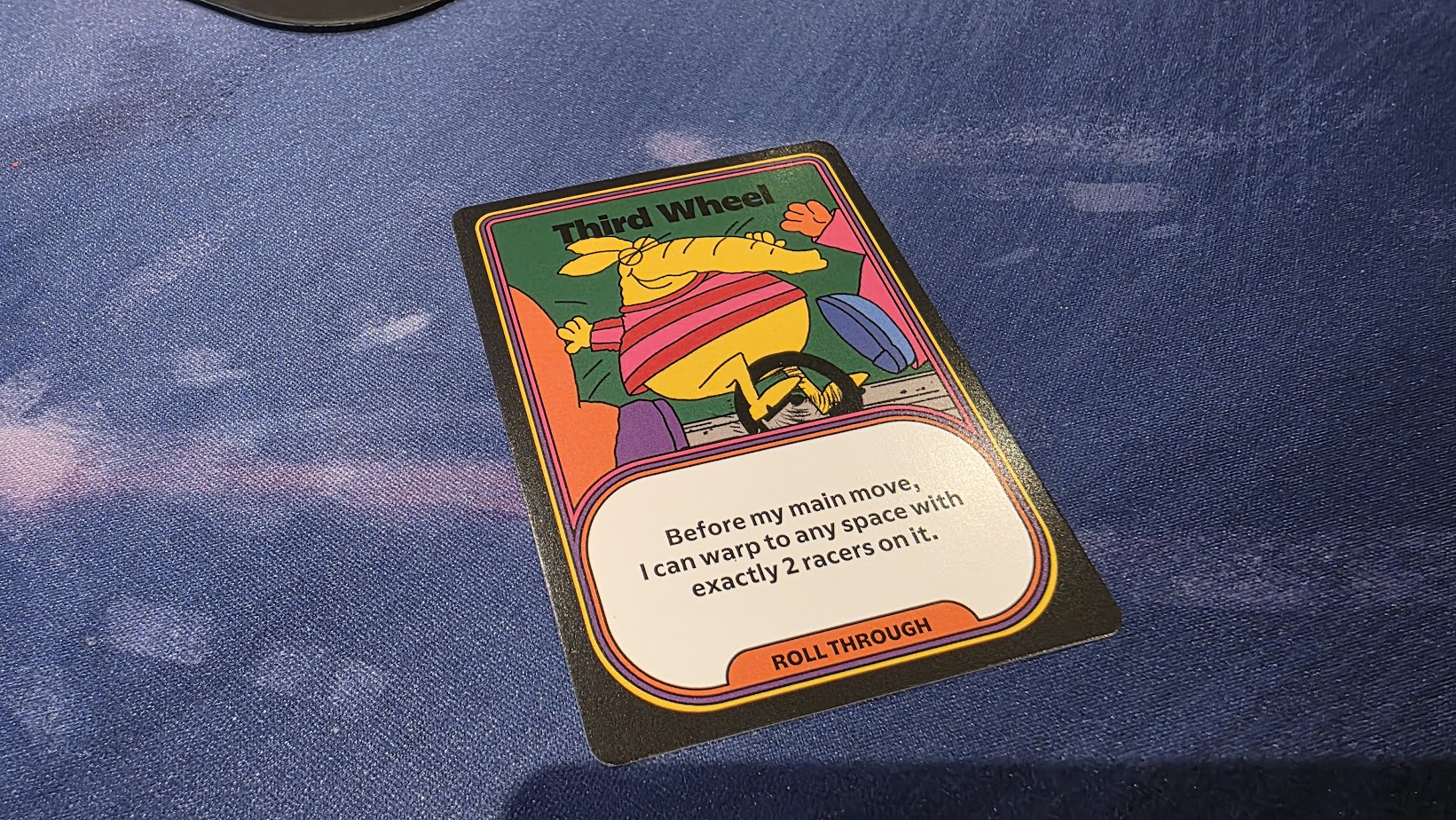
Before the first race begins, players assemble a team of racers. Flip over twice as many racer cards as there are players and place them in a row in the middle of the table. Everyone rolls their die and the player with the highest roll drafts first. Players take turns choosing racers in a snake draft, meaning the order reverses when the last player picks. This process continues until everyone has drafted four racers that they will use across the four races in the game.
At the start of each race, all players secretly choose one of their remaining racers and reveal them at the same time. This is a key moment in the game, as choosing the best racer at the best time is really important. Some racers complement others, and some perform better depending on which side of the board you are playing. This turns into a mini game of rock-paper-scissors as you try to pick the best racer. The racers are not balanced, and some are definitely better than others, while some carry a decent amount of risk and reward in terms of gaining points. The corresponding racer meeples are placed on the Start space of the track. Each racer can only be used once during the game.
Races are played in turns. On your turn you roll your die and move your racer forward that many spaces in the most unassuming board game way. This is known as your main move. Many abilities reference the main move specifically, so it is important to keep track of when movement comes from the die roll and when it comes from a special ability instead. After completing your turn, play continues clockwise around the table.
What makes the game unique is that every racer has a unique power that can influence movement or interact with other racers on the track. Some powers are optional and can be used when the player chooses, while others automatically trigger when certain conditions are met. If several effects happen at the same time, they resolve in a specific order: racetrack spaces resolve first, then the current player’s racer abilities, and finally the abilities of other racers in clockwise order. This can sometimes create massive chain reactions that can boost or disrupt certain racers. Sure, there is a lot of luck involved, but the fact that you made the decision about which racer to play that round almost turns the game into an autobattler, and I do like those.
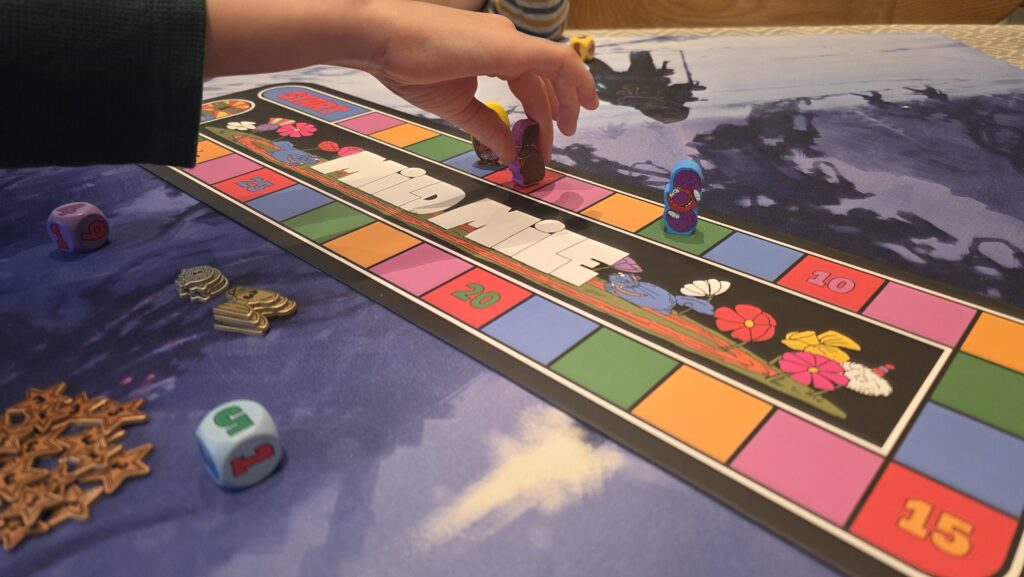
Some of my favourite abilities are:
The Duelist can challenge another racer sharing its space to a duel. Both players roll a die and the winner moves two spaces. The Duelist wins ties.
Rocket Scientist can double the number rolled for their main move, but then immediately trips after moving. Tripping means you miss a turn.
Scoocher moves one space whenever another racer’s ability happens.
M.O.U.T.H. has one of the most dramatic abilities in the game. If it stops on a space with exactly one other racer, that racer is eliminated from the race entirely, which can instantly change the outcome if it happens near the finish line.
Copycat permanently copies the power of whichever racer is currently in the lead. If multiple racers are tied for the lead, the player controlling Copycat chooses which power to copy, meaning the ability can change throughout the race.
The race continues with players rolling, moving, and resolving abilities until two racers cross the finish line. The first racer to finish takes the top gold chip for first place, and the second racer takes the top silver chip for second place. As soon as second place is determined, the race ends immediately.
After the race, the racers that participated are removed from play for the rest of the game. The track is then flipped to the other side, as the game alternates between the Mild and Wild versions of the track. Players simultaneously reveal a new racer from their remaining team and place the matching tokens on the Start space ready for the next race. The player whose racer finished furthest behind in the previous race takes the first turn in the next one.
Once four races have been completed the game ends. Players total the points they earned from their finishing positions across all races, and the player with the most points wins the game. If players are tied, the tie remains and they share the victory.
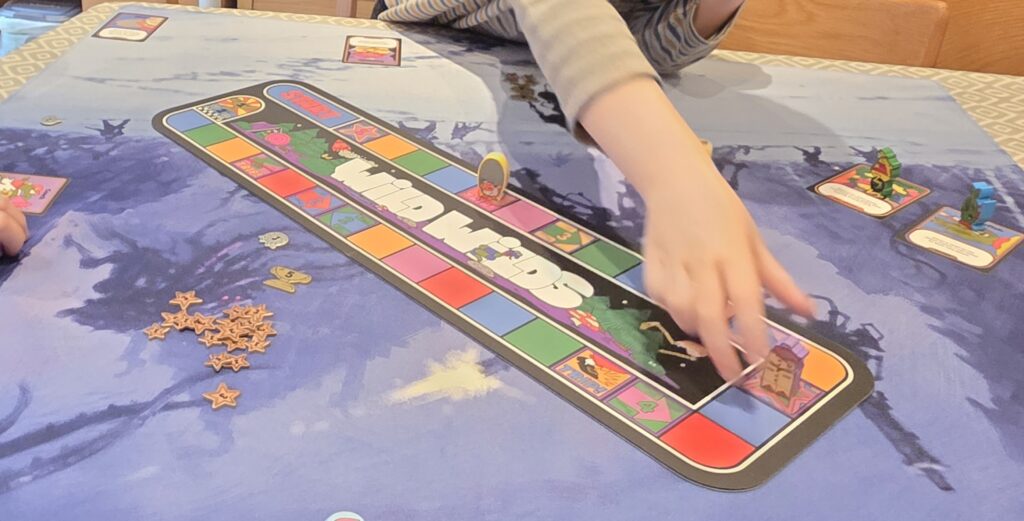
It sounds relatively simple, and that is because, to be honest, it kind of is. But the sum of its parts and the enjoyment of playing it is something quite special. You are just going to have to take my word for it, but the amount of buzz online for this game shows that people are responding to it.
The visual design of the game is wonderful. Once I got over the fact that it is not in a board game shelf friendly box, I really appreciated the colourful presentation, the wonderful meeples, and the 1970s psychedelic cartoon style artwork. It looks like something out of a Dr Seuss book, with characters that also remind me a little of Adventure Time.
Magical Athlete is incredibly light and incredibly approachable, but even as a family that has now played well over 1000 board games, Magical Athlete still feels wonderful. I also really enjoyed playing with two racers each, which lets you try to choose abilities that complement each other.
While I do accept that Magical Athlete is not going to be for everyone, I think for many people in this group it could be exactly what they are looking for. It is approachable and on the surface is not radically more complicated than Snakes and Ladders, but the overall sum of the game’s parts is quite special and another hit for CMYK.