
 Matthew Bailey
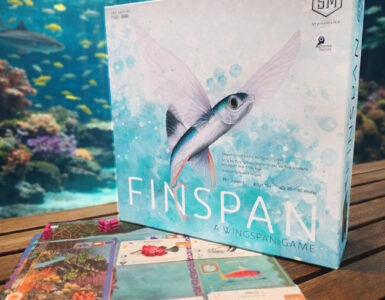
Wingspan is the second in our “span” trilogy, and probably the game I should have covered first. Instead, I decided to look at them in order of perceived complexity. In this review, I’m going to talk about Wingspan, why I really like it, and refer a little back to my review of Finspan from a few days ago, so if you haven’t read that one, I will put a link in the comments. I will also be looking at Wyrmspan in a couple of days, though I will largely leave that out of this review.
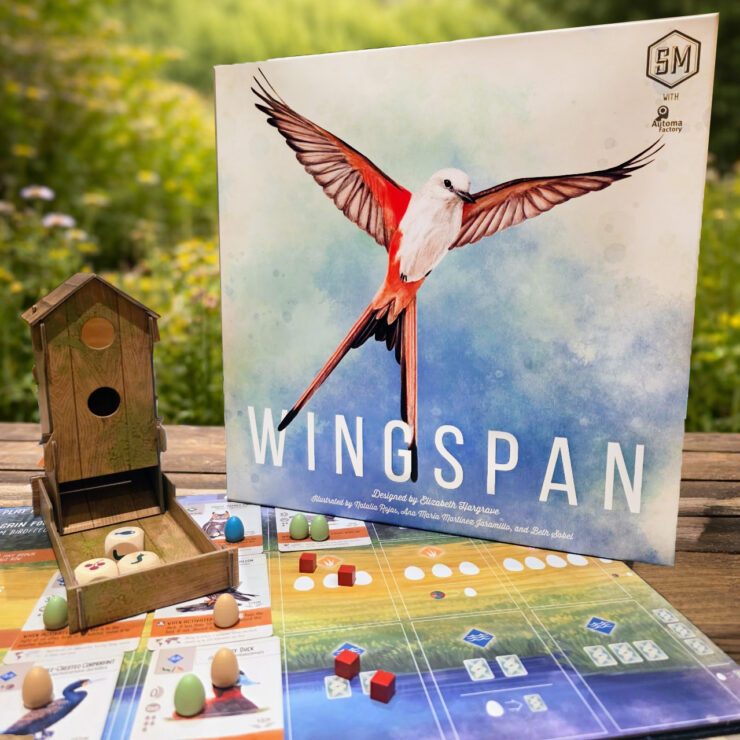
Wingspan is the original game, released in 2019 and designed by Elizabeth Hargrave, which went on to widespread critical acclaim. The theme of the game is that you are a birdwatcher, gradually building up a collection of birds across different habitats. One of the things that really made it stand out was its cosy atmosphere and its focus on nature, something that even now still feels relatively underused in board games.
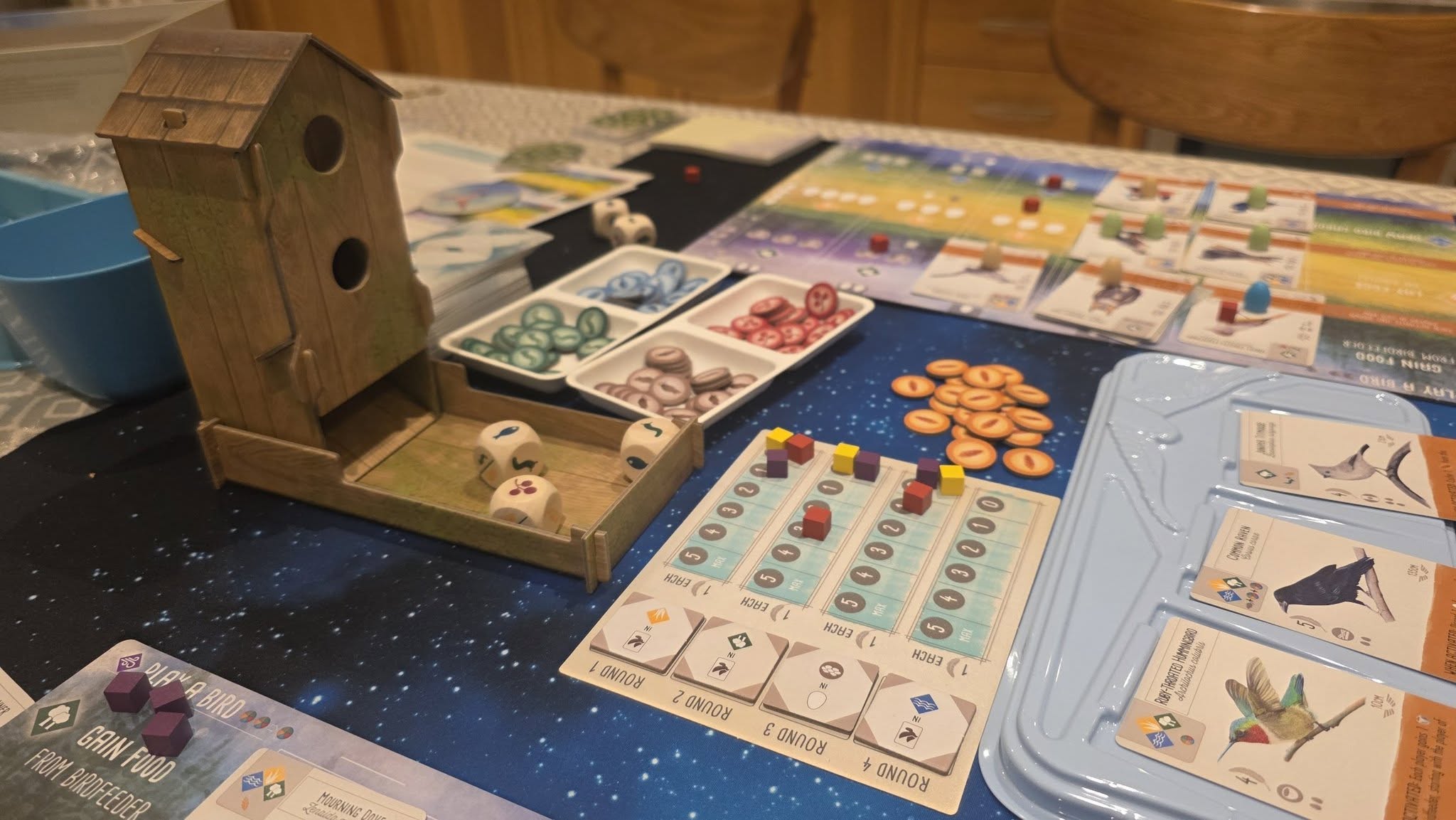
Before getting into how Wingspan works, I will say this up front. I do slightly prefer Wingspan to Finspan. Jack (10) also prefers Wingspan, but Toby (7) likes Finspan more. I actually think Finspan could have gone even further in simplifying things. The areas where Wingspan is more complex are mostly in the cards themselves. Some birds have slightly more detailed effects, particularly those involving drawing and discarding cards, but these are generally quite easy to understand.
In fact, because much of this is written out clearly rather than relying heavily on iconography, like in Finspan, I think it is often easier to interpret, especially for younger players. All of us, including Toby, who is seven, actually preferred this approach. Wingspan holds your hand slightly less than Finspan, but I would not say that makes it harder in any meaningful way. If anything, Finspan can have more to keep track of with moving fish, stacking, and forming schools. Wingspan feels a little cleaner in that regard. If your child can play Finspan, they can play Wingspan.
At its core, Wingspan is an engine-building game where you are developing three different habitats: the forest, the grassland, and the wetlands. Each of these habitats is tied to a different core action. The forest is primarily about gaining food, the grassland focuses on laying eggs, and the wetlands are used for drawing bird cards.
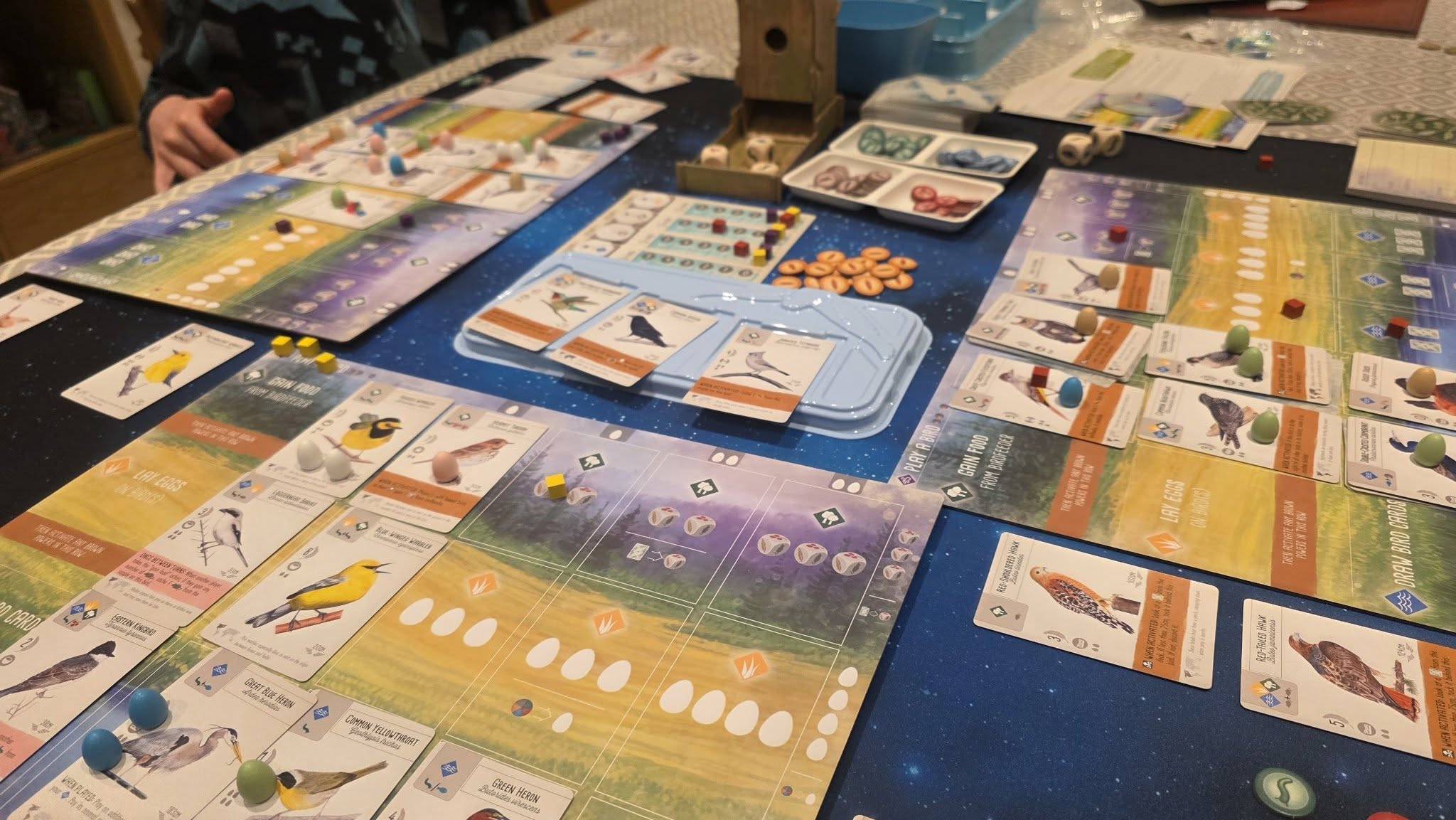
On your turn, you choose one of four actions. You can:
- Play a bird
- Gain food
- Lay eggs
- Draw cards
Playing a bird involves placing it into one of the three habitats, paying its cost in food and sometimes eggs if it is not the first bird in that habitat, and then adding it to your growing engine in that row.
Gaining food involves taking food from the bird feeder based on the dice currently showing. If all of the dice show the same type of food, you can re-roll them. The dice are rolled into a really nice cardboard bird feeder that you assemble, which is a great touch.
Laying eggs allows you to place eggs onto your birds, up to the limit shown on each card. Eggs are important as they are both a scoring element and a resource, as they are often required to play birds further along a habitat.
Drawing cards allows you to refill your hand. Unlike in Finspan, cards are not generally used as a currency, although some bird abilities allow you to tuck cards under others, which then score points at the end of the game.
The key idea in Wingspan is that when you take an action in a habitat, you do not just perform the basic action. You also activate all of the birds in that row, moving from right to left. Early in the game, this might be quite simple, perhaps gaining a single food or drawing a single card. As your engine grows, those same actions become far more powerful, triggering multiple bird abilities in sequence and allowing you to chain together increasingly efficient turns.
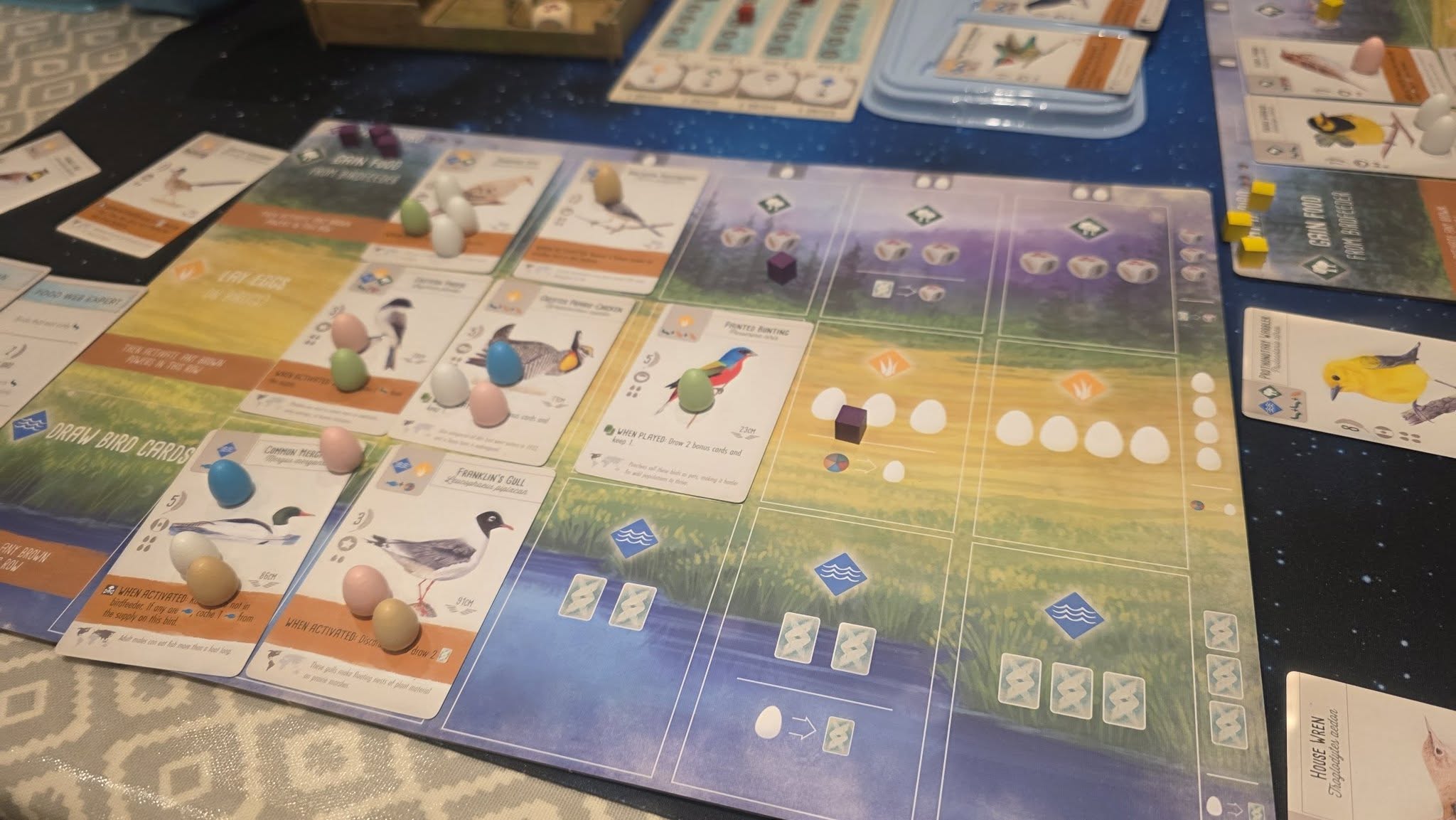
One thing I will say about Wingspan, and the same goes for Finspan, is that I have never really felt like my engine is generating massive combos in the way some engine builders do. Instead, it is more about becoming steadily more efficient over time.
The game is played over four rounds, and in each round you have a limited number of turns. Interestingly, the number of turns decreases slightly each round, which adds a bit of pressure as the game progresses. At the end of each round, players score based on specific objectives, which might reward things like the number of birds in a habitat or how eggs are distributed.
At the end of the game, final scoring comes from several areas:
- Points printed on bird cards
- Bonus cards that reward certain strategies
- Eggs placed on birds
- Cached food and tucked cards, depending on bird abilities
Compared to Finspan, the overall structure is very similar. Both games are about building an engine and improving your actions over time. The main difference is how that engine is organised. Wingspan uses horizontal rows across habitats, while Finspan uses vertical columns based on depth. Wingspan also feels slightly more straightforward in terms of upkeep, whereas Finspan introduces additional elements like moving fish and grouping them together, which can make it feel a bit more fiddly at times.
Component quality, much like Finspan, is the usual wonderful Stonemaier standard. Everything is linen-finished and feels great. The bird feeder that you drop the dice into is a really nice touch, and one of the standout components. One of the biggest advantages over Finspan is that the boards are horizontal rather than vertical, which makes a huge difference on the table. It is much easier to set up and play without having to rearrange everything in an awkward way. The eggs are good quality, everything is clear and functional, and the dice are nice, chunky, and wooden.
Overall, Wingspan remains an excellent example of an accessible but satisfying engine builder. It strikes a really nice balance between depth and approachability, and it is easy to see why it has remained so popular. I will do a final roundup once we have had a chance to look at Wyrmspan. If you really like engine builders, you could probably justify owning both Wingspan and Finspan, although they are quite similar. If you are choosing between the two, I would lean towards Wingspan. I prefer the use of dice and how the engine builds, even if the costs are slightly more complex than in Finspan. I also prefer this to managing fish movement and schools, which can sometimes feel a bit fiddly.
To be honest, the horizontal boards alone go a long way towards making Wingspan feel like the better overall experience.
Join me back here in a few days, where we will be looking at the most complex of the three games, and that is Wyrmspan.



 Nicola Asker


