 Matthew Bailey
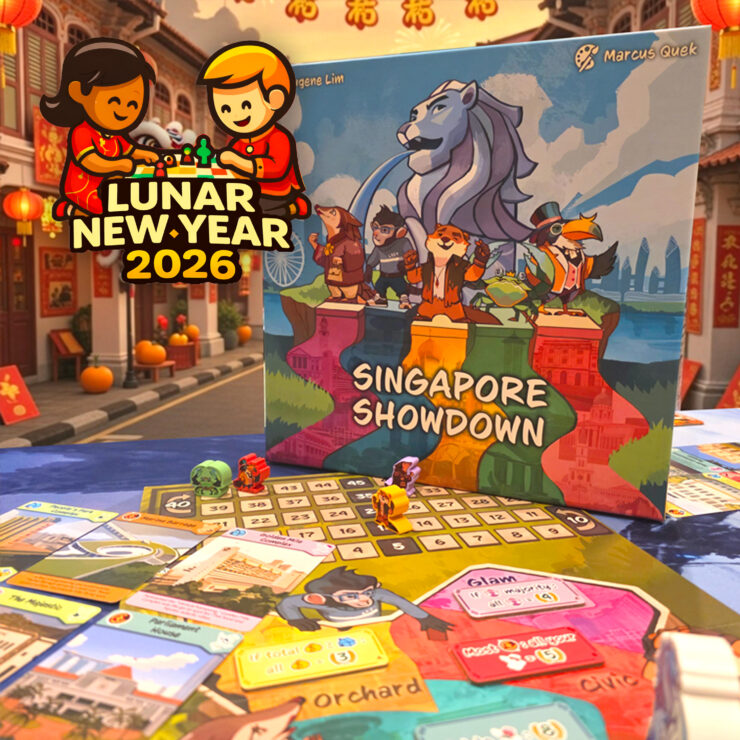
As we reach roughly halfway through our Lunar New Year celebration, we take a look at Singapore Showdown, a low-to-medium weight drafting game where you are trying to fulfil scoring situations on the board and gain the most prestige (points).
Singapore Showdown is played over two rounds, with players competing to earn the most prestige. To begin, lay out the board, then each player chooses an animal and takes the matching tokens and meeple. Place all figurines at the starting position. The Merlion meeple is placed on the board purely to look cool and does absolutely nothing… which is a bit weird, as it is easily one of the coolest components in the box. My boys found its lack of use oddly irritating.
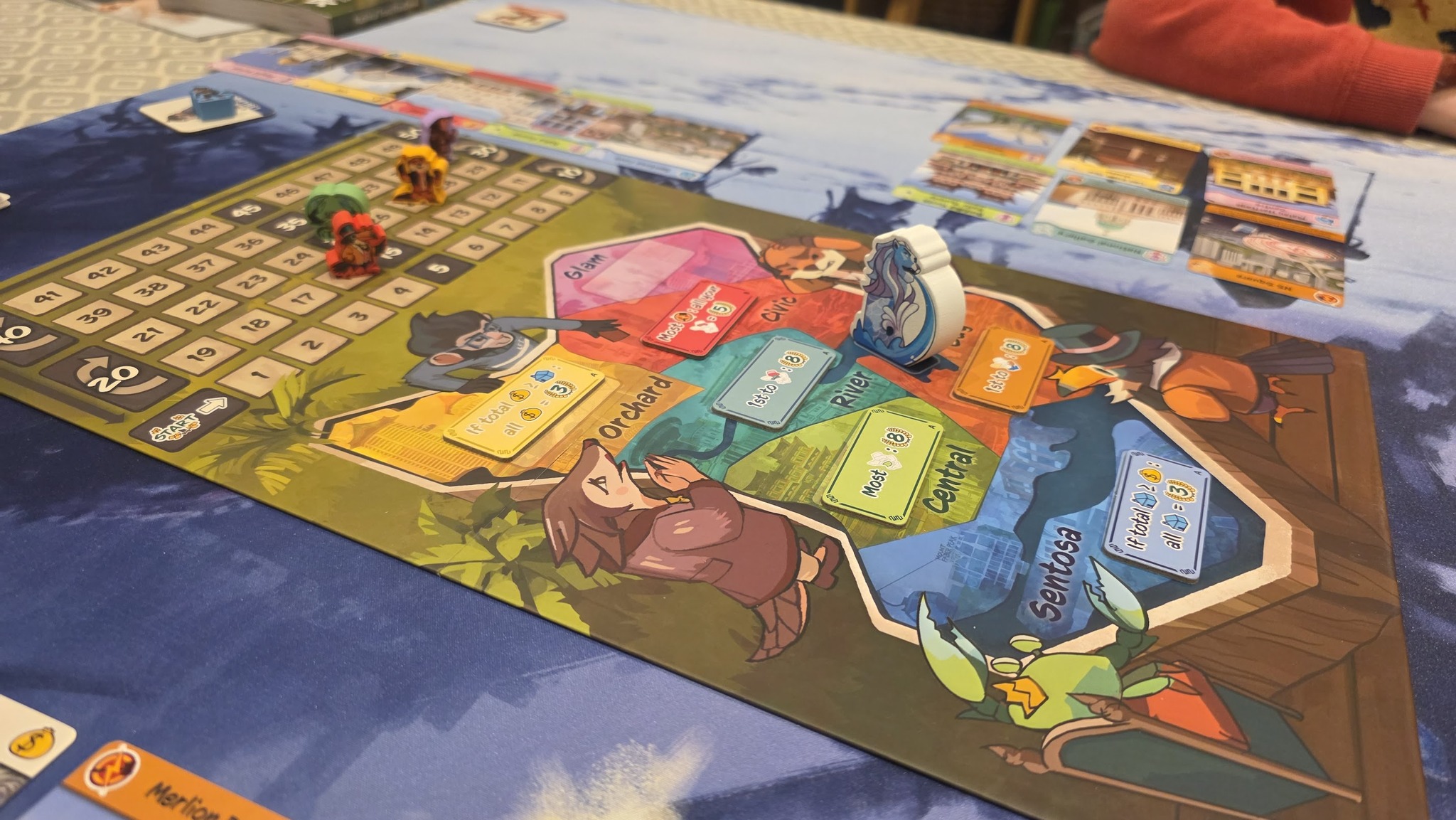
Next, place the seven reward tiles onto their matching districts. If this is your first game, the rules recommend using Set A. There are two sets, both double-sided, and the sides can switch mid-game. Shuffle the deck thoroughly and deal cards to each player based on the player count. Once everyone has their starting hand, you’re ready to begin.
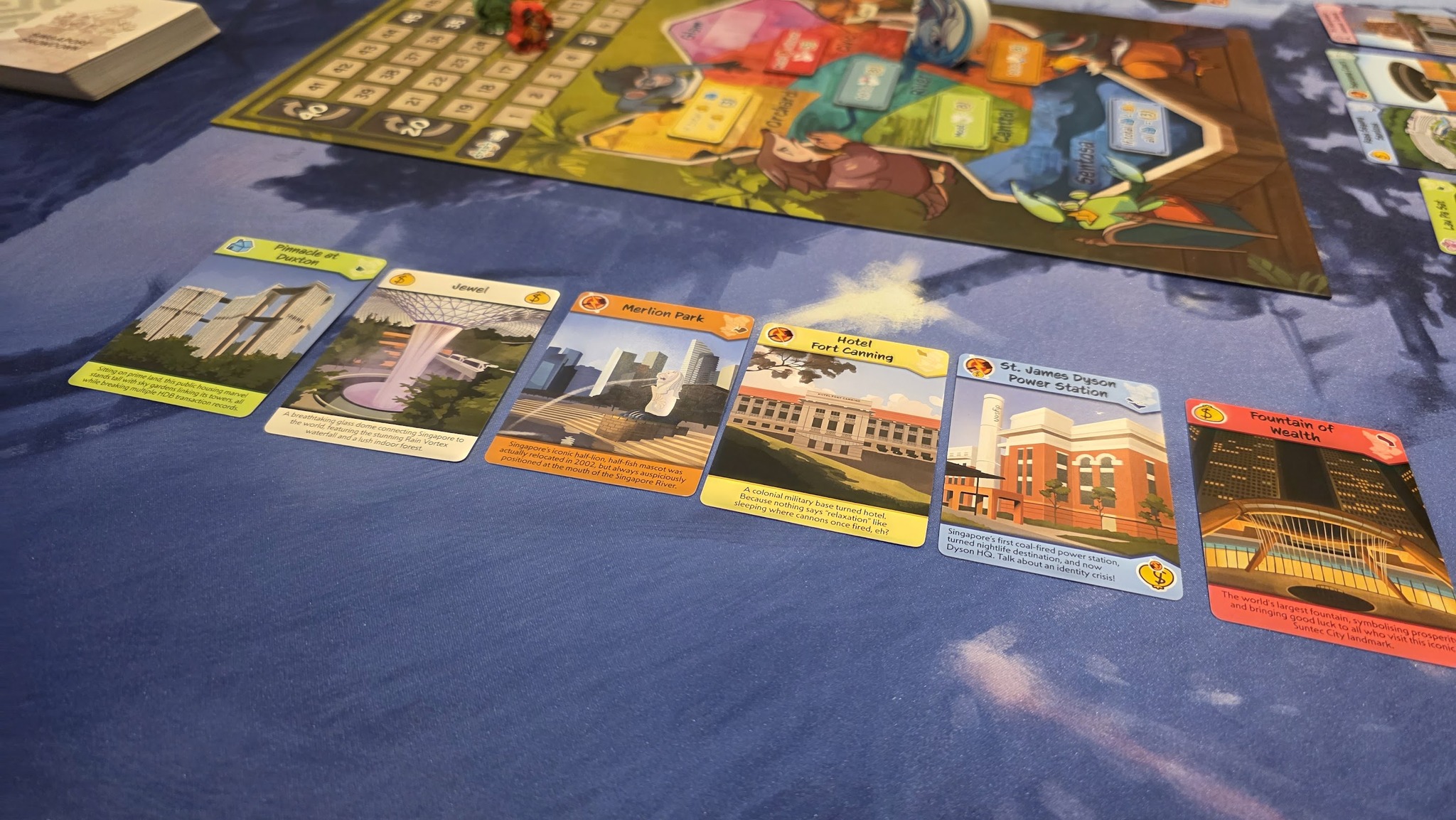
Cards fall into two categories: landmarks and actions. Most landmarks provide two benefits when played. They grant a landmark type, shown by the symbol on the card, and contribute to a district, indicated by colour and icon. Some landmarks offer flexibility, showing two possible types. In these cases, the orientation of the card determines your choice. Whichever symbol appears at the top is the type you gain. Regardless of orientation, the district reward always applies. A few special landmarks do not belong to any district but instead count as two of their type.
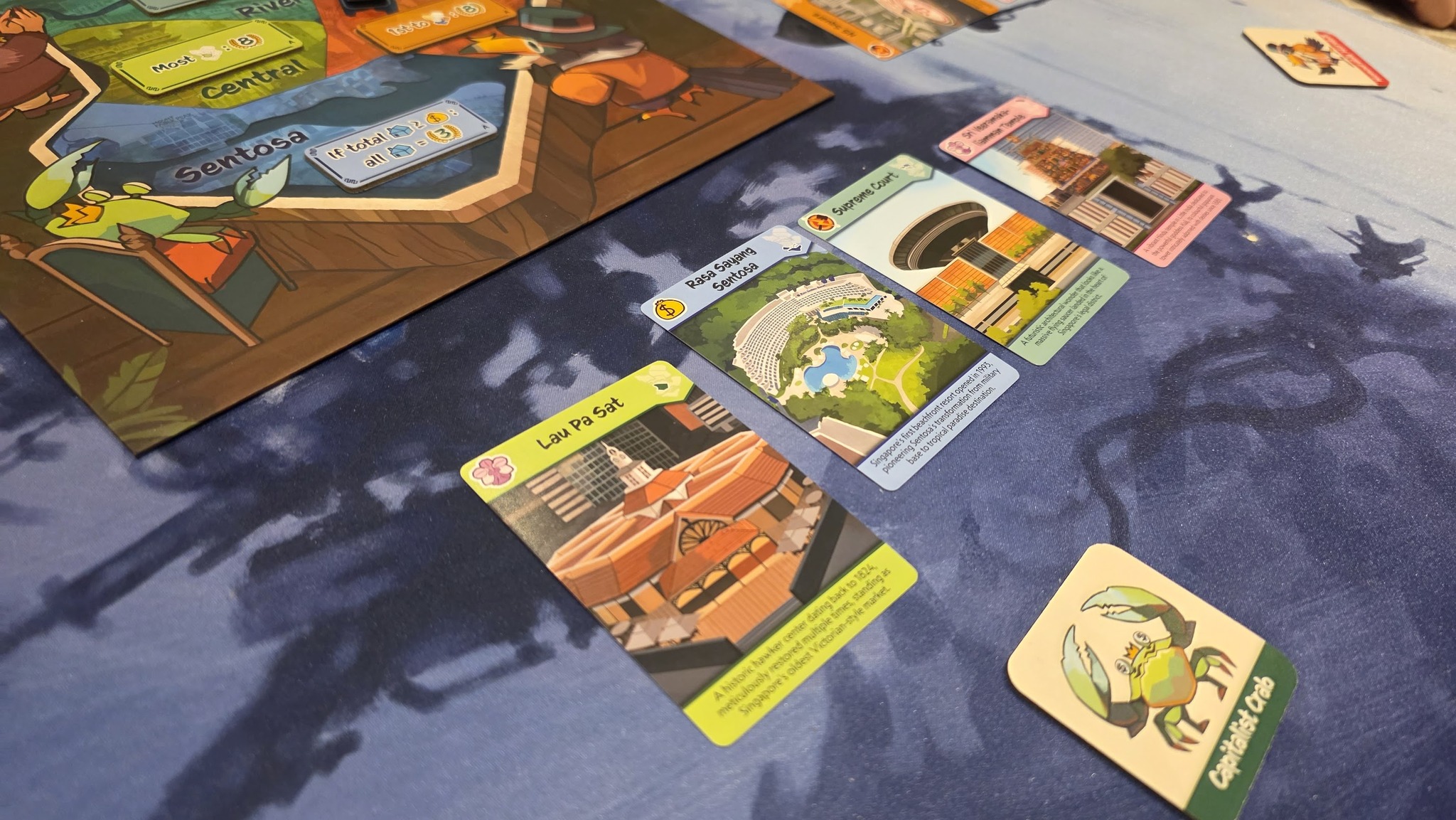
Action cards behave differently. Rather than contributing to your collection, they trigger an immediate effect when revealed. Simply follow the instructions printed on the card. If multiple actions appear in the same turn, they resolve in numerical order, with lower numbers activating first. This can often create all sorts of positive effects for you, along with potential negatives for the other players, most commonly flipping scoring tokens or interfering with another player’s game plan.
Each round follows the same structure. Players look at their cards privately and choose one to play. When everyone has made their decision, all cards are revealed simultaneously. After resolving those plays, players pass the remaining cards to the next player. This cycle of pick, play, and pass continues until only two cards remain. At that point, players choose one final card to play and discard the other, ending the round and proceeding to scoring.
After the first round ends, players score prestige according to the seven district reward tiles, which evaluate the landmarks collected during the round. Before beginning round two, each player secretly keeps one card from their previous hand. This card remains face down and will score again later. A fresh hand is then dealt, and play resumes using the same pick-play-pass structure. The only slight change is that passing now moves in the opposite direction.
Once round two concludes, all secret cards are revealed. Prestige is scored again using the same district tiles, and the player with the highest total prestige claims victory in the Singapore Showdown.
The game, however, works well. It is a fun, relatively light-hearted drafting game with some good strategic decisions.
What I will say, though, is that nothing in the game left me feeling this was a must-play. It was fine, it was fun, but there was not really anything that stood out as being particularly special. You are drafting, you are trying to win through very familiar board-game scoring styles, such as having the most of one type or being the first to reach a certain threshold. Even with the ability to change scoring conditions mid-game, there was not really anything that felt especially unique.
The game could probably have supported another round. The two-round structure works perfectly well, but it did leave me feeling like I wanted a little more room for longer-term planning or additional scoring opportunities. While the alternative scoring sets add some variability, extending the core structure might have made the experience feel slightly more satisfying.
The artwork is really nice, the components are solid, and the cards are decent. I just would have liked to see a bit more. This is absolutely a fine game, and if it ends up in your collection you are going to have a fun time playing it. However, there are so many games in this drafting and scoring genre that I struggle to see how Singapore Showdown truly sets itself apart from others that are, in my opinion, stronger.
So this is not a negative review, more of a neutral-positive one. If you really love drafting games, there is certainly something to enjoy here. But if you are looking for something that feels genuinely different, especially if you already have a larger collection, there is not quite enough here to make it stand out as something special.
Disclaimer – A copy of Singapore Showdown was kindly gifted by Genie Games via the UK BG Review Circle. All of our thoughts and opinions are our own.




 Nicola Asker