 Nicola Asker
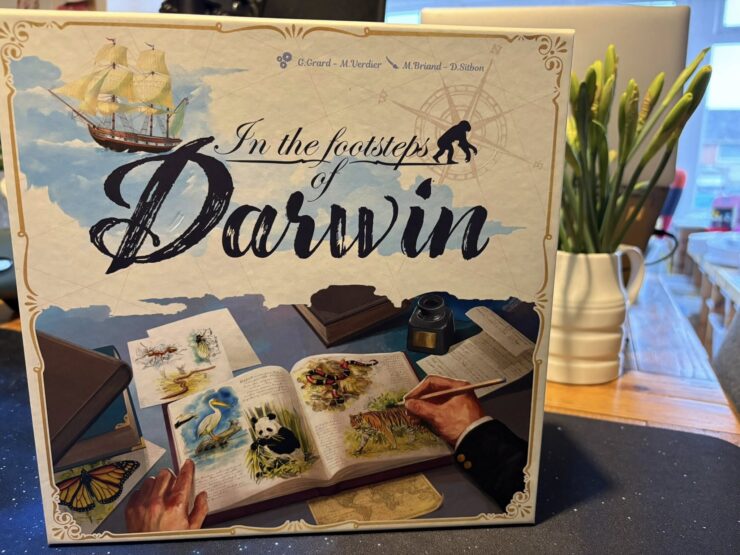
I bought this at UKGE last year and finally played it with my husband yesterday. We decided it was a bit too quick, simple and random for us BUT I realised it might be about the right level of challenge for my 7 year old. So today I tested it out again!
In this game you’re discovering animals and recording them in your journal. Each animal has a type (e.g. Animal, bird) and a location (e.g. Africa). Each time you complete a set of types or locations in your journal you get five points. You also get points from the tiles themselves in a few ways. There are also additional scoring objectives but I didn’t include them when playing with my daughter to keep it simpler.
On your turn you only need to do two things:
1. Take a tile
2. Move the boat
To take a tile your choice is dictated by the current position of the boat which travels around the edge of a 3×3 grid of tiles. You can choose from whichever row or column the boat is beside. If you’re not happy with your options you can use a guide first to either move the boat one space forward or back, or replace the three tiles with ones from the draw pile.
After you take a tile you add it to your journal by putting it in the right spot for it’s type and location which is really easy to see from the icons. You can place the tile on top of a previous one but if you cover any symbols relating to points then you won’t get them at the end of the game. If you’re using the objective flags then you gain these by covering tiles.
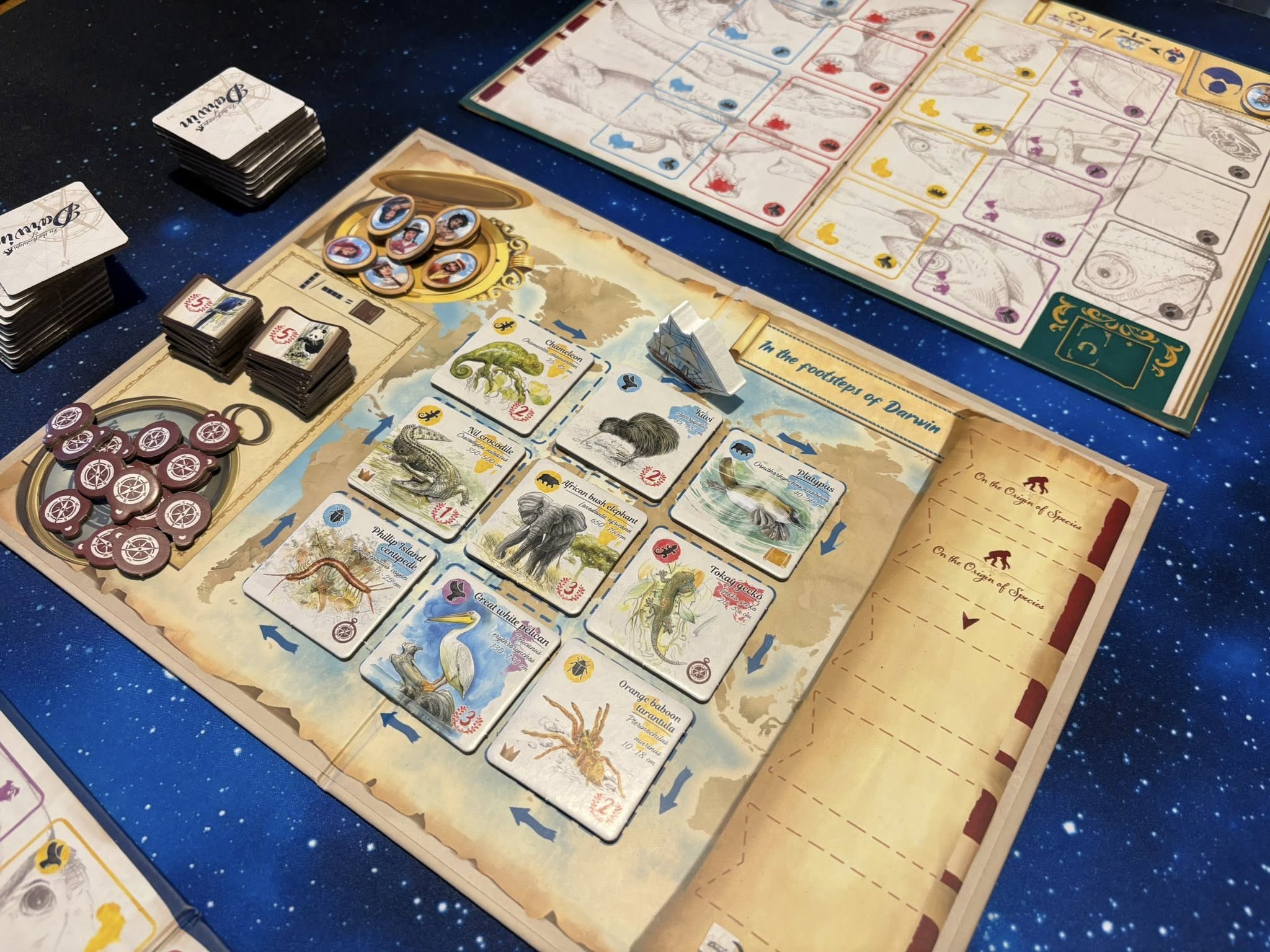
There are a few character tiles which go at the side of your journal and don’t help you complete sets. All the tiles use the same icons for the benefits they give you:
– points at the end of the game
– new guides
– a crown let’s you take the Darwin token worth 2 points
– compasses and charts – these are multiplied together for points at the end of the game
Once you’ve resolved any immediate benefits you move the ship. The distance is based on which tile you took. I.e. If you took the tile closest to the ship (slot 1) you move the ship one space around the edge following the arrows.
The game ends when everyone has placed 12 tiles.
My daughter got the hang of trying to complete her sets and decided to go hard after compasses and charts, which paid off for her. She also got the hang of using guides to better control her options so I think I probably could introduce the objectives for more points next time.
There’s loads of information in the rule book about the characters and animals but there’s also little bits on the tiles which my daughter noticed. Definitely a good game for animal lovers. I think it’s very much dependent on your child’s gaming stage as it would be too simple for some but it seemed to hit a sweet spot for us.

 Matthew Bailey