 Matthew Bailey
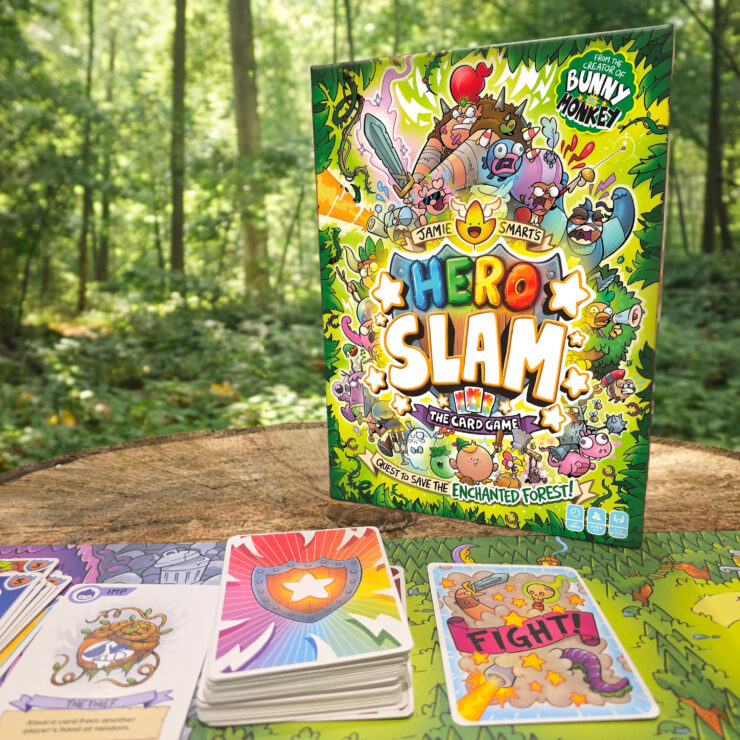
I really wanted to like Hero Slam, the game. Popular author Jamie Smart, who most of you will most likely know from the really funny Bunny vs Monkey books. Unfortunately, as much as I tried, there are quite a few things about it that left me with a reasonably sour taste in my mouth.
Simply, each player chooses a fate and therefore is a leader of one of the four clans. This gives you a special power, which aren’t all that balanced, but I’ll get to that later. You then choose a villain and put that on the bottom of the deck, make up all the hero cards and put those on top of the deck, and there you have your draw pile.
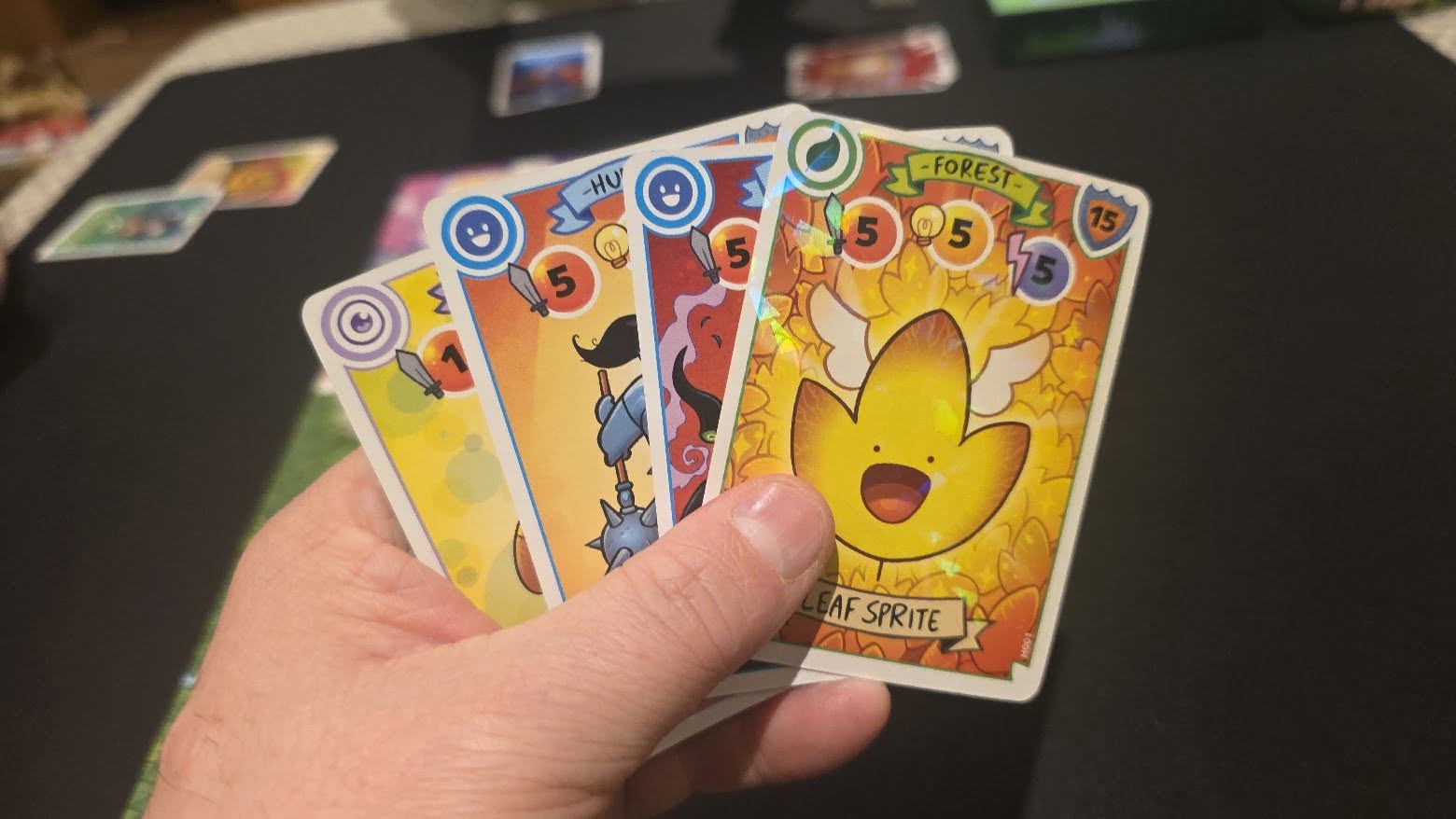
Each time you draw a card from the deck and place it in the first slot in the forest. If this is a hero, you can count up the overall value of its three stats and then, if you want to, you can draw another hero. If your second hero drawn is more powerful overall than the previous one, you get to keep both. If it’s lower, then you only get to keep one. This is the general way that you build your deck as you go through the game. It’s fine as a push-your-luck mechanic. There are no ways to manipulate your luck, which leaves it completely up to chance.
If it’s a side quest, you do what it says and then invariably end up losing some of your monsters. If it’s an imp, these are basically extra powers that can be used and, in some cases, are absolutely essential.
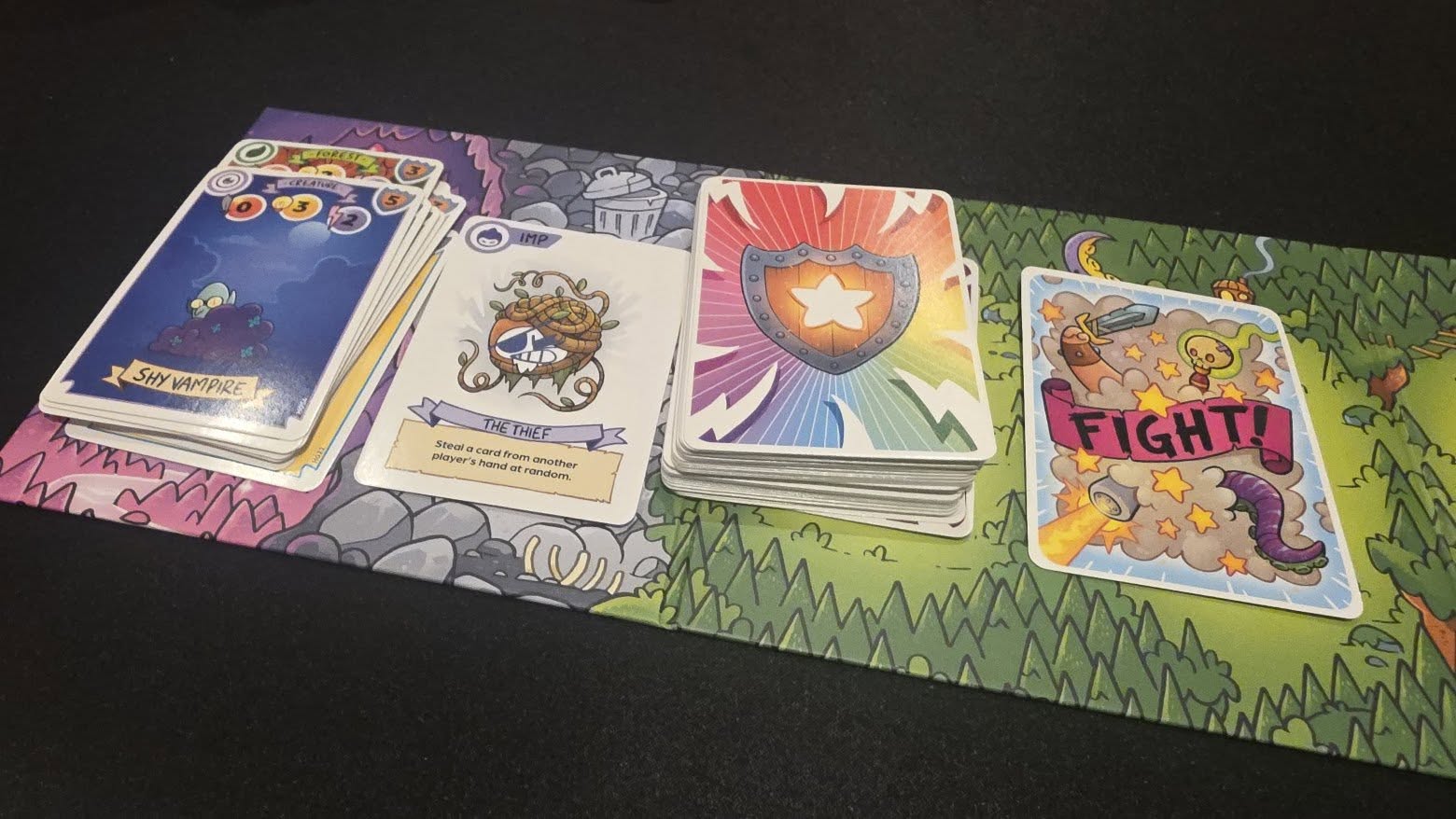
There is one card called the Underling, which essentially makes you lose a card and then requires you to put him back in the deck three times. This was a bit weird in that there’s no actual physical way to keep track of how many times you put him back in the deck. You just kind of have to remember that it’s three times, which is very unusual when you could have had a simple tracker or something like that on the board, or even a card.
The final thing is fight, and if fight is chosen, essentially the game then becomes kind of like Top Trumps, where the main person chooses one of three stats on their card and the highest, in most cases, wins, although there is an imp card that means the lowest wins.
Fighting is a core mechanic in the game and generally it plays like a bad version of Top Trumps, and let’s be brutally honest, Top Trumps isn’t a good game to begin with. There is a shiny Top Trumps-style card that has maxed-out stats, and if the human hero that has +1 to its value manages to get that, essentially, it’s absolutely unbeatable unless you use one of the imp cards that switches it. But if you’ve already used those, you’re essentially screwed for the rest of the game, which is a pretty glaring issue. In one of the games we played, we used imp cards earlier when they came out, at which point Jack got that card and was basically unstoppable for the rest of the game.
This is where the whole thing kind of falls apart a little bit. You reveal the villain and essentially what you’re looking for is one of your stats, that can also be upped slightly by completing those side quests, has to be added up and has to beat the enemy for someone to win the game. If two people manage to beat the enemy, then the person who beat them by the most wins, which all feels a little bit flat. The biggest issue I have, though, is the way that it works where you’re only allowed to use cards that are based on your fate. So let’s say you’re the human fate, you can only gain points from humans, yet you can use humans throughout the whole game, which is really unusual. While you would think this obviously means that you want to try and collect humans, which of course you do, it means again you’re very, very at the mercy of pure luck, which didn’t feel great. To be clear, luck is important in games and that’s fine, as long as there are ways to mitigate it, manage it, or increase your luck, but here there just isn’t. It’s just luck.
Now let’s talk about the rulebook. Obviously, based on the fact that this is based on a very visual series of kids’ books, they have tried to make the rulebook into a kind of storybook in its own right. It’s very pictorial, with lots of stuff, but it needs to be said that the rulebook is 30 pages long to describe rules that could probably be written on a side of A4. This rulebook is a mess and it’s very difficult to completely understand the rules of the game. You only have to have a quick look on the BoardGameGeek forum to see people not really understanding how things work, and Jack originally played the game at a friend’s house and clearly got half the rules wrong before we then played it together.
Having played a couple of games, we just kind of felt this wasn’t that fun and definitely didn’t want to come back to it, unlike some other card games we’ve played recently.
The artwork is lovely and the drawings are really cool. Jamie Smart, I think, is a really good graphic artist and the books that he produces are really good, and I quite enjoy reading the Bunny vs Monkey books with the kids, and that is something that the game has got going for it. I can see some kids being really into it purely based on the artwork alone. The cards are sadly not quite as good quality, with them feeling very cheap and actually feeling very much like counterfeit Uno cards that you might get off Temu, which was a little bit disappointing, as there is definitely a negative to playing with horrible playing cards.
It’s a shame. I really wanted to like this and I think there’s some really good stuff here that has a lot of potential. I think part of the problem is that it didn’t really know what it wanted to be. It’s obviously gone for a very mainstream audience, which is fine, but it’s added some non-mainstream elements into it that I just don’t think have been done very well. The concept of making essentially a more complex Top Trumps doesn’t feel like the best use of what is really cool, engaging artwork from a well-known kids’ author.