 Matthew Bailey
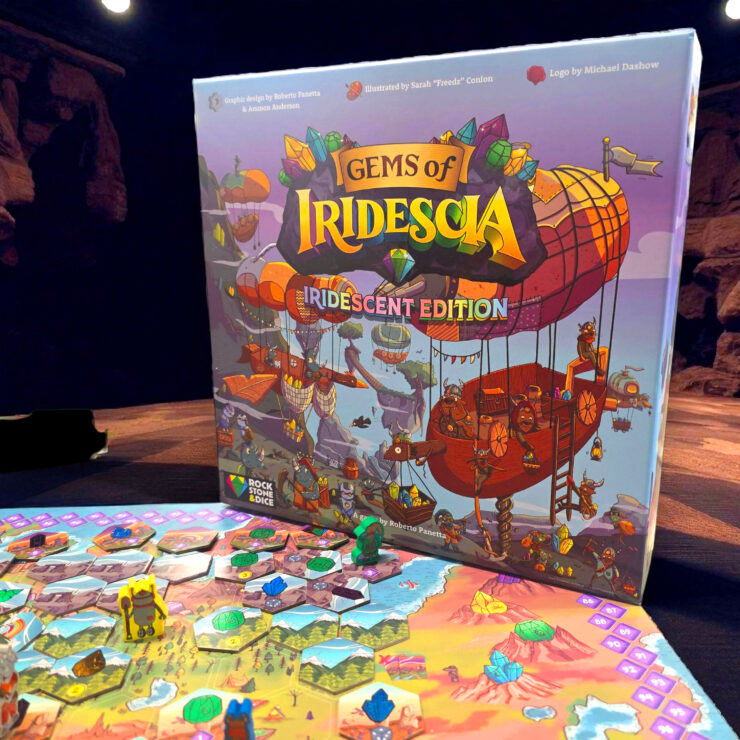
Today I’m talking about “Gems of Iridescia”, a family-weight game that mixes set collection, dice rolling, worker movement and a dash of end-game bonuses.
You start by laying out all of the gem tiles – and honestly, this was the first thing that made me a bit iffy. The tiles don’t anchor to the board in any way, and they sit at a slight diagonal. All it takes is one knock across the table and suddenly everything is out of place. I know that’s true of a lot of tile-laying games, but here, especially when you’re leaning over to flip things, it felt even more precarious. In fact, we managed to scatter the entire board twice while playing.
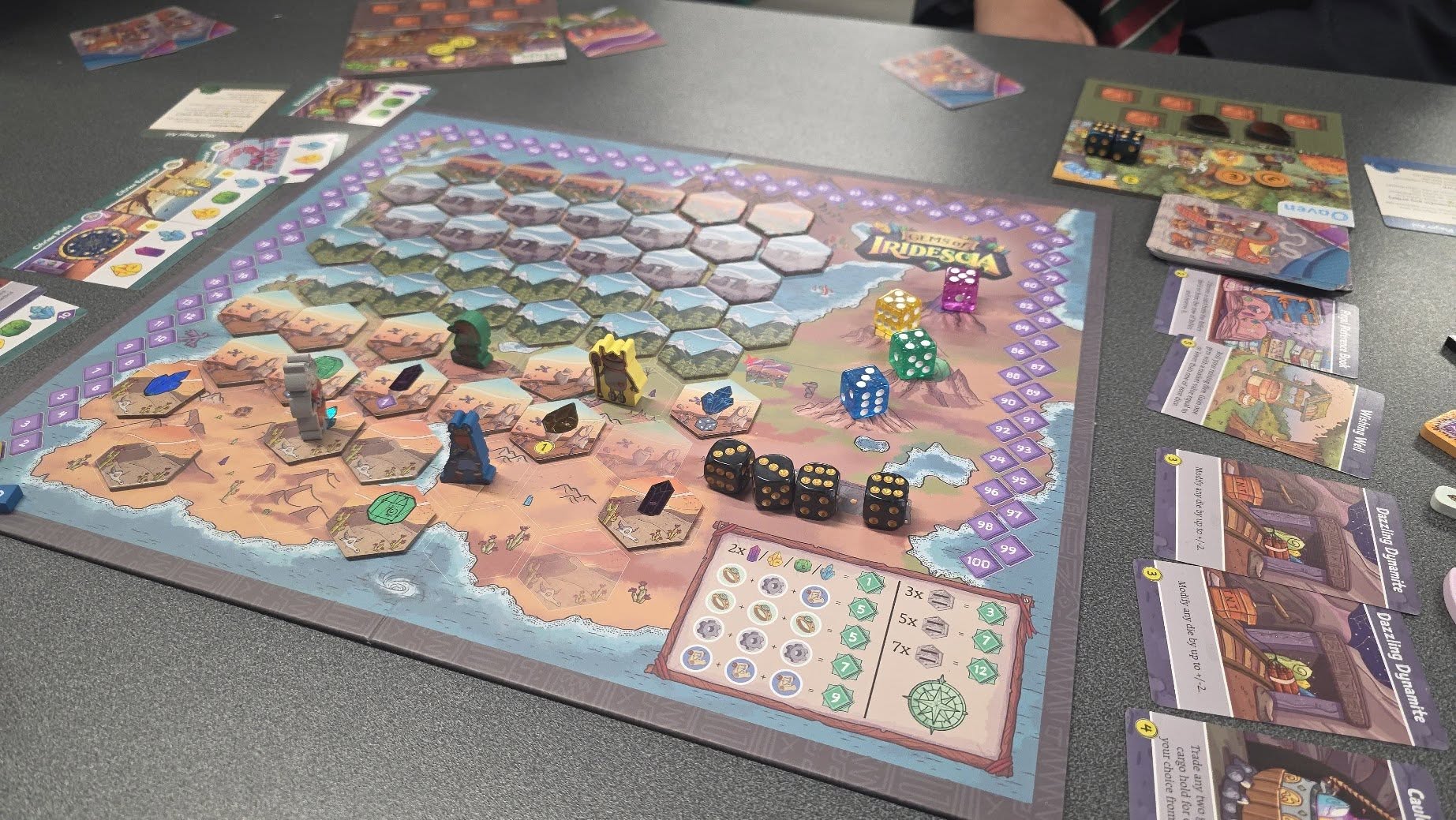
The gameplay itself is straightforward. Everyone begins at the bottom of the board and works their way towards the top, with the game ending once all players reach the final section. On your turn, you flip two tiles, move onto them, and then (if you want) try mining that gem by rolling a die. To succeed, you need to roll the gem’s value or lower. After each attempt, the difficulty increases, looping back around after six – so timing your mining attempts is really important. You can also sell your gems for coins, which are then spent on tools that give you handy little abilities.
Gems can also be turned in for relics, a bit like how “Splendor” works, and these give you points at the end of the game. Alongside that, you’re collecting sets of gems for bonuses and trying to complete your secret mission card from the start of the game. The higher up the board you climb, the better the rewards get. At the end, you score for relics, sets of tiles, your personal goal, and leftover crystals. Highest total wins. It all works well enough, and it gives the game a clear end point, which isn’t a bad thing.
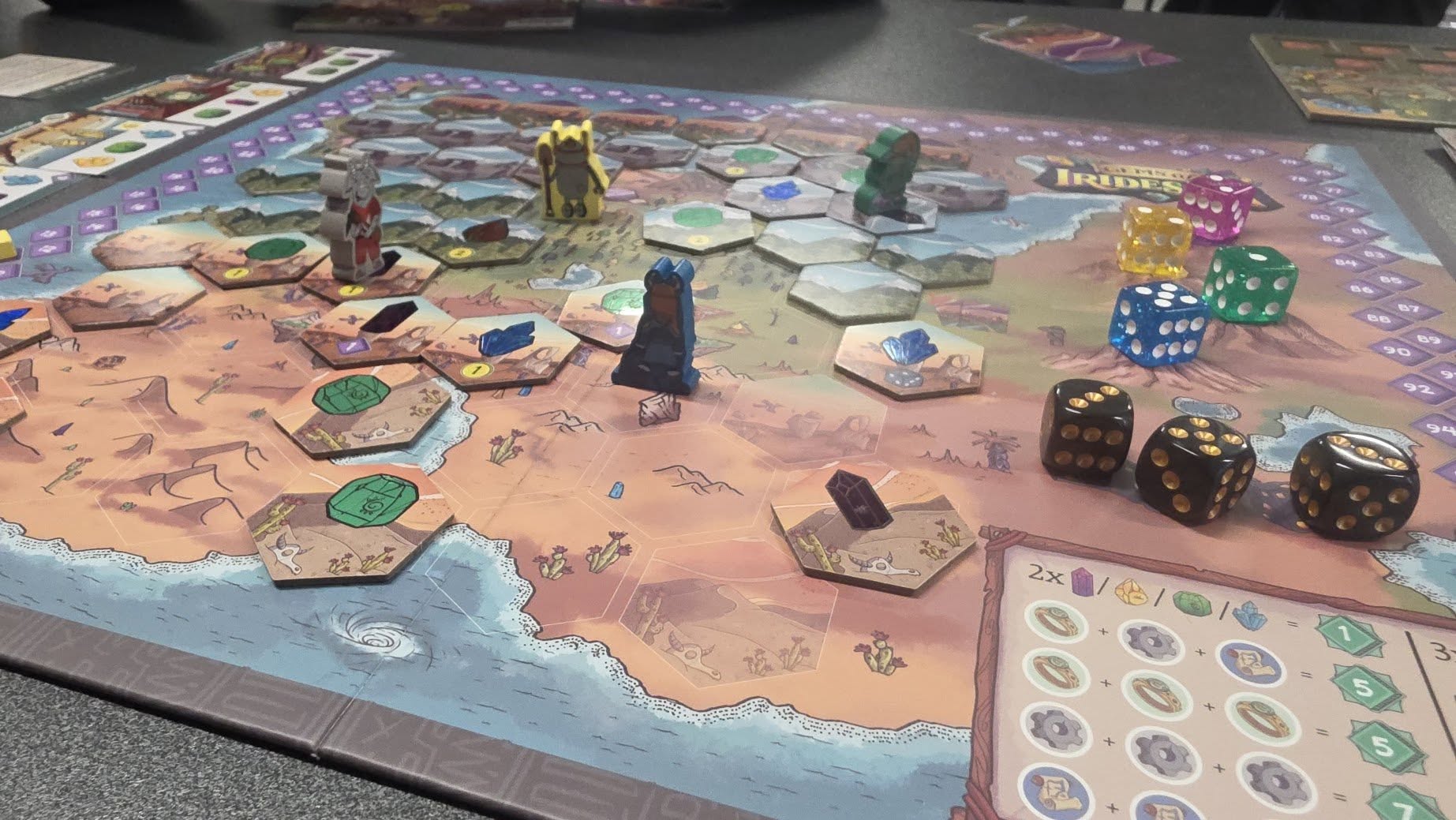
So what’s it like to play? Honestly, “Gems of Iridescia” is… fine. It’s quick, and there’s some strategy, but it leans heavily into tactics – just doing the best with what you’ve got each turn. There’s a fair bit of luck too, both in the dice rolls and in which tiles appear, as some are definitely more useful than others for sets or relics. There’s also some interaction, mainly blocking paths or nabbing tiles before someone else gets there. But here’s the thing: while blocking is supposed to be a key part of the game, I found it a bit fiddly. Turns often felt short and underwhelming, and I think it would actually have been better if players had a bit more to do each turn.
We also ran into a strange issue with coins. It might just be a first-printing problem, but we actually ran out of coin tokens. Selling gems at a high value can net you 30 coins in one trade, and since money doesn’t get used for much else, the supply dried up quickly. That’s not something I’m used to seeing in games like this.
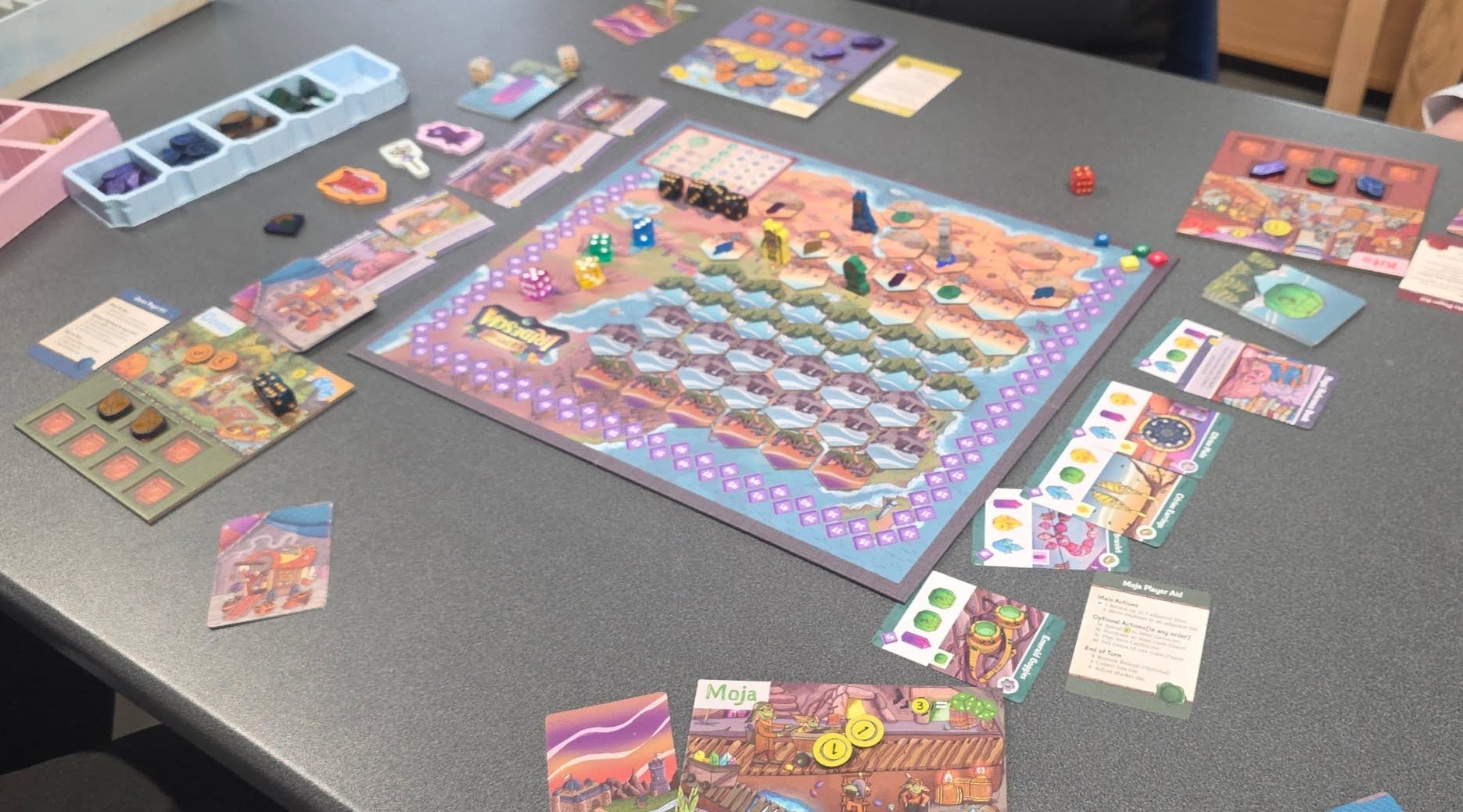
That said, there are moments of excitement – flipping over a tile and hoping it’s just the one you need, or rolling for a crystal and holding your breath. Tools help you adjust the odds, but realistically you’ll only want to spend on easier rolls. The theme doesn’t come through strongly, and it all feels quite abstract, though the artwork and tools do their best to add some flavour. The components are very nice, with chunky pieces and bright artwork that really pops on the table.
But here’s the catch, after a couple of plays, “Gems of Iridescia” doesn’t really offer much that feels new. The mix of mechanics is familiar, and it ends up feeling like a sum of parts I’ve seen in other games – games that I’d probably choose to play instead.
Reading this back, it might sound like I’m being harsher than I mean to be. Is “Gems of Iridescia” a bad game? No, not at all. It’s got redeeming features, and if a friend had it set up at their house, I’d happily play. The problem is that I just never felt truly excited while playing. There weren’t those “wow” moments of surprise or tension that I think are really important in this kind of game.
It is currently playable on BGA so try it out and see what you think.