 Matthew Bailey
Finspan is a game that I have been wanting to review for quite a while, but for whatever reason I just haven’t quite got to it. So instead, I thought over the next few weeks we would take a look at all of these “span” games, give you my thoughts, and help you decide where they all sit. Should you get them, and if so, which one would probably suit you best?
In the Comments, I am also going to include a separate section that goes through the differences compared to Wingspan for anyone who is familiar with it.
For those unaware, Wingspan was released in 2019 by Elizabeth Hargrave to widespread critical acclaim as a cosy engine builder based around the idea of watching birds. A few years ago, Wyrmspan was released, based around the concept of dragons, and this added some extra layers of complexity to Wingspan. As such, it is often preferred by the more experienced gaming crowd.
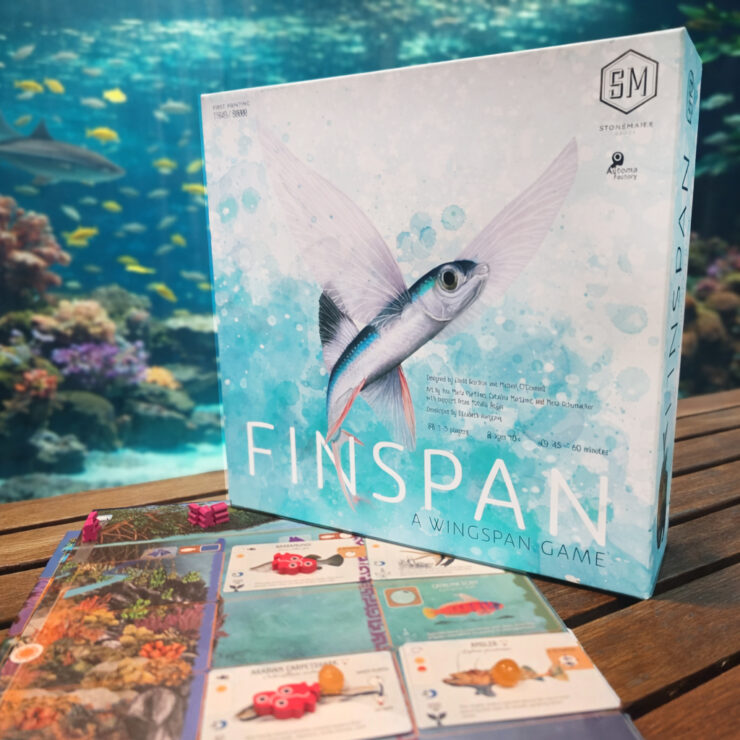
Most recently, last year, we saw the release of Finspan, a game about finding fish in the sea, diving, and exploring ocean life. It is generally the simplest of the three and is very much geared towards younger players or those wanting to be introduced to engine builders. It also has the added bonus of some lovely marine photography and a few educational touches along the way.
To start the game, each player takes an ocean board (we will talk about these annoyingly shaped beasts later) and begins with a small number of starting resources, including a set number of cards, two eggs, and a small fish. A central deck of fish cards is shuffled and placed within reach, with a number of cards dealt face up to form a shared display. Round objective cards are revealed for the game, outlining the scoring conditions for each round. Once all players have their starting hands and resources, and the central display is ready, the game is ready to begin.
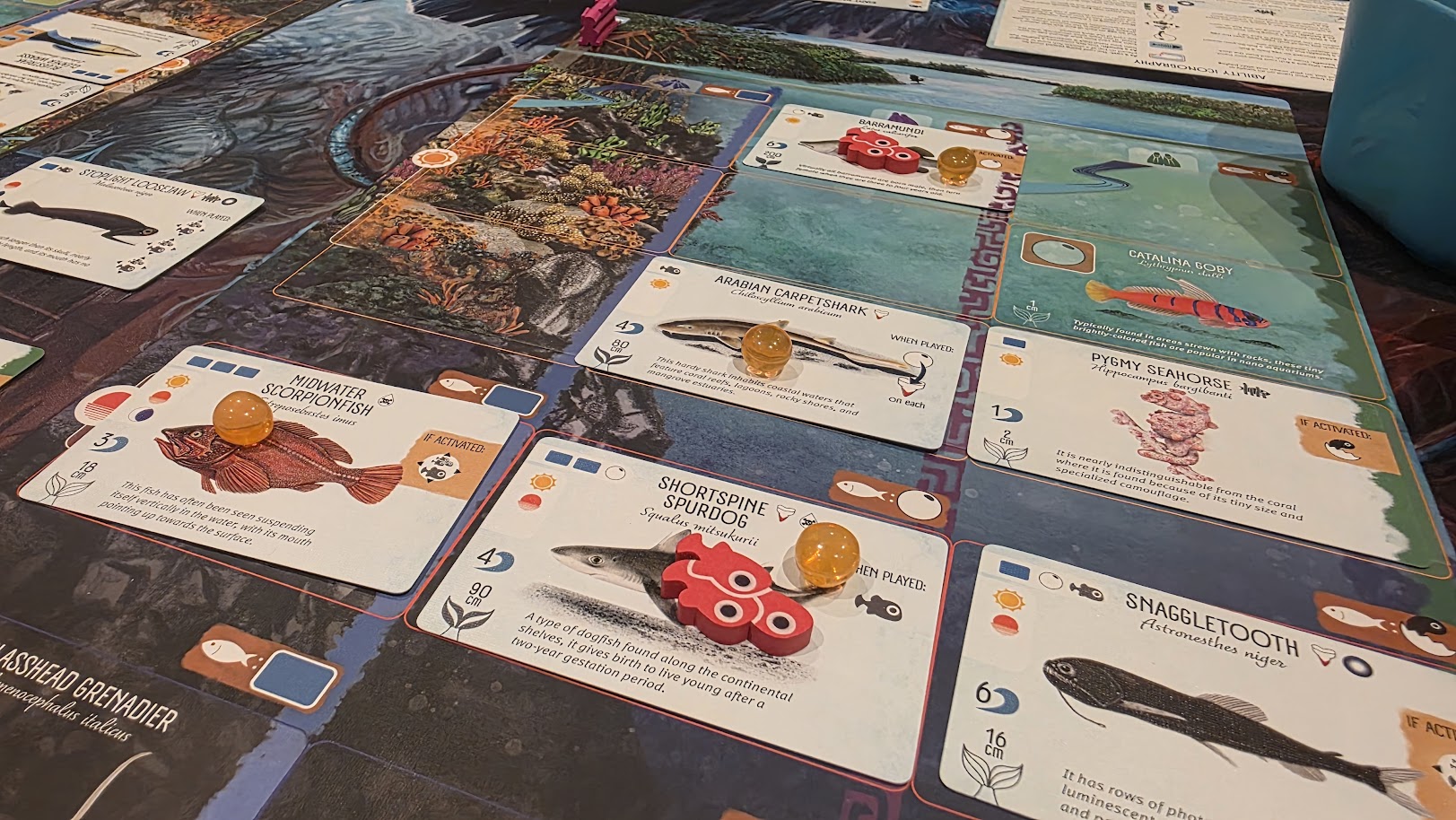
All players get six divers that they use each “week” (round), and on every turn players use one of their divers to perform one of a small number of available actions, typically placing a fish card into their personal ocean board or activating one of their existing columns by sending a diver to the bottom of the sea. The board is divided into three vertical columns that represent different stages of a dive (sunlight, twilight, and midnight), and each column can contain multiple fish cards stacked from shallow to deeper levels.
Each fish card has a cost, which may include discarding other cards, spending eggs, eating other fish, or meeting specific placement requirements such as depth or column restrictions. When a fish is played, it is placed into a column at the appropriate depth, and any immediate effects shown on the card are resolved.
Instead of activating rows as seen in other games in the series, players activate entire columns. When a column is activated, abilities on all visible fish in that column trigger in order, from top to bottom as your diver heads down to the depths. These abilities may allow players to gain resources, draw cards, place eggs, or perform additional actions, with the left column generally focused on card draw, the middle on gaining eggs, and the right on converting those eggs into fish or eventually schools (three fish joining together to earn more points).
Eggs are a key resource and are placed onto fish cards, often acting as both a cost and a way to track certain effects. Some fish also have abilities that interact with eggs directly, such as generating them or requiring them to activate stronger effects.
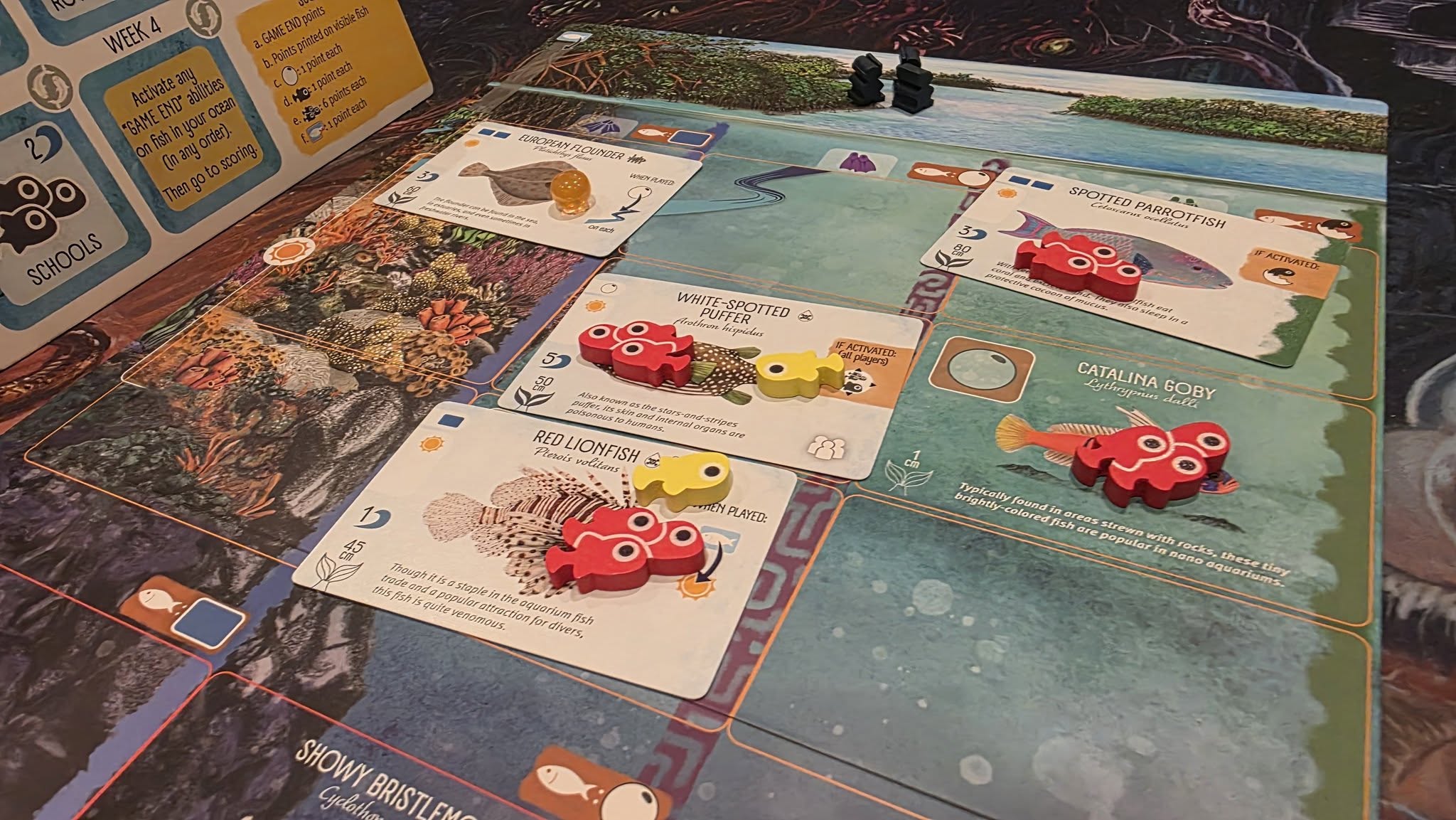
The game is played over four weeks (rounds), and you get six turns each round. At the end of each round, players score based on specific round objectives, which may reward things like the number of fish in certain columns or particular configurations. At the end of the game, players total points from fish cards, completed objectives, and other scoring conditions to determine the winner.
I really like Finspan. It is a wonderfully well-produced engine builder that captures the overall feel of what the series achieves and works really well as a gateway into medium-weight games, while still being accessible enough for kids or adults who are not as familiar with hobby board games. As you would expect from Stonemaier Games, everything is very well made and presented. In the photos here, I am using the deluxe tokens, which are also really lovely, but all of the standard tokens are perfectly serviceable. I also really like the fact that all of the fish are real, and there is information about them, so you can learn a little as you play.
The game has the usual strong Stonemaier production quality, with well-designed boards, tokens, and trays that are all used effectively. The photos you can see do show the deluxe tokens that I own, which are a nice bonus but completely unnecessary to enjoy the game. The artwork is lovely, and I particularly like that all of the fish are real species, with information included, so you can almost use them like Top Trumps and pick up a bit of knowledge as you go.
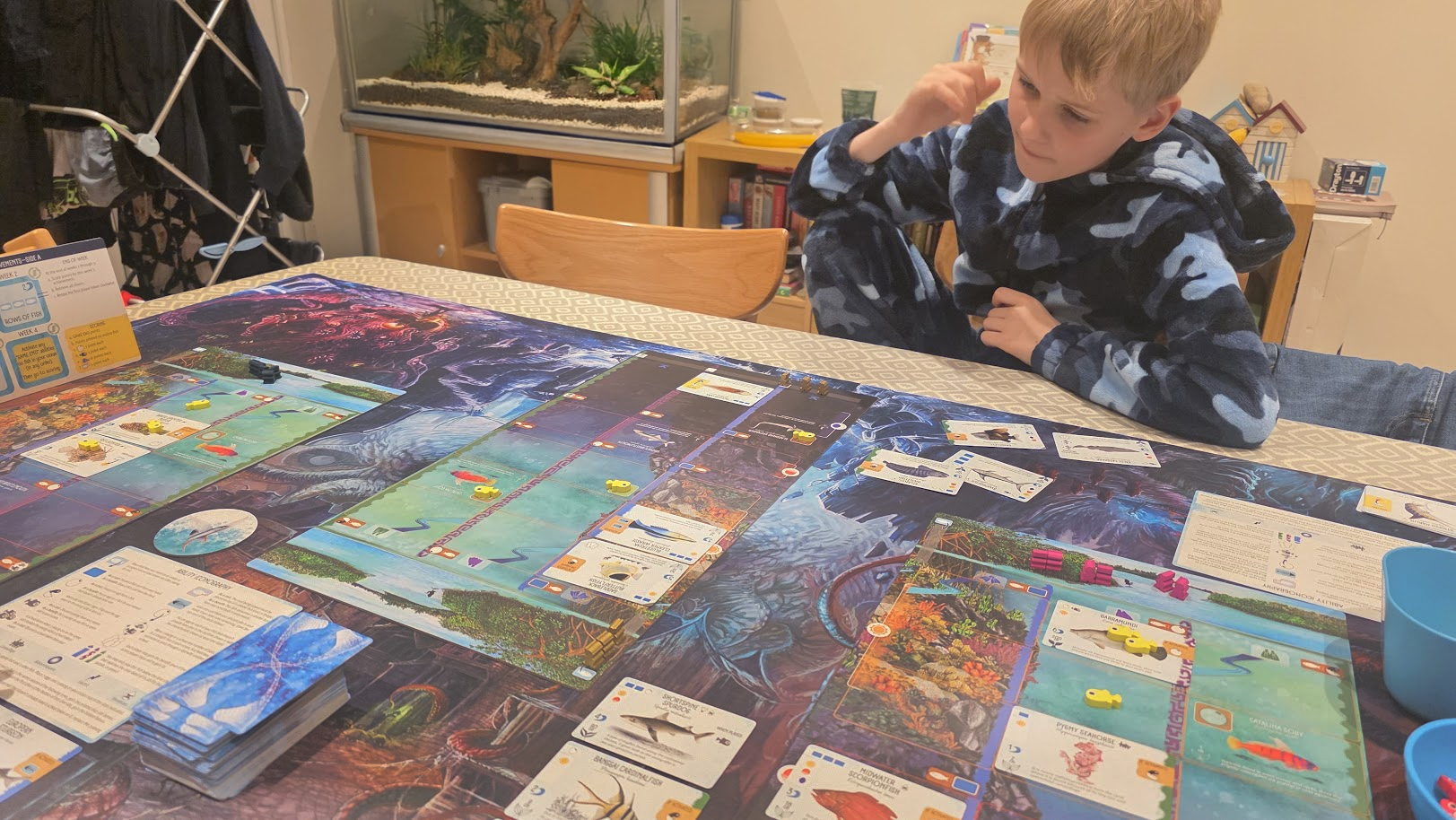
My one big gripe, and this is a difficult one to solve, is the orientation of the boards. The boards themselves are quite large and are laid out vertically, so unless you are sitting around something like a round table, this does not fit comfortably on a standard square or rectangular table. As you can see in the photos, we had to use a slightly unusual opposite-side arrangement to make it work, which then made access to shared components more awkward. I am not entirely sure how this could be improved without changing the core design, but it was definitely a bit of a pain. You would also struggle to play this on a smaller table, and even with three players it felt tight. Larger player counts would be even more challenging.
Overall, Finspan is a streamlined and accessible entry in the series and while this is definitely no “My First Wingspan” or “Wingspan Junior” is definitely the most accessible for the 3 games. The boys really enjoyed playing at and they also like the overall theme… even if the board are a bit of a Blue Whale on the table.



 Nicola Asker