 Matthew Bailey
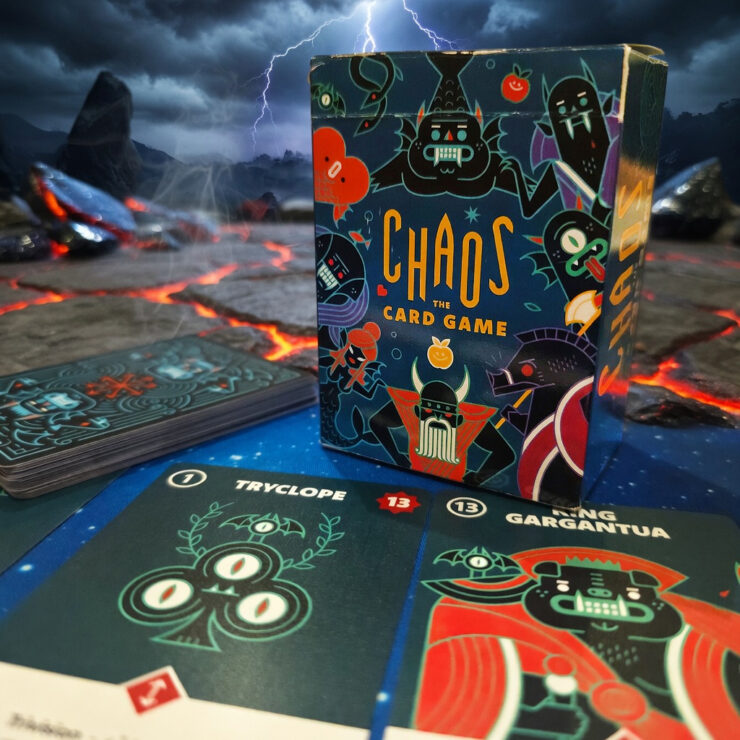
I was super excited when a prototype copy of “Chaos: The Card Game” landed on my desk a week or so ago, and I’ve played it quite a few times this week with the boys at different player counts. Luckily, I can confidently say that it is a really good card battling game.
You choose which faction you are going to be, all of which come with slightly different themes. Some are more about card management, some provide ways to neutralise your opponents, and others focus on boosting your damage depending on what cards you play together. Essentially the game is a lane battle played over three lanes, but it can quite comfortably be played at three or four players. Your left card fights the right card of the person to your left, your right card fights the left card of the person to your right, and all of the centre cards of the players fight each other.
The point of the game is generally to win three games in a row, or win two games in a row where one of those wins is achieved with your chaos value, which essentially counts as two wins. This is tracked by the Forbidden Fruit. First you have to get the Forbidden Fruit, then you have to turn it over to the tasted side, and then you have to win with the Forbidden Fruit tasted.
There is another way to win, however, which is also very key to the strategy of at least one of the decks. You don’t actually have to win three games in a row, you simply have to be the person with a card remaining whenever everyone else runs out of cards. This happens relatively quickly as the decks are limited and you cannot get cards back out of your discard pile.
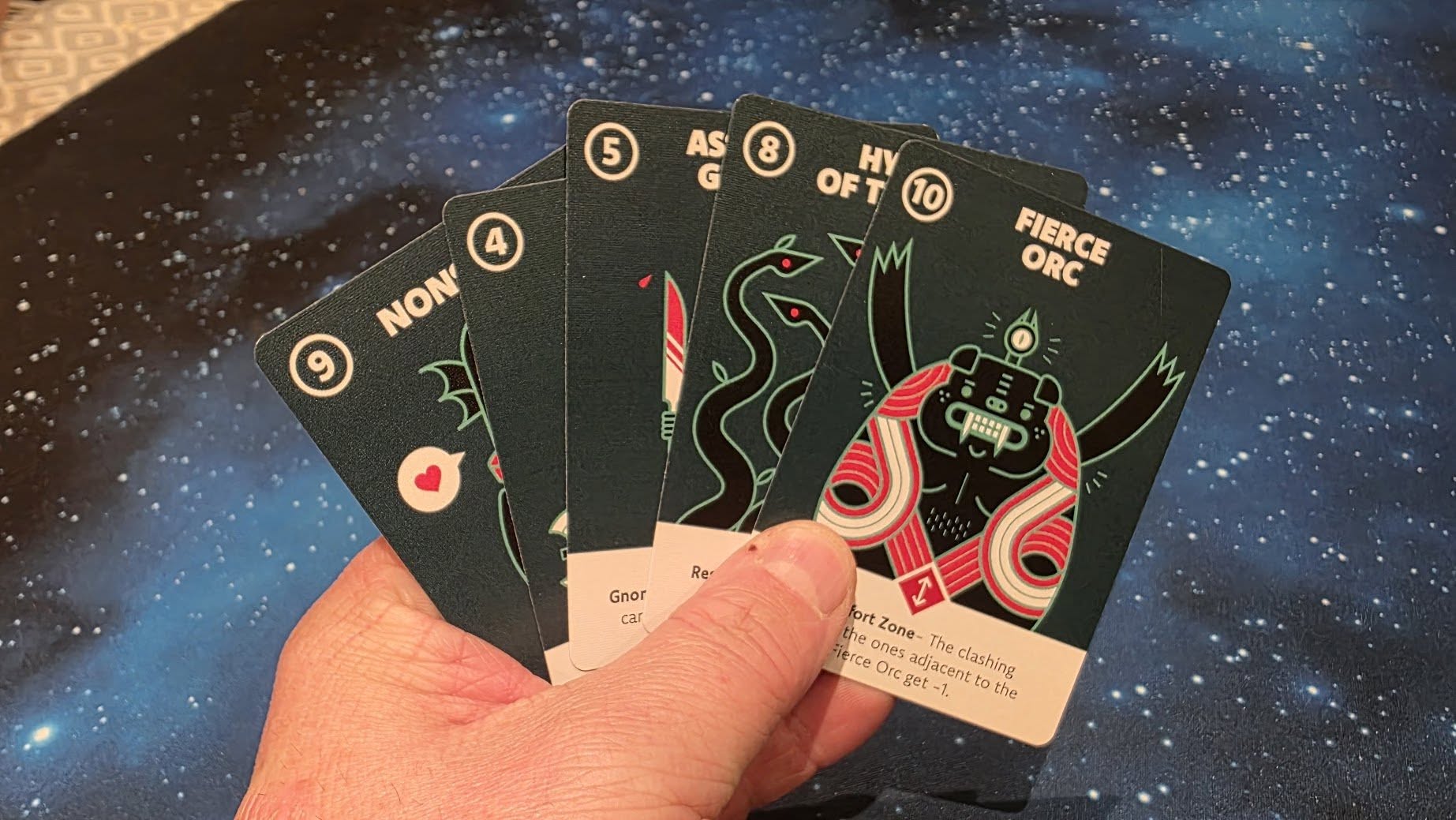
The game follows a number of phases. At the start you draw a hand of five cards from your deck and use these to make a hand of three cards, placing them face down in front of you as your three lanes. You then take turns revealing one card at a time as you go around the table. Doing this in order is important, as some cards have reveal abilities that affect other things going on during the reveal phase and can involve moving cards around or discarding cards from other players.
This is where some of the strategy comes in, as during the reveal phase you can do quite a bit of clever board manipulation. Some factions also have abilities where you can swap your own cards around if you see that a potential matchup is going to be better by moving those cards about.
You then play your battle effects and the cards battle using their base values as stated on the card. First and foremost you resolve the left and right battles, seeing if your left and right cards win their matchups. This is where the key strategy comes in because if your left and right cards win their battles then the middle battle gets its chaos value activated, making it a lot stronger.
The middle battle is the one that actually matters in terms of who wins that round. I already think of this a bit like how the TV show Gladiators works, where the Eliminator is the only thing that really matters. All the Gladiator challenges beforehand simply give you a head start or extra points to help you in that final event. It is similar here. The side battles are effectively helping power up the middle battle.
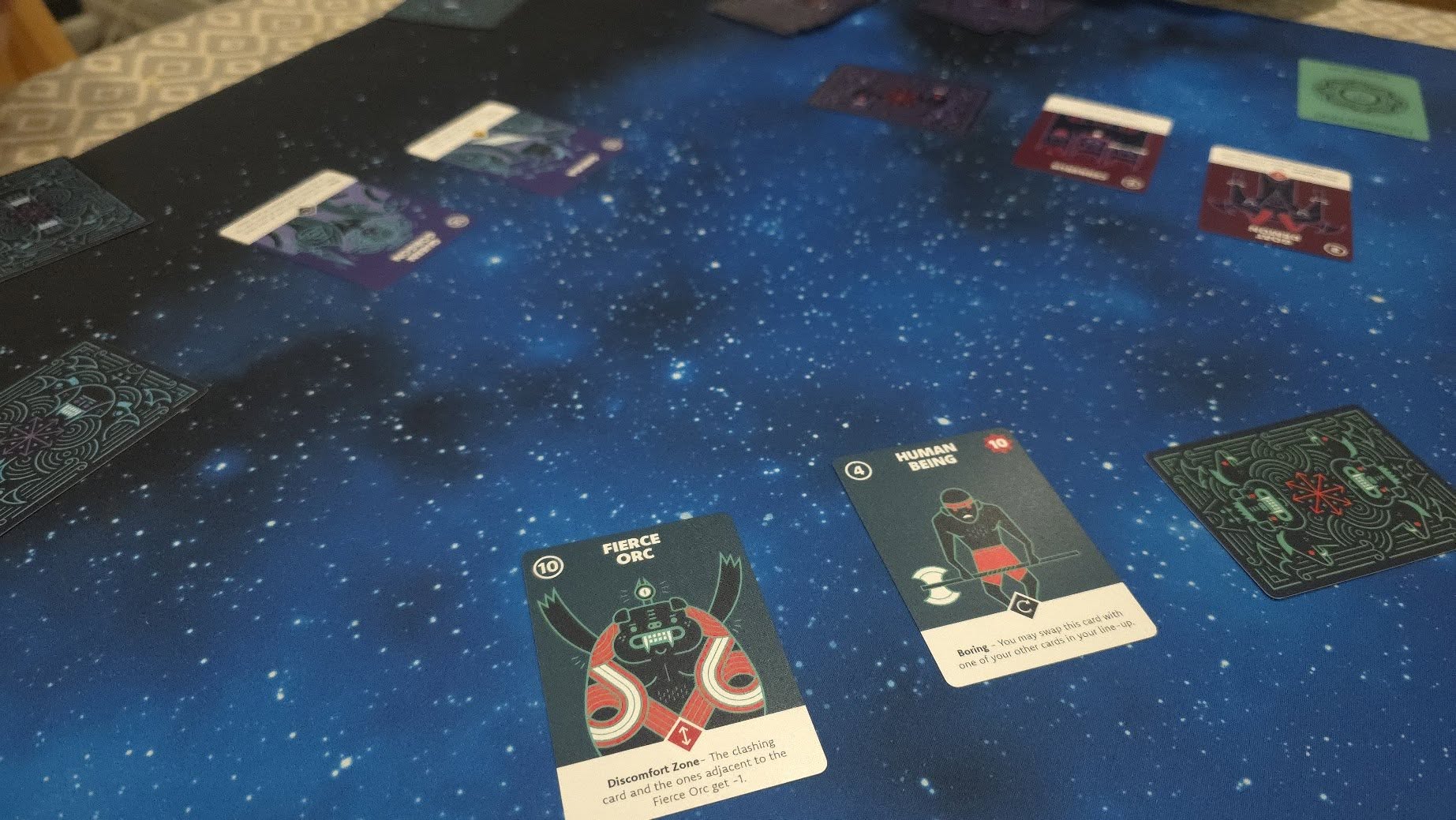
There are some cards that are clearly meant to be strong in that middle lane, but equally if no one wins both of their side battles, or if there are drawn battles, everyone goes into the middle fight with their base values.
It’s a really clever system that means you have to think carefully about card placement. You have to think about which cards are strong in which positions, and you also have to do a bit of guessing about what the other player might play. This is where playing the game multiple times really improves the experience because you start to learn the decks in the game and understand where they are strong and where they are weak.
Once the battles resolve you move the fruit. If you do not currently have it and it is on the green picked side you move it towards you, otherwise you turn it from tasted back to picked. Essentially you have a tug of war system with the other player or players as you try to win three in a row, or two in a row with your chaos value activated in the middle lane which moves the Forbidden Fruit twice.
You always keep two cards in your hand during the pickup phase, and there are some cards that actually have abilities that activate during the pickup phase. Because you can hold cards back in your hand you can plan ahead and try to set up stronger future turns. You might even deliberately take a loss in one round if it means you can set up a much stronger turn in the next round.
There are also two variants you can add into the game. One is the Goddess of Law variant where you take a Goddess of Law card which creates an ongoing effect that affects you for the whole game. These tend to slightly change the gameplay but with the added bonus that you draw six cards instead of five during the initial setup. These are fine. We didn’t have any issues with them but we also did not end up using them very much.
What we did like was the Chaos Cat variant. This adds a single Chaos Cat card into your hand and when the Chaos Cat is revealed it activates a special rule for that round, such as lowest score winning.
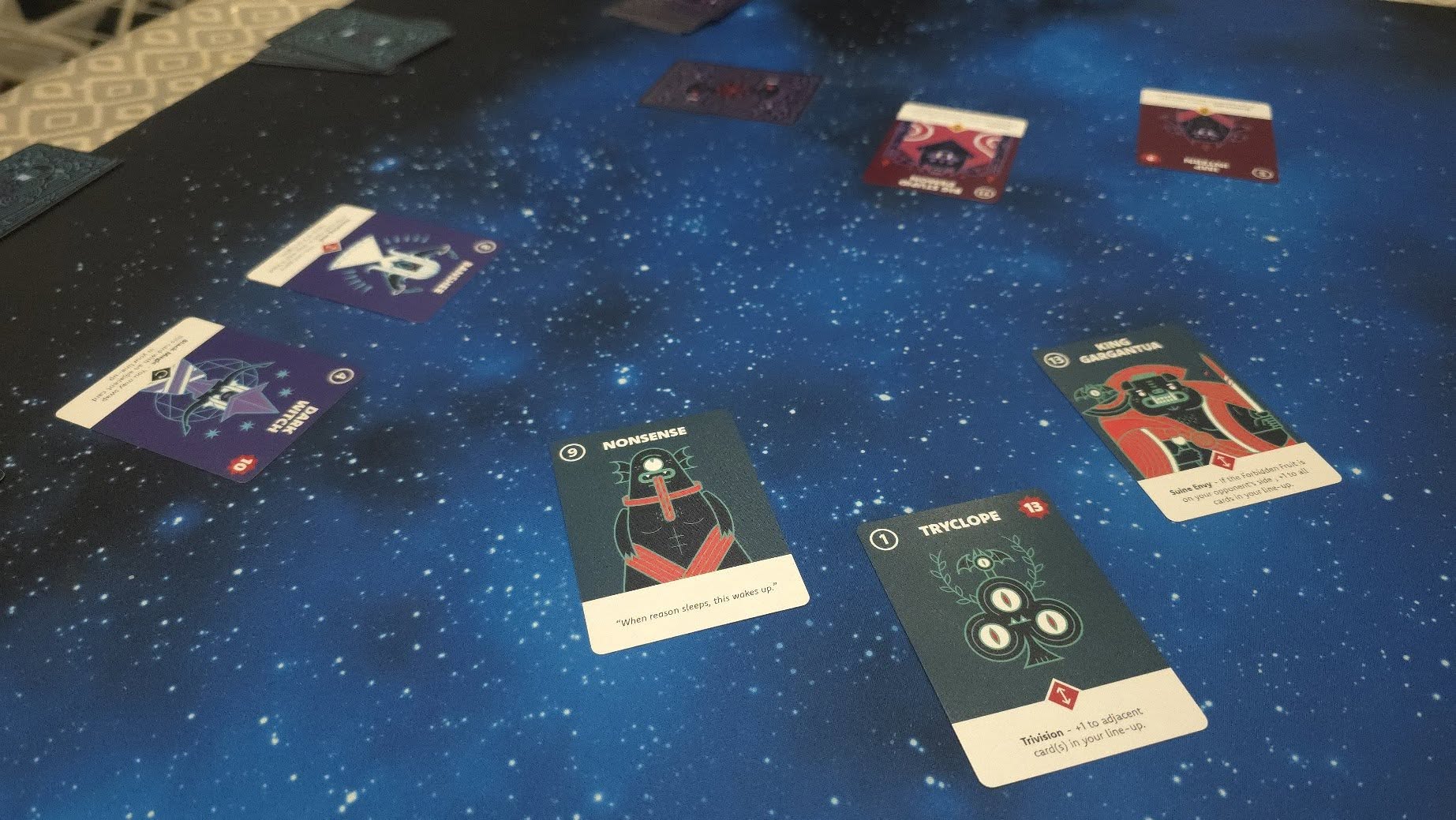
The artwork is really nice and stylish. I really like it and, at least as far as the prototype goes, the fact it comes in a nice small box gives it the feel of a lane battling TCG without you having to buy booster packs. There is definitely scope here for more factions further down the line.
I cannot currently comment fully on the card stock of the final version, but the prototype I received felt nice and had a finish that was very pleasant to handle. I have no reason to suspect the final release will not be similar. If that is the case then these will be good quality cards.
Overall I really enjoyed playing “Chaos: The Card Game”. It’s a really good little lane battling card game with some elements of auto battlers thrown in. Nothing here is too complex for a child to understand. I played it quite happily with Jack, 10, and Toby, 7, and they both really enjoyed it. We played at both two and three players and I also played it with a number of other kids at four players.
Even though it probably shines best at two as a one on one experience, it still works really well at larger player counts.
Games don’t last that long and you will probably end up playing a best of series, but you can also just have a quick one off game. The speed at which everything happens is fairly consistent because the game is limited by you running out of your deck, which is quite appealing when playing with kids where it can sometimes be difficult to sit down for something longer.
The game is currently available on Kickstarter and I will put the Kickstarter link in the comments below. The funding period has ended but it is still available as a late backer for about £19. I think it’s a very decent buy. It is due to be delivered around May but, to be brutally honest, that is very likely to slip slightly given recent shipping issues around the world.



 Nicola Asker