
 Matthew Bailey
Today, we are going to be looking at Capybaras vs Pelicans, a simple card game with a surprising amount of decision-making at its heart.
The game comes as a single deck of cards. To set up, simply shuffle the deck and deal three cards to each player. The remaining cards are placed face down to form a draw pile.
The starting player is the person who most recently ate something orange (a slightly odd choice, as if you are playing with kids, chances are you all ate carrots at the same meal, but whatever). Play then continues clockwise around the table. On your turn, you play one card from your hand and then draw one card from the draw pile. Play continues in this way until all cards have been played.
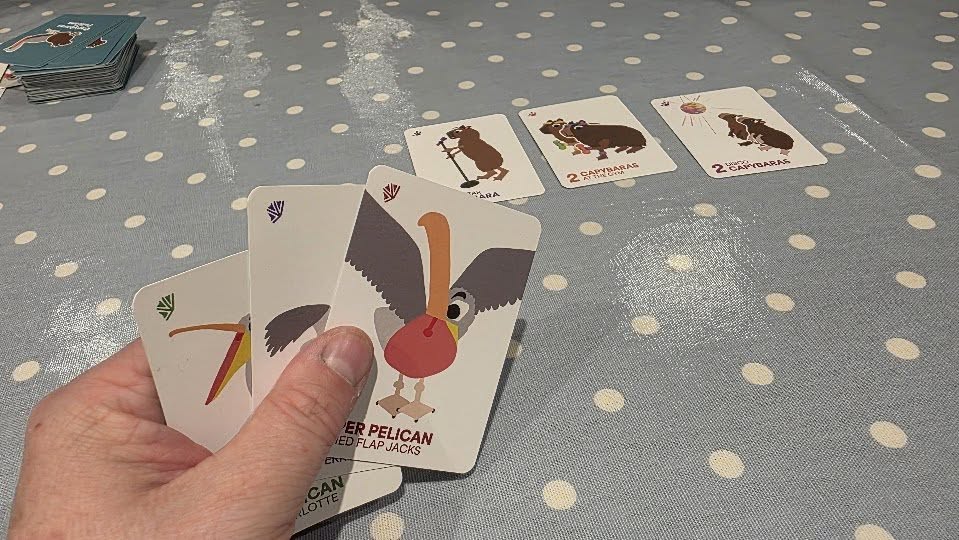
There are four types of cards in the game. Capybara cards are placed in front of you and represent your growing collection of very relaxed rodents. Some cards feature more than one capybara, which obviously scores more. Pelican cards allow you to steal a single capybara card from in front of another player, placing it into your own play area. Super Pelican cards are much stronger, allowing you to choose another player and steal all capybara cards currently in front of them. Finally, Hot Spring cards provide safety. When played, all capybara cards currently in front of you are banked. These capybaras are now safe and can no longer be stolen.
On the surface, this all seems incredibly simple, and in reality it is, but there is a surprising amount of decision-making going on.
While a Super Pelican is very powerful, it also makes you extremely vulnerable to having your cards stolen straight back, so players tend to sit on Super Pelicans until the timing feels just right. This creates a constant tension, as there is always the worry that your carefully built collection will be taken before you have the chance to Hot Spring them on your next turn.
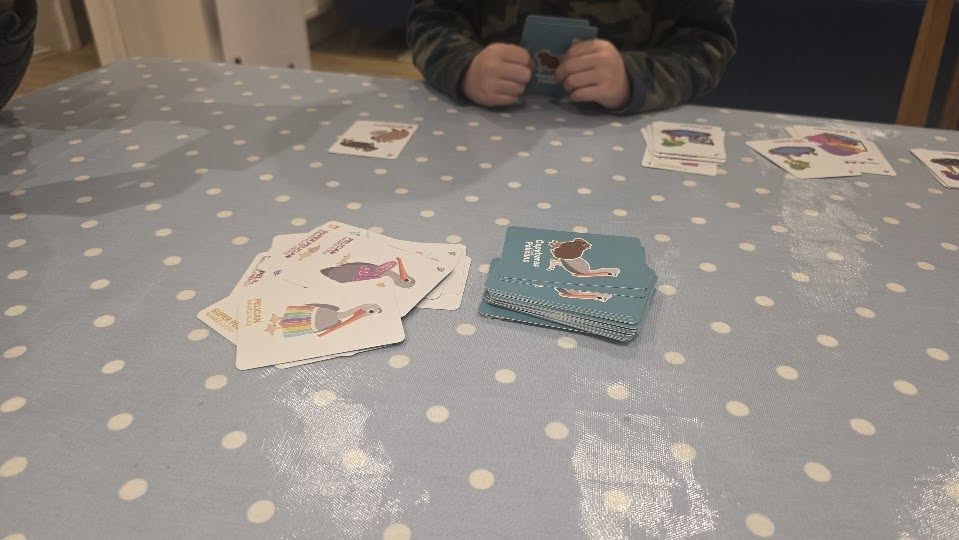
This gameplay, and the constant feeling of living on the edge of your seat, is genuinely compelling. We really enjoyed every game we played.
Equally, because capybara cards have different values, not all cards carry the same inherent worth. A large stack of cards can actually be less valuable than a few carefully timed steals.
One key rule that really shapes the experience is that you must play a card on your turn, even if it does nothing. This often forces you into choosing which sub-optimal play to make. It also creates some nice moments of deduction. For example, if someone plays a Hot Spring card with no capybaras in front of them, you can be fairly confident they are holding more Hot Spring cards.
The game ends once the deck has been exhausted. Scoring is based only on capybaras that successfully made it to the hot springs. Any capybaras still sitting in front of a player at the end of the game are not counted. Each capybara is worth one point, meaning cards with multiple capybaras are naturally more valuable.
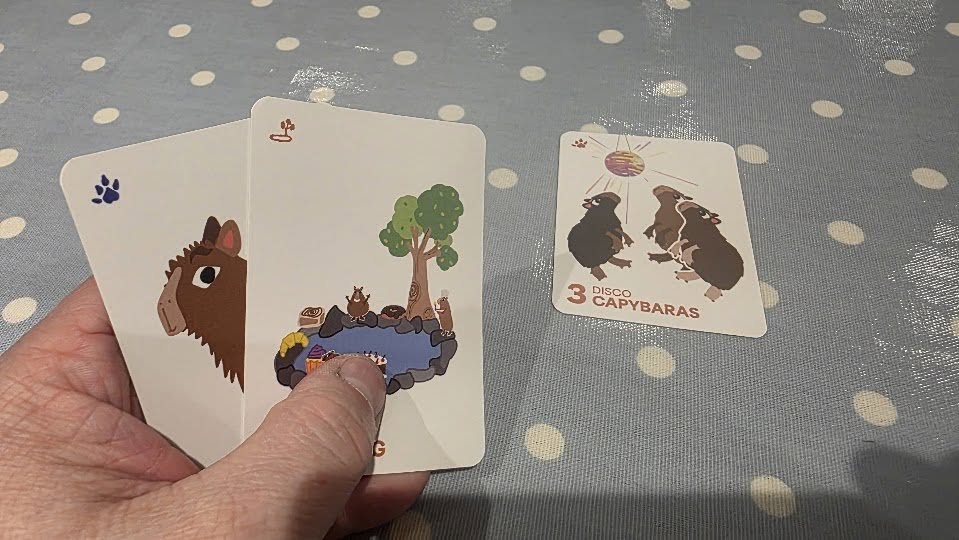
The game plays out in about 10 minutes, and we were massive fans of it. I have only played a prototype copy, but everything felt very well made and good quality.
All 3 of the boys loved it and it has become a game we have played daily. over the half-term break so far.
Capybaras vs Pelicans is due for release soon, with no exact date confirmed yet. I will post an update when it launches, as this is a small card game that is definitely worth picking up and works brilliantly across age groups.
Disclaimer: A prototype copy of Capybaras vs Pelicans was kindly loaned by Disco White via the UK BG Review Circle. All thoughts and opinions are our own.