 Matthew Bailey
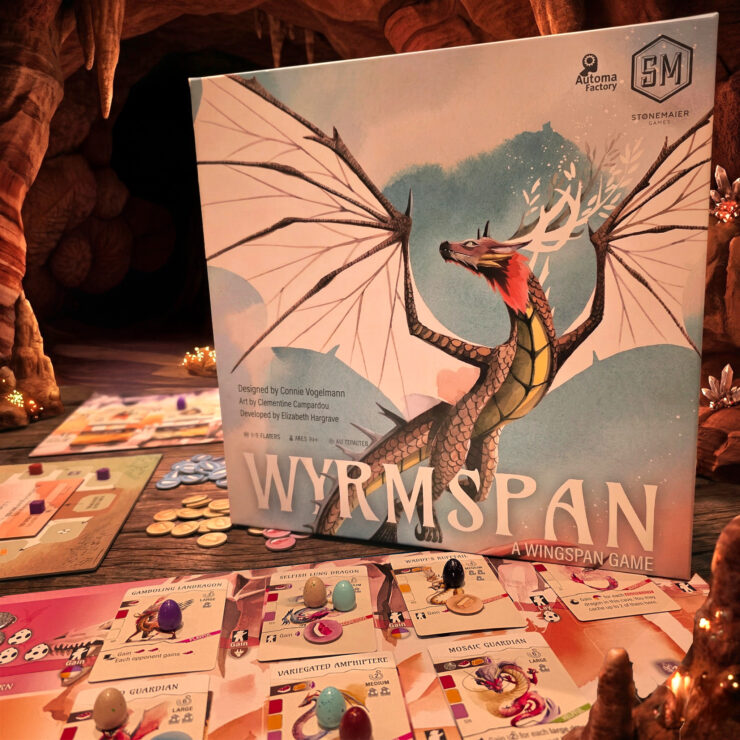
Today is the last entry in our Wingspan series the final game of the four we’ve looked at? That would be Wyrmspan, the most complex of the set, but not by a massive margin. It brings in some interesting ideas and, for some people, this could well be the one to go for.
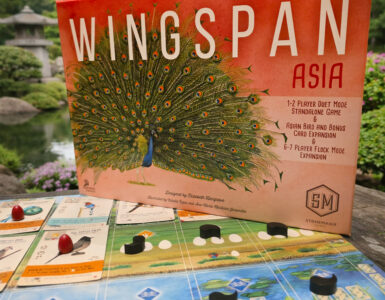
If you haven’t already, please do go and check out my previous reviews of Wingspan, Wingspan Asia, and Finspan from the last few days. I’d really encourage it, as I’m going to be referencing those quite a lot here, especially Wingspan.
Wyrmspan was released a few years after Wingspan and is generally regarded as the more complex of the games. That said, it’s not dramatically more complicated. If you’re playing with a child who can handle Wingspan, they can almost certainly play Wyrmspan as well.
At its core, the game still follows the same overall structure as Wingspan. On your turn, you are choosing one of a small number of actions, developing your personal player board, and building up a tableau of cards that trigger effects as the game goes on. Instead of birds, you are playing dragons into different caverns, with each area representing a different type of environment.
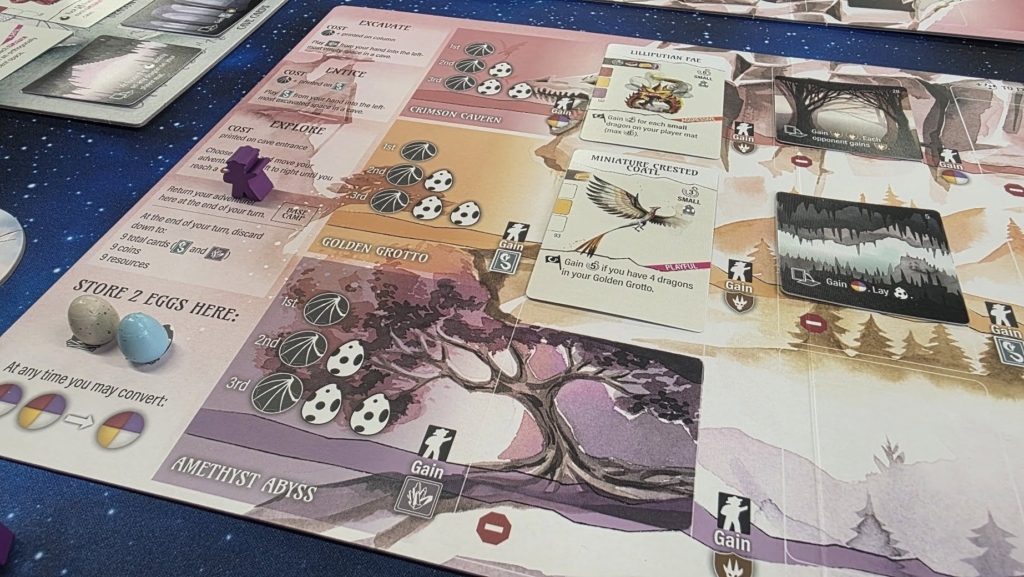
One of the main differences is how those caverns are developed. Rather than simply placing cards into fixed slots like in Wingspan, you are excavating caves (spaces) before you can place your dragons. This adds an extra step to progression, as you are not just playing a card but also building the space it will go into. Over time, this creates a slightly more involved engine, as each row develops in stages rather than being immediately available. I actually really like this, as it gives an extra element of customisation. Some of the actions you get when you play these caves are quite powerful and allow you to chain actions together. This leads into one of my favourite things about Wyrmspan, which is the ability to create combos and a genuinely functioning engine. I feel this works a little better than it does in Wingspan. This might be different if you are using multiple expansions with Wingspan, but at least with the base game, I’ve never quite felt like my engine worked together in the same way as it does in Wyrmspan if you set it up well.
In order to do this, you use the Excavate action. Rather than just placing a card straight into your tableau, you are first expanding your cave system by playing cave cards into specific slots. These have to be placed from left to right, and the further along the cave you go, the more it costs, bringing in coins and eggs as additional requirements. When you place a cave, you often trigger effects both from the card itself and from the space you’ve just covered, which adds a bit more sequencing and decision-making to what would otherwise just be “play a card” in Wingspan.
It’s also worth mentioning that instead of taking a set number of turns each round, most of your actions in Wyrmspan are driven by coins. You start each round with six coins, meaning you effectively have six turns, but there are ways to gain more. This means that some players can end up taking more turns than others in a round, with the round only ending once all players have passed. It’s a small change, but it adds a nice layer to the pacing of the game.
The second thing you can do is the Entice action, which is how you play dragons into those caves. This is probably the closest part to Wingspan, as you are essentially playing a dragon into a slot, provided you have already built a cave there. It does mean you have to think a little further ahead than in Wingspan, but it’s not a massive increase in complexity, more just making better use of your turns. This also costs a coin, tying back into the game’s overall economy.
The third main action, Explore, is where the engine really starts to come together. Instead of simply activating a row like in Wingspan, you move your adventurer through one of your caves from left to right, much like you do in Finspan, triggering abilities as you pass each space and dragon. The further you’ve developed that cave, the more effects you will trigger in a single action.
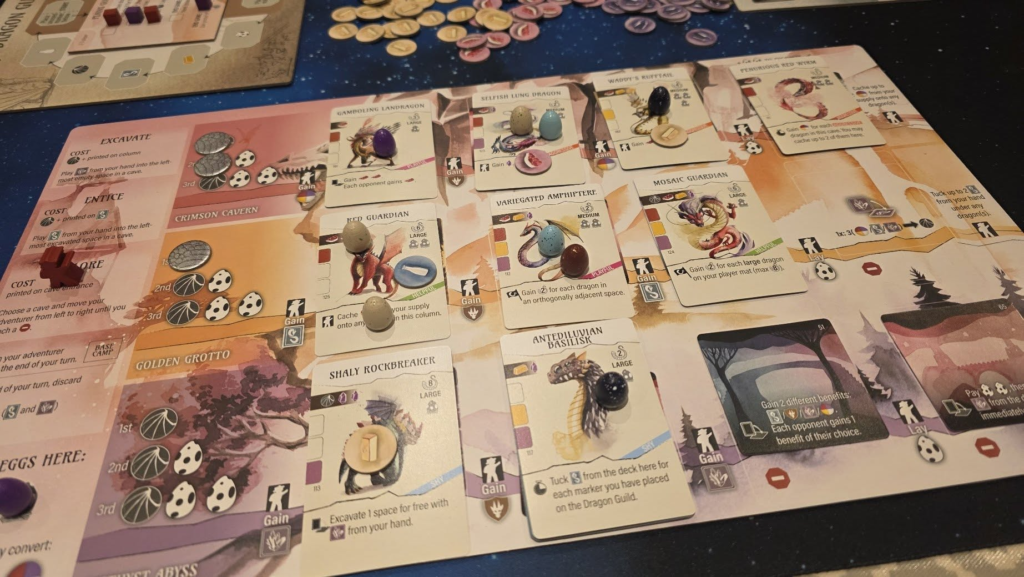
However, there is a scaling cost to doing this multiple times in a round, with coins and eggs required for repeat explorations. This adds a bit more planning around when and how often you activate each row. This is a change I actually really like. In Wingspan, if you get a strong row set up, you can just repeat it again and again. Here, you can’t really do that, as the cost increases each time, which feels like a very welcome tweak to something that could be exploited in Wingspan.
Abilities work in much the same way as they do in Wingspan, although dragons also have types such as aggressive, shy, or helpful. These are often used alongside other powers to support your engine or help you achieve end-game goals.
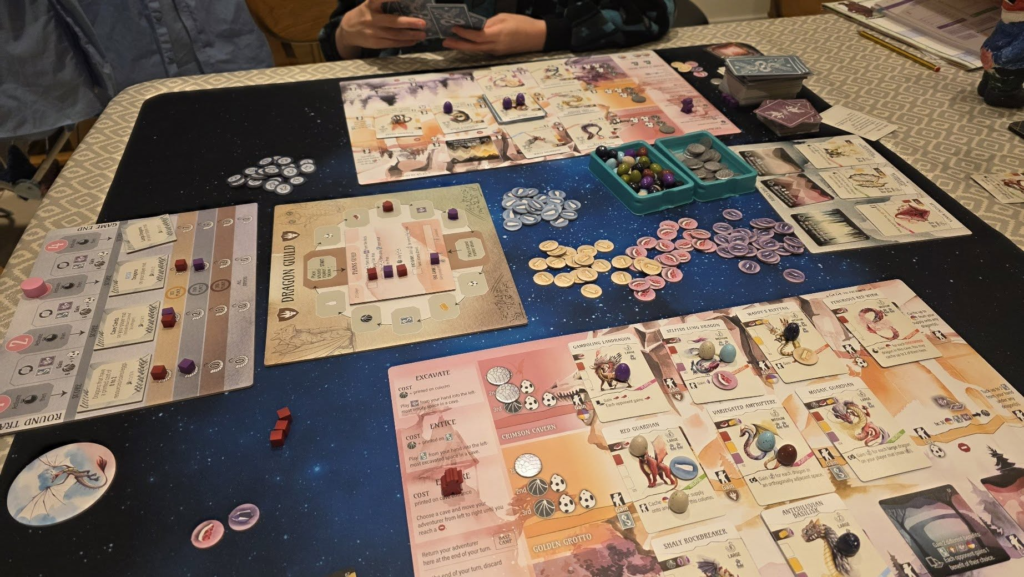
There are also some additional systems running alongside your main board. The Dragon Guild track gives you bonuses as you progress along it, often triggered through normal play, and each round has objectives that are scored based on how players have built their caves and dragons. Structurally, the game still runs over four rounds like Wingspan, with players taking turns until they pass, but there are more small interactions and rewards layered into that structure as you go.
Overall, while the flow will feel very familiar if you’ve played Wingspan, the main difference with Wyrmspan is that progression is less immediate. You are not just placing cards and activating them, you are first building the space, then filling it, and then running through it, which adds a few extra steps to how your engine develops over the course of the game.
There’s an awful lot to like here. The cave system adds an extra layer without massively increasing the complexity. As I mentioned before, I think the engines you build tend to be a little more engaging than in Wingspan, and I also really like the Guild track. It’s a nice, simple addition that brings in a few elements I enjoyed from Wingspan Asia.
Another thing I like about Wyrmspan is that resources are generally easier to gain. In Wingspan, you are quite reliant on the roll of the bird feeder for what is available, whereas in Wyrmspan, you can more consistently get what you need, especially if you build your engine well.
As usual, the components are fantastic. The quality is excellent, everything is nicely presented, the artwork is great, and, let’s be honest, dragons are just cool.
Another thing I really like in Wyrmspan compared to Wingspan is how the end of the game plays out. In Wingspan, as your turns decrease, you often end up just collecting eggs in the final rounds as you run out of better options. In Wyrmspan, it didn’t really feel like that. You tend to still be doing meaningful actions right until the end, and even looking for ways to extend your turns, which makes the final rounds feel much more engaging.
I am going to do a final wrap-up to try and say which one I think you should get, but having now played all of them quite close together, I think it largely comes down to personal preference. I’ll cover that more in my wrap-up.
Personally, I prefer Wyrmspan out of all of them. I think the engine building is better, the game feels more balanced, and I prefer how it plays overall. While it is slightly more complex than the others, I don’t think that’s a deal breaker, and if a child can play Wingspan, they can definitely play Wyrmspan.
I really like Wingspan Asia, and I think that’s a definite option if you are mainly looking for a two-player experience with the original Wingspan. If you want something slightly simpler, then that might be the better choice. Finspan was probably my least favourite of the four. I’m not keen on the board shape or the movement of the tokens, and overall, it just felt the least engaging to me.
Jack(10) prefers Wingspan Asia, and I prefer Wyrmspan, but not by a massive margin.
So, to sum up, Wyrmspan is a slightly more complex version of Wingspan, but in my opinion, those small extra complexities make it a slightly better game overall, even if only by a small margin.