 Matthew Bailey
Today we’re going to be looking at Re;MATCH, currently on Kickstarter and soon to finish, so if you like the look of it in this review, you will probably need to get in quite quickly, although I hope there will be late pledges available.
Kickstarter Link – https://www.kickstarter.com/projects/brotherminggames/rematch
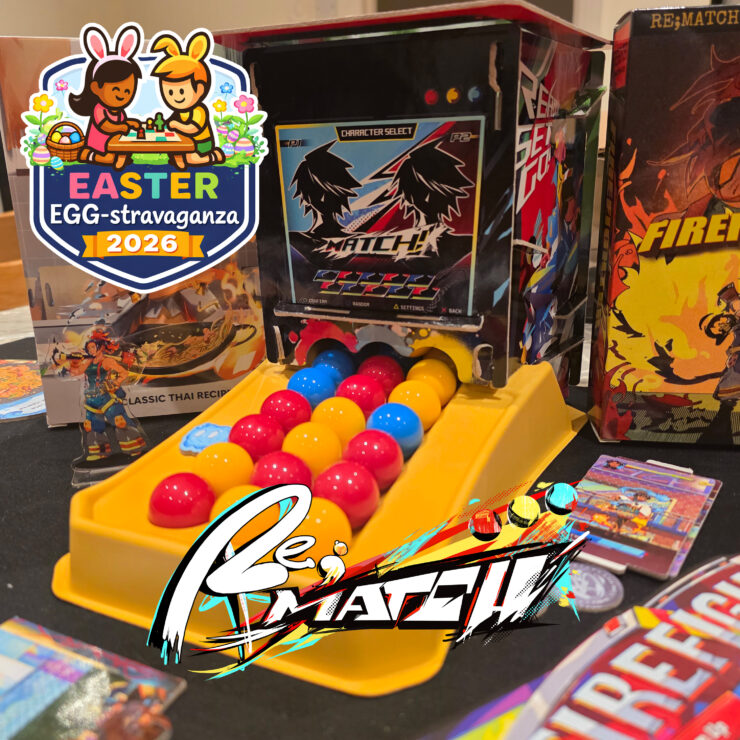
Re;MATCH is a puzzle-based 1v1 fighter where you and your opponent are going against each other by removing marbles from an ever-flowing tray in sets, much like a Candy Crush-style video game, in order to create attacks that damage your opponent in an attempt to eventually finish them off and render their attacks useless.
Before I even start explaining, it’s worth mentioning that this is an early prototype version, pre-Kickstarter, so some of the things here are subject to change and some of the artwork is not necessarily final, but everything here is already giving a very clear impression of what the final product is going to be like.
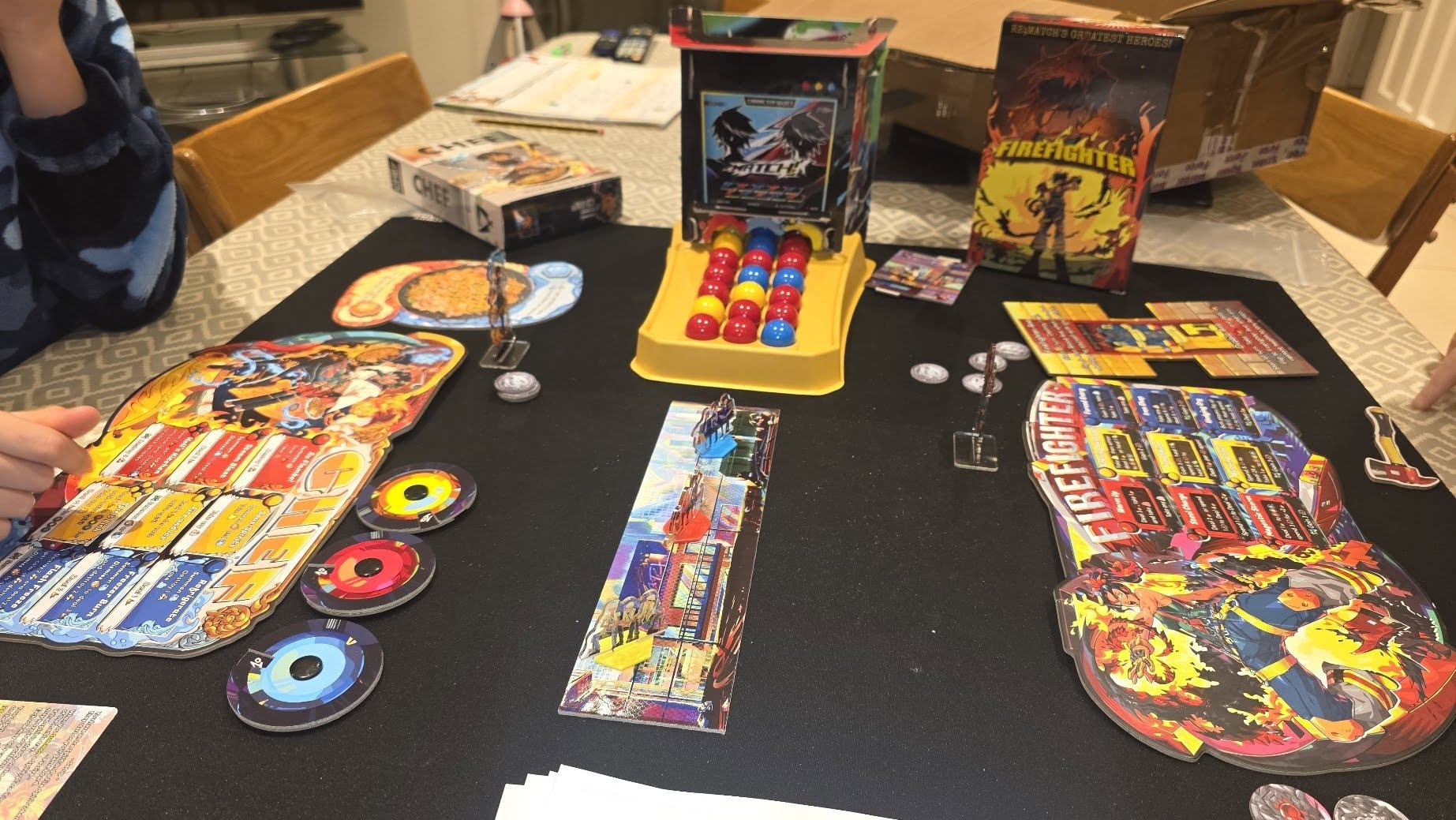
At its core, the game is played over a series of alternating turns, with each player performing a single attack on their turn before passing play over to their opponent. The objective is to deal enough damage to your opponent’s health dials to force them to spend their limited credits, and if they are unable to pay, they lose the game.
On your turn, everything revolves around selecting an attack from your player board and then clearing the required marbles from the tray to activate it. Each character has a set of attacks split across three colours, and each one requires either 1, 2, or 4 marbles of that colour to be cleared.
The marble tray itself is constantly feeding new marbles in from the top (which works some of the time, but hopefully by the time the final version comes out the feeding system will have been refined), creating a shifting puzzle that both players are interacting with. You can only take marbles from the two lanes closest to you, with the middle lane being shared between both players, which creates a constant point of interaction and competition over key pieces.
When clearing marbles, they must be connected orthogonally rather than diagonally, and if you are taking larger groups, you need to form a continuous chain without backtracking. This means positioning and planning your route through the marbles becomes important, especially when trying to line up larger attacks. As you can see exactly what everyone else has, it becomes not only about picking the marbles you need but also making sure that you don’t leave your opponent able to do a crushing 4-marble attack on their next turn.
Once the required marbles have been cleared, the chosen attack is resolved exactly as written on your board, working from top to bottom. Some attacks will deal damage, others may allow you to recover health, manipulate the marble tray, or interact with other elements in play depending on the character you are using.
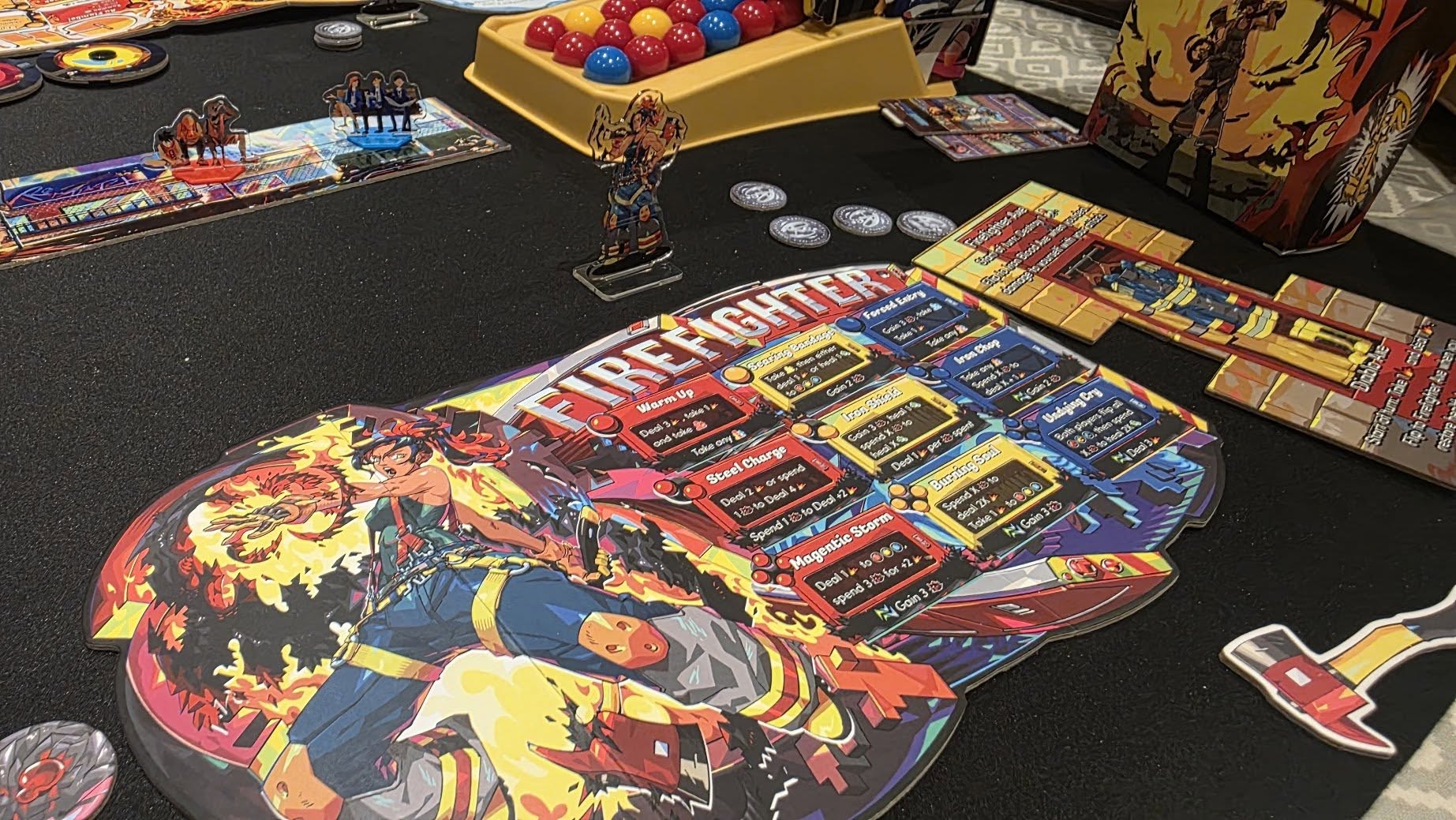
In addition to the base attack, there is also a secondary effect known as a kicker, which can be triggered if the fans are behind you at the start of your turn, brought about by pulling them to your side as part of other abilities. These add an extra layer to each action and can slightly change how you approach your turn depending on what is available to you.
As the game progresses, you are trying to manage both your own health dials and your available options, while also reacting to how the shared marble tray is evolving. Because the board is constantly changing, each turn presents a slightly different puzzle, even if you are aiming to use the same attacks repeatedly.
As the game progresses, damage is tracked across multiple button health dials, each tied to one of the colours. When a dial is reduced to zero, it becomes broken, and that immediately puts pressure on the player to spend one of their limited credits to stay in the game. If multiple buttons are broken at once, the cost increases, meaning things can escalate quite quickly if you are not careful.
Breaking a button also has an impact on what you can do moving forward. While a button is broken, you are no longer able to use attacks of that colour, which reduces your available options and changes how you approach the puzzle in front of you. However, those same marbles are not wasted, instead becoming what the game refers to as short circuit marbles.
These short circuit marbles act as connectors, allowing you to link together groups of other colours that would not normally be connected. They do not count towards the number needed for an attack, but they can extend your chains and also provide healing to the corresponding broken button as they are used, creating a small recovery loop within the system.
You can “unbreak” a button at any point, but the sooner you do it, the lower health it comes back with. This means it is more likely to break again quickly, and you also run the risk of ending up with two buttons broken at once, which is really costly. There is a clear risk and reward element here, and it creates a very tight balancing act.
Because of this, the state of your buttons directly affects how you interact with the marble tray. At different points in the game, you may be working with a reduced set of attacks while also gaining new ways to form connections across the board, which shifts how each turn plays out.
Over the course of the game, this back-and-forth continues until one player is unable to pay the required credits after their buttons are broken, at which point the game immediately ends.
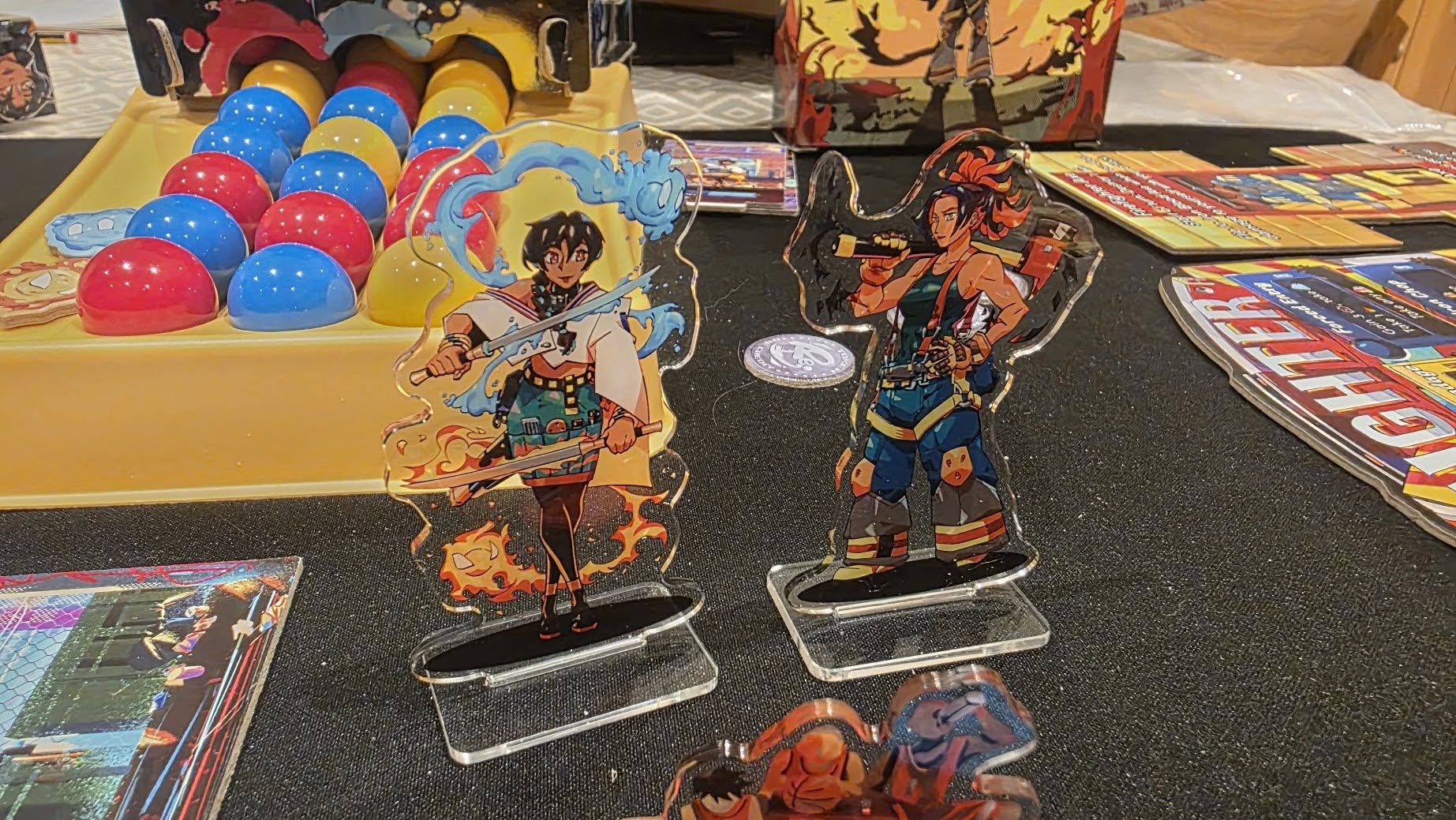
On top of the core system, each character comes with their own set of attacks and abilities, which slightly changes how they interact with the marble tray and the overall flow of the game. Every character has a unique move list built around the same three colours, but the effects tied to those attacks can vary, with some focusing more on direct damage, others on recovery, or manipulating the marbles themselves. The Chef uses fire and water elementals to lock certain rows, preventing your opponent from doing what they want, while the Firefighter has a core mechanic where they gain energy and can spend it as an additional resource to power their abilities. They also vary in complexity, meaning you can choose one that fits how you want to play. In the games we played, they all seemed fairly balanced, with differences coming more from playstyle than anything else.
Re;MATCH is really unique and I really enjoyed the time we spent with it. I think it is well worth considering if you like this kind of puzzle gameplay. The components, at least in the prototype, are really cool and everything works well. The marbles themselves are nice, chunky bakelite-style plastic, similar to the tiles in Hive, which is a good reference point, and they feel great to handle and remove.
The game actually reminds me most of Bullet, which we have featured quite a bit on Little Board Gamers over the years and remains a constant favourite with the boys. Because of that, Re;MATCH was a game that immediately stood out. Jack absolutely loved it, Toby really liked it, and I also thought it was really strong. What I will say is that with younger children, while they may be able to understand the relatively simple rules, the strategy and planning required is quite in-depth, so your mileage may vary depending on the strengths of the child you are playing with. The best way I can explain it is that most young children can play Tetris, but in my experience, not many are able to plan effectively to make the best use of their space or think several steps ahead.
I really like Re;MATCH, I think it is a really solid puzzle game and definitely something unique enough that I would recommend if you are looking for this kind of cool video game crossover. It is available now on Kickstarter, with the campaign ending in about 12 hours, which is partly my fault timing-wise, but hopefully there will be late pledges available, as well as a chance to pick up a retail version further down the line.
Discliamer – A prototype copy was kindly provided for us by Brother Ming Games vias the UK BG Review Circle