 Matthew Bailey
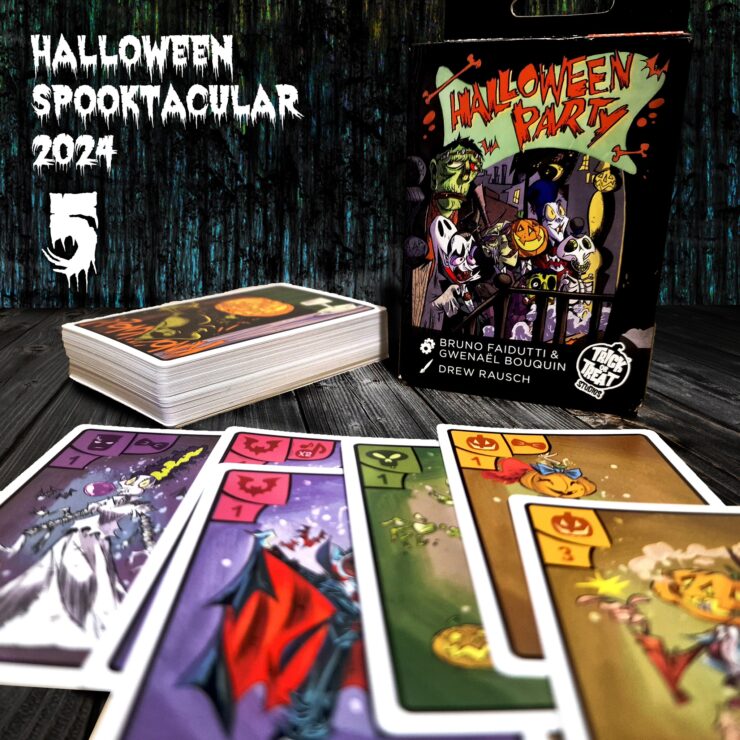
Game 5 of the”Halloween Spooktacular 2024″ is “Halloween Party” a set collection card game that arrived in my house on the 1st of November last year, which meant we missed out on adding it to last year’s Halloween Spooktacular.
Played with Jack(9) and Toby(6).
The general concept of the game is that you’re hosting your own Halloween party, filled with spooky monsters, and you’re trying to convince the best possible monsters to attend and score the most points.
You start by each taking a collection of cards, then shuffle the rest and place them face down on the board, creating a tableau of four available cards to choose from.
Essentially, you’re aiming to collect sets of guests in different colours that are worth points. There are also multiplier cards that multiply the value of all cards of a particular colour, making it potentially lucrative to focus on one colour if possible.
There are also negative cards that you want to avoid at your party, such as the Host. If a Host ends up in your hand, the player who gave it to you gets to take it back, along with one of your other cards. Similarly, there are negative cards like the Hearse and the Horseman, which either force you to discard all cards of one type or allow another player to take all of your cards in one go.
On your turn, you offer a card to another player of your choice. That player must either accept the card and add it to their party—gaining points or dealing with the negatives, or reject it, in which case you must take the card and face the consequences, good or bad.
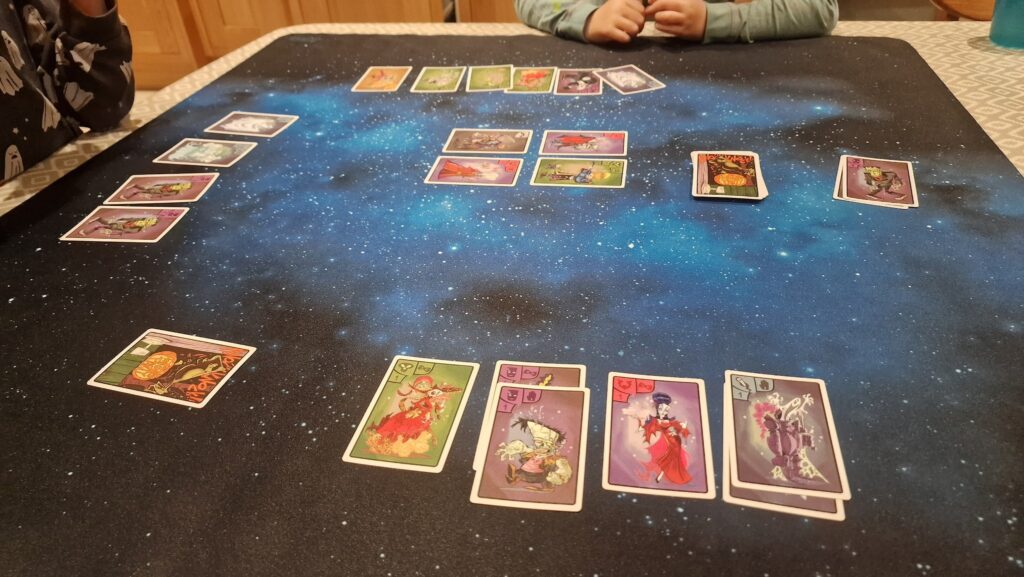
The game continues until you run out of party guests, and the player with the most points wins. On the surface, it’s a fun, simple card game that I think is actually quite good for young children, as it encourages social deduction with a bit of bluffing. It’s also a great way to introduce kids to bluffing mechanics.
While the game is a lot of fun and has a great light-hearted, bluffing vibe, we did notice that the balance can feel a little one-sided at times. Because the cards are mostly points or detrimental ones, if a player gets ahead early, they can simply decline further cards, which makes it tough for others to catch up.
We found that tweaking cards like the Hosts, Hearses, or Horsemen to let players steal or swap cards added a new layer of tension and kept the game unpredictable right until the end. Even just a few positive “comeback” effects alongside the negative ones would keep everyone invested and on edge throughout.
It’s worth saying that the core of the game is really enjoyable — it gets people laughing, bluffing, and second-guessing each other straight away. With just a few balance adjustments, it could go from very good to excellent, making it even more replayable for groups of all kinds.