 Matthew Bailey
Today we are going to be looking at Fuzzballs: Pizza Thief, a really cool prediction, take-that card game based around the Fuzzballs licence, which are these cute, adorable little critters who are all trying to host a pizza party but can’t work out how generous they want to be.
Usually when I play games, I’ve got a fairly good idea of how things will play out going in, but actually Pizza Thief took me a couple of moments to get my head around because it’s really unusual, and I’ve not actually played anything exactly like this before. For this kind of small card game, that’s a really cool thing. Let me explain.
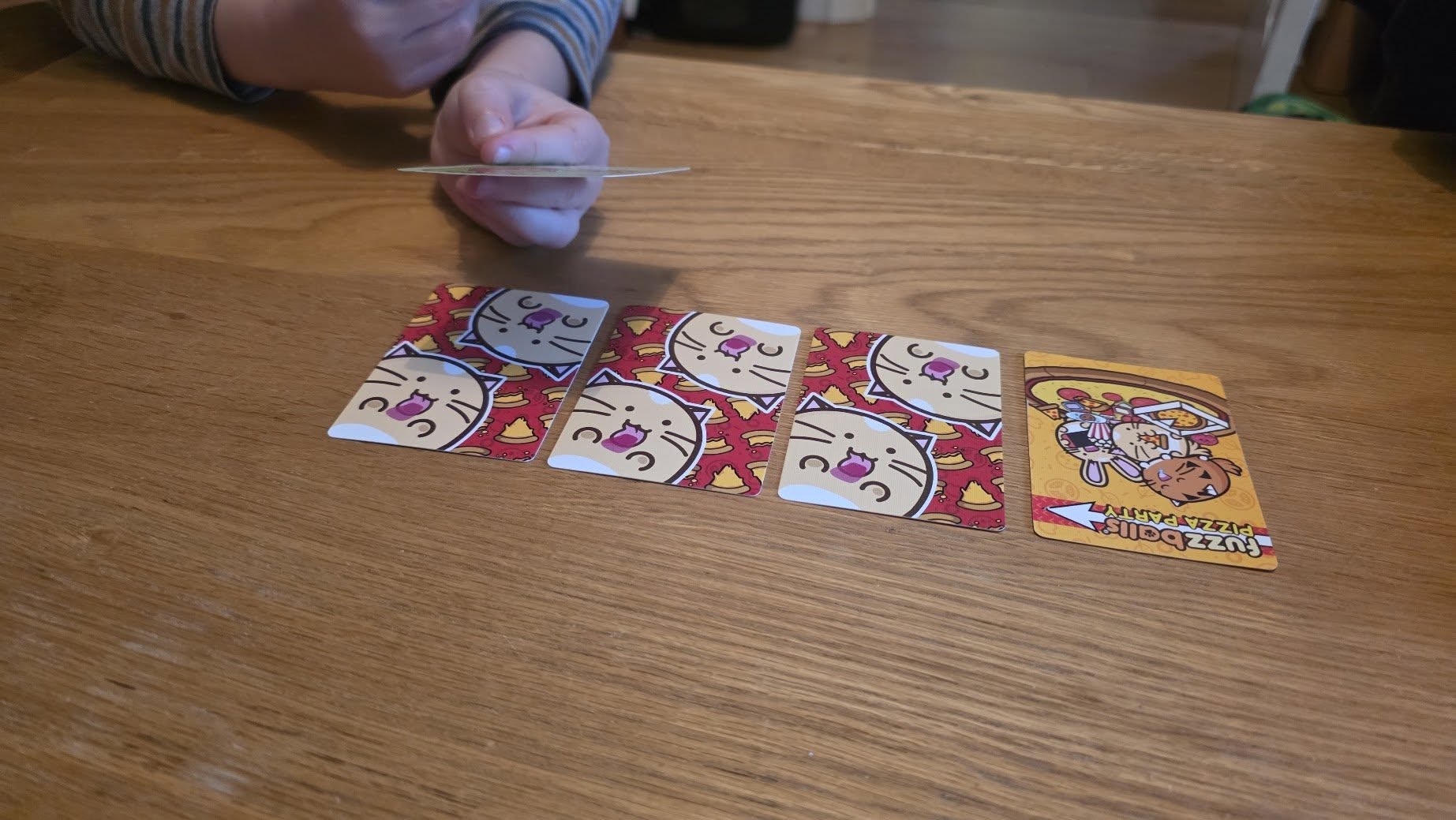
In Fuzzballs: Pizza Thief, each player begins the game with a hand of two cards, and this hand size is maintained throughout by drawing back up to two whenever a card is played. At the start of the game, every player selects one card from their hand and places it face down into a central row. Each card has both a positive and a negative value, and players choose which value to contribute by orienting the card so that either the positive or negative number is at the top. This number represents the amount of pizza at the pizza party, and it’s your task to predict it and get your prediction pile as close to that number as possible.
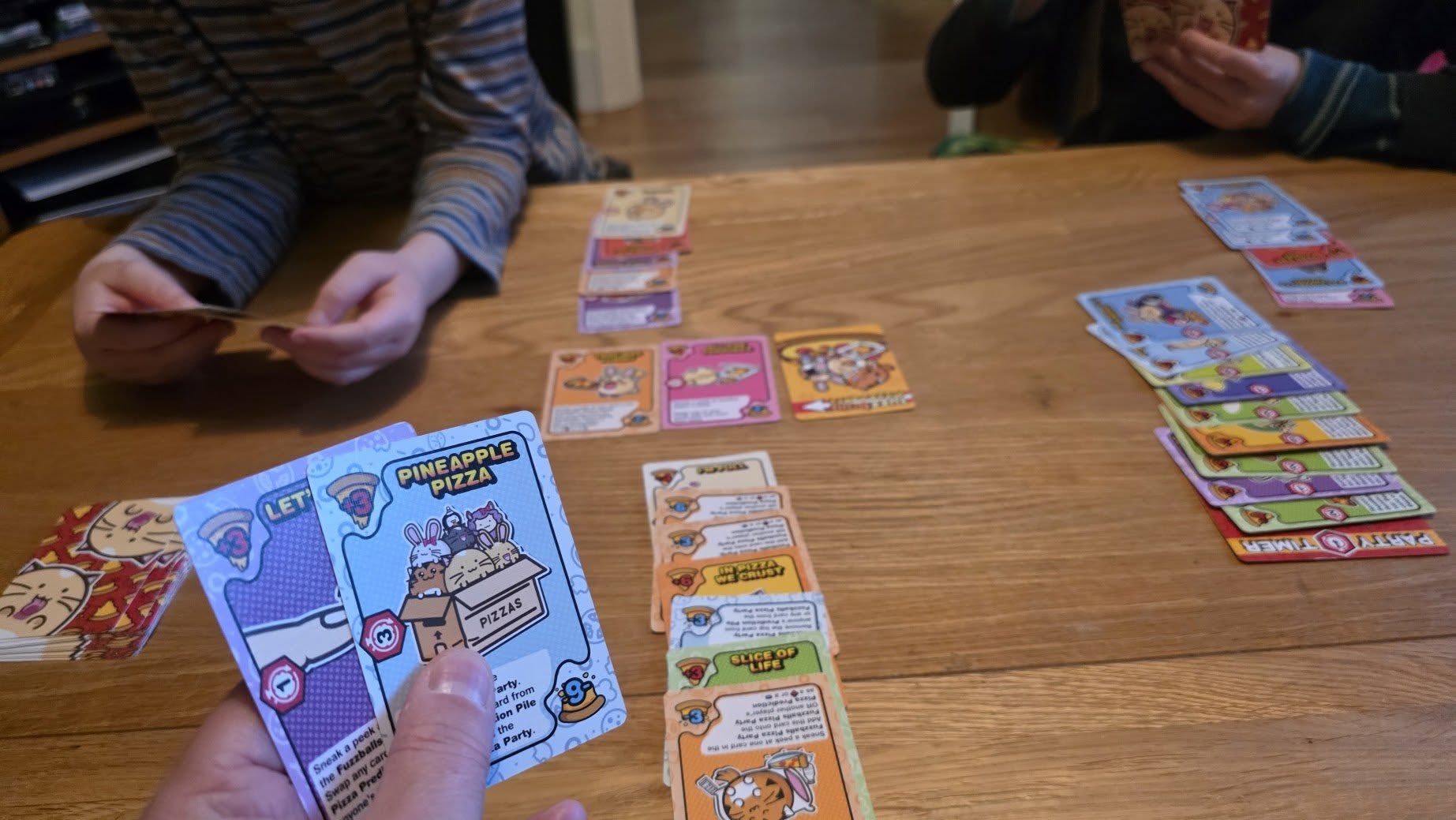
Players then take turns. On a turn, a player may either add to their prediction pile or place a card into the timer pile and play its ability. To add to their prediction, the player places a card face up in front of themselves, choosing whether to use its positive or negative value. These cards form that player’s prediction pile, representing their estimate of the total value of all cards in the central row.
Alternatively, a player may place a card sideways into the timer pile. When doing so, the player resolves the effect written on the card. These effects can include actions such as looking at cards in the central row, swapping cards in the central row, modifying their own prediction pile, or affecting other players’ prediction piles. Some cards also include effects that trigger when the game ends if you keep them in hand.
In every game we have played, about halfway through it becomes apparent that everyone knows, or has a good idea of, the cards in the middle pile. At that point, it becomes much more of a take-that game, as everyone tries to get closer to the number, knowing full well that removing or adding cards can disrupt both their own total and the central pile’s total.
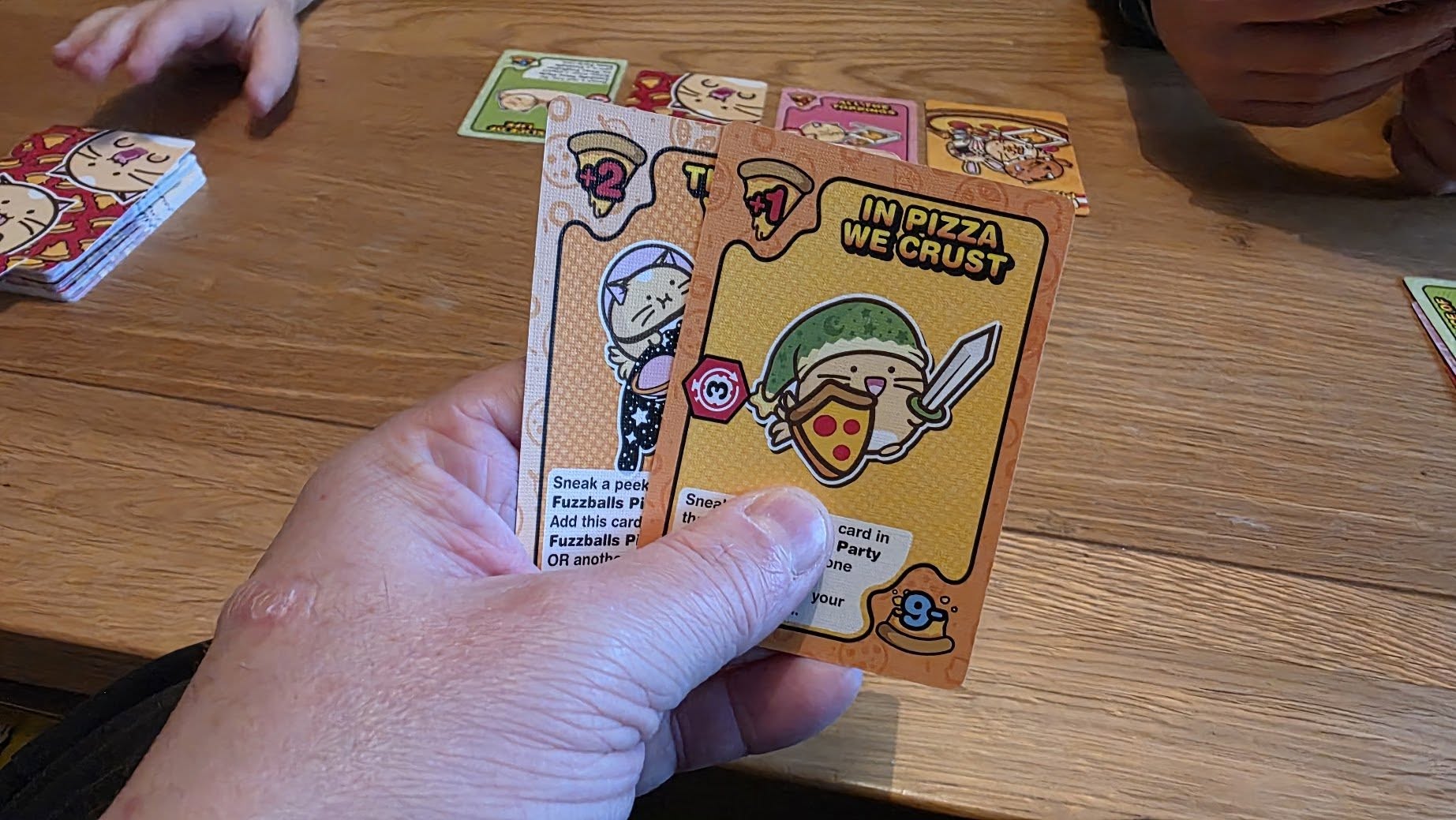
The game requires a decent amount of mental arithmetic, which was definitely good for getting the boys’ brains going.
The game continues with players taking turns until the timer pile reaches its limit. When this happens, the game ends immediately. All cards in the central row are revealed and their values are totalled. Each player then totals the values in their prediction pile, and the player whose prediction is closest to the central total wins the game.
The game itself is over very quickly, and you can play it in about 10 minutes, especially once people know what they’re doing. Quite a lot of the game involves players working out the maths in their head to find the best possible move.
The box is really nice, it’s designed like a pizza box. It’s not the most shelf-friendly shape, but it works, it’s nice, and the components are good quality, as are the cards.
We all really liked Fuzzballs: Pizza Thief. It’s super unusual, and I haven’t really played anything quite like it. It’s got a strong take-that element, the prediction aspect works really well, and overall it all comes together nicely. It’s a really simple little card game, the artwork is lovely, and it completely came out of left field. It’s unexpectedly become one of my favourite games I’ve played this year so far.
Fantastic stuff, and one of our first “Definitely” recommendations in a little while.