 Matthew Bailey
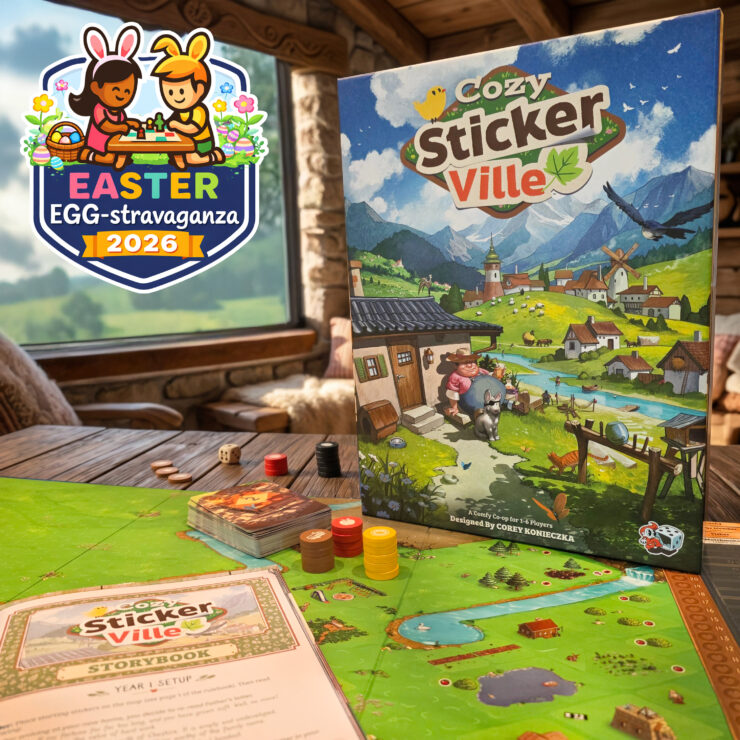
Today we’re going to be talking about Cozy StickerVille, a quite unusual choose-your-own-adventure style board game that has made quite a bit of noise in the hobby over the last month or so. I finally picked up a copy, and I’m really pleased to say that it’s super enjoyable and well worth your time, although that does come with a few caveats.
The best way I can describe Cozy StickerVille is, if you’ve ever played the video game Stardew Valley, and if you haven’t then to a lesser extent something like Animal Crossing, it’s basically that but with a choose-your-own-adventure book thrown in, combined with isometric stickers that build out your town as you play. I know that’s probably one of the least articulate sentences I’ve written in a long time, but it genuinely is the best way I can describe it.
You start the game by picking your side. The board has two different sides, and this means you can play through the adventure twice. But, and this is a big but, if you’re the sort of person who likes to replay games again and again, you can only play through the campaign twice before you’ve essentially used everything up. I do find it a bit odd that the stickers aren’t removable, as you could quite easily have done that and reset the game. Instead, they’re one-and-done stickers, and you really need to make sure you place them correctly. We did misplace one, and when we tried to remove it, it ended up tearing, so these are not forgiving stickers. With that said, let’s move on.
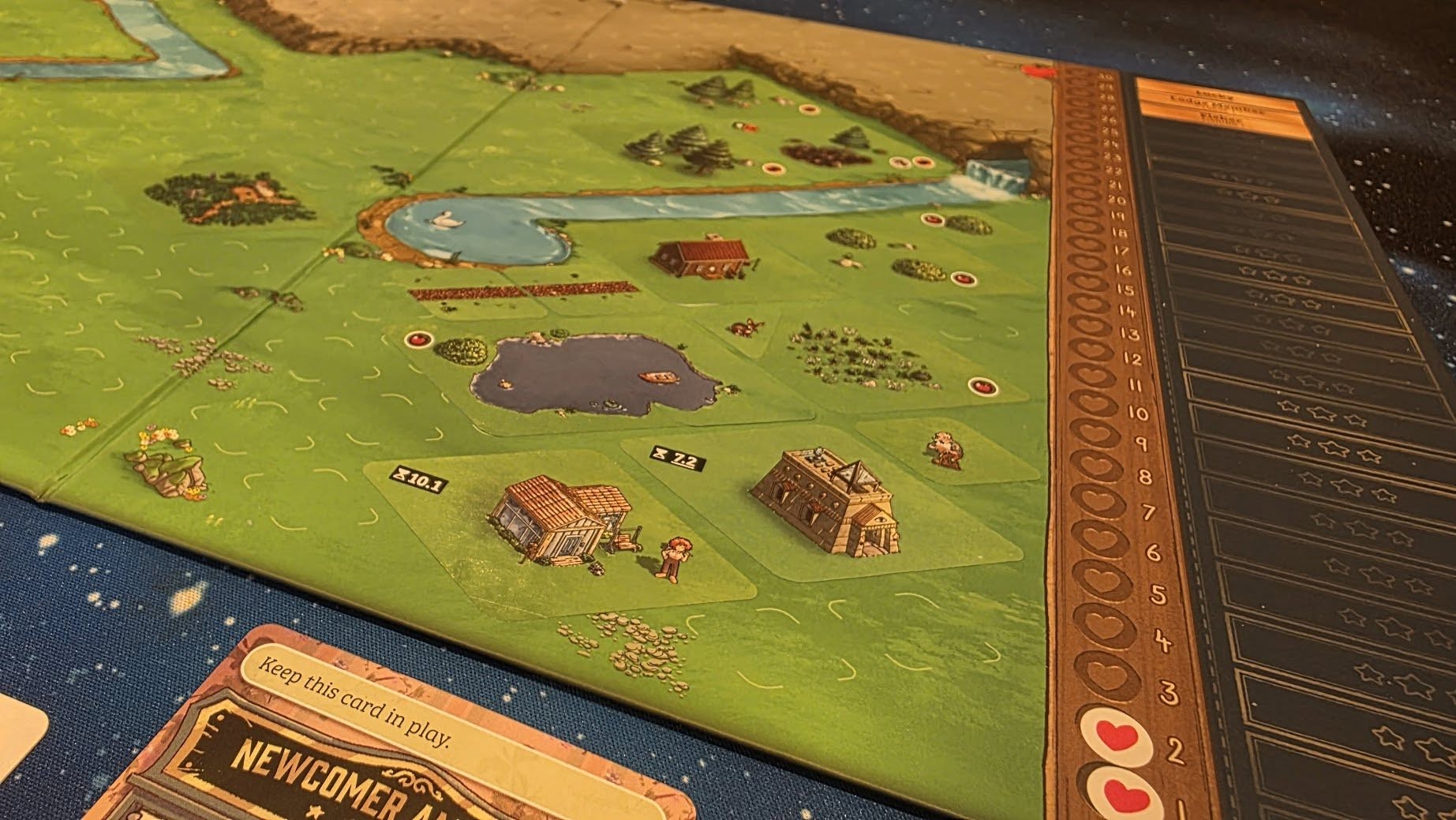
Once you’ve chosen your side, you start by laying out your starting tiles, which consist of your house, some trees for wood, and some bushes for food. You then take the deck for the first year, shuffle it so the events are randomised, take some tokens, and you’re pretty much ready to go.
The first thing you do on your turn is draw an event card. This could be one of many different things, such as a new person coming into town, a request from a villager, a choice between two options, or an event happening, like a lightning strike hitting a tree. Generally, you resolve these by spending tokens, making choices, spending money, or rolling a die, and these will potentially change the outcome of your town.
Some of the cards are branching. For example, two potential people might want to move into your town, and you choose which one joins. You then place that character’s sticker into your town, and at that point you’re locked into that decision and won’t have access to the alternative. What this does mean is that when you encounter that card on your second playthrough, you can take the other option, so the second run becomes a kind of “what if” scenario.
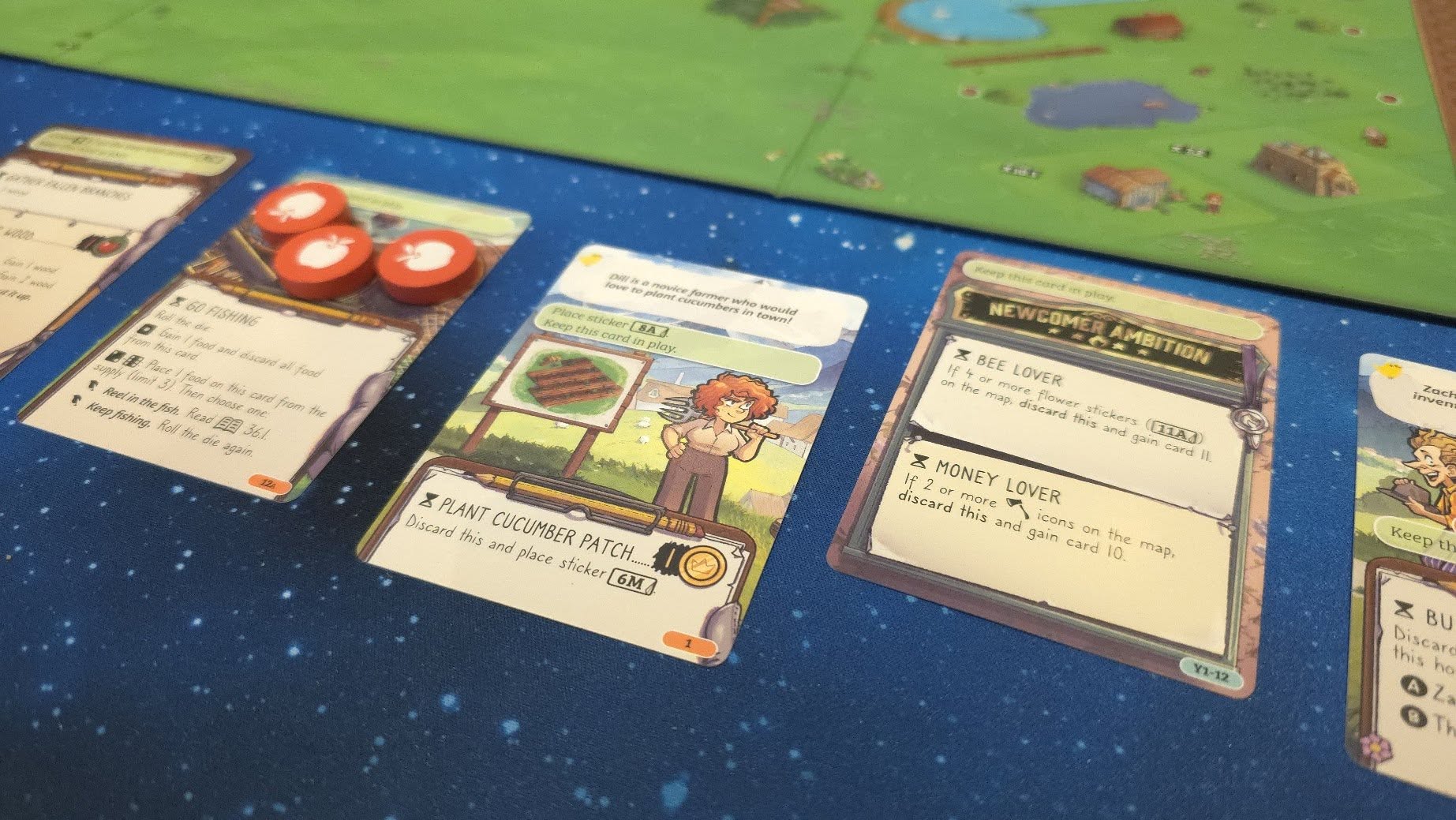
After resolving the card, if there’s nothing else to do immediately, you can take an additional action. This usually involves either completing one of the events currently on your map (often tied to stickers), or resolving one of your available actions from your cards. I won’t go into too much detail here, as it’s really nice to discover these as you play, but a few early favourites with the boys included a fishing activity, where you’re trying to gain different fish using food and dice rolls, and another where you can chop down trees safely or push your luck for a bigger reward. Both worked really well.
As you play through the year, you eventually reach the end, where there’s usually some sort of event that wraps things up. This can be positive or negative, depending on how the year has gone. At that point, you can save the game by putting everything back into the provided box, or move on to the next year. The game runs across ten in-game years, with each year taking around 45 to 60 minutes depending on how quickly you play and how much you get into the story.
Now, this is worth mentioning, this is essentially a solo game. If you’re playing as a group, the way it works is that you take turns resolving cards, but in practice we just played it cooperatively, making decisions together as we went. It actually worked really well for us. Henry was able to get involved in a slightly more in-depth game than he normally would, and Toby really enjoyed managing our resources. It quickly became clear that while we had plenty of food and wood, money was much tighter, which made decision-making more interesting.
Cozy StickerVille is lovely. It’s a really lovely thing to do, and the main reason we picked it up is because we knew we’d be able to play through it over the Easter holidays. Full disclosure, we haven’t quite finished it yet, we’re about two in-game years away from completing the full ten-year cycle, but I wanted to get this review out now because this is exactly the sort of game you’ll want to play during the holidays. It’s a great “at home together” activity.
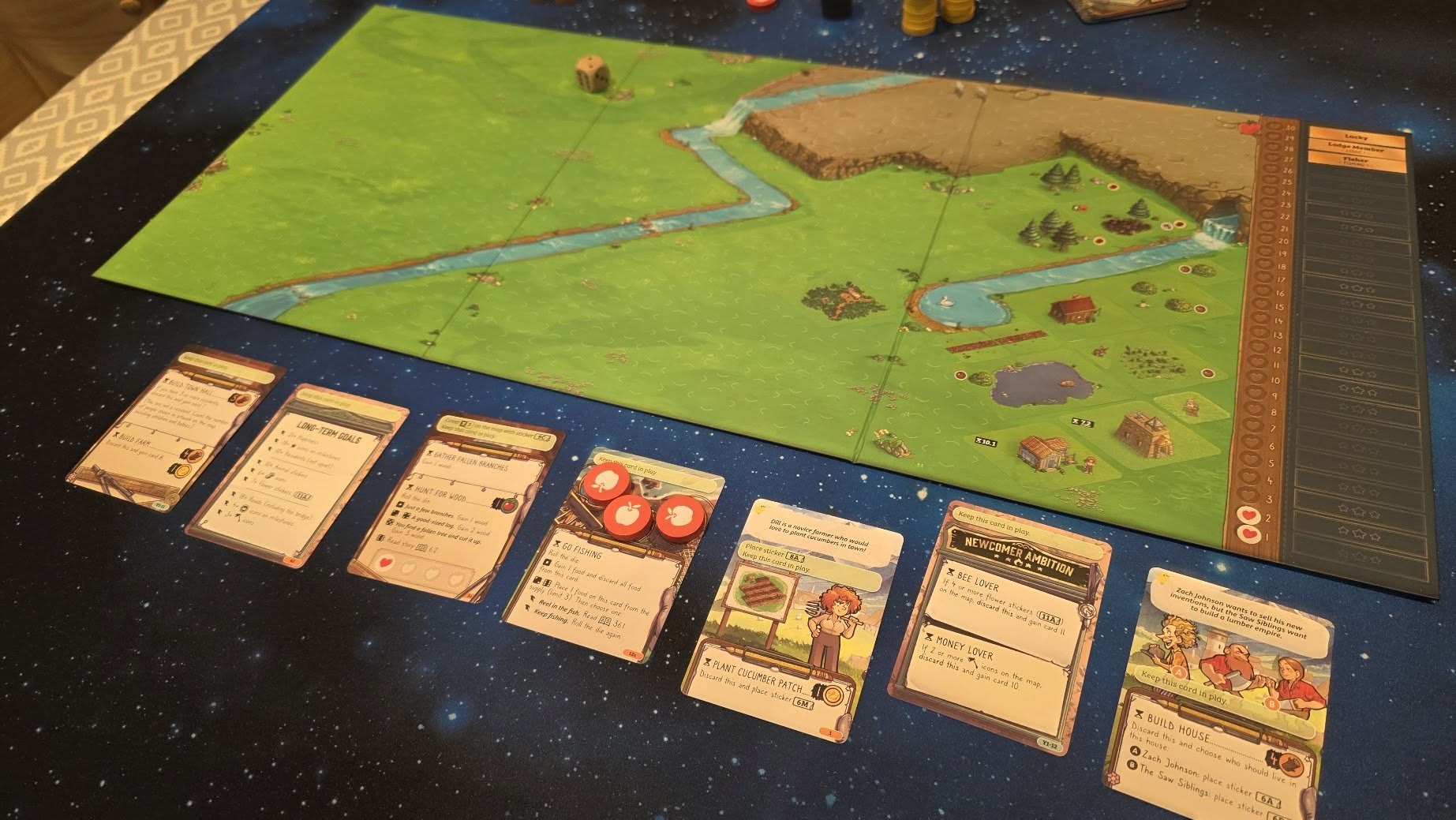
And that’s really how you have to look at it. This is an activity rather than a traditional board game. Even if you treat each in-game year as one session, and you play through twice, you’re only going to get around 20 sessions out of it. For some people, that could be a deal breaker, especially as it’s not the cheapest. But if you compare it to the cost of taking the kids to the cinema or going out for a day trip, it starts to feel much more reasonable.
The component quality is really nice. I’m playing with the upgraded tokens, which I got as a free promo, and a lot of copies I’ve seen, especially in friendly local game shops, seem to include these as standard, although it’s worth checking. Everything looks beautiful, but I do have some reservations about the stickers. These are very sticky, almost TK Maxx-level stickers, and if you try to remove them, they will tear. That’s frustrating. These could have been vinyl, or even something like Press ‘n’ Peel for those of us old enough to remember it, or even fuzzy felt.
The fact that you can’t replay the campaign more than twice, and even then the second playthrough is partially predetermined by your earlier choices, feels like a bit of a missed opportunity. Slightly different sticker choices could have made this far more replayable. Personally, we’re not likely to play it more than twice anyway, but it would have been nice to have the option. It would also be nice to be able to pass the game on afterwards, which isn’t really possible here. And if you make a mistake placing a sticker, that’s it, it’s not coming off cleanly.
My final small gripe is with how some stickers line up. The artwork on the board is really nice, but occasionally stickers overlap areas they shouldn’t. For example, placing a grass sticker can end up covering part of a rock area, which spoils the look slightly. That’s a shame, especially as this is the kind of game where you end up creating something you might genuinely want to display.
This has been one of the more waffly reviews I’ve written in a while. Recently I’ve tried to keep things more factual and succinct, but this has really just been me having a chat. If you prefer this style, great, and if not, I’ll rein it back in a bit as we go through the Easter Egg-stravaganza.
To sum up, Cozy StickerVille is a wonderful activity to do with your children, but you do need to go in with the right expectations. Think of it as a shared experience rather than a traditional game, and accept that even if you absolutely love it, you’re probably looking at buying another copy if you want to do it all over again.