 Matthew Bailey
Clank!: A Deck-Building Adventure is a game that I’ve known about for a really long time, but have only recently jumped on board with, and I honestly wish I’d tried it sooner. Having now played it probably over a dozen times in the last few weeks, which is more than I play almost anything, it has very quickly become one of my favourite games.
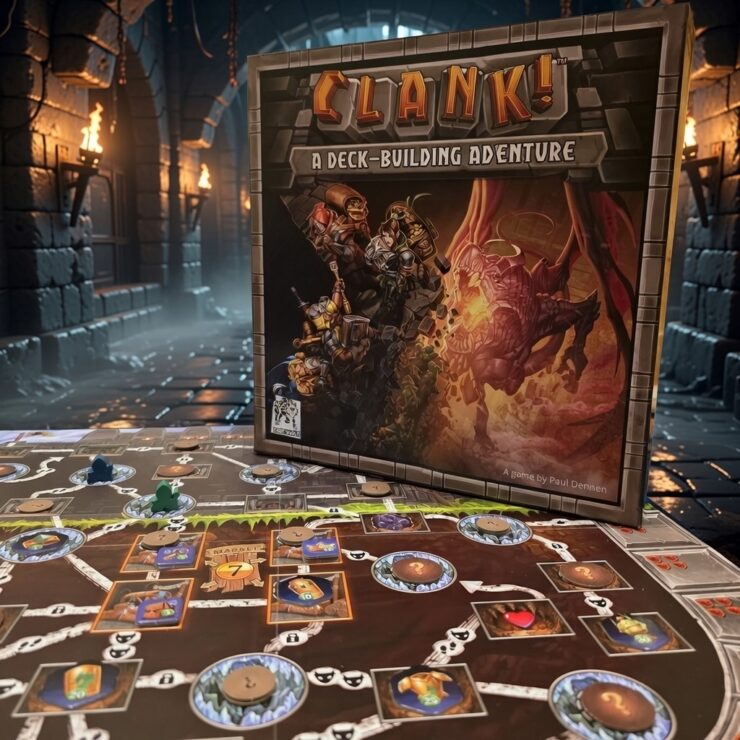
At its heart, Clank!: A Deck-Building Adventure is a deck builder crossed with a dungeon crawler. You’re infiltrating a castle, heading down into the depths to grab an artefact, picking up other useful things along the way, and hopefully getting back out before you die.
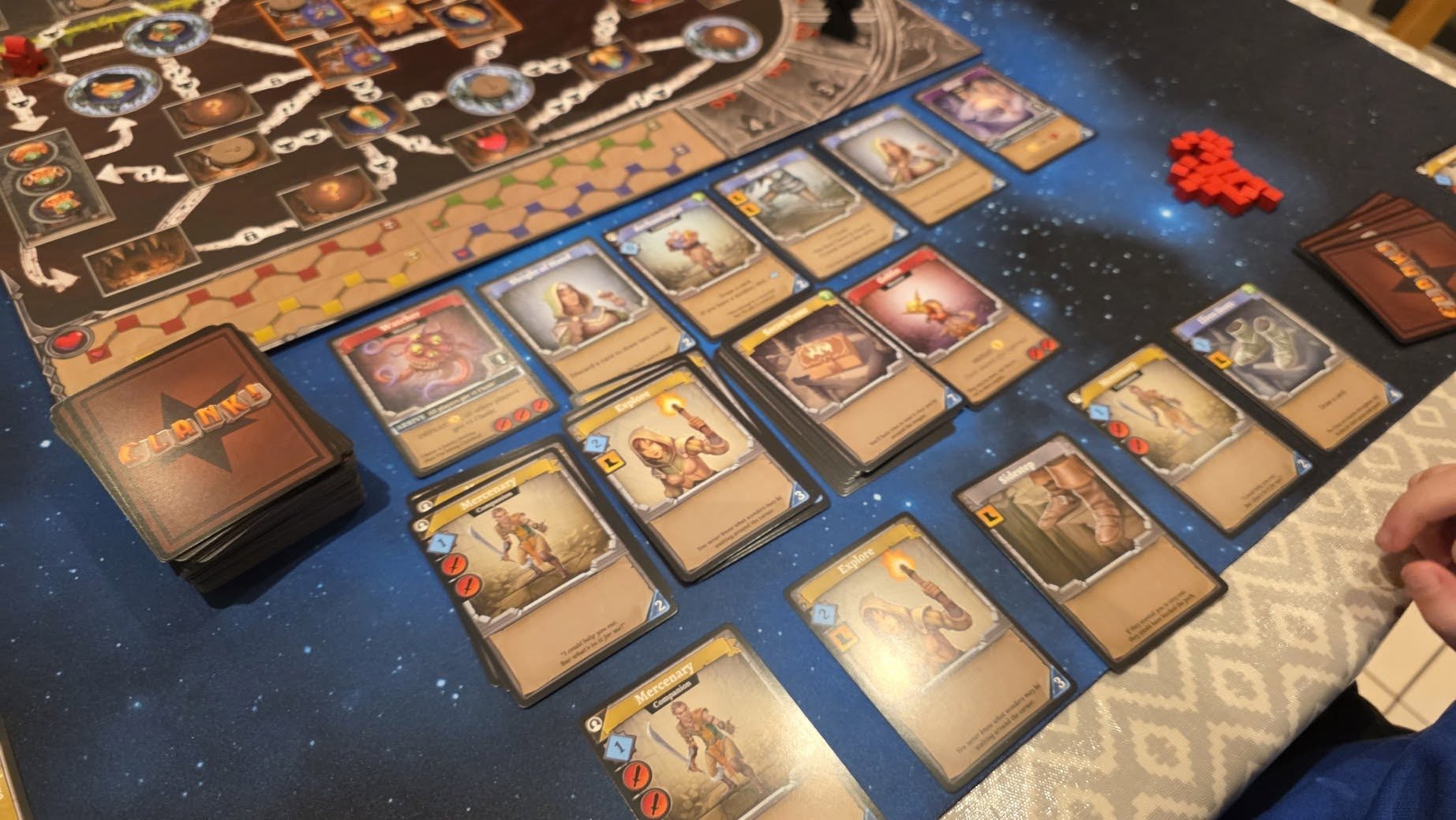
Everyone starts with the same small personal deck of cards, which you use to move around the board, fight monsters using swords, and acquire new cards with skill. On each turn you play cards from your hand, resolve their effects, move if you can, and then buy new cards from a shared market to slowly improve your deck over the course of the game.
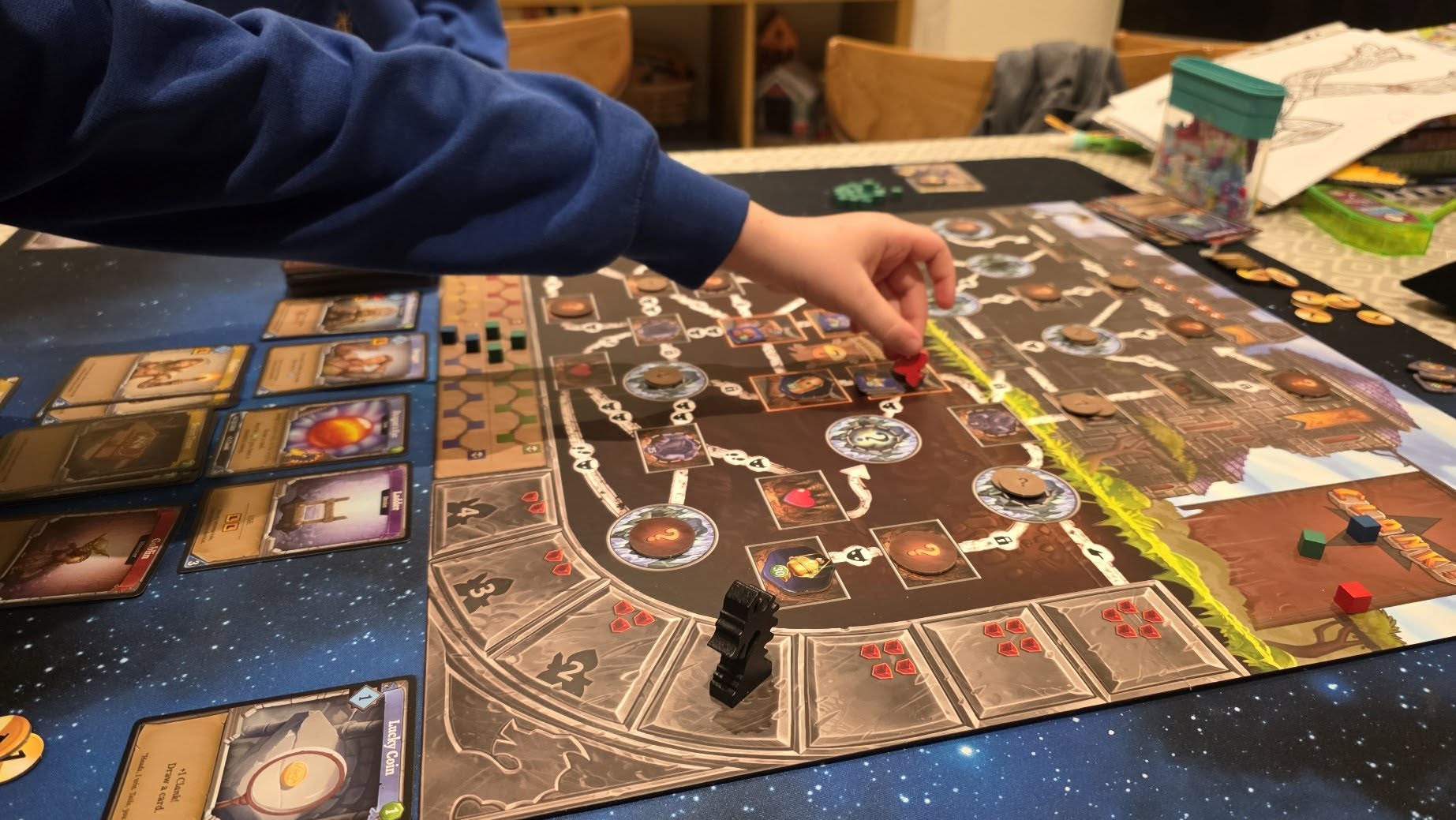
Movement takes place across a dungeon-style board made up of interconnected rooms, which are the same every time. The game comes with two maps, which is a really nice touch, and if you get properly into it there are expansions with new boards. There’s also another version of the game called Clank! Catacombs, which is often preferred as it uses random dungeon tiles, but I really like the fact that here I can plan ahead and properly strategise.
Players head deeper into the dungeon to collect one artefact each, although you can buy a bag to cheat that rule, as well as optional items such as gold, secrets, and other bonuses. The deeper areas of the board offer higher-value rewards but are also harder to reach and escape from, and that’s where the fun risk and reward element really comes into play.
Some cards cause players to add Clank! cubes to a shared bag. At various points during the game, cubes are drawn from this bag, and players take damage if their colour is pulled. Once a player has collected an artefact and escaped the dungeon, the endgame is triggered and the remaining players have a limited amount of time to make it out before the game ends.
There is so much to like here, and after a game or two it became very apparent that I absolutely adore this game, as do the boys. One of the really good things about it is that there isn’t actually that much player interaction. Aside from occasionally giving yourself a bit of Clank, there aren’t many ways to directly interfere with or ruin someone else’s game. That works really well when you’ve got a mixed group of ages and abilities around the table.
There are some really strong cards in here, but everything feels pretty well balanced. There isn’t anything that stood out to me as being overly powerful, and there are loads of different strategies you can go for. One approach is to load up on movement so you can get through the dungeon quickly, reach the lower levels, and grab the better loot. Another is to focus on attack, killing monsters to earn gold and then buying powerful items from the shop. You can also mix the two.
Then there’s the big decision of whether you push all the way to the bottom of the dungeon or grab something halfway up and try to get out early, leaving the rest of the competitors to face the dragon’s wrath. Once someone escapes, the dragon starts pelting everyone still inside, turn after turn, which creates a great sense of tension.
One thing I really like is how the scoring system works. When the game ends, you score points for pretty much everything, but crucially, you get 20 points for successfully escaping the dungeon. That’s not an insignificant amount, which means escaping really matters. However, it’s not the only way to score well.
The map is split into two halves, with the upper section being the castle area. If you die in this top half, you don’t get the 20 points for escaping, but you do get rescued by the villagers and keep all the other points you earned during the game. A couple of time,s we’ve had games where someone rushed down, grabbed an artefact, and escaped quickly, only to lose to someone who stayed near the top, collected loads of points, and then died in the upper area but still won overall.
If you die in the bottom half of the dungeon, though, you score zero points, so you really do have to strike that balance. It’s a genuinely interesting decision space that plays out brilliantly, and even if you don’t make it back, or you do die, there’s still a chance you might do really well or even win.
The box suggests older ages, but we’ve played the game happily with a seven-year-old. As long as you can read and understand the basics of the three different resource systems, you’ll be absolutely fine. Because there’s very little hidden information, it’s also really easy to help younger players with their turns without ruining anything.
The artwork is lovely, everything is well-made, and it all fits together nicely. The game is actually about ten years old now, but I am fully on board with getting expansions. I’m pretty sure Clank! Catacombs will be the next one we pick up. I’m also really looking forward to trying the Legacy version, which I’m very keen to play, and I’m sure you’ll see that reviewed here later in the year, probably around summer.
I don’t think I’ve played any longer game as many times in such a short space of time as I have Clank!: A Deck-Building Adventure. Since picking it up just before Christmas, I’ve probably played it about ten times with a wide range of people. I’ve also played it digitally on the app, which is great for practice and includes some really good solo challenges.
All in all, Clank!: A Deck-Building Adventure is brilliant, and I genuinely can’t recommend it enough. It really is something special, and as I slowly work through the expansions and other versions, I think you’re going to see quite a bit more Clank! on Little Board Gamers in 2026.